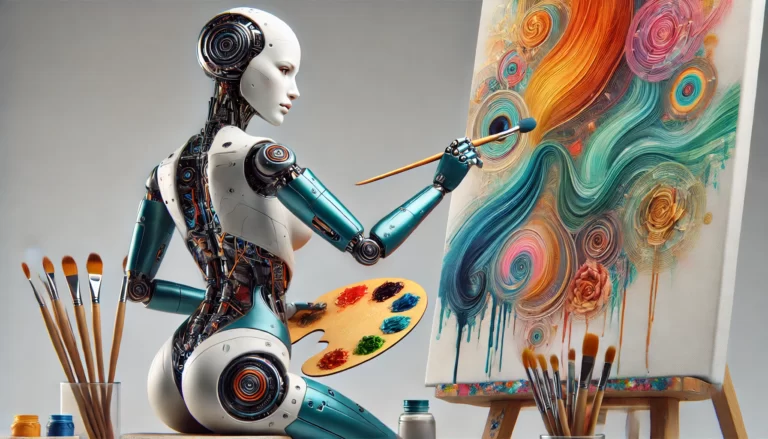
AI and Copyright: Who Gets the Rights?
Author- The Lawscape Team
Introduction
Generative AI is everywhere. With tools like ChatGPT, MidJourney, and DALL·E, anyone can create poems, songs, images, articles, or even short films in seconds. This is both exciting and unsettling. On the one hand, it makes creativity more accessible than ever. On the other, it raises a pressing legal question: if AI creates something, who owns it? Is it the user who typed the prompt, the company that built the AI model, or no one at all. Copyright law wasn’t designed with artificial intelligence in mind. Traditional rules assumed a human author behind every creation. But now, with machines generating text and art at scale, the law is struggling to catch up. Let’s break down how different countries are approaching this issue, why human creativity still matters, and what it means for creators, businesses, and students.
1. Copyright Needs Human Creativity
The U.S. position
The U.S. Copyright Office has taken a clear stance: works created entirely by artificial intelligence cannot be copyrighted. The logic is simple—copyright protects original works of human authorship. If no human creativity is involved, the work is not protected under U.S. law. This doesn’t mean AI-assisted works are banned from copyright altogether. If a human edits, arranges, or meaningfully shapes the AI-generated output, that human contribution can qualify for protection. For example, if you use MidJourney to generate an image but then retouch it extensively, or if you combine AI-written drafts into a structured article with your own analysis, those human choices can make the work copyrightable.
Case law example
The Zarya of the Dawn case in the U.S. is a perfect example. The author registered copyright for a comic book created with MidJourney-generated illustrations. The Copyright Office later ruled that the story and dialogue (human-created) were protected, but the AI images were not. This case shows the blurry line between human and AI input, and how courts are likely to treat such hybrid works going forward.
United Kingdom
The UK takes a different approach. Under the Copyright, Designs and Patents Act 1988, computer-generated works with “no human author” are still protected. In such cases, the “author” is the person who made the arrangements necessary for the creation of the work. This means if a programmer or user designs the conditions that lead to an AI’s output, they could legally be considered the author. This is a more AI-friendly stance than the U.S., but it still leaves room for debate as AI systems become more autonomous.
India
India’s Copyright Act also contains a provision that assigns authorship to the person who causes a computer-generated work to be created. However, this law was written long before modern generative AI tools existed, so its application is unclear. Legal experts in India are divided. Some argue that the user who enters prompts should be considered the author, since they guide the creation. Others suggest that the developers or companies behind the AI could claim rights, especially if the user’s input is minimal. The debate has already reached Indian courts. A Delhi High Court case, ANI v. OpenAI, is examining whether training AI models on copyrighted material without permission amounts to infringement. At the same time, a government-appointed panel in 2025 is reviewing whether Indian copyright law needs an update to address generative AI specifically. This shows how India is at a crossroads—balancing between protecting creators, promoting innovation, and preventing misuse.
3. AI Training and Copyright Infringement
One of the hottest controversies is not about the outputs of AI, but the training data behind it. Most generative AI models are trained on massive datasets scraped from the internet, including copyrighted books, articles, songs, and artworks.
The U.S. and lawsuits
In 2025, a U.S. court examined whether AI companies violated copyright law by using pirated books to train large language models. While the ruling suggested that training might not always count as direct infringement, the issue remains unsettled. Meanwhile, authors like George R.R. Martin and media companies such as Disney have sued AI firms for allegedly copying their works without permission.
Transparency laws
In response, new regulations like California’s Generative AI Copyright Disclosure Act now require companies to disclose whether copyrighted material was used in training. This is a big step toward transparency and accountability. The outcome of these legal battles will determine how freely AI companies can build future models—and how much protection creators will have when their works are used as training material without consent.
4. Why It Matters
For creators and businesses
If you’re a writer, artist, or entrepreneur using AI tools, you can’t automatically assume you own the rights to AI-generated content. Unless you add meaningful human creativity, your work may remain in the public domain. This creates risks if you try to commercialize purely machine-made work.
For policymakers
Lawmakers face a challenge: balancing innovation with fairness. Copyright laws were drafted in an era where machines couldn’t “create.” Now they must evolve to decide how much credit and protection should go to humans versus algorithms.
For students and laypersons
Understanding AI copyright is crucial not just for lawyers, but for anyone experimenting with digital creativity. Whether you’re writing a thesis, running a blog, or building a startup, knowing what is legally yours (and what isn’t) can save you from disputes down the line.
Conclusion
Across most countries, the rule is the same: AI itself cannot own copyright. Only human creativity counts. If you use AI as a tool but bring your own originality—through editing, arrangement, or creative direction—your contribution can be protected. But if you let the machine run freely, the result may not belong to anyone. Different countries are experimenting with different answers. The U.S. stresses human authorship, the UK credits arrangers, and India is in the process of clarifying its position through cases and law reform. Meanwhile, lawsuits over training data show that the copyright debate doesn’t end with outputs—it also goes back to how AI is built.
So the golden rule? Don’t rely on AI alone. Use it as an assistant, but always add your own human creativity. That’s what gives your work legal weight—and keeps ownership in your hands, not in the machine’s circuits.
The Lawscape — clear, practical legal insight for students and future lawyers.