
Navigating Today’s Constitutional Paradox
Author: Fatima Sayed
Student, University of Jammu (Jammu & Kashmir)
—————————————————————————————————————-
1. Understanding the Paradox
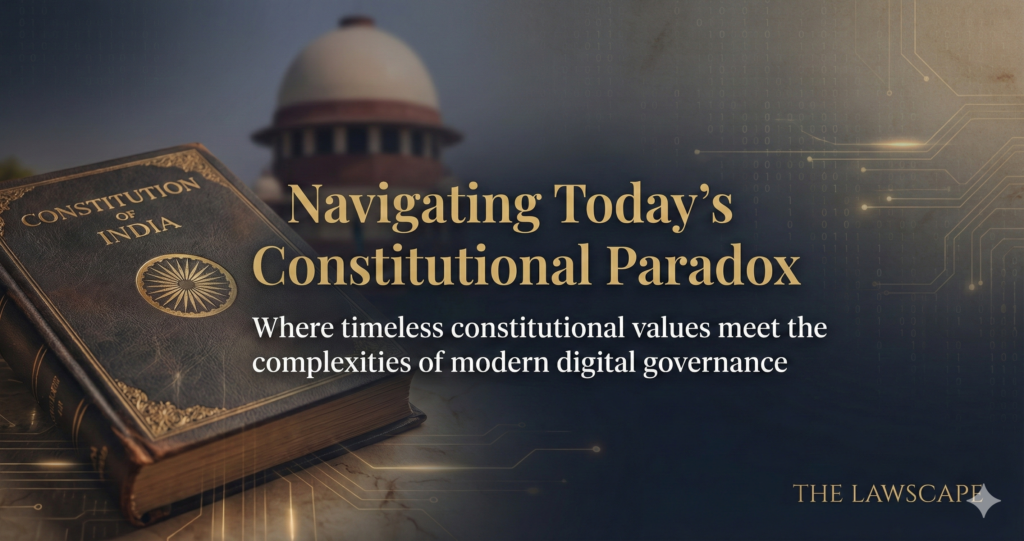
Ever since childhood, we have been taught that the constitution serves as an expression of identity and the moral values of national symbolism. Being the largest written constitution in the world, it stands as a comprehensive charter, not just a legal document but a living structure that embodies the values of equality, justice and liberty. However, it must be recalled that it is a product of historical circumstances, philosophical thought, and global influences. In today’s context, there is an apparent contradiction between timeless values and rapidly changing governance, which leads me to shed light on the concept of the “constitutional paradox”.
This paradox becomes visible because of factors such as:
- The widening gap between constitutional principles and rapidly advancing technologies
- Digital inequality across socio-economic groups
- Traditional legislation being outpaced by digital expansion
- Growth of dependence on AI in governance
- Accelerating risks of surveillance and the blurring of boundaries between public monitoring and personal privacy
This brings us to a crucial question: can its functionality adapt to modern governance while remaining compliant with regulations?
Our political malaise arises not because the document is outdated, but because it is often ignored and distorted. Society is changing faster than ever and thus requires reform with full momentum, while still giving due consideration to its foundational origins. Today, we have novel modes of communication enabled by technology, along with a massive surge in artificial intelligence and its everyday integration. These rapidly occurring digital developments require careful and strict contemplation, as unchecked proliferation poses a serious threat to the safeguards of privacy, free speech, and equality. Interpretation becomes essential because the gap between the traditional principles and modern governance is where this paradox truly arises.
The expansion of digital services and online platforms makes it more complex to reinterpret constitutional values such as social fairness, equal opportunity, unity, and, most important, accountability, where the government is required to remain answerable to the people. In this era, digital services should be accessible to all, yet examining the reason behind unequal access will help us understand issues rooted in human rights and social justice. Inequalities are present everywhere and therefore there is a dire need for inclusion.
There is also a need to understand the importance of balance, recognising that privacy is a fundamental right. When digital India collects vast amounts of data, consent and access must be taken into account as prescribed under the Digital Personal Data Protection Act, 2023. Furthermore, efficient e-governance strengthens transparency, which is widely sought, even as the risk of surveillance increases with continued digital monitoring. This surfaces the tension between liberty and security and often leaves citizens uncertain.
2. Two sides of Digital Accountability
Stressing constitutional accountability is utterly necessary, yet it should be kept in mind that it comes in two parts: building accountability and, at the same time, complicating it. For instance, the presence of real-time data dashboards, direct benefit transfer without intermediaries, and online grievance redressal systems can significantly strengthen constitutional accountability.
The second side of the coin reveals that the same digitalisation, particularly through algorithmic decision-making, often lacks transparency. This makes it unclear who is responsible within automated systems, leaving citizens uncertain about how or whom to challenge when such systems malfunction.
Each citizen certainly deserves better and to make informed choices for the future, while also reflecting possibly on the past. Today’s citizens must recognise the seriousness of modern governance and the rights they hold for themselves. This era highlights how closely digital literacy corresponds with constitutional literacy. Emphasising a democracy of regulation, where privacy, misinformation and data usage are systematically managed alongside active public participation, is essential.
3. Bridging the Gap
A section that inspires both hope and practicality can enhance governance beyond symbolic values. These values should serve as the guiding framework for technological development, not the other way around. Being conscious of data protection laws, promoting the ethical use of technology, ensuring digital access for all, calling for judicial oversight of surveillance, and reinforcing transparent algorithms are key steps that can help bridge this evolving gap.
The constitution is stable but not static. It evolves through interpretation and practice. The paradox lies in technology advancing rapidly while constituent power remains under strain. Discussions regarding the application of rights will continue, but India’s way forward lies in embracing the principles that formed the foundation of the Republic. Advancement will materialise only when digital governance becomes constitutional, not merely modern, while also preserving the moral foundations of the Republic.
Ultimately, the constitutional paradox is not a sign of failure but of resilience. It reflects a constitution strong enough to confront modern governance without surrendering its foundational values. In navigating technology, accountability, individual rights, India’s challenge is not to choose between progress and principle, but to ensure that progress remains guided by constitutional conscience.
** Disclaimer: The views expressed in this article are those of the author and do not necessarily reflect the views of The Lawscape.
The Lawscape — clear, practical legal insight for students and future lawyers.