
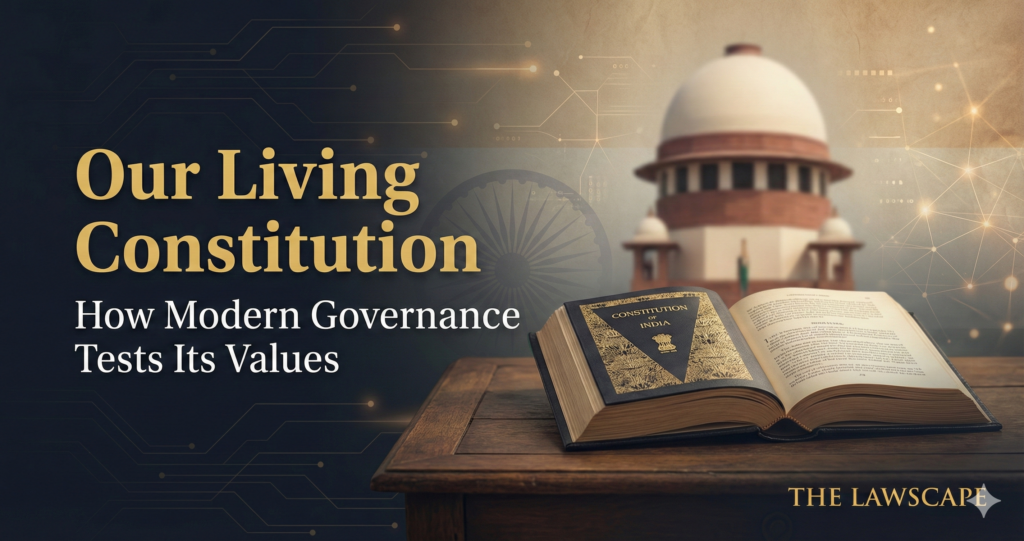
Our Living Constitution:
How Modern Governance Tests Its Values.
Author: Prapti Chhettry
Student, ICFAI University, Dehradun (Uttarakhand)
—————————————————————————————————————-
When I first started studying the Constitution in depth, one thing struck me immediately that it is not a frozen text. It responds, evolves, stretches, and sometimes even resists the pressures of changing society. And today, when technology grows faster than our laws, where social identities are openly asserted, and where governance extends from paper files to algorithms; constitutional values are being tested almost every day.
In this blog, I seek to understand how the core values of our Constitution justice, equality, liberty, accountability are being interpreted in modern governance. These are not mere abstract ideas anymore. They shape policy, court judgments, elections, digital life, and even personal identities.
1. Post Navtej Johar: How LGBTQ+ Rights Redefined Constitutional Morality
I revisited the Navtej Singh Johar v. Union of India (2018) judgment several times, and what stood out most to me was not merely the decriminalization of Section 377, but the Court’s firm assertion that constitutional morality must take precedence over social morality. This was such a powerful shift. Implying that even if society is uncomfortable with queer identities, the Constitution still sees everyone as equal and deserving of dignity.
However, this is precisely where modern governance continues to struggle. Even after Navtej, queer individuals still face police harassments, lack of housing, discrimination in hospitals and schools, refusal of recognition for their relationships, and several other barriers to equal citizenships.
Even the 2023 same-sex marriage verdict (Supriyo @ Supriya Chakraborty vs Union Of India) shows this tension. The Court didn’t grant legal marriage rights, but it clearly criticized discrimination and asked the State to form a committee to look into civil rights of queer couples.
So, the constitutional value of dignity is now pushing the State to think beyond mere decriminalization. Modern governance must create actual systems, policies, guidelines, and training modules that protect queer individuals, rather than simply ensure that they are not punished.
2. Digital India and the Pressure of Accountability
Almost every public service is shifting online, including welfare, education, and even legal procedures. But with this digitalization, constitutional values increasingly intersect with technology. When I read the Puttaswamy (2017) judgment on the Right to Privacy, I realized that privacy is a structural and indispensable element of digital society. Today, Aadhaar tracks identity, apps track our location, the government relies on AI for welfare delivery, and facial recognition systems are functioning across several cities. Together these systems show how deeply digital surveillance is embedded in everyday governance.
Modern governance must therefore confront several pressing questions. How much data is too much data, and at what point does collection becomes intrusive? Who bears accountability if an algorithm erroneously denies someone a benefit? And can the State deploy surveillance tools without proper judicial oversight? Addressing these questions is essential to ensure that constitutional values remain protected in an increasingly digital world.
The new Digital Personal Data Protection Act, 2023 marks an important step towards regulating data use, yet many experts argue that it grants the State excessive exemption powers. If accountability weakens, constitutional values suffer. In simple terms, technology cannot become an excuse to disregard fundamental rights.
3. Election Commission and the Crisis of Democratic Trust
To understand the constitutional role of the Election Commission, I examined both the history of electoral reforms and recent controversies surrounding the election process. What becomes immediately clear is that public trust lies at the heart of any functioning democracy. Several contemporary challenges demand serious constitutional introspection, including opaque political funding (especially before the Electoral Bonds judgment), the growing influence of online political advertising, the spread of hate speech during campaigns, and the alleged misuse of central agencies in the electoral context. Together, these issues raise important questions about electoral fairness, institutional neutrality, and the ability of the Election Commission to safeguard democratic integrity.
The Election Commission is expected to be the neutral backbone of Indian democracy. However, neutrality cannot merely be asserted; it must be visibly demonstrated. Recognizing this concern, several expert committees, as well as a recent ruling of the Supreme Court (Anoop Baranwal v. Union of India, 2023), have emphasized the need for a more transparent and balanced process for the appointment of Election Commissioners, rather than a framework in which the ruling government exercises disproportionate control.
The constitutional value at stake is institutional independence. Without genuine independence, electoral governance risk drifting towards majoritarian dominance instead of remaining rooted in democratic principles.
4. When AI Meets the Constitution: New Conflicts, No Precedents
This section genuinely fascinated me because artificial intelligence is advancing faster than the law. From my reading, it is clear that AI systems are already being deployed in ways that directly affect individual rights. These include machine learning tools used for crime prediction, which risk enforcing existing caste and social biases, AI-based evaluation systems for job applications, and automated mechanisms that determine eligibility for welfare benefits.
However, our Constitution never imagined a future governed by algorithms. This raises a fundamental question: how do we apply constitutional values to a machine? The challenge is not merely technological but deeply constitutional.
One major concern arises under Article 14, which guarantees equality and non-arbitrariness. If AI systems make decisions that are opaque or cannot be explained, they risk violating the principle of equal protection of law. Article 21 presents an equally serious concern. When an algorithm impacts an individual’s livelihood, liberty or access to essential benefits, procedural fairness and transparency become indispensable elements of due process
Accountability further complicates this landscape. If an AI system discriminates or causes harm, it is unclear whether responsibility lies with the government deploying the technology or the private entity that designed it. These unanswered questions demonstrate why modern governance cannot afford to wait for harms to escalate. India has a unique opportunity to develop a rights-based regulatory framework for artificial intelligence before corporate or purely market-driven models come to dominate the field.
5. Fundamental Duties: Becoming Relevant Again
Initially, like many students, I viewed Fundamental Duties as largely moral guidelines rather than enforceable constitutional norms. However, when one considers the realities of widespread misinformation, online hate, environmental degradation, and declining civic responsibility, these duties begin to appear far more practical and relevant than often assumed.
The duty to develop a scientific temper has renewed importance in an age dominated by fake news and misinformation. Similarly the duty to protect the environment resonates strongly in the context of the ongoing climate crisis. The duty to promote harmony acquires urgency when social media platforms frequently promote communal tension, while the duty to safeguard public property becomes particularly significant during protests and public demonstrations.
Modern citizenship, therefore, requires active participation. The State alone cannot uphold constitutional values if citizens themselves neglect their constitutional responsibilities. Fundamental Duties serve as a reminder that constitutional governance is a shared project between institutions and the people they serve.
Conclusion: The Constitution Is Still the North Star
After reading judgments, reports, interviews, and real-world examples, one conclusion became clear to me. The Constitution is not losing relevance; rather, it is becoming more important than ever. Modern governance operates in an increasingly complex environment. It must navigate identity based debates such as LGBTQ+ rights, manage powerful and often opaque technologies involving data and artificial intelligence, administer vast electoral machinery, and ensure that democratic institutions remain neutral and accountable.
Every time the State makes a new policy, deploys a digital tool, or passes a law, it is effectively reinterpreting constitutional values. The true test of Indian democracy lies in whether these reinterpretations remain faithful to the Constitution’s founding vision. A Constitution endures not merely through formal amendments, but through a sustained culture of constitutionalism upheld by judges, governments, institutions, and, most important, citizens.
And that is why, even in 2025, the Constitution is not just a legal document. It continues to function as the guiding ethical framework for a nation learning to govern itself in an era of rapid change.
** Disclaimer: The views expressed in this article are those of the author and do not necessarily reflect the views of The Lawscape.
The Lawscape — clear, practical legal insight for students and future lawyers.