
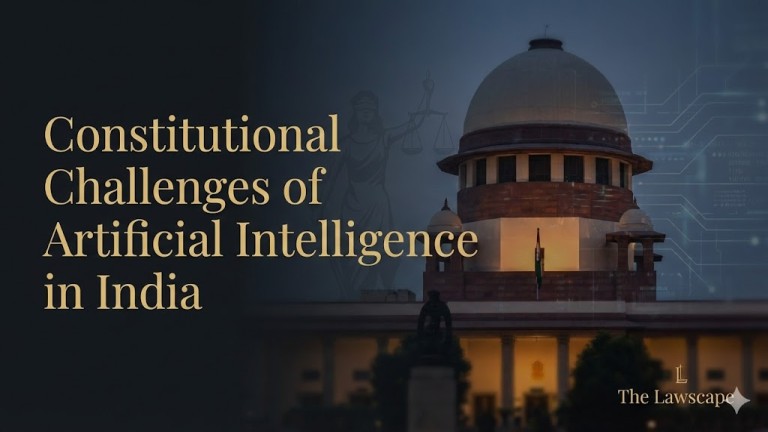
Constitutional Challenges to Artificial Intelligence and Data Regulation
Author: Shreyajit Mandal
Student, Parul University (Gujarat)
—————————————————————————————————————-
I. Introduction
Artificial Intelligence is increasingly permeating everyday life, from digital payments to facial recognition, online shopping suggestions, and predictive policing, even to medical diagnosis. While AI offers efficiency and convenience, it simultaneously raises profound constitutional questions relating to privacy, fairness, transparency, accountability, and human dignity. In a country like India, where the Constitution guarantees fundamental rights, the rise of AI must be scrutinized through a constitutional lens rather than viewed merely as a technological advancement.
This blog examines how Artificial Intelligence tests constitutional rights, particularly under Article 21, and why India urgently required robust data and AI regulation to protect citizens in the digital age.
II. Article 21 and the New Threats Created by AI
1. AI and the Right to Privacy: In Justice K.S Puttaswamy vs Union of India, (2017), the Supreme Court recognized the right to privacy as a fundamental right under Article 21. However, modern AI system routinely collect, store, and analyse enormous quantities of personal data, including photographs, voice recordings, browsing history, location data, and even behavioural or emotional patterns. Such extensive data tracking exposes individuals to mass surveillance, unauthorized monitoring and loss of personal autonomy, often without informed consent or adequate safeguards. As a result, AI increasingly becomes a silent intruder into private life, posing serious threats to constitutional guarantees of privacy and dignity.
2. AI and Defamation through Fake Image and Videos: One of the most serious emerging risks posed by AI is the creation of defamatory images and videos. Today, AI tools can be misused to generate fake photographs, morphed images, and harmful videos that severely damage a person’s dignity and reputation. Defamation directly affects the right to live with dignity and honour, which forms an essential component of Article 21. The speed and ease with which AI-generated defamatory content can be produced makes it extremely difficult for victims to defend themselves before irreversible harm occurs.
3. Identity Theft Using AI Tools: AI has also made identity theft significantly easier and more sophisticated. Technologies such as voice cloning, face-swapping applications and deepfake generators can be used for impersonation, financial fraud, and reputational harm. Criminals can create fake profiles, conduct scams, steal money, or circulate harmful content in another person’s name. This directly violates an individual’s right to personal security and autonomy, both of which fall within the protective scope of Article 21.
4. Deepfakes and Fake Photos Flooding the Internet: The internet is increasingly flooded with AI-generated fake photographs and deepfake videos, where a person’s face can be replaced or manipulated within seconds. This creates serious threats to reputation and psychological well-being, which are core components of the right to life under Article 21.
What makes this threat particularly dangerous is that many viewers are unable to distinguish fake content from real material. By the time victims realise the falsity, the content has already gone viral across digital platforms, causing irreversible harm.
5. AI and Instant Spread of False Information: AI can generate the fake news, fabricated statements and misleading videos within seconds, allowing misinformation to spreads rapidly on social media platforms. Such false narratives can severely impact an individual’s reputation, mental health, and social standing, thereby infringing the right to life and dignity under Article 21. The absence of effective control mechanism over AI-generated misinformation raises serious constitutional concerns.
III. Weaknesses in India’s Current Legal Framework
The Digital Personal and Data Protection Act, 2023 was enacted to protect personal data. However, it does not comprehensively address AI-generated harms, including deepfakes, voice cloning, identity theft, defamatory AI-generated content. There is no specific provision that explicitly safeguards individuals against algorithmic manipulation or synthetic media misuse.
India currently lacks a dedicated legal framework to regulate AI misuse. There are no clear statutory provisions dealing specifically with deepfakes, AI-generated defamation, or digital impersonation. In cases where AI causes harm, the law does not clearly define liability. It remains uncertain whether responsibility lies with the developer, the platform, or the end user. Additionally, AI companies are not legally required to conduct safety audits or ensure transparency in how their systems function or are trained. This absence of accountability mechanism makes detection, proof, and punishment of AI-related harms extremely difficult.
Legal remedies remain slow and ineffective in addressing AI misuse. Complaint filing, verification of fake content, and take down procedures take considerable time, while harmful content can go viral within minutes. By the time legal intervention occurs, the damage to dignity, privacy, and reputation under Article 21 is often already complete.
IV. Why India Needs Stronger AI Regulation
Article 21 protects the right to privacy which must be strongly extended into the digital domain. AI systems should not collect, store, or process personal data without explicit and informed consent. Strict data minimisation principles must be enforced, ensuring that AI collects only data that is absolutely necessary. Further, mandatory privacy impact assessments should be required for AI systems to evaluate risks to personal data and individual autonomy.
There must be clear, swift, and stringent laws criminalising misuse of AI-generated fake images, morphed photographs, deepfake videos, impersonation content, and AI-generated revenge content. Such regulations must be directly linked to the constitutional value of dignity under Article 21.
India should establish a national-level deepfake reporting and removal portal, enabling victims to report harmful content immediately and seek rapid takedown. Such a system would provide a fast-track constitutional remedy and institutional support to victims of AI abuse. An independent AI regulatory authority should be established to oversee misuse of synthetic media, AI-enabled identity theft, harmful deepfake tools, data abuse, and biometric misuse.
Public awareness is crucial in protecting citizens from AI misuse. Citizens must be educated about fake images, videos, and AI-generated messages, enabling early detection and reporting. Digital literacy must evolve alongside constitutional literacy, empowering citizens to safeguard their rights in a technology-driven society.
V. Conclusion
Artificial Intelligence is a powerful tool, but it has also introduced serious threats to privacy, dignity, reputation, and personal autonomy all of which are integral to the right to life under Article 21 of the Constitution of India. AI generated fake images, defamatory videos, identity theft, and rapidly spreading misinformation demonstrate how technology can destroy lives within seconds. It is therefore imperative that India acts swiftly to establish a comprehensive legal and constitutional framework to regulate AI responsibly. In the absence of effective regulation, AI will continue to threaten the core constitutional values of privacy, dignity, and personal liberty that lie at the heart of India’s constitutional democracy.
** Disclaimer: The views expressed in this article are those of the author and do not necessarily reflect the views of The Lawscape.
The Lawscape — clear, practical legal insight for students and future lawyers.