
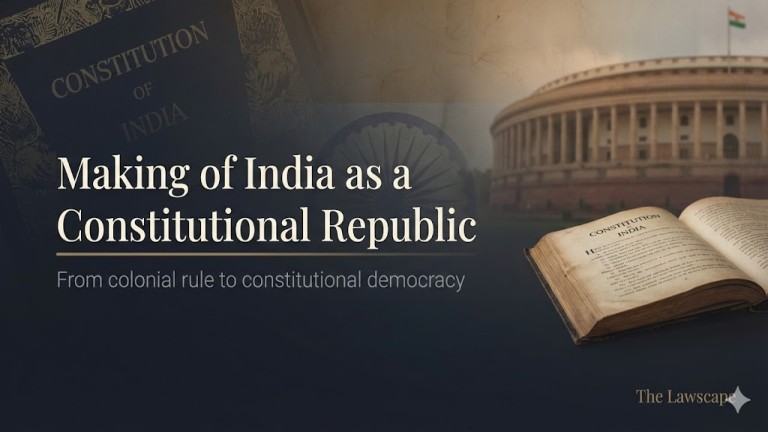
Making of India as a Constitutional Republic
Author: Yashita Uchil
Student, SVKM’S NMIMS, Mumbai, Maharashtra
—————————————————————————————————————-
Introduction
On this special occasion of Samvidhan Divas, or Constitution Day of India, also known as National Law Day, let’s remember the great history of our country, which is deeply rooted in emotions, struggles, justice, dignity, sacrifice, unity, and glory. The making of India as a Republic was not an overnight event but the result of centuries of resistance, reform, and resilience. To make this country, in which we proudly reside and identify ourselves as Indians or Bhartiyas, there are very few words sufficient to describe such a uniquely diverse nation. No matter how much we speak about our beloved country, it always feels inadequate. Let us recall the efforts of our founding fathers and founding mothers, who played indispensable roles in the freedom struggle and in shaping the foundations of nation-building.
Historical Background of the Indian Constitution
The British first arrived in India in 1608 as traders through the East India Company. Gradually, trade transformed into territorial control, and British governance continued until India achieved independence in 1947. With independence came the urgent need for a comprehensive constitutional framework to govern a newly free nation. Hence, a Constituent Assembly was formed in 1946 for this purpose, and on 26 January 1950, the Constitution of India came into force. The Constitution of India is the first Constitution framed and given to themselves by the people of India, adopted by the Constituent Assembly on 26 November 1949, which is why this day is celebrated as Constitution Day. It came into full operation on 26 January 1950. The Constitution, as originally adopted, had 22 Parts, 395 Articles, and 8 Schedules, and its present form reflects amendments made from time to time to meet evolving needs.
Although many principles from ancient Indian governance traditions are reflected in the Constitution, the direct sources of the Indian Constitution lie in the administrative and legislative developments during the British period. Our Constitution is often referred to as a “bag of borrowings”, as it has borrowed provisions from the constitutions of various countries. However, these provisions were not copied blindly; they were carefully adapted and modified to suit India’s unique social, political, and historical conditions. The aim was to establish a sovereign, secular, socialist, democratic republic that promotes peace, harmony, unity, and justice among its people.
This process led to the creation of an innovative and uniquely Indian constitutional framework. The idea of a Constituent Assembly for India was first proposed by M.N. Roy, a pioneer of the communist movement in India. Today, the Indian Constitution stands as one of the longest and most remarkable written constitutions in the world, and as a living document that continues to guide the nation.
Transformative Role of the Constitution in Shaping Modern India
A country like India has gone through multiple phases of evolution in terms of culture, practices, norms, and traditions. The rule of different dynasties and kingdoms created hierarchical social structures, most notably the caste system, which resulted in deep-rooted inequalities. The diffusion of different religions, languages, and customs, while enriching India’s diversity, also led to discrimination and social divisions. These factors resulted in injustice in education, economic conditions, social status, and political participation.
To make our country inclusive, free from discrimination, and capable of self-governance, the Constitution of India plays a transformative role. The Preamble of the Constitution promises justice, liberty, equality, and fraternity, which serve as the guiding principles of governance. Fundamental Rights under Part III protect citizens from discrimination and arbitrary state action, while the Directive Principles of State Policy under Part IV aim to establish social and economic justice through welfare-oriented governance. Together, these provisions ensure that democracy in India is not merely political but also social and economic in character.
Challenges Faced by the Constitution in Contemporary Times
The Constitution of India has now completed 75 years, yet it continues to face numerous challenges that demand thoughtful solutions. Persistent issues such as discrimination based on socio-economic background, caste, and gender inequality remain significant concerns. There is a growing need to strengthen rights related to the LGBTQ+ community and environmental sustainability. Additionally, empowering local governments, maintaining a healthy balance of federalism, and reducing delays in the delivery of justice are pressing constitutional challenges.
In the contemporary era, new concerns have emerged, including the need for laws governing technology, privacy, data protection, artificial intelligence, child safety, and women’s security. Addressing these challenges requires interpreting the Constitution as a living document while remaining faithful to its core values.
Conclusion
Despite these challenges, India continues to stand strong and actively seeks solutions to improve its constitutional framework. Our country has undergone numerous transformations, which make it one of the most unique and resilient democracies in the world. The Constitution is not merely a legal document; it is a unifying force that has strengthened national unity from the past and will continue to do so in the future. It empowers the nation to grow stronger by fostering peace, harmony, inclusivity, and justice. As long as the Constitution is respected and upheld in both letter and spirit, the Republic of India will continue to thrive.
** Disclaimer: The views expressed in this article are those of the author and do not necessarily reflect the views of The Lawscape.
The Lawscape — clear, practical legal insight for students and future lawyers.