
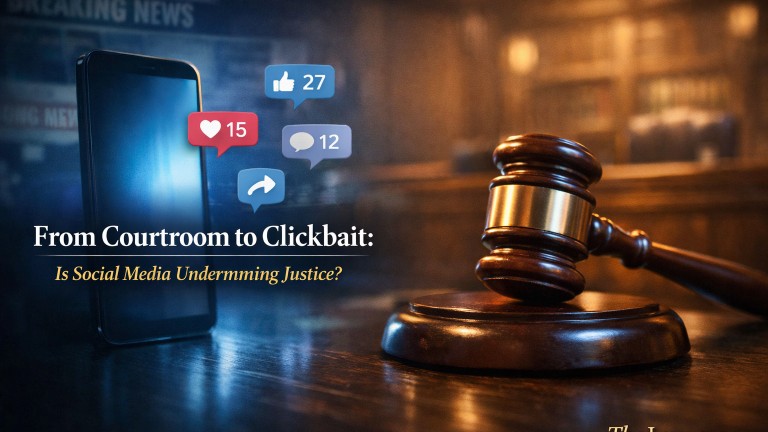
From Courtroom to Clickbait: Is Social Media Undermining Justice?
Author: Riya Kumari
Central University of South Bihar
—————————————————————————————————————-
Key Takeaways:
- Social media platforms are increasingly acting as “Digital Courtrooms,” delivering public verdicts long before judges do.
- Media trials threaten the fundamental constitutional principle of “innocent until proven guilty.”
- While social media can accelerate justice and amplify marginalized voices, it also spreads sensationalism and misinformation that can cause irreparable damage.
Introduction
In earlier times, justice was delivered strictly within the four walls of the courtroom, guided by evidence, legal reasoning, and constitutional principles. Judges carefully examined every aspect of a case before pronouncing their verdicts. Today, however, the landscape has changed dramatically. Even before a court reaches a decision, platforms like Twitter, Instagram, and YouTube host what can be called a “Digital Courtroom.” Based on a 15- second reel, people decide who is guilty and who is innocent. This raises a crucial question: is the crowd-driven culture of social media influencing our justice system?
Social Media: A Double-Edged Sword
Social media functions as a double-edged sword. On one hand, it spreads awareness and gives voice to public concerns; on the other, it often turns serious legal matters into public spectacle. The Sushant Singh Rajput case demonstrated how, in the absence of verified evidence, new theories surfaced daily. When emotions begin to outweigh facts, the possibility of a fair trial diminishes significantly.
Today, the moment a high-profile case emerges, it becomes a trending topic. People no longer wait for judicial outcomes. This leads to the dangerous phenomenon of a “public trial.” While judges operate within the framework of law and the Constitution, public opinion on social media is frequently driven by anger, assumptions, and incomplete information. Excessive online pressure raises legitimate concerns about its potential impact on the justice delivery system.
Media Trials and the Principle of “Innocent Until Proven Guilty”
One of the gravest challenges posed by social media is the concept of “trial by media.” News channels and digital influencers often conduct parallel investigations, shaping public perception long before courts deliver their verdicts. The Aarushi Talwar case stands as a prominent example, where a narrative was formed in the public mind well before judicial scrutiny concluded. Indian law firmly upholds the principle that every individual is innocent until proven guilty, yet social media often delivers punishment in advance. The Supreme Court itself cautioned against such practices in the Sahara vs. SEBI case.
In theory, judges are expected to remain neutral and impartial. However, they are also members of the same society that engages with social media discourse. When a case generates overwhelming online attention, an indirect pressure inevitably arises. If a judicial decision contradicts popular opinion, public criticism may be directed at the judiciary itself, potentially eroding public trust in the justice system.
The Positive Role of Social Media
It would be inaccurate to view social media solely as a negative force. During the Nirbhaya case, widespread public outrage on social platforms accelerated legal reforms and prompted swift action. Social media can amplify the voices of the marginalized and draw attention to injustices that might otherwise be ignored. The key lies in responsible and ethical usage.
Social media thrives on sensational content. In the pursuit of likes, views, and shares, even serious legal issues are often trivialized. Misinformation spreads rapidly, and by the time the truth emerges, irreparable damage may already have been done to an individual’s reputation and dignity.
Conclusion
It is essential to recognize that freedom of speech does not extend to violating an individual’s right to a fair trial. There exists a delicate line between justice and clickbait, one that must be carefully preserved. Justice cannot be determined by likes or shares but must rest on evidence, due process, and the rule of law. For a strong and healthy democracy, social media should be used not to provoke outrage, but to support truth and accountability.
References:
- Sahara India Real Estate Corp. Ltd. v. Sec. & Exch. Bd. of India, (2012) 10 S.C.C. 603 (India).
- Dr. Nupur Talwar v. State of Uttar Pradesh, (2018) 1 S.C.C. 634 (India) (popularly known as the Aarushi Talwar Murder Case).
- In re: Death of Sushant Singh Rajput, various proceedings and investigations, 2020 (India).
- Mukesh & Anr. v. State (NCT of Delhi), (2017) 6 S.C.C. 1 (India).
- INDIA CONST. art. 21.
- Presumption of Innocence, a Fundamental Principle of Criminal Jurisprudence, recognized under Indian law and international human rights norms.
- Press Council of India, Norms of Journalistic Conduct (revised ed.).
** Disclaimer: The views expressed in this article are those of the author and do not necessarily reflect the views of The Lawscape.
The Lawscape — clear, practical legal insight for students and future lawyers.