
Donoghue v. Stevenson [1932]: The Case That Built the Modern Law of Negligence
Author: Yashoda Rajput
Student, SAGE University Bhopal
————————————————————–
💡 3 Quick Takeaways
1. Donoghue v. Stevenson established that a manufacturer owes a duty of care to the ultimate consumer even in the absence of any contractual relationship — liability in tort is independent of contract.
2. Lord Atkin’s “neighbour principle” introduced foreseeability as the central test for duty of care — if harm to a person is reasonably foreseeable, a legal duty to avoid that harm may arise.
3. The case transformed negligence from a narrow, category-based doctrine into a general and flexible principle, directly influencing consumer protection law across common law jurisdictions including India.
Case Title: Donoghue v. Stevenson
Citation: [1932] AC 562
Court: House of Lords, United Kingdom
Introduction
Donoghue v. Stevenson stands as a watershed moment in the development of tort law, particularly the law of negligence. Prior to this decision, liability for negligence was largely dependent on the existence of a contractual relationship between the parties. The House of Lords, through this landmark judgment, laid down the foundational principles of duty of care, transforming negligence into an independent cause of action. The case introduced the famous “neighbour principle,” which continues to influence common law jurisdictions, including India. This commentary critically examines the facts, legal issues, arguments, judgment, and long-term implications of the decision.
Facts of the Case
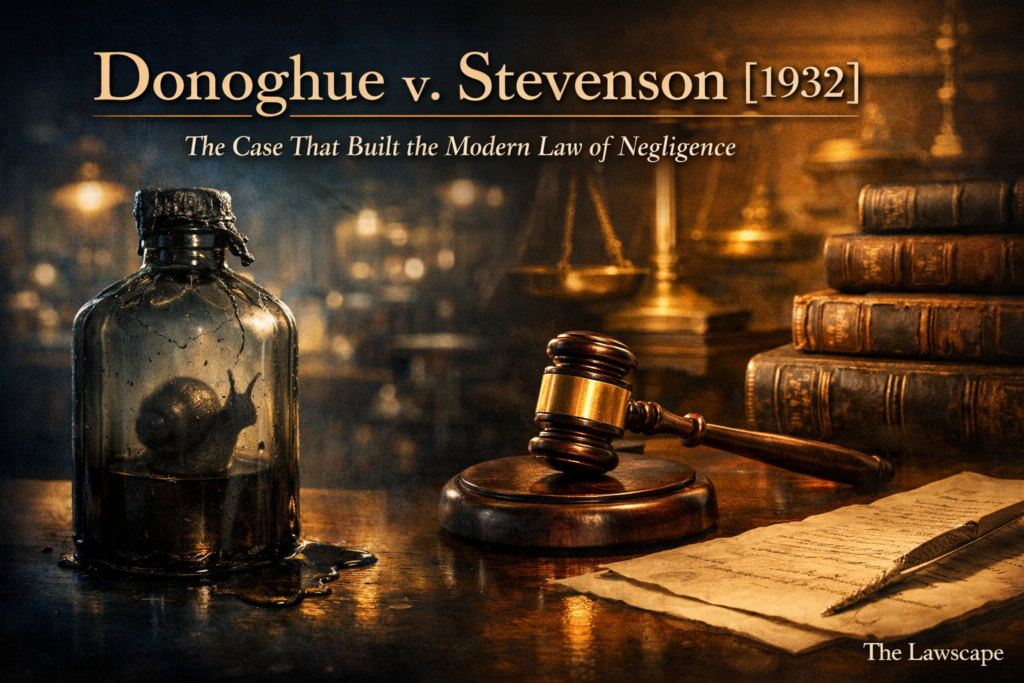
On 26 August 1928, Mrs May Donoghue went to a café in Paisley, Scotland, with a friend. The friend purchased a bottle of ginger beer manufactured by Mr David Stevenson. The bottle was made of opaque glass, preventing any visual inspection of its contents. Mrs Donoghue consumed part of the ginger beer and later poured the remainder into a glass, where she discovered the decomposed remains of a dead snail.
As a result, Mrs Donoghue allegedly suffered shock, severe gastroenteritis, and nervous illness. Since the contract of sale was between the café owner and her friend, Mrs Donoghue had no contractual relationship with the manufacturer. She accordingly filed a claim in tort against Mr Stevenson, alleging negligence in the manufacturing process.
The central question before the House of Lords was whether a manufacturer owed a duty of care to a consumer with whom there was no contractual relationship.
Legal Issues Raised
- Whether a manufacturer owes a duty of care to the ultimate consumer in the absence of a contractual relationship.
- Whether negligence can be established on the basis of foreseeability of harm alone.
- Whether the facts disclosed a valid cause of action in tort.
Arguments of the Parties
Plaintiff (Mrs Donoghue)
The plaintiff contended that the manufacturer owed a duty of care to consumers who were likely to consume the product. It was argued that the ginger beer was intended for human consumption and was sold in a sealed, opaque bottle that left no opportunity for intermediate inspection. The manufacturer ought therefore to have foreseen that any lack of reasonable care in production could result in harm to consumers. Counsel for Mrs Donoghue relied on emerging principles of negligence and public policy considerations, asserting that manufacturers should be held accountable for unsafe products placed into the market.
Defendant (Mr Stevenson)
The defendant argued that no duty of care existed because there was no contractual relationship between the manufacturer and the plaintiff. It was further contended that, under existing precedents, liability for negligence arose only in limited and established categories — such as inherently dangerous goods — which ginger beer did not constitute. The defendant relied heavily on the traditional principle of privity of contract, arguing that extending liability beyond contractual boundaries would open the floodgates of litigation.
Judgment and Reasoning
By a majority of three to two, the House of Lords ruled in favour of Mrs Donoghue. Lord Atkin delivered the leading judgment, which has since become one of the most cited judicial opinions in common law history.
The Neighbour Principle
Lord Atkin formulated the now-iconic “neighbour principle,” stating that a person must take reasonable care to avoid acts or omissions which can reasonably be foreseen as likely to injure persons so closely and directly affected by those acts that one ought reasonably to have them in contemplation. He defined “neighbour” as persons who are so closely and directly affected by one’s act that one ought reasonably to have them in mind when directing one’s conduct.
Duty of Care
The Court held that a manufacturer who produces goods intended for consumption, in circumstances where no intermediate examination is possible, owes a duty of care to the ultimate consumer. The absence of a contract did not negate this duty.
Rejection of Privity as a Barrier
The House of Lords rejected the rigid application of privity of contract, emphasising that tort law operates independently of contract law. The Court recognised negligence as a general and expansive principle rather than a collection of isolated, pre-defined categories.
Critical Analysis
The decision in Donoghue v. Stevenson marked a fundamental shift in tort law. By grounding duty of care in the general principles of foreseeability and proximity, the House of Lords laid the foundation for modern negligence jurisprudence.
The most significant contribution of this case is the establishment of a universal test for duty of care. The neighbour principle introduced moral reasoning into legal liability, aligning the law with broader societal expectations of responsibility and fairness. Lord Atkin’s reasoning transcended rigid legal formalism and embraced a wider conception of justice — ensuring consumer protection at a time when industrial production was rapidly expanding.
The decision directly influenced subsequent cases including Grant v. Australian Knitting Mills Ltd [1936] AC 85 and Hedley Byrne & Co. Ltd v. Heller & Partners Ltd [1964] AC 465. In India, courts have adopted and expanded this principle — notably in M.C. Mehta v. Union of India (1987) 1 SCC 395, where the Supreme Court applied a strict liability standard for hazardous industries, going further than the duty of care framework to develop an absolute liability rule suited to Indian conditions.
Despite its strengths, the decision has attracted criticism. The neighbour principle, while elegant, is inherently open-ended. Determining who qualifies as a “neighbour” often requires significant judicial discretion, which can lead to unpredictability. Critics have also argued that the judgment expanded liability without clearly defined limits, contributing to concerns about excessive litigation. Subsequent cases had to refine the principles of proximity, foreseeability, and policy to prevent over-extension — a task that took decades of litigation to work through.
Implications for Modern Law
The principles established in Donoghue v. Stevenson continue to shape tort law globally. The case transformed negligence into a flexible and evolving doctrine capable of responding to new social and technological contexts. In the field of consumer protection, the judgment paved the way for statutory reforms — in India, the Consumer Protection Act, 2019 reflects similar concerns for consumer safety and manufacturer accountability. The case also underscores the judiciary’s role in law-making, particularly where legislative frameworks lag behind societal needs — a role that remains as relevant today as it was in 1932.
Conclusion
Donoghue v. Stevenson is rightly regarded as the cornerstone of modern negligence law. By recognising a duty of care beyond contractual limits, the House of Lords ensured that legal liability aligns with moral responsibility. The neighbour principle not only reshaped tort law but reinforced the law’s protective function in society. Despite criticisms regarding its breadth and the ambiguity it left behind for later courts to resolve, the decision’s enduring relevance lies in its adaptability and foundational influence. It remains a guiding authority for courts worldwide, including India, and continues to inform the balance between individual responsibility and societal welfare.
Disclaimer: The views expressed in this article or case commentary are those of the author and do not necessarily reflect the views of The Lawscape.
The Lawscape — clear, practical legal insight for students and future lawyers.