
Joseph Shine v. Union of India (2018): Striking Down the Adultery Law as a Violation of Constitutional Dignity
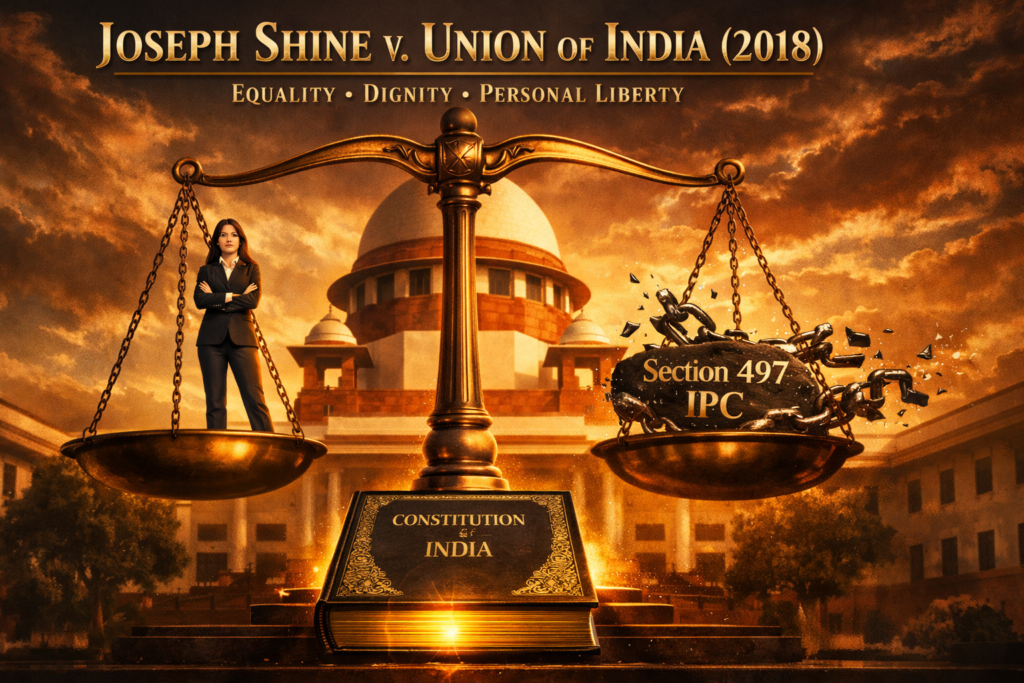
Author: Bhumika Kiran Dubey
Student, KES Shri Jayantilal H. Patel Law College
———————————————————————————————————————————–
💡 3 Quick Takeaways
1. The Supreme Court unanimously struck down Section 497 of the Indian Penal Code, 1860 as unconstitutional — holding that it violated Articles 14, 15, and 21 of the Constitution by treating women as the property of their husbands rather than as individuals with autonomous rights.
2. Adultery remains a valid ground for civil divorce but is no longer a criminal offence — the Court drew a clear distinction between a private moral wrong and a matter warranting State punishment.
3. The judgment reaffirmed that sexual autonomy, dignity, and the right to privacy are core aspects of personal liberty under Article 21 and cannot be subordinated to patriarchal conceptions of marriage.
Case Title: Joseph Shine v. Union of India
Citation: (2019) 3 SCC 39; AIR 2018 SC 4898
Court: Supreme Court of India
Bench: Five-Judge Constitution Bench — Chief Justice Dipak Misra, Justice A.M. Khanwilkar, Justice R.F. Nariman, Justice D.Y. Chandrachud, and Justice Indu Malhotra
Date of Judgment: 27 September 2018
Parties:
- Petitioner: Joseph Shine
- Respondent: Union of India
Introduction
Joseph Shine v. Union of India is a landmark judgment delivered by the Supreme Court of India on 27 September 2018, in which a five-judge Constitution Bench unanimously struck down Section 497 of the Indian Penal Code, 1860 and Section 198(2) of the Code of Criminal Procedure, 1973 — the provisions that had criminalised adultery in India for over 150 years.
The Bench held that the adultery law violated Articles 14, 15, and 21 of the Constitution of India by discriminating on the basis of sex, denying women their equal standing before the law, and treating them as objects within marriage rather than as individuals entitled to dignity and autonomy. While adultery continues to be a ground for divorce in civil law, it can no longer attract criminal liability.
This decision is considered significant as it reflects the constitutional shift towards gender equality and personal liberty in Indian constitutional jurisprudence.
Facts of the Case
Joseph Shine, an Indian citizen of Kerala origin residing in Italy, filed a Public Interest Litigation under Article 32 of the Constitution challenging the constitutional validity of Section 497 of the Indian Penal Code, 1860 and Section 198(2) of the Code of Criminal Procedure, 1973.
Section 497 IPC criminalised sexual intercourse by a man with the wife of another man without that husband’s consent. Only the husband of the woman could file a complaint — the woman herself had no standing either as complainant or as accused. The Petitioner argued that these provisions were discriminatory, violated fundamental rights guaranteed under the Constitution, and had no place in modern Indian law.
The petition contended that Section 497 and Section 198(2) CrPC were in violation of Article 14 (equality before law), Article 15 (prohibition of discrimination on grounds of sex), and Article 21 (right to life and personal liberty including the right to dignity and privacy).
Issues Raised
- Whether Section 497 IPC is arbitrary and discriminatory under Article 14 of the Constitution.
- Whether Section 497 IPC discriminates on the basis of sex in violation of Article 15.
- Whether Section 497 IPC and Section 198(2) CrPC are constitutionally valid.
- Whether criminalising adultery infringes the right to dignity, sexual autonomy, and personal liberty under Article 21.
- Whether adultery laws should be made gender-neutral.
- Whether the wife of the offending spouse should have a right to file a complaint under the adultery provisions.
Arguments of the Parties
Petitioner (Joseph Shine)
Counsel for the Petitioner argued that Section 497 IPC was a colonial-era provision with no relevance in modern times. It criminalised adultery on the basis of gender alone, creating an unreasonable classification between men and women with no rational basis. The law assumed the wife to be a passive object whose consent was immaterial — she could neither file a complaint if her husband committed adultery nor be treated as an accused if she engaged in an extra-marital relationship. This was submitted to be a direct violation of Article 14.
It was further argued that the provision discriminated on the basis of sex in violation of Article 15, as it was rooted in the patriarchal notion that a wife is the property of her husband. The Petitioner also contended that Section 497 violated the right to privacy under Article 21. Relying on Justice K.S. Puttaswamy v. Union of India (2017), it was submitted that decisions relating to sexual relationships between consenting adults fall within the constitutionally protected sphere of privacy, and that criminalising such conduct amounted to a disproportionate interference with personal liberty.
Respondent (Union of India)
Counsel for the Respondent defended Section 497 on the ground that adultery undermines the institution of marriage, causes harm to spouses and children, and affects the morality of society as a whole. It was argued that the provision was morally justified and that such conduct should be deterred and punished.
The Respondent further contended that the right to privacy under Article 21 is not absolute and is subject to reasonable restrictions where public interest is at stake. It was also argued that Section 497 could be viewed as a form of affirmative protection for women rather than a discriminatory provision. The Respondent requested that if any part of the section was found unconstitutional, the Court should strike only that portion and retain the rest.
Judgment
The Supreme Court unanimously struck down Section 497 IPC and Section 198(2) CrPC, holding both to be unconstitutional. All five judges agreed that Section 497 was violative of Articles 14, 15, and 21 of the Constitution of India. The decision revoked several earlier judgments that had upheld the criminalisation of adultery.
The Court held that the adultery law was founded on patriarchal assumptions — that a wife is the husband’s property and that her sexual agency is subordinate to his authority. This conception of marriage has no place in a constitutional framework that guarantees dignity, equality, and personal liberty to every individual. No one should be allowed to treat a woman as a chattel or as property.
Justice D.Y. Chandrachud, in his concurring opinion, emphasised that misogyny and patriarchal notions of sexual control over women find no place in the constitutional order. He referred to Navtej Singh Johar v. Union of India (2018) to underscore the significance of sexual autonomy as a dimension of individual liberty. He further noted that adultery is a private wrong — one that may justify civil remedies — but that the State should not involve itself through the criminal law in matters that are personal and do not cause harm to society at large.
Following this judgment, adultery remains a ground for seeking divorce under personal law but is no longer a criminal offence, and no person can be prosecuted or punished under Section 497 IPC. The decision shows how the Supreme Court is willing to reconsider earlier precedents in light of evolving constitutional principles.
Conclusion
Joseph Shine v. Union of India represents a progressive step in Indian constitutional law. By striking down Section 497 IPC, the Supreme Court affirmed that being married does not take away a person’s fundamental rights to equality, dignity, and personal liberty under the Constitution of India. The judgment recognises that while adultery is morally wrong and can be a ground for civil remedies, it cannot be treated as a criminal offence. Ultimately, the decision strengthens the constitutional commitment to gender justice, individual autonomy, and the protection of fundamental rights.
Disclaimer: The views expressed in this article are those of the author and do not necessarily reflect the views of The Lawscape.
The Lawscape — clear, practical legal insight for students and future lawyers.