
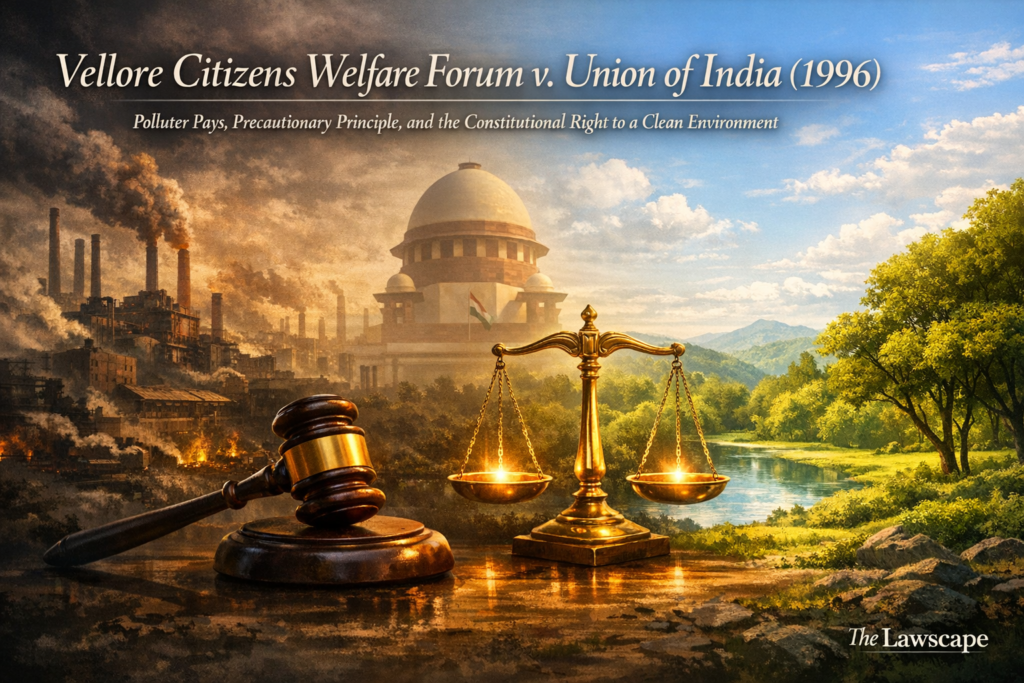
Vellore Citizens Welfare Forum v. Union of India (1996): Polluter Pays, Precautionary Principle, and the Constitutional Right to a Clean Environment
Author: Vikas
Student, KCC Institute of Legal and Higher Education, Noida
—————————————————————————————————–
💡 3 Quick Takeaways
1. The Supreme Court held that the right to a clean and healthy environment is an integral part of the right to life under Article 21 of the Constitution — industrial pollution that threatens public health and livelihoods directly violates this fundamental right.
2. The Court formally incorporated three international environmental principles into Indian domestic law — the Polluter Pays Principle, the Precautionary Principle, and the doctrine of Sustainable Development — giving them binding legal force.
3. Economic development cannot override environmental protection — both the State and private industries have a constitutional obligation to safeguard the environment, and industries causing pollution bear strict liability for the damage they cause.
Case Title: Vellore Citizens Welfare Forum v. Union of India
Citation: (1996) 5 SCC 647
Court: Supreme Court of India
Introduction
Vellore Citizens Welfare Forum v. Union of India (1996) is a landmark judgment in Indian environmental law. The Supreme Court recognised and applied the principles of Sustainable Development, the Polluter Pays Principle, and the Precautionary Principle as essential parts of Indian environmental jurisprudence — incorporating internationally recognised environmental standards into domestic constitutional law for the first time.
The judgment strengthened environmental protection by holding industries accountable for pollution and emphasised the importance of balancing economic development with ecological preservation under the Constitution of India. It remains a cornerstone of Indian environmental jurisprudence and a foundational authority on the constitutional dimensions of environmental rights.
Facts of the Case
The case arose from severe environmental pollution caused by tanneries and industrial units located in Tamil Nadu, primarily in and around the town of Vellore. These tanneries processed leather using hazardous chemicals including chromium salts, acids, and other toxic substances. Effluents from these industries were routinely discharged into nearby rivers, irrigation canals, and agricultural lands without proper treatment.
Local communities relying on these water sources for drinking, cooking, and irrigation began suffering serious health problems and a significant loss of agricultural productivity. Contamination of groundwater and soil rendered farmland unfit for cultivation, causing long-term economic and social harm to villagers. Fish and aquatic life in affected rivers were also severely impacted by the toxicity of the industrial waste.
Despite existing legislation — including the Water (Prevention and Control of Pollution) Act, 1974 and the Environment Protection Act, 1986 — the State Pollution Control Board and government authorities had failed to enforce environmental standards effectively, and the discharges continued unchecked.
In response, the Vellore Citizens Welfare Forum, an environmental NGO, filed a Public Interest Litigation before the Supreme Court seeking judicial intervention to enforce environmental laws, hold polluting industries accountable, and ensure protection for the communities affected.
Issues Raised
- Whether industrial pollution by tanneries violated environmental laws and the fundamental rights of affected communities.
- Whether the polluting industries should be held strictly responsible for environmental damage caused by their activities.
- Whether international environmental principles — the Polluter Pays Principle, the Precautionary Principle, and Sustainable Development — should be applied as part of Indian domestic law.
Arguments of the Parties
Petitioner (Vellore Citizens Welfare Forum)
The petitioner argued that the tanneries were causing widespread environmental pollution by discharging untreated effluents containing harmful chemicals into rivers, canals, and agricultural lands. This pollution directly violated the fundamental right to life under Article 21 of the Constitution, which encompasses the right to a clean and healthy environment.
The petitioner emphasised that regulatory authorities had failed to enforce applicable environmental laws. It was argued that the industries should be held strictly liable for the environmental damage caused and that international environmental principles — the Polluter Pays Principle and the Precautionary Principle — should be applied by the Court to prevent further harm. Directions were sought for the installation of effluent treatment plants, compliance with pollution control standards, and compensation for affected communities.
Respondents (Union of India and Polluting Industries)
The Union of India and the polluting industries argued that the tanneries were important contributors to economic development and employment in the region, and that imposing strict environmental obligations risked harming industrial growth and livelihoods. The respondents contended that environmental management was primarily a legislative and executive function and that judicial intervention should be limited. They acknowledged that certain industrial practices required improvement but maintained that existing regulatory frameworks were sufficient to address the issue.
Judgment
The Supreme Court delivered a landmark judgment holding that the discharge of untreated effluents by the tanneries violated the fundamental right to life under Article 21 of the Constitution. The Court rejected the argument that economic development could outweigh environmental protection and held that the right to life necessarily includes the right to a clean and healthy environment.
The Court applied three key environmental principles. The Precautionary Principle requires preventive action against potential environmental harm even in conditions of scientific uncertainty — the absence of conclusive proof of harm does not justify inaction. The Polluter Pays Principle holds industries strictly responsible for compensating the costs of environmental damage they cause, including restoration of the environment and compensation for affected communities. The doctrine of Sustainable Development requires that economic growth and ecological preservation be pursued together — neither can be sacrificed for the other.
The Court directed the polluting tanneries to install Effluent Treatment Plants and comply with the standards set by the State Pollution Control Board. Industries that failed to implement adequate pollution control measures were ordered to cease operations. The judgment affirmed that both the State and private enterprises are constitutionally obliged to protect the environment, and that courts can intervene to enforce this obligation where the executive has failed to act.
Ratio Decidendi
The ratio decidendi of Vellore Citizens Welfare Forum v. Union of India lies in the recognition that environmental protection is a fundamental aspect of the right to life under Article 21 of the Constitution. The Court held that pollution of rivers, groundwater, and agricultural land by industrial effluents directly threatens public health and livelihoods and thereby infringes the constitutional right to a clean and healthy environment.
The Court established that industries engaging in hazardous or polluting activities are strictly liable for the environmental damage they cause — the Polluter Pays Principle mandates that the costs of environmental restoration and community compensation must be borne by the polluter. The Precautionary Principle requires preventive measures even in conditions of scientific uncertainty. The principle of Sustainable Development holds that economic growth cannot be pursued at the expense of ecological preservation.
The judgment affirmed that both the State and private actors have a constitutional obligation to protect and preserve the environment and created binding legal precedent by incorporating international environmental principles into domestic law.
Conclusion
Vellore Citizens Welfare Forum v. Union of India marked a defining moment in Indian environmental jurisprudence. By linking the right to a clean environment to Article 21, the Supreme Court ensured that environmental protection became a matter of constitutional obligation rather than merely regulatory compliance.
The case established that industries cannot use economic development as a shield against accountability for pollution. Courts can and must intervene when regulatory authorities fail to enforce environmental standards, and polluters bear full responsibility for the damage they cause. The formal incorporation of the Polluter Pays Principle, the Precautionary Principle, and Sustainable Development into Indian law gave these internationally recognised standards domestic legal force — a development that continues to shape environmental litigation and regulation in India to this day.
Disclaimer: The views expressed in this article are those of the author and do not necessarily reflect the views of The Lawscape.
The Lawscape — clear, practical legal insight for students and future lawyers.