
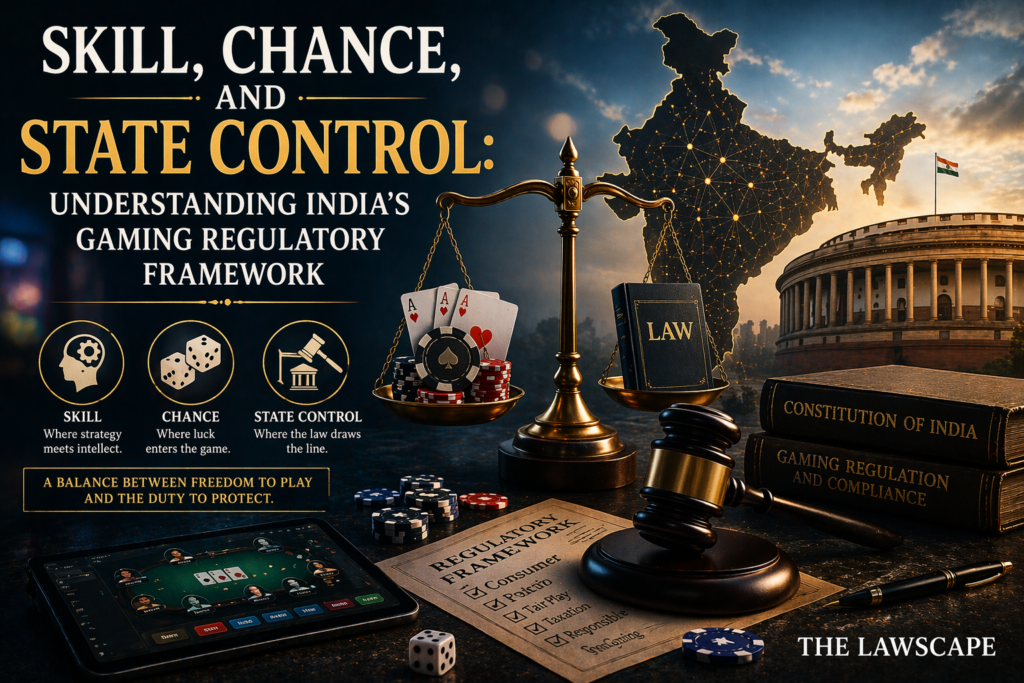
Skill, Chance, and State Control: Understanding India’s Gaming Regulatory Framework
Author: Vanshika Haritwal
Student, Subhash Desai College of Law, Nirmal Education Society (University of Mumbai)
————————————————————————————-
💡 3 Quick Takeaways
1. India’s gambling regulation remains primarily a State subject under Entry 34, List II of the Seventh Schedule — resulting in a fragmented legal landscape where activities permitted in one state may be prohibited in another.
2. The judiciary has drawn a consistent line between games of skill and games of chance — skill-based games such as rummy, poker, and horse racing have been held to fall outside gambling prohibitions, shaping the legal space in which the online gaming industry operates.
3. The Promotion and Regulation of Online Gaming Act, 2025 represents India’s most significant attempt to establish a uniform national framework for online gaming — but challenges around offshore platforms, taxation, and addiction remain unresolved.
Abstract
Online gaming and gambling in India are growing rapidly, driven by digital technology, easy internet access, and a young population. However, the legal system governing this sector remains complex and fragmented. While the industry has evolved into a major economic force, the laws regulating betting and gambling still largely stem from older frameworks like the Public Gambling Act, 1867, with States having the primary authority to regulate these activities. This has resulted in different rules across states, creating confusion and legal uncertainty.
The judiciary has played an important role in distinguishing between games of skill and games of chance, allowing certain skill-based games such as rummy and horse racing to operate legally. The rise of online gaming has raised concerns about addiction, financial loss, mental health issues, and the risks posed by offshore betting platforms that operate beyond Indian regulatory control. High taxation policies, including income tax and GST on online gaming, have further added to the complexity.
This article examines the constitutional framework, key court judgments, state-level regulatory diversity, taxation issues, social and psychological impacts, and the challenge of illegal offshore gambling websites. It argues that India needs a clear, balanced, and coordinated national approach that protects consumers, prevents misuse, and supports the responsible growth of the gaming industry.
Introduction
Online gaming in India has emerged as one of the fastest-growing segments of the country’s digital entertainment industry. Encompassing mobile gaming, e-sports, fantasy sports, and web-based gaming platforms, the sector has expanded rapidly due to increased smartphone penetration, affordable internet access, and a young, technology-driven population. What was once considered a niche recreational activity has evolved into a significant economic industry attracting domestic and foreign investment.
At the same time, gambling in India remains a legally sensitive and State-regulated subject. Under the constitutional framework, individual States are empowered to enact their own laws concerning betting and gambling. States such as Goa have legalised casinos under specific licensing conditions, while others restrict or prohibit gambling activities altogether. State-run lotteries and horse racing have been selectively permitted under regulatory supervision. This diversity in State approaches has contributed to a fragmented and often confusing legal environment.
As Black’s Law Dictionary (4th ed., 1968) notes, “gaming” properly refers to the act of the players themselves, while “betting” describes wagers placed by third parties on the outcome of a game — a distinction that continues to have practical legal significance in how Indian courts and regulators classify different activities.
In the twenty-first century, the rapid expansion of online platforms has intensified policy debates surrounding betting and gambling. Critics argue that gambling can contribute to crime, corruption, addiction, and money laundering. Proponents of regulated gaming contend that a well-structured legal framework can generate substantial State revenue, create employment, and ensure consumer protection. Parliament’s enactment of the Promotion and Regulation of Online Gaming Act, 2025 reflects India’s ongoing effort to balance technological innovation, economic growth, and social safeguards within this complex regulatory framework.
History
In the late nineteenth century, the colonial administration introduced the Public Gambling Act, 1867, reflecting the British Parliament’s growing concerns about betting and gambling in India. While India, with limited exceptions in states like Nagaland and Goa, has largely maintained a restrictive stance against legalising gambling, the United Kingdom progressively updated its laws to accommodate the modern gambling industry, including online gambling — a contrast that highlights the relative stasis of India’s legislative framework in this area.
Following independence, the Seventh Schedule granted State governments the power to regulate gambling and betting through Entry 34, List II. However, not all States have exercised this power, and only a few States with specific legislation provide a clear definition of gambling. This has left online gambling to operate in a significant legal grey area. The call for regulatory reform gained further momentum following the recommendation of former Chief Justice of India R.M. Lodha that the Ministry of Youth Affairs and Sports consider legalising online betting for cricket — a recommendation aimed at addressing inadequate sports funding and preventing corruption, particularly match-fixing.
Constitutional Framework
The constitutional scheme distributes legislative powers between the Union and the States under Article 246 of the Constitution of India. Entry 34 of List II (State List) expressly grants States the power to legislate on “betting and gambling,” making gambling primarily a State subject. However, online gaming involves telecommunications and digital infrastructure, potentially invoking Entry 31 of List I (Union List), which relates to communication and internet-based services. While States regulate gambling as such, the Union Government has exercised authority under the Information Technology framework to regulate online intermediaries and digital platforms, creating a concurrent regulatory space that has contributed to legal uncertainty.
Judicial Interpretation on Online Gaming and Gambling
The judiciary has played a crucial role in shaping gambling regulations in India, particularly by distinguishing between games of chance — which are generally prohibited — and games of skill — which may be permitted. These decisions highlight the ongoing interaction between legislation and judicial interpretation in shaping India’s gaming framework.
RMD Chamarbaugwala v. Union of India (1957)
This landmark Supreme Court case examined whether competitions involving skill fall under the category of “betting and gambling” as prohibited by the Constitution. The Court held that skill-based competitions do not amount to gambling and are not subject to betting and gambling prohibitions. This judgment set the foundation for distinguishing between games of skill and games of chance, establishing that games predominantly involving skill are legal and not considered gambling. It has since been referenced in numerous judgments regarding online skill-based games including poker and rummy.
Dr. K.R. Lakshmanan v. State of Tamil Nadu (1996)
This case involved the legality of betting on horse races under the Public Gambling Act, 1867. The Supreme Court held that betting on horse racing is a game of skill, as it requires knowledge of horses, jockeys, form, and other factors that influence the race’s outcome. The ruling reinforced the skill versus chance distinction in Indian law and has had significant implications for the treatment of sports betting and skill-based online gaming.
State of Andhra Pradesh v. K. Satyanarayana & Ors. (1968)
This case addressed whether rummy constituted gambling. The Supreme Court held that rummy is a game of skill rather than chance, as a certain degree of skill is required for success, and therefore falls outside gambling prohibitions. This ruling has had lasting influence on the legality of skill-based games in India, particularly for online rummy platforms, and is routinely cited in the defence of skill-based online gaming.
Together, these cases drew a clear line between games of skill and games of chance, laying the groundwork for a regulatory approach that has allowed the gaming industry to grow while maintaining limits on pure gambling. As online gaming continues to evolve, the principles from these cases continue to guide courts and regulators in finding the right balance between innovation and responsible regulation.
The Rise of Online Gaming and the Regulatory Response
India’s digital gaming landscape has undergone a significant shift with the enactment of the Promotion and Regulation of Online Gaming Act, 2025 (PROG Act) in August 2025. The legislation represents the government’s attempt to address the complex challenges surrounding online gaming while fostering legitimate sectors of the industry through a uniform national framework.
The Indian online gaming sector has emerged as a major economic force, with over 488 million gamers making India the world’s second-largest gaming market. The industry was valued at approximately ₹35,000 crore in 2024, with real-money gaming contributing 85–86% of total revenue. However, this rapid growth came with substantial challenges including gaming addiction, financial losses, money laundering concerns, and national security risks. Government estimates suggest that nearly 450 million Indians were adversely affected by money-based games, with cumulative losses estimated at around ₹20,000 crore.
The legislation emerged from pressing public health concerns — including reports of 47 suicides linked to gaming addiction in Tamil Nadu alone over five years — and investigations revealing that certain gaming platforms were being used for terror financing, money laundering, and illegal communications. The regulatory vacuum that previously existed had created fragmented State-level approaches and significant legal ambiguity. The PROG Act was introduced to establish clarity and to distinguish between legitimate gaming activities and harmful money-based games. The success of the framework will ultimately be measured by its effectiveness in curbing harmful gaming practices while fostering a sustainable and responsible gaming ecosystem.
State-Level Regulatory Diversity
Due to the constitutional allocation of legislative power, States have adopted widely varied regulatory approaches.
In Sikkim, gambling activities are regulated under the Sikkim Casino Act, with licences granted to operators conducting activities in five-star hotels. The State also permits online games — subject to geo-restriction to Sikkim only — covering a range of games including roulette, poker, baccarat, and sports prediction games. Operators must be companies incorporated in India.
In Nagaland, operators must obtain licences for skill-based games conducted online, covering a broad range including fantasy sports, chess, poker, rummy, quiz games, and virtual sports. Licences are issued only to entities incorporated in India with substantial domestic ownership and control, and operators must have no criminal history or interest in offline gambling activities.
In Goa and Daman and Diu, casino licences are issued to operators in five-star hotels and offshore vessels, and licences are also available for electronic amusement and slot machine operations.
In Tamil Nadu, local online games providers are required to obtain a certificate of registration from the Tamil Nadu Online Gaming Authority before offering online games, provided those games do not fall within the prohibitions under the applicable State legislation.
Taxation and GST
Online gaming in India is subject to a 30% income tax on net winnings under Section 115BBJ of the Income Tax Act, with TDS deducted at 30% on net winnings upon withdrawal or at the financial year-end under Section 194BA. These provisions apply to both skill-based and chance-based games involving money.
GST on online gaming has been a significant and contentious issue for the industry. At present, online games attract 28% GST on the full face value of bets or deposits. With the PROG Act coming into force in 2025, the taxation framework under GST is also under review, and developments in how online games will be classified and taxed under GST are expected to follow.
Social and Psychological Impact of Online Gaming
Online gaming has had a significant social and psychological impact on players. On the positive side, multiplayer and team-based games foster social connection, build communities, develop teamwork and communication skills, and can provide stress relief and cognitive development. Gaming has also found applications in therapeutic contexts, helping individuals manage anxiety and other mental health conditions.
On the negative side, excessive gaming can lead to social isolation, reduced face-to-face interaction, cyberbullying, and disruption of family and social life. Internet Gaming Disorder — recognised as a mental health condition — can cause significant functional impairment, with addicted players experiencing withdrawal symptoms and compulsive behaviour. Addiction-driven financial losses and the availability of real-money gaming platforms have led to serious harm in individual cases, including instances of debt, fraud, and in extreme cases, self-harm. These concerns underpin much of the regulatory impetus behind the PROG Act 2025.
Curbing Offshore Online Betting and Gambling
The issue of illegal offshore online betting and gambling has become a serious concern in India, discussed in Parliament due to its growing financial and social risks. Offshore platforms — frequently operating from jurisdictions such as Malta and Curacao — allow Indian users to place bets in violation of applicable gambling laws, foreign exchange regulations, money laundering provisions, and consumer protection standards.
These platforms expose users to financial distress, fraud, addiction, and mental health risks. The risks are particularly acute for minors, who can access unregulated platforms with minimal barriers. While some enforcement actions have been taken — including notices under foreign exchange laws and website blocking orders — regulatory efforts remain fragmented. Jurisdictional challenges between State and central authorities, combined with lack of inter-agency coordination, make effective enforcement difficult.
A systematic and coordinated response is urgently needed. This includes stronger legal amendments, improved inter-agency coordination, prompt blocking of illegal platforms, and a centralised reporting mechanism to identify and act against offshore gambling websites before the problem escalates further.
Conclusion
Online gaming and gambling in India illustrate how rapidly the country is changing in the digital age. What began as simple entertainment has become a large and fast-growing industry — one that the legal system has struggled to keep pace with. Old colonial laws, divergent State approaches, and rapid technological growth have made the regulatory landscape complicated and often unclear.
Judicial decisions have provided important clarity by separating games of skill from games of chance, and the PROG Act 2025 represents a significant step toward bringing structure to the sector. However, challenges around offshore betting platforms, high taxation, addiction risks, and regulatory coordination remain. Online gaming has both positive and negative effects, and regulation must strike a careful balance — protecting consumers and society while encouraging legitimate innovation and business.
Ultimately, the future of gaming and gambling regulation in India depends on thoughtful reform and consistent enforcement. A clear, cooperative, and technology-driven regulatory framework can ensure that the industry grows responsibly while safeguarding public welfare. If managed wisely, India has the potential to develop a model that supports a vibrant and globally competitive digital gaming ecosystem while protecting its citizens.
Disclaimer: The views expressed in this article are those of the author and do not necessarily reflect the views of The Lawscape.
The Lawscape — clear, practical legal insight for students and future lawyers.