
A Study on the Contribution of Dr. B.R. Ambedkar to Labour Legislation in India
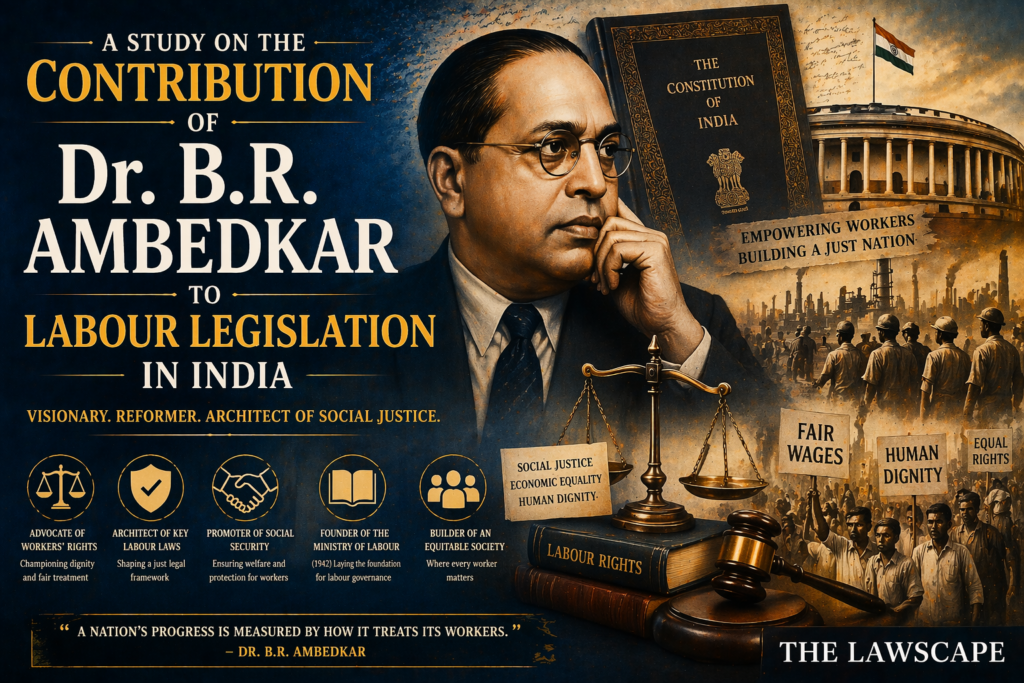
Author: Shubham Upadhyay
Student, Faculty of Legal Sciences, Shoolini University, Solan
Co-Author: Mrs. Richika Mehta
Assistant Professor (IPR), Faculty of Legal Sciences, Shoolini University
————————————————————————————-
💡 3 Quick Takeaways
Dr. B.R. Ambedkar’s tenure as Labour Member in the Viceroy’s Executive Council (1942–1946) was a turning point in Indian labour history, producing landmark reforms on working hours, trade union rights, and social security.
Ambedkar ensured that the welfare of workers was not left to policy alone — he embedded labour protections directly into the Indian Constitution through Fundamental Rights and Directive Principles of State Policy.
His legacy extends beyond formal legislation: Ambedkar’s vision of economic democracy and social inclusion continues to shape the framework of labour law in independent India.
Abstract
Dr. B.R. Ambedkar was a social reformer and one of the principal architects of the Indian Constitution. During his tenure as Labour Member in the Viceroy’s Executive Council from 1942 to 1946, he introduced a series of progressive labour reforms aimed at securing equity, dignity, fair wages, and social security for workers. He worked towards establishing minimum wages, regulating working hours, ensuring equal remuneration, and creating welfare programmes for workers in the industrial sector. He also shaped the Indian Trade Union (Amendment) Act, 1942, strengthening workers’ rights to organise and bargain collectively. His vision further informed the inclusion of social security and fair employment principles within the Directive Principles of State Policy of the Constitution. This paper examines Dr. Ambedkar’s contributions to labour legislation in India, the enduring relevance of his reforms, and his role as a champion of labour justice and social reform.
Keywords: Dr. B.R. Ambedkar, labour legislation, social justice, labour reforms, welfare.
Introduction
Dr. B.R. Ambedkar, visionary scholar and principal drafter of the Indian Constitution, made foundational contributions to labour rights in India. As a country that houses one of the largest labour forces in the world, India’s economic development is deeply tied to the conditions and protections afforded to its working population. Ambedkar recognised this connection clearly. His tenure in the Labour Department of the Viceroy’s Executive Council from 1942 to 1946 marked the beginning of a meaningful transition towards progressive reform in working conditions, wages, and welfare provisions for labourers.
His labour reforms were rooted in a broader vision of economic democracy and social inclusion. He championed the reduction of working hours from twelve to eight hours per day, strengthened workers’ rights to unionise, advocated for minimum wage requirements, and laid the groundwork for social security provisions including maternity benefits, workers’ insurance, and pension plans. His policies were consistently directed towards protecting marginalised and vulnerable workers from exploitation and restoring their economic dignity.
Labour Legislation Development through the Contribution of Dr. B.R. Ambedkar
Pre-Independence Period
Labour Reform Administration
Before independence, labour laws in India were largely shaped by colonial interests and served the needs of the British Empire rather than the welfare of Indian workers. Employees in textile, mining, and plantation industries endured gruelling working conditions, excessive hours, inadequate wages, and a complete absence of social security. The Factories Act, 1881, adopted by the British government to regulate working hours and factory conditions, was insufficient to provide meaningful protection to workers. While the Trade Union Act, 1926, was a landmark development as the first legislation acknowledging the right to form trade unions, it too carried significant restrictions and fell short of comprehensive worker protection.
Dr. Ambedkar’s appointment as Labour Member of the Viceroy’s Executive Council in 1942 marked the beginning of his direct legislative influence. From this position, he worked to introduce changes that would improve the condition of industrial workers and promote social welfare. His key contributions during this period include:
- Amendments to the Factories Act reducing daily working hours from twelve to eight and introducing stricter safety standards, significantly improving labour conditions.
- The Indian Trade Union (Amendment) Act, 1942, which granted trade unions formal legal status and expanded workers’ rights to form and organise unions, enabling collective bargaining.
- The promotion of social security measures including insurance, pension, and health provisions, which laid the groundwork for post-independence labour policy and were later entrenched in the Constitution and subsequent legislation.
Post-Independence Period
Formalisation of Labour Laws
After India attained independence in 1947, Dr. Ambedkar became the country’s first Law Minister. During his tenure, he worked to institutionalise the rights of labourers through both the Constitution and acts of Parliament.
Constitution of India, 1950
Fundamental Rights: Dr. Ambedkar ensured that the Indian Constitution incorporated a range of fundamental rights directly relevant to the protection of workers, including equality before the law (Article 14), non-discrimination and equal employment opportunities (Article 16), protection of personal liberty (Article 21), the right to assemble and form associations and unions (Article 19(1)(c)), prohibition of forced labour (Article 23), and the prohibition of child labour in hazardous occupations (Article 24).
Directive Principles of State Policy: Ambedkar embedded within the Constitution a set of directive principles under Articles 39, 41, 42, 43, and 43A, designed to guarantee dignified, just, and humane working conditions. These principles promote equitable pay, occupational safety, and social security for workers. Article 39(d), in particular, enshrines the principle of equal pay for equal work for both men and women. All subsequent labour legislation in India draws its foundational basis from these constitutional provisions.
Other Key Labour Legislation
Trade Union Amendment Act, 1942: Ensured the establishment of labour unions and prohibited unfair labour practices.
Industrial Disputes Act, 1947: Provided a legal framework for the resolution of industrial disputes, including those arising from strikes, lockouts, layoffs, retrenchment, and collective bargaining, while safeguarding the rights of workers.
Minimum Wages Act, 1948: Championed by Ambedkar to prevent exploitation of workers by mandating a statutory minimum wage across various industries.
Employees’ State Insurance Act, 1948: Introduced a comprehensive medical insurance scheme for workers, covering medical services and financial assistance in cases of illness, injury, or death.
Factories Act, 1948: Building on the amendments of 1942 to the earlier Factories Act, this legislation provided comprehensive regulation of working hours, safety standards, and welfare conditions for factory workers.
Equal Remuneration Act, 1976: Though enacted posthumously, this Act directly reflects Ambedkar’s vision of gender equality in the workplace, giving legislative force to the constitutional mandate of equal pay for equal work under Article 14.
The Correlation Between Labour Law and the Indian Constitution
Indian labour laws are firmly grounded in constitutional provisions, with the Constitution serving as both the foundation and the benchmark for employment law. Through the protection of Fundamental Rights, the articulation of Directive Principles touching on social and economic justice, and the declaration of the state’s commitment to just working conditions, Dr. Ambedkar — as the Constitution’s principal drafter — ensured that the welfare of labour was recognised as an essential component of India’s democratic and economic structure.
Fundamental Rights and Labour Protection
The Constitution provides a range of fundamental rights that directly protect workers against exploitation, forming the legal basis for equality and justice in the workplace.
- Article 14 (Equality before Law): Guarantees that workers are not discriminated against on grounds of religion, caste, sex, or place of birth, providing the foundation for equal employment opportunity and the prevention of discriminatory labour practices.
- Article 19 (Freedom of Speech, Assembly, and Association): Empowers workers to organise themselves into associations and trade unions — a critical tool for defending their collective interests. This provision underpins trade union legislation and the right to collective bargaining under the Indian Trade Unions Act.
- Article 23 (Prohibition of Forced Labour): Prohibits involuntary servitude and human trafficking. This constitutional mandate directly influenced legislation such as the Bonded Labour System (Abolition) Act, 1976. In Bandhua Mukti Morcha v. Union of India (1984 AIR 802), the Supreme Court affirmed that bonded labour is unconstitutional, reinforcing the prohibition under Article 23.
- Article 24 (Prohibition of Child Labour): Prohibits the employment of children below the age of fourteen in factories, mines, and hazardous occupations, supporting legislation such as the Child and Adolescent Labour (Prohibition and Regulation) Act, 1986.
Directive Principles of State Policy and Labour Legislation
The Directive Principles of State Policy, contained in Part IV of the Constitution, guide the government in policymaking and provide the ideological foundation for labour legislation. While not enforceable by courts, they represent the constitutional aspirations for social and economic justice.
- Articles 39(e) and (f): Direct the state to prevent the exploitation of workers and ensure equal pay for equal work for men and women. This directive forms the basis of the Equal Remuneration Act, 1976. In Randhir Singh v. Union of India (1982 AIR 879) and State of Punjab v. Jagjit Singh (2016 AIR 5177), the Supreme Court accepted equal pay for equal work as a constitutional goal flowing from Articles 14, 16, and 39(d).
- Article 41: Directs the state to secure the right to work and public assistance in cases of unemployment, old age, sickness, or disability. It forms the basis of social security legislation such as the Employees’ State Insurance Act, 1948, and the Employees’ Provident Fund Act, 1952.
- Article 42: Requires the state to provide just and humane working conditions and maternity benefits. Its influence is visible in the Maternity Benefit Act, 1961, and the Factories Act, 1948.
- Article 43: Directs the state to ensure a living wage, decent working conditions, and an adequate standard of living for workers. It underpins minimum wage legislation including the Minimum Wages Act, 1948. In People’s Union for Democratic Rights v. Union of India (1982 AIR 1473), the Supreme Court affirmed the principles of fair wages and working conditions in alignment with Ambedkar’s labour reform vision.
Fundamental Duties and Labour Welfare
Although not legislative in nature, the Fundamental Duties under Part IVA of the Constitution reinforce a culture of respect for the dignity and welfare of workers. Article 51A(e) directs citizens to renounce practices that violate human dignity, reinforcing the broader need for laws that protect workers from exploitation.
Legislative Competence and Labour Laws
The constitutional scheme also determines which level of government may legislate on labour matters. Entry 22 of the Union List (Seventh Schedule) grants the Central Government the power to legislate on industrial disputes, trade unions, and social security, enabling comprehensive legislation such as the Industrial Disputes Act, 1947, and the Trade Unions Act, 1926. Entry 24 of the Concurrent List permits both Central and State Governments to legislate on labour welfare, wages, insurance, and working conditions, enabling legislation such as the Factories Act, 1948, as affirmed in Air India v. Nergesh Meerza (1981 AIR 1829).
Conclusion
Dr. Ambedkar’s contribution to labour legislation in India was both immediate and enduring. As a policymaker and visionary leader, he understood the intrinsic relationship between national development and the welfare of the working population. His efforts to improve labour conditions, secure fair wages, and establish social security mechanisms have left a permanent mark on Indian labour law. Crucially, his vision extended beyond immediate reform — it sought to dismantle the institutionalised exploitation deeply rooted in caste and class structures. The right to unionise, the creation of social security instruments such as provident funds and pensions, and the advancement of gender equality in the workplace all form the enduring content of modern labour law in India, bearing the unmistakable imprint of Ambedkar’s lifelong commitment to justice and dignity for all workers.
Disclaimer: The views expressed in this article are those of the author and do not necessarily reflect the views of The Lawscape.
The Lawscape — clear, practical legal insight for students and future lawyers.