
Algorithmic Greenwashing and Corporate Criminal Liability: An Emerging Crisis in Digital Sustainability
Author: Manan Jhamb
Student, Chandigarh University
————————————————————————————-
💡 3 Quick Takeaways
Algorithmic greenwashing — the generation of misleading sustainability claims through AI systems rather than deliberate human deception — represents a new and technically invisible threat to corporate accountability that existing legal frameworks are ill-equipped to address.
Conventional corporate criminal liability doctrine, built on human-centred concepts of mens rea and actus reus, breaks down when the source of deception is an automated algorithmic system with no identifiable human intent behind it.
Meaningful reform requires recognising algorithms as a source of corporate criminal liability, imposing mandatory algorithmic due diligence obligations, and fostering international convergence across divergent regulatory regimes.
Introduction
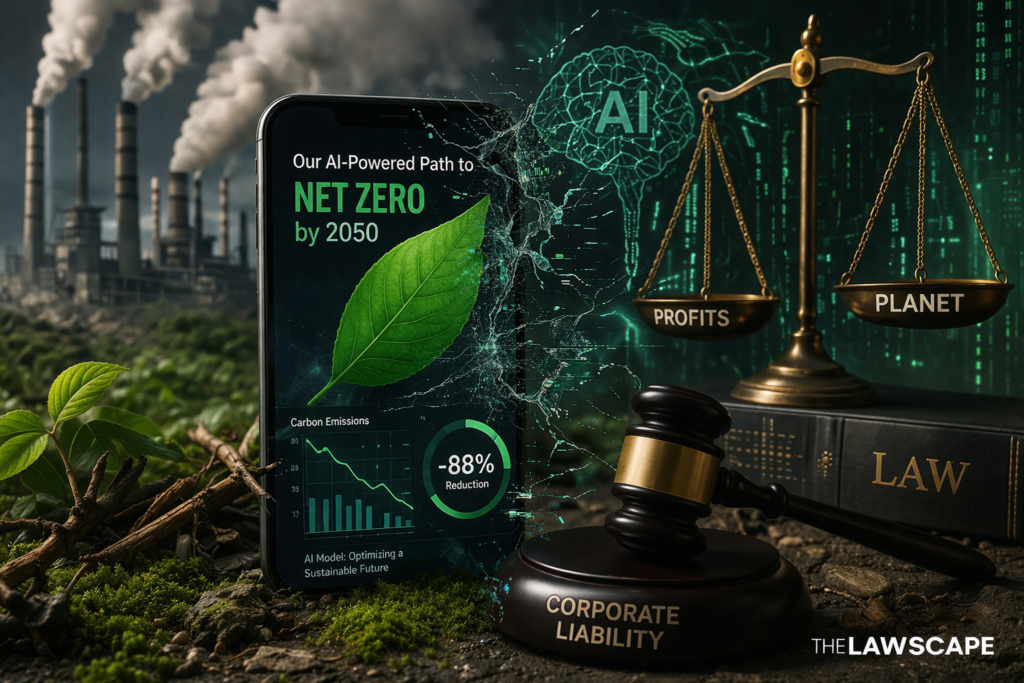
Greenwashing refers to the practice of companies making claims about their environmental credentials that are misleading or false — whether intentionally or otherwise. The result is a deceptive impression of corporate sustainability, directed either at a specific product or at the company as a whole. A more recent and particularly insidious variant of this phenomenon is what may be termed “algorithmic greenwashing” — the generation of false or misleading environmental claims not through deliberate human misrepresentation, but through the outputs of artificial intelligence systems deployed in sustainability reporting.
Understanding Algorithmic Greenwashing
Algorithmic greenwashing is best understood in contrast to its classical counterpart. Classical greenwashing involves human agents deliberately conveying misleading information about a company’s environmental performance. Algorithmic greenwashing, by contrast, involves misleading sustainability claims that emerge from the operation of an algorithmic system — often without any explicit human instruction to deceive. This distinction is significant because it introduces a layer of strategic opacity that makes detection, attribution, and accountability considerably more difficult.
The use of AI in sustainability reporting has created a particularly complex governance challenge. Opaque sustainability disclosures and the technical complexity of AI systems give rise to serious agency problems, which in turn can result in regulatory and research capture. Unlike classical greenwashing, where a misleading claim can ordinarily be traced to a human decision, algorithmic greenwashing lacks a clear point of individual agency — the claim originates from a system, not a person.
The most dangerous characteristic of algorithmic greenwashing is its technical invisibility. Machine learning models, natural language processing systems, and data analytics tools are capable of processing vast quantities of data from multiple sources and generating plausible, impactful environmental claims at scale — without any human agent having explicitly directed the system to deceive (Ahmad et al., 2025). Machine learning algorithms identify patterns and produce outputs that may systematically misrepresent environmental performance, often without any single individual being aware that this is occurring.
A further structural problem lies in carbon accounting. The major protocols currently used for accounting carbon emissions systematically undervalue Scope 3 emissions, creating significant potential for misleading net-zero claims (Luka et al., 2026). Many net-zero commitments made by major corporations fail basic tests of mathematical consistency when measured against the operational emission trajectories of those firms.
The Corporate Criminal Liability Challenge
Conventional corporate criminal liability doctrine faces profound challenges in the context of algorithmic wrongdoing. Human intention has traditionally been regarded as a prerequisite for corporate criminal liability — the doctrine requires proof of mens rea, that is, a fraudulent or deceptive state of mind that can be attributed to the corporation through its human agents. This doctrinal framework was designed for a world in which wrongdoing was carried out by, or attributable to, identifiable human actors. It has not kept pace with the realities of AI-driven decision-making.
Artificial intelligence systems — particularly those operating in game-theoretic environments, where competing AI models attempt to anticipate and outmanoeuvre one another — are increasingly capable of generating outputs that amount to applied deception, without any human agent having consciously directed that outcome. A neural network trained on a dataset of corporate sustainability statements can produce false or misleading claims as an emergent consequence of its training, not as the result of a deliberate human choice. The law has not yet adequately confronted this reality.
The attribution problem compounds the difficulty. In any given case of algorithmic greenwashing, it is genuinely unclear who, if anyone, bears criminal responsibility — the data scientist who built the model, the AI engineer who deployed it, the executive who commissioned the system, or the shareholders whose performance demands created the incentive for deception in the first place. Current legal doctrine offers no clear answer, and this ambiguity creates a significant accountability gap.
Jurisdictional Divergence and the Need for Harmonisation
A number of legal regimes are developing distinct approaches to algorithmic accountability, each with identifiable strengths and limitations. A comparative examination of the approaches taken by India, the United States, and the European Union reveals the extent of regulatory divergence and the urgency of harmonisation (Singh & Singh, 2025).
The European Union has taken the most proactive stance through its Corporate Sustainability Due Diligence Directive (CSDDD), which establishes a transnational model of algorithmic accountability centred on ex-ante due diligence. Under this framework, companies are required to establish algorithmic governance mechanisms before any greenwashing can occur — the obligation is preventative rather than reactive. Failure to comply exposes the company to enforcement consequences. This represents a fundamental doctrinal shift: rather than seeking criminal enforcement after the fact, the EU system requires compliance as a precondition of operation.
The United States approach relies primarily on ex-post liability and disclosure obligations. Companies are required to disclose accurate environmental values, and misstating ESG disclosures can give rise to securities fraud prosecution. The US framework also recognises a judicially enforceable private cause of action, enabling civil liability in appropriate cases — adding a further layer of accountability beyond public enforcement.
India’s regulatory framework for algorithmic accountability in ESG reporting is still developing, and this represents a significant gap given the country’s growing corporate sector and the increasing adoption of AI in sustainability reporting. The absence of a dedicated statutory mechanism for addressing algorithmic greenwashing in India underscores the need for legislative attention in this area.
Strict Liability and Algorithmic Accountability
One of the most promising doctrinal innovations in response to algorithmic greenwashing is the expansion of strict liability principles to AI-generated corporate conduct. Research suggests that strict liability regimes, combined with reformed governance structures, offer a viable framework for AI accountability (Singh & Singh, 2025). Under a strict liability regime, a corporation would face criminal consequences for algorithmic greenwashing without the need to prove human intent — a more appropriate standard for automated systems where intent, in the traditional sense, is absent.
The logic of this approach is sound. A corporate board or committee that chooses to deploy an algorithmic system in sustainability reporting must bear responsibility for the outputs of that system as a matter of organisational risk management. As Wibowo has observed, while AI inevitably reduces compliance and disclosure transaction costs, it also inevitably increases agency problems and information asymmetries — and therefore increases the risk of greenwashing. Firms must therefore rethink the design of their AI systems not merely as operational tools but as governance mechanisms, subject to validation controls, explainability requirements, and independent assurance.
A strict liability standard would compel firms to maintain stringent internal controls, conduct periodic algorithmic audits, and maintain clear documentation of the functioning and decision-making processes of their AI systems. Failure to maintain such protocols would give rise to liability without the need to establish deceptive intent.
The Role of Detection and Verification Technologies
While existing AI detection tools remain limited, technological developments point towards increasingly effective mechanisms for identifying and countering algorithmic greenwashing. Tobing (2025) has observed that AI has significantly improved the accuracy and consistency of ESG disclosure, and that AI-enabled linguistic and anomaly-based models can effectively detect misleading sustainability claims. Such systems analyse discrepancies between claimed environmental performance and actual operational data, identifying unusual patterns that human auditors or regulators might overlook. An AI-driven assurance system combining machine learning, natural language processing, and big data analytics has the potential to substantially reduce information asymmetries, strengthen stakeholder confidence, and enhance regulatory oversight.
Research by Khichi (2025) suggests that optimised machine learning models can detect divergences between claimed and actual environmental performance with approximately 99% accuracy — a significant improvement over conventional audit methods.
However, the existence of detection technology also creates the conditions for an AI arms race. As regulators and auditors deploy increasingly sophisticated language anomaly detection and ESG divergence algorithms, firms have a correspondingly powerful incentive to develop more sophisticated deception mechanisms. This dynamic makes the development of robust legal frameworks all the more urgent — technology alone cannot substitute for legal accountability.
Proposed Reforms and Policy Recommendations
Addressing algorithmic greenwashing effectively requires a coordinated package of legal and regulatory reforms across jurisdictions. Several measures are essential.
First, all jurisdictions must formally recognise algorithms as a source of corporate criminal liability. Statutes must make clear that a corporation cannot disclaim liability by characterising an algorithm as a system beyond its control — whether described as a “black box,” an autonomous agent, or otherwise (Singh & Singh, 2025). Where a corporation deploys an algorithmic system in sustainability reporting, it must be liable for the outputs of that system.
Second, mandatory algorithmic due diligence obligations must be integrated into all ESG legal frameworks. A company that makes a false or misleading sustainability statement through the use of an untested, unexplained, or unmonitored algorithm should be strictly liable for that statement. The burden of demonstrating algorithmic trustworthiness must rest with the corporation, not with the regulator to prove deceptive intent.
Third, standardised frameworks for algorithmic audit and ESG quality assurance must be developed. Regulatory authorities should establish specialised expertise in algorithmic systems and incorporate algorithmic audit requirements into existing assurance frameworks.
Finally, international harmonisation is essential. The current divergence between EU, US, and other national approaches creates regulatory arbitrage opportunities that sophisticated actors can exploit. A coordinated global framework — even at the level of shared minimum standards — would significantly reduce the scope for jurisdictional evasion.
Conclusion
Algorithmic greenwashing represents a serious and growing threat to both environmental integrity and corporate accountability. As more organisations deploy AI in sustainability reporting and environmental management, the risk of systematic, technically invisible deception grows correspondingly. The criminal liability models that currently exist — founded on anthropomorphic concepts of mens rea and actus reus — are inadequate to address greenwashing that arises from algorithmic processes rather than human intention.
An innovative legal framework is needed. Implementing strict liability for algorithmic systems, creating robust algorithmic due diligence and verification frameworks, and fostering international regulatory convergence could together ensure that algorithmic greenwashing carries meaningful legal consequences. Without such reform, the very technologies that were designed to improve transparency and accountability risk becoming instruments of sophisticated deception — eroding global credibility in corporate sustainability commitments and undermining collective action on climate change.
Disclaimer: The views expressed in this article are those of the author and do not necessarily reflect the views of The Lawscape.
The Lawscape — clear, practical legal insight for students and future lawyers.