
Plea Bargaining in India: An Efficient Justice or Compromise to Due Process?
Author: Asra Siddiqui
Student, City Academy Law College, Lucknow University
————————————————————————————-
💡 3 Quick Takeaways
Plea bargaining was formally introduced into the Indian criminal justice system through the Criminal Law (Amendment) Act, 2005, adding Chapter XXIA to the CrPC, 1973 — a significant shift from the Supreme Court’s earlier position that the practice was unconstitutional.
The Bharatiya Nagarik Suraksha Sanhita, 2023 has restructured and strengthened the plea bargaining framework, introducing fixed timelines, enhanced benefits for first-time offenders, and a more structured negotiation process.
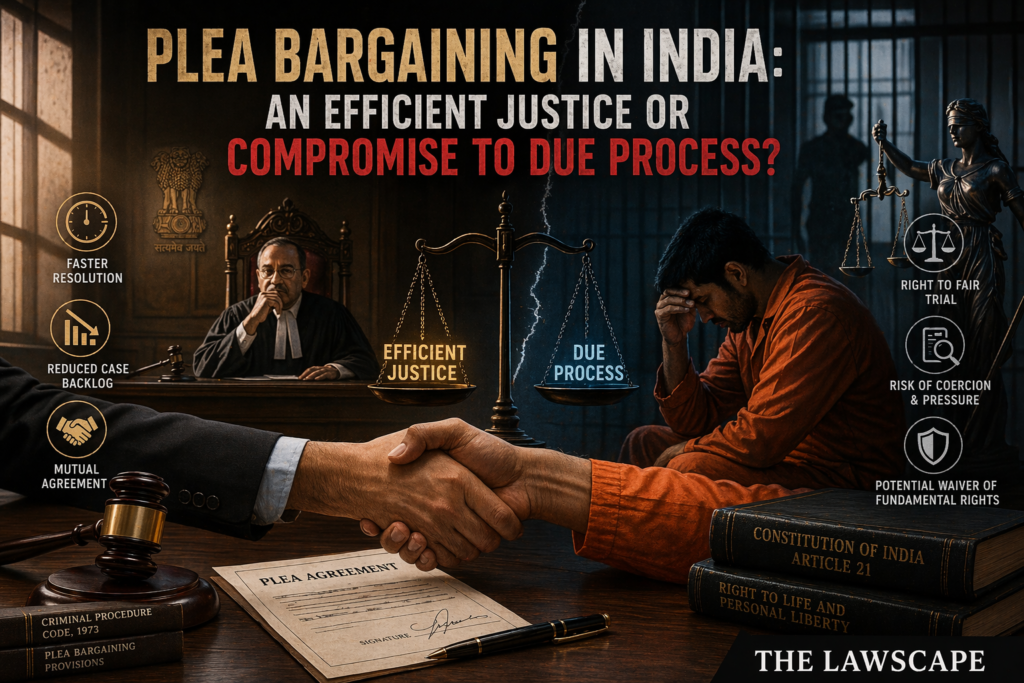
While plea bargaining offers meaningful relief to an overburdened judiciary and to undertrial prisoners, it carries serious risks of coercion, erosion of deterrence, and inequality — demanding careful judicial oversight to ensure that efficiency does not come at the cost of fairness.
Abstract
The Indian judiciary faces a persistent backlog of cases, where the institution rate of suits consistently outstrips the disposal rate. For judicial efficiency and to ensure the expeditious resolution of cases, Parliament introduced the concept of plea bargaining through the Criminal Law (Amendment) Act, 2005. While this was introduced with the intention of fostering positive change, critics have highlighted significant downsides. This article examines the concept of plea bargaining in India — its meaning, its legislative journey, its advantages, and the critical challenges it poses. It traces how plea bargaining was initially rejected by the Supreme Court and subsequently introduced into the Indian legal system, and discusses how the criminal law reforms of 2023 have modified and reinforced the concept. Despite its potential to reduce case backlogs and conserve judicial resources, plea bargaining remains underutilised in India and requires significant reform.
Keywords: Plea bargaining, case backlogs, criminal procedure, criminal justice, Law Commission.
Introduction
As of today, nearly five crore cases remain pending in Indian courts, awaiting hearing, trial, and just decision. There is an urgent need for mechanisms and tools that can alleviate systemic backlog and expedite case resolution. Plea bargaining is one such tool.
Plea bargaining may be understood as a pre-trial negotiation process in which the defendant agrees to plead guilty to a charge — often a lesser one — in exchange for concessions from the prosecutor, such as a reduced sentence or the dismissal of other charges. In India, plea bargaining has been introduced as a mechanism to ease the burden on a judiciary already strained by an enormous volume of pending cases, and to address the wretched conditions faced by undertrial prisoners who often spend more time in custody than the maximum sentence for the offence they are alleged to have committed.
Critics of the system, however, contend that plea bargaining leads to excessive leniency in sentencing and undermines the core deterrent objective of criminal law. If offenders believe that by pleading guilty they can significantly reduce their punishment, the fear of legal consequences diminishes — potentially encouraging recidivism. The waiver of the right to trial in exchange for sentencing concessions also remains one of the most debated criticisms of the practice. This article examines both dimensions, arguing that while plea bargaining has emerged as a pivotal mechanism in contemporary Indian criminal justice, it also raises critical challenges that demand careful legal attention.
Meaning and Concept of Plea Bargaining
Black’s Law Dictionary defines plea bargaining as “a negotiated agreement between a prosecutor and a criminal defendant in which the defendant pleads guilty to a lesser offence or to one of multiple charges in exchange for some concession by the prosecutor, usually a more lenient sentence or the dismissal of the negotiated charges.”
In essence, plea bargaining is an agreement arrived at through active negotiation between the prosecution and the defence, by which a criminal case is resolved without a full and lengthy trial. The accused pleads guilty or confesses their wrongful act before the court in exchange for a lighter punishment than would otherwise be imposed. Given the daily volume of cases instituted in Indian courts, plea bargaining serves as a mechanism for quick disposal and early resolution of matters — a progressive legislative intervention aimed at easing pressure on the trial courts.
In the United States, plea bargaining is the primary method by which approximately ninety to ninety-five percent of criminal cases are resolved, rather than through jury trials. The core requirement of a valid plea bargain is the free and voluntary consent of the accused to plead guilty, and the presiding judge is legally obligated to satisfy themselves that the consent is given willingly and without coercion.
Plea bargaining in India takes three forms: charge bargaining, sentence bargaining, and fact bargaining. While each form offers a different strategic path, all three aim to balance the need for speedy disposal of matters with the demands of equitable justice.
Plea Bargaining in India: Historical Development
Before the Criminal Law (Amendment) Act, 2005
The concept of plea bargaining is not indigenous to the Indian legal tradition. Before 2005, Indian courts consistently rejected it, holding that the practice was contrary to law and potentially unconstitutional.
The earliest significant instance of judicial rejection is Madanlal Ramachander Daga v. State of Maharashtra (AIR 1968 SC 1267), in which the Supreme Court held that plea bargaining is wrong in the eyes of law. The Court acknowledged that a lesser punishment than the maximum prescribed may be imposed in appropriate circumstances, but held that it is not proper for the court to bargain with the accused. Subsequently, in Thippaswamy v. State of Karnataka (AIR 1983 SC 747), the Supreme Court held that where an accused is persuaded to plead guilty on the assurance of a lighter sentence, only for the sentence to be enhanced on appeal or revision, such a practice violates Article 21 of the Constitution of India.
The formal proposal for introducing plea bargaining was made in the 142nd Report of the Law Commission of India (1991), which noted the unavailability of reliable data on undertrial prisoners, highlighted instances where accused persons had spent time in custody exceeding the maximum sentence for the alleged offence, and emphasised the urgent need for a structured mechanism to address these concerns. The Malimath Committee Report (2003) further recommended reform of the criminal justice system, though the plea bargaining provisions ultimately enacted in 2005 did not fully reflect either set of recommendations.
The Criminal Law (Amendment) Act, 2005
Plea bargaining was formally introduced into the Indian criminal justice system through the Criminal Law (Amendment) Act, 2005, which added Chapter XXIA — comprising Sections 265A to 265L — to the Code of Criminal Procedure, 1973. The new chapter established a legislative framework for plea bargaining, limited to offences punishable with imprisonment of up to seven years, and expressly excluded offences affecting the socio-economic conditions of the country and offences committed against women and children.
The Bharatiya Nagarik Suraksha Sanhita, 2023
In 2023, Parliament repealed the Code of Criminal Procedure, 1973 and replaced it with the Bharatiya Nagarik Suraksha Sanhita, 2023 (BNSS). The plea bargaining framework, previously housed in Chapter XXIA (Sections 265A–265L) of the CrPC, was re-enacted under Chapter 23 (Sections 289–300) of the BNSS.
The BNSS introduced several significant changes. Under the CrPC, there was no fixed timeline for a defendant to file an application for plea bargaining. The BNSS now fixes this at thirty days from the date of framing of charges. Similarly, the negotiation phase must now be completed within a maximum of sixty days — a limit that did not exist under the CrPC. First-time offenders receive additional benefits under the BNSS framework. These reforms have made the plea bargaining process more structured, time-bound, and rehabilitative in orientation, reaffirming the validity of the concept within the reformed criminal law architecture of India.
Plea Bargaining as a Tool for Justice
Plea bargaining serves as a vital instrument for judicial efficiency, enabling the justice system to allocate its limited resources more effectively by resolving less serious cases expeditiously and directing greater attention to complex and critical matters.
In India, where an overwhelming volume of pending cases threatens to paralyse the judiciary, plea bargaining has emerged not merely as a procedural shortcut but as a cornerstone of judicial reform. It provides a mechanism for quick and fair resolution through negotiated settlement, rather than subjecting parties to the delays and costs of a full trial. As emphasised repeatedly in Law Commission reports, there was a dire need for solutions to address the backlog of criminal cases in India — plea bargaining was conceived as an effective strategy to ease the burden on courts, conserve judicial time, and facilitate restorative justice.
For undertrial prisoners — who have often spent more time in custody awaiting trial than the maximum sentence for their alleged offence — plea bargaining operates as a critical safety valve, offering a path to resolution and release. The BNSS 2023 further enhances relief for first-time offenders who fall within the eligibility criteria: courts may award one-fourth of the prescribed sentence where a minimum sentence is fixed by law, and one-sixth of the maximum sentence where only an extendable punishment is prescribed. Additionally, by avoiding prolonged trials, plea bargaining substantially reduces the financial burden on all parties — eliminating costs associated with investigation, witness testimony, expert evidence, and extensive legal representation.
Critical Analysis and Challenges
Plea bargaining is, in many ways, two sides of the same coin. While introduced with positive intent, the concept carries significant risks that critics have consistently highlighted.
The most fundamental concern relates to deterrence. Where an accused receives a substantially reduced punishment through plea bargaining, the law’s incapacitative and deterrent effects are weakened. If potential offenders believe that committing a crime can be followed by a negotiated reduction in punishment, the fear of legal consequences diminishes — with the attendant risk of increased recidivism and crime rates.
A second and equally serious concern is the voluntariness of consent. The core requirement of plea bargaining is that the accused must freely and voluntarily agree to plead guilty. In practice, however, this voluntariness is frequently compromised. Prosecutors may exert pressure on defendants to secure a conviction and avoid the uncertainty of trial. Police may intimidate defendants into pleading guilty to avoid custodial mistreatment. Where consent is vitiated by such pressures, the foundational requirement of plea bargaining is undermined.
Plea bargaining also raises concerns about equality before the law. Effective plea negotiation demands strong legal representation and strategic preparation by defence counsel. Accused persons who are poor or otherwise unable to secure competent legal assistance are placed at a significant disadvantage, raising questions about whether plea bargaining delivers equitable outcomes across different sections of society.
Finally, by pleading guilty, the accused waives their right to a full and fair trial — a fundamental procedural protection that lies at the heart of the criminal justice system. This waiver, extracted in exchange for sentencing concessions, has been criticised as compromising the due process guarantees to which every accused person is entitled.
Conclusion
Plea bargaining in India functions as a pragmatic instrument in the service of the justice system’s core objectives — speed, efficiency, and the resolution of an overwhelming backlog of cases. It cannot, however, be characterised as an unqualified benefit. It carries significant risks of coercion, erosion of deterrence, inequality of outcomes, and the waiver of fundamental trial rights. To navigate these complexities, the system must strike a careful balance between procedural efficiency and the substantive protection of defendants’ rights, ensuring that fairness and the objectives of criminal justice are never sacrificed at the altar of expediency.
The BNSS 2023 has taken meaningful steps towards making plea bargaining more structured and rehabilitative. But the concept remains underutilised in India, and further reform — particularly in safeguarding voluntariness, ensuring equal access to legal representation, and maintaining robust judicial oversight — is essential. Plea bargaining must neither be subverted by coercion nor leveraged to secure unjustified advantages. Used with care, it can be a powerful tool for justice; used carelessly, it risks becoming an instrument of its very opposite.
Disclaimer: The views expressed in this article are those of the author and do not necessarily reflect the views of The Lawscape.
The Lawscape — clear, practical legal insight for students and future lawyers.