
The Intersection of Law, Gender, and Political Power Dynamics
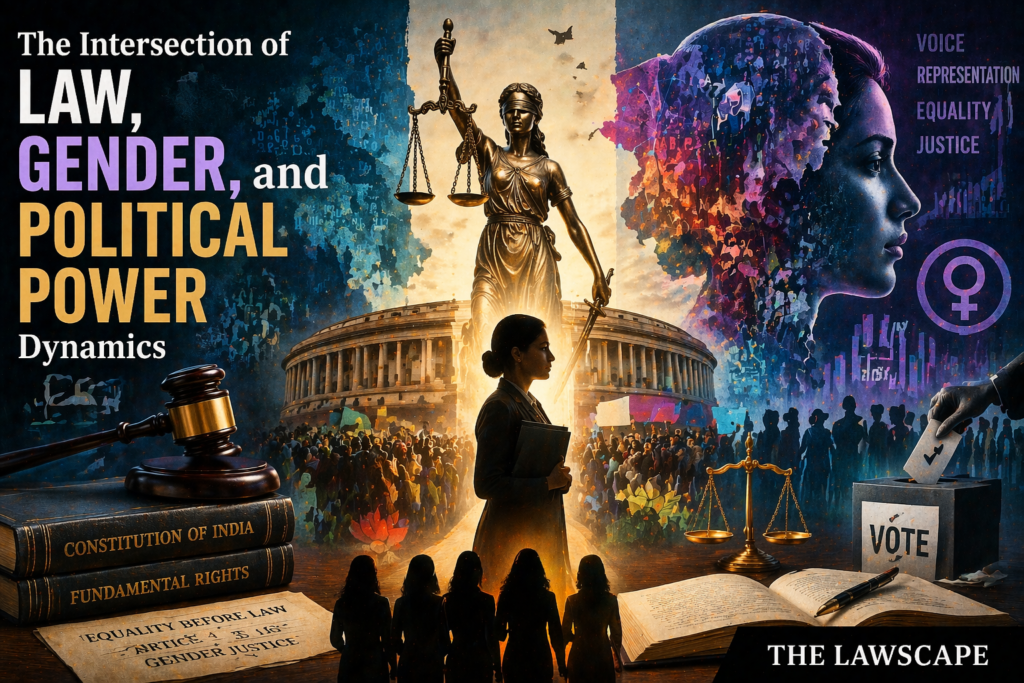
Author: Soham Tanaji Bhosale
Student, KES Shri Jayantilal H Patel Law College
————————————————————————————-
💡 3 Quick Takeaways
Law is not a neutral arbiter of justice — it is a social construct that reflects the power structures of the society in which it operates, and historically those structures have been deeply patriarchal.
Legislative reform alone is insufficient for achieving gender justice; without a concurrent transformation in political representation and the power dynamics behind law-making, progressive statutes risk remaining symbolic rather than substantive.
A truly equitable legal system must account for intersectionality — recognising that gender discrimination compounds with race, class, caste, and sexuality to produce layered and distinct forms of marginalisation that a monolithic legal approach cannot address.
Abstract
This paper provides a comprehensive examination of the intricate relationship between legal frameworks, gender constructs, and the dynamics of political power. It posits that law is not a neutral arbiter of justice but rather a reflection of the societal power structures in which it operates. By analysing historical and contemporary legal paradigms through the lenses of feminist legal theory — specifically the works of Catharine MacKinnon and Kimberlé Crenshaw — this study explores how legal systems have institutionalised gender inequalities. The analysis traces the trajectory of legal reforms from the patriarchal codification of property and personhood to the modern era of anti-discrimination statutes and international conventions such as CEDAW. The paper argues, however, that legislative reform alone is insufficient without a concurrent transformation in political representation. It highlights the critical “implementation gap” that persists despite progressive laws, emphasising that true gender justice requires equitable political participation to ensure that laws effectively address systemic biases. The study concludes that sustainable equity demands not only the creation of fair laws but also the dismantling of the patriarchal political structures that shape them.
Keywords: Law, Gender, Political Power, Patriarchy, Feminist Legal Theory, Representation, CEDAW.
Introduction
“The Constitution is a feminist document… it embodies the aspiration to break the shackles of patriarchy and build a society based on equal dignity.”¹ This profound assertion by Justice D.Y. Chandrachud captures the transformative potential of constitutional law. It also serves as a stark counterpoint to the historical reality of legal systems worldwide. For centuries, the law was not a tool of liberation for women and gender minorities — it was an instrument of subjugation. The relationship between law and gender is deeply rooted in the structures of power and society, revealing a complex dynamic where legal authority has historically mirrored the prevailing hierarchies of the time.
To understand the current struggle for gender justice, one must recognise that law is rarely, if ever, neutral. It is a social construct that codifies the values of those who wield power. Historically, this meant that legal systems were designed by men, for men, effectively treating women as legal minors or dependents. While the twentieth and twenty-first centuries have witnessed significant legal advancements — from suffrage to reproductive rights — the foundational biases embedded in legal institutions persist.
This paper explores the multifaceted connection between law, gender, and political power. It argues that while legal reforms are necessary, they are inherently limited by the political contexts in which they are created. As scholar and activist Kimberlé Crenshaw has observed, when those in power write the rules, those rules tend to reinforce the existing hierarchies. Achieving genuine equality therefore requires a dual approach: reforming the law to dismantle explicit discrimination, and transforming the political landscape to ensure inclusive representation. Without addressing the power dynamics that underlie the law, justice remains aspirational rather than actualised.
I. The Patriarchal Foundations of Legal Systems
The relationship between law and gender cannot be understood without acknowledging the historical institutionalisation of patriarchy. Legal systems have long served as the mechanism through which gender inequalities were formalised and enforced. For much of recorded history, the law explicitly denied women legal agency, treating them as chattels or as extensions of their husbands and fathers.
Catharine MacKinnon provided a seminal critique of this dynamic, observing that “the law sees and treats women the way men see and treat women.”³ This perspective highlights that the ostensibly “objective” standard of the law is frequently a male standard. When laws were written regarding property ownership, contract rights, or criminal justice, they reflected the male experience and perspective, rendering women’s realities invisible or illegitimate. The common law doctrine of coverture — by which a woman’s legal rights were subsumed under her husband’s upon marriage — was not merely a social custom; it was the law. It restricted women’s access to political participation, economic independence, and personal autonomy.
These laws were not accidental. They reflected societal biases that regarded women as intellectually and physically inferior to men. By codifying these biases, the law lent them an aura of legitimacy and permanence. Even as societies began to modernise, the legal system remained a conservative force, often resisting calls for gender equality. The resistance was not merely to the idea of equality, but to the redistribution of power that equality implied. The law thus functioned as a gatekeeper — preserving the privileges of the dominant gender while restricting the rights of the marginalised.
II. Political Power and the Formulation of Gender Laws
The formulation of law is inextricably linked to political power. Who gets to make the laws determines whose interests those laws serve. Male-dominated political institutions have historically created and enforced laws that reinforced patriarchal structures, often under the guise of protection or tradition.
Political power influences gender laws in three primary ways: exclusion, tokenism, and co-optation. Exclusion occurs when women and gender minorities are entirely absent from legislative bodies, producing a legislative agenda that ignores issues specific to women — such as domestic violence, sexual harassment, and maternity rights. For decades, these issues were treated as “private matters” outside the scope of legal regulation, largely because the men writing the laws did not experience them.
Even when women are included in political processes, their influence is frequently minimised through tokenism. Token representation allows political institutions to claim inclusivity while maintaining the status quo. Laws may be passed that appear progressive on the surface but lack the enforcement mechanisms or funding to be effective — producing “formal equality,” equality on paper, without “substantive equality,” where the lived realities of women actually change.
Third, political power can be deployed to co-opt feminist language in service of conservative goals. Laws restricting reproductive rights, for instance, are often framed as “protecting” women — a paternalistic narrative that strips women of their autonomy and illustrates how legal language can be manipulated to serve the interests of dominant groups. The effectiveness of legal reforms therefore depends heavily on the political will behind them. True progress in gender law requires more than changing statutes; it requires a fundamental shift in the power dynamics of the institutions that create them.
III. The Trajectory of Progress: From Reform to Implementation
Despite the entrenched nature of patriarchal power, substantial progress has been achieved in advancing gender equality through legal reform. The last century has seen a global movement towards dismantling legal barriers — laws prohibiting discrimination in employment and education, ensuring equal pay for equal work, and criminalising gender-based violence have been enacted across many jurisdictions. These reforms were not achieved in a vacuum; they were the product of decades of activism by women’s movements and civil society organisations.
International law has played a pivotal role in this progress. The Convention on the Elimination of All Forms of Discrimination Against Women (CEDAW), often described as the international bill of rights for women, has established a comprehensive standard for gender equality. By ratifying CEDAW, nations commit to enacting measures to end discrimination — yet the gap between international commitments and domestic enforcement remains wide.
Educational and employment opportunities for women have expanded significantly, contributing to broader societal change. Women are entering professions that were once closed to them, challenging entrenched stereotypes and reshaping the workforce. However, these advancements are uneven. In many jurisdictions, laws designed to protect women are poorly enforced due to inadequate judicial training, institutional corruption, or pervasive societal stigma. Domestic violence may be illegal, yet police may refuse to file reports, treating it as a private family matter. Equal pay laws may exist, yet the gender pay gap persists due to structural barriers such as the “motherhood penalty” and occupational segregation.
This disparity highlights the limitations of legal reform in isolation. A law is only as effective as its enforcement. Without sustained political will and institutional reform, laws remain symbolic. The persistence of systemic barriers underscores the need for a more holistic approach to gender justice — one that addresses the cultural and economic roots of inequality alongside the legal ones.
IV. The Imperative of Political Representation for Gender Justice
The connection between representation and policy priorities explains why political representation is indispensable to gender justice. When women and gender minorities hold decision-making positions, issues previously dismissed as peripheral gain prominence on the national agenda. Studies have shown that increased female representation in legislatures correlates with the passage of more progressive laws concerning health, education, and welfare. When women are at the table, matters such as gender-based violence, reproductive rights, and economic inequality receive greater attention and more effective legislative responses.
This is not to suggest that all women politicians hold feminist views. Rather, the diversity of perspective that meaningful representation brings inherently challenges the homogeneity of male-dominated governance. Representation challenges entrenched power structures and promotes more inclusive policy-making. It shifts the narrative from women as passive recipients of law to women as active authors of it. Without meaningful participation, laws risk reflecting only the interests of dominant groups, perpetuating a cycle of marginalisation.
The symbolism of representation is equally significant. Seeing women and gender minorities in positions of power disrupts the socialisation that associates authority with masculinity. It normalises the idea of women as leaders and agents of change, inspiring future generations and shifting cultural expectations. Political representation is therefore both a mechanism for policy reform and a tool for cultural transformation — the two are inseparable in the pursuit of genuine gender justice.
V. The Intersectionality of Law and Power
A comprehensive analysis of law and gender must also account for intersectionality — the way in which gender intersects with other axes of identity such as race, class, caste, and sexuality. Kimberlé Crenshaw’s foundational work on intersectionality reveals that the law frequently fails women who belong to marginalised communities because it treats gender as a monolithic category, ignoring the compounding effects of multiple, overlapping forms of discrimination.
A law designed to address sexual harassment in the workplace may protect middle-class women in formal corporate settings while failing entirely to protect women in the informal economy, or migrant domestic workers whose vulnerabilities are compounded by immigration status and class. The political power dynamics that exclude women from governance also disproportionately exclude women of colour, poor women, and queer individuals — ensuring that the laws produced by such systems reflect an even narrower range of experience.
The struggle for gender justice must therefore be inclusive in both its vision and its practice. It requires a legal system that recognises and responds to multiple, layered forms of discrimination, and a political landscape that amplifies the voices of the most marginalised rather than the most represented. Inclusive political representation ensures that the law does not merely protect a privileged subset of women but addresses the needs and experiences of all genders in their full complexity.
Conclusion
The intersection of law, gender, and political power dynamics captures the ongoing and unfinished struggle for genuine equality. Historically, laws reinforced gender hierarchies, institutionalising the subordination of women under the guise of tradition and social order. The tireless efforts of activists and scholars have driven legal reforms and expanded political representation, opening meaningful pathways towards justice. Yet progress remains uneven. Systemic biases and enforcement gaps persist, reminding us that the law is a contested terrain — and that the transition from patriarchal legal norms to equitable ones is neither linear nor inevitable. It faces constant resistance from those invested in maintaining the status quo.
Achieving genuine gender equality requires not only the creation of fair laws but also the transformation of the political structures that determine how those laws are made, interpreted, and enforced. As Justice Chandrachud affirmed, the aspiration of the constitutional framework must be to break the shackles of patriarchy. This can only be realised through sustained political will, institutional reform, and active participation from all genders. Only by democratising political power can we build a legal system that truly embodies equal dignity for all — a system in which the law is not an end in itself, but a means to a society where power is shared, and justice is not merely a legal ideal, but a lived reality.
Disclaimer: The views expressed in this article are those of the author and do not necessarily reflect the views of The Lawscape.
The Lawscape — clear, practical legal insight for students and future lawyers.