
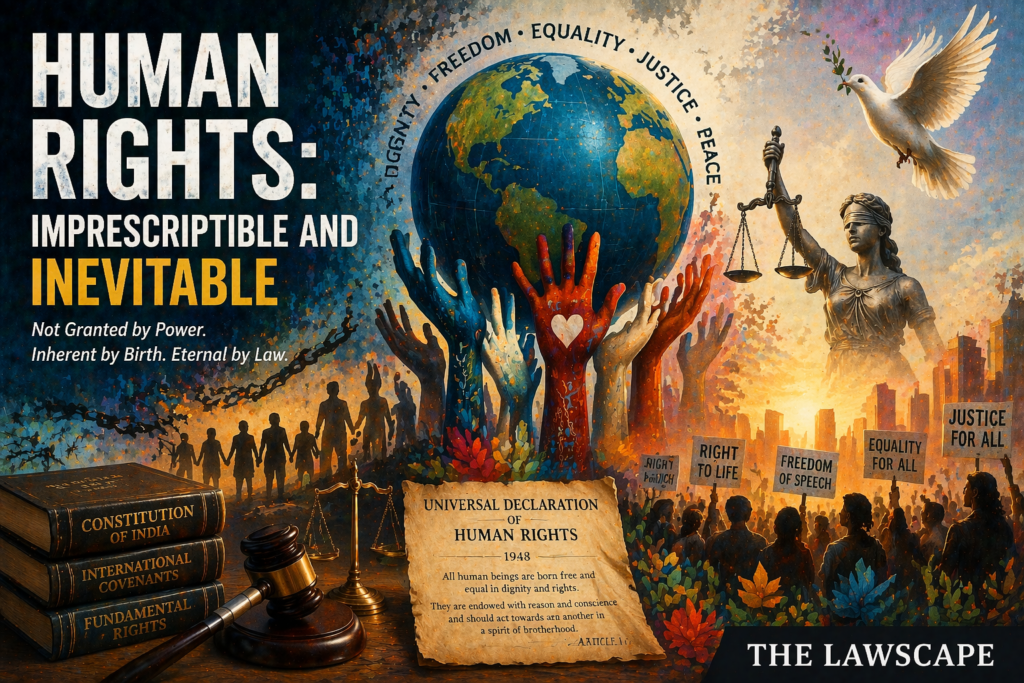
Human Rights: Imprescriptible and Inevitable
Author: Vishnupriya Arvind Shukla
Student, KES Shri Jayantilal H Patel Law College
————————————————————————————-
💡 3 Quick Takeaways
International human rights law, anchored by the UDHR, ICCPR, and ICESCR, establishes a universal framework of rights that are inherent to every individual by virtue of their humanity — rights that no state can legitimately extinguish or deny.
The international community has adopted specific conventions to address and eradicate inhuman acts such as genocide and apartheid, reflecting the global consensus that certain violations of human dignity constitute crimes under international law.
Vulnerable groups — including women, children, ethnic minorities, refugees, persons with disabilities, and the LGBTQ+ community — continue to face systemic barriers to the enjoyment of their rights, demanding inclusive legal frameworks and sustained political will to bridge the gap between law and lived reality.
Abstract
International Human Rights Law (IHRL) constitutes a foundational framework designed to secure the fundamental rights and freedoms of every individual across the globe. In the aftermath of World War II, IHRL emerged as a response to the urgent need for a universal standard safeguarding human dignity. Foundational instruments such as the Universal Declaration of Human Rights (UDHR), adopted in 1948, laid the groundwork for subsequent treaties and conventions addressing civil, political, economic, social, and cultural rights. While the UDHR is not legally binding on member states, it carries immense moral authority and remains one of the foremost achievements of the United Nations in the field of human rights. The International Covenant on Civil and Political Rights (ICCPR) and the International Covenant on Economic, Social and Cultural Rights (ICESCR), adopted in 1966, gave legal force to the rights articulated in the UDHR. Together, these instruments form the International Bill of Rights. This article examines the architecture of international human rights law, the major covenants and conventions that give it substance, its application to vulnerable groups, and the enduring relevance of human rights as both imprescriptible and inevitable.
Keywords: Human Rights, UDHR, ICCPR, ICESCR, International Human Rights Law, Vulnerable Groups, Genocide, Apartheid, CEDAW.
Introduction
Human rights are the inalienable rights of every person, regardless of their race, sex, nationality, religion, language, or any other status. The word “right” refers to the freedom or entitlement of a person that the law recognises and protects. The legacy of the Magna Carta can be seen in the earliest human rights documents — its overreaching theme was the protection of individuals against arbitrary acts by the sovereign, and it introduced the concept of trial by jury in Clause 39.
There are three broad categories of rights: natural rights, fundamental rights, and human rights. Natural rights, propounded by John Locke, are those considered inherent to human beings — such as the right to life, liberty, and property. Fundamental rights are those enshrined in the constitution of a particular country, indivisible in nature and guaranteed by domestic law. Human rights, by contrast, are universal — they are grounded in international law and apply to all people everywhere, irrespective of the country in which they reside.
Human rights serve to ensure justice and protect individuals across a wide range of aspects of life, ensuring that every person is treated with dignity and fairness. The UDHR enumerates thirty specific human rights — including the right to life, the right to equality, the right to education, and freedom from torture and slavery. The characteristics of human rights include their inherent nature, universality, protection against abuse, and their capacity for progressive development as societies evolve. There are five principal categories of human rights: civil rights, political rights, economic rights, social rights, and cultural rights. Civil rights ensure personal freedom and protection — such as the right to life, the right to privacy, and freedom of speech. Political rights concern participation in government and political processes — such as the right to vote and the right to nationality. Economic rights support a healthy and fulfilling life — such as the right to work, the right to own property, and the right to social security. Social rights contribute to the smooth functioning of society — such as the right to education, the right to marry, and the right to health. Cultural rights acknowledge the importance of cultural identity — such as the right to practise one’s culture and to preserve and celebrate one’s cultural heritage.
International Human Rights Law
Human rights are international and universal, applying to all individuals. However, when a state fails to ensure the realisation of human rights to individuals within its jurisdiction, international obligations arise. The obligation to provide human rights is primarily a domestic one, but in certain circumstances it becomes international in character.
In 1946, the United Nations Commission on Human Rights was constituted to draft an International Bill of Rights, with the aim of enforcing human rights globally and giving them universal recognition. The drafting committee consisted of representatives from eight countries and was chaired by Eleanor Roosevelt. All six principal organs of the United Nations — the General Assembly, the Security Council, the Economic and Social Council, the Trusteeship Council, the International Court of Justice, and the Secretariat — make effective contributions to the promotion and protection of human rights and fundamental freedoms throughout the world. Four specialised agencies — the International Labour Organization, the United Nations Educational, Scientific and Cultural Organization (UNESCO), the World Health Organization (WHO), and the Food and Agriculture Organization (FAO) — carry out activities in the field of human rights. Seven monitoring committees were also established to supervise the implementation of multilateral treaties aimed at ensuring the enjoyment of human rights and fundamental freedoms without distinction.
The Universal Declaration of Human Rights was adopted on 10th December 1948 by 48 votes with eight abstentions. It was proclaimed as “a common standard of achievement for all peoples and all nations.” The UDHR consists of 30 articles covering economic, social, civil, and political rights. The idea for the protection of human rights at the international level was first conceived in the Atlantic Charter of 1941 and the Declaration of the United Nations of 1942. When the founders of the United Nations convened at the San Francisco Conference in 1945 to draft the UN Charter, Latin American states sought to place an international Bill of Human Rights on the agenda. The Charter affirmed the determination of member states to reaffirm faith in fundamental human rights but did not define them.
The initiative for the drafting of an international bill of human rights was taken by Panama, which submitted a draft to the General Assembly at its first session in 1946. The General Assembly referred the draft to two of its committees — the First Committee on Political and Security matters, and the Third Committee on Social, Humanitarian and Cultural matters. The Commission on Human Rights was made responsible for the preparation of the International Bill of Human Rights. In January 1947, the Commission appointed a Drafting Committee, which prepared two sets of documents: first, draft articles in the form of a declaration setting forth general principles and standards; and second, draft articles in the form of a convention defining specific rights and the limitations that may be placed upon them. The Commission, at its second session from 2 to 17 December 1947, established three working groups — one on the declaration, one on the covenant, and one on implementation — and through these working groups prepared the draft instruments that were eventually transmitted to the General Assembly.
The concluding provisions of the UDHR, under Articles 29 and 30, lay down certain limitations on the rights and freedoms declared. Article 29(2) provides that rights are subject to the just requirements of morality, public order, and the general welfare in a democratic society — confirming that the rights declared are not absolute. Article 30 makes clear that nothing in the Declaration may be interpreted as implying any right for any state, group, or person to engage in any activity aimed at the destruction of any of the rights and freedoms set forth therein.
The influence of the UDHR has been profound, both internationally and domestically. While at the time of its adoption it was agreed that it would not impose legal obligations on states, many of its provisions have since come to be regarded as reflecting customary international law — including the right to equality, the prohibition against slavery, the prohibition against torture, and the prohibition against arbitrary arrest and detention — and are therefore binding on all states.
International Covenant on Human Rights
The UDHR inspired a number of declarations and international conventions concluded under the auspices of the United Nations and its specialised agencies. The most prominent among them are the International Covenant on Civil and Political Rights, 1966 (ICCPR) and the International Covenant on Economic, Social and Cultural Rights, 1966 (ICESCR). Together with the UDHR, these two covenants constitute the International Bill of Rights.
The International Covenant on Civil and Political Rights (ICCPR)
Human rights are sometimes classified by generation. The rights contained in the ICCPR are considered first-generation rights — civil and political rights that developed since the classical period and were concretised in documents such as the Magna Carta. The rights in the ICESCR constitute second-generation rights. Third-generation rights are collective rights, such as the right to self-determination and the right to development.
The ICCPR consists of 53 Articles divided into six parts. Parts I, II, and III (Articles 1 to 27) deal with the substantive rights and freedoms guaranteed under the covenant. The remaining parts deal with implementation procedures. Part I, containing Article 1, affirms the right of all peoples to self-determination. Part II (Articles 2 to 5) deals with the obligations of state parties, including the obligation to incorporate covenant provisions into domestic law and to ensure equality between men and women in the enjoyment of civil and political rights. Part III (Articles 6 to 27) sets out the specific rights of individuals and the obligations of state parties in relation to them.
The rights under the ICCPR are not absolute and are subject to limitations necessary to protect national security, public order, public health, morality, or the rights and freedoms of others. Article 4 makes provision for public emergencies that threaten the life of the nation, permitting states to derogate from certain covenant obligations to the extent strictly required by the exigency of the situation. However, Article 4(2) provides that certain rights are non-derogable under any circumstances — these include the right to life (Article 6), freedom from inhuman or degrading treatment (Article 7), freedom from slavery and the slave trade (Article 8(1)), and freedom from servitude (Article 8(2)). These have been identified as the core of essential human rights.
Unlike the UDHR, the ICCPR is legally enforceable. Signatory states are bound by the Articles of the covenant, and violations are subject to investigation and accountability. Articles 40 and 41 set out the mechanism for state reporting and the procedure for interstate complaints.
The International Covenant on Economic, Social and Cultural Rights (ICESCR)
The ICESCR came into force on 3rd March 1976, and as of 2019 had 173 signatory states. It consists of 30 Articles divided into five parts, and deals primarily with rights such as the right to education, the right to an adequate standard of living, and labour rights. Several rights under the ICESCR closely mirror provisions of the Indian Constitution, including equal pay for equal work (Article 7(a)(i)), safe and humane conditions of work (Article 7(b)), maternity relief (Article 10(2)), the right to work (Article 6(1)), opportunities for children (Article 10(3)), and compulsory education for children (Article 13(2)(a)).
International Conventions on Inhuman Acts
The UN Charter expressed the desirability of promoting and encouraging respect for human rights and fundamental freedoms without distinction as to race, sex, language, or religion. In furtherance of this commitment, the international community has adopted conventions specifically aimed at eradicating certain inhuman acts — including genocide, apartheid, slavery, forced labour, torture, and trafficking in persons.
Genocide
The term “genocide” is derived from the Greek word genos, meaning race or people, and the Latin word cide, meaning killing. In its simplest sense, it refers to the killing of a group of human beings on account of their collective identity. The Convention on the Prevention and Punishment of the Crime of Genocide was adopted by the General Assembly on 9th December 1948 and came into force on 12th January 1951. As of June 2000, it had 130 state parties.
Article 1 of the Convention defines genocide as an international crime, irrespective of whether it is committed in time of war or peace. Article 2 enumerates specific acts that may be classified as genocidal. The UN General Assembly, by Resolution 96(I) of 11th December 1946, unanimously declared that genocide is a crime under international law. The Convention provides punishment not only for the commission of genocide but also for conspiracy to commit genocide, direct and public incitement, attempt, and complicity. Article IV provides that persons committing genocide shall be tried by a competent tribunal of the state in whose territory the act was committed, or by such international penal tribunal as may have jurisdiction. Where a perpetrator flees to another state, the contracting parties undertake to grant extradition in accordance with their domestic laws and treaty obligations.
Apartheid
The word “apartheid” is an Afrikaans term meaning “separateness” or “separation.” It refers to the institutionalised system of racial segregation and discrimination that was formally implemented in South Africa by the National Party government from 1948. The system enforced the separation of people on the basis of race, restricting the rights, movement, and opportunities of non-white South Africans through law. The United Nations condemned apartheid in 1966 as a crime against humanity. The UDHR had affirmed that all human beings are born free and equal in dignity and rights — a principle that apartheid directly and systematically violated. The international community’s sustained opposition to apartheid ultimately contributed to its dismantling and to South Africa’s transition to democratic governance in 1994.
Human Rights Law and Vulnerable Groups
Certain groups — whether by reason of their nature or because of entrenched social norms — are particularly vulnerable to violations of their human rights. These include children, women, persons with disabilities, the elderly, migrants, and those belonging to historically marginalised communities. They are sometimes referred to as the deprived sections of society, and international human rights law has developed specific instruments to address their particular needs and vulnerabilities.
Women
Despite significant legislative progress, women continue to be treated as a vulnerable group in many parts of the world. The Convention on the Elimination of All Forms of Discrimination Against Women (CEDAW), adopted in 1979, aims to uplift the status of women through a comprehensive framework of rights and entitlements. On 7th November 1967, the General Assembly adopted the Declaration on the Elimination of Discrimination Against Women, laying down the principles for implementation. The UN Development Fund for Women, established in 1975, was created to provide financial support for programmes promoting women’s human rights, political participation, and economic security. The Declaration on the Elimination of Violence Against Women (1993) defined gender-based violence broadly to include any act that causes physical, sexual, or psychological harm on the basis of gender. Under CEDAW, women have been guaranteed equal access to education, including pre-school, general, technical, and professional education, and to the attainment of diplomas in all educational establishments.
In India, the right to equality under Article 14 of the Constitution provides a constitutional guarantee of equal treatment irrespective of caste, religion, race, language, or sex — a provision that has been invoked repeatedly to uplift women and challenge discriminatory practices.
Children, Ethnic Minorities, Refugees, and Persons with Disabilities
Human rights are universal entitlements, yet vulnerable groups frequently face significant barriers in accessing and enjoying them. Children, particularly those in marginalised communities, are at risk of exploitation, trafficking, and denial of education — harms with lifelong consequences for their development and well-being.
Ethnic and racial minorities often encounter discrimination that restricts their access to essential services such as healthcare, education, and employment. This marginalisation can entrench cycles of poverty and disenfranchisement. Refugees and displaced persons face unique challenges, including lack of legal protection and inadequate living conditions. Their vulnerability is compounded by the political and social instability that forces them to flee their homes, leaving them dependent on host states that may not fully recognise or protect their rights.
Persons with disabilities face barriers to accessibility, pervasive social stigma, and discrimination despite international frameworks such as the Convention on the Rights of Persons with Disabilities. Many individuals with disabilities continue to encounter obstacles to education, employment, and healthcare that result in social isolation and economic hardship.
The LGBTQ+ Community
The LGBTQ+ community faces pervasive discrimination and violence in many parts of the world. In several jurisdictions, laws and cultural attitudes criminalise same-sex relationships and gender identities, resulting in severe penalties — including imprisonment — for individuals simply expressing who they are. This marginalisation gives rise to mental health consequences, social exclusion, and heightened vulnerability to violence.
Addressing the human rights of all vulnerable groups requires a multifaceted approach encompassing legal protections, social support systems, and sustained public awareness. Governments, civil society organisations, and international bodies must collaborate to create inclusive policies that recognise and uphold the rights of every individual, regardless of background or circumstance. Empowering vulnerable groups through education, advocacy, and community engagement is essential to dismantling the structural barriers they face and ensuring that their voices shape the laws and institutions that govern them.
Conclusion
Human rights are often described as imprescriptible and inevitable — two qualities that together capture their essential character. The term “imprescriptible” conveys that human rights cannot be surrendered, forfeited, or extinguished over time. They are inherent to every individual by virtue of their humanity, transcending legal systems, cultural contexts, and historical circumstances. This is a crucial principle in a world where violations of human rights continue to occur — it asserts that these rights are not granted by governments or institutions but are intrinsic to all people.
The inevitability of human rights, on the other hand, reflects the recognition that respect for these rights is not merely aspirational but essential for the flourishing of societies. As humanity progresses, the acknowledgment of human rights becomes increasingly indispensable for social stability, peace, and justice. The evolution of human rights norms — from the Magna Carta to the UDHR, from the ICCPR to CEDAW — illustrates a growing and deepening global consensus that these rights are fundamental to human dignity and development.
The protection and promotion of human rights for all — and in particular for vulnerable groups — are critical to achieving social justice and equality. By recognising the unique challenges faced by marginalised communities and taking proactive measures to address them, the international community can move closer to a world where every individual genuinely enjoys their fundamental rights and freedoms. The commitment to human rights must be unwavering — it is the foundation upon which a just and equitable society is built. The journey towards universal human rights is ongoing, and it demands the collective and sustained efforts of individuals, communities, and nations to ensure that these rights are not only recognised but actively protected and promoted for generations to come.
Disclaimer: The views expressed in this article are those of the author and do not necessarily reflect the views of The Lawscape.
The Lawscape — clear, practical legal insight for students and future lawyers.