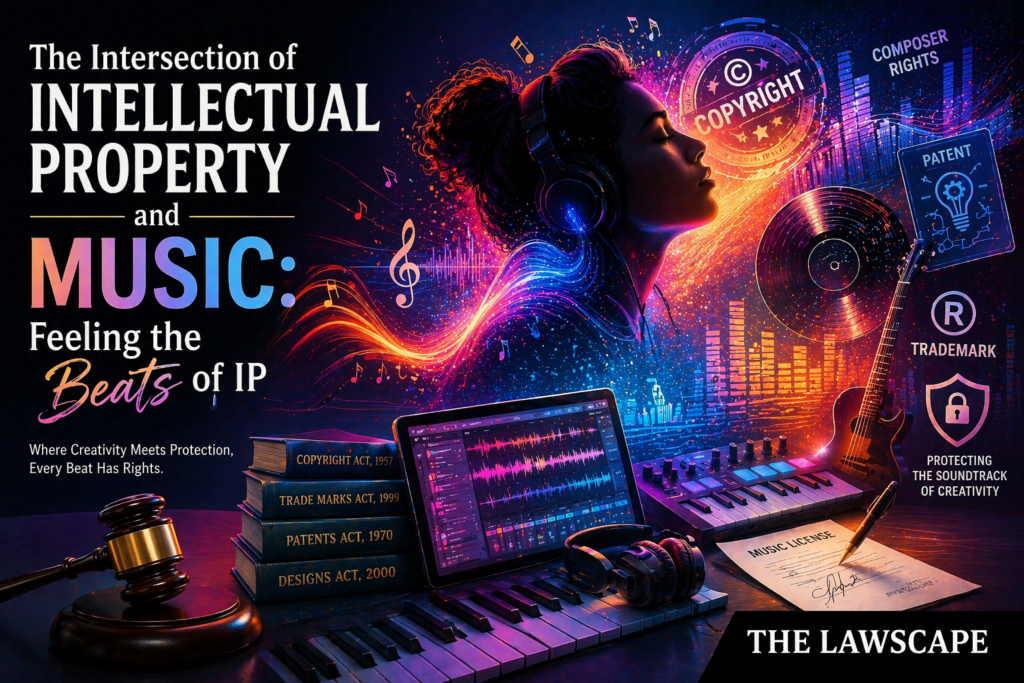
The Intersection of Intellectual Property and Music: Feeling the Beats of IP
Author: Astha Arvind Shukla
Student, KES Shri Jayantilal H Patel Law College
————————————————————————————-
💡 3 Quick Takeaways
Intellectual property in music — primarily through copyright and trademarks — forms the legal backbone that enables artists to control, monetise, and protect their creative works in an increasingly complex digital landscape.
High-profile copyright disputes such as Blurred Lines and Dark Horse illustrate the fragile and often contested boundary between artistic inspiration and infringement, prompting ongoing reassessment of how IP frameworks apply to musical creativity.
Emerging technologies — from blockchain to artificial intelligence — are reshaping the future of IP in music, demanding that legal systems evolve to address novel questions of authorship, ownership, and fair compensation.
Abstract
The intersection of intellectual property (IP) and music is a complex and dynamic landscape where creativity, economy, and artistic expression converge. This article explores the multifaceted dimensions of IP in music, examining copyright, trademarks, and licensing to shed light on the challenges and opportunities that arise within this intricate interplay. As the digital landscape evolves and technology reshapes music consumption, understanding IP nuances becomes essential for musicians, producers, and consumers alike. The article navigates the foundations of copyright, its scope and limitations, and the role of trademarks in branding, highlighting the tensions between protecting artists’ rights and fostering an environment conducive to collaboration and innovation. By embracing new technologies and promoting an ethical approach to consumption and creation, the music industry can strike a balance between honouring the rights of artists and the collective spirit of musical expression — ensuring that the beats of IP in music continue to inspire future generations.
Keywords: Intellectual Property, Music, Copyright, Trademarks, Licensing, Creativity, Digital Landscape, Innovation, Collaboration.
Introduction
Intellectual Property (IP) plays a vital role in the music industry, influencing the way music is created, distributed, and monetised. As the digital landscape evolves and technology reshapes how we consume and interact with music, understanding the nuances of intellectual property rights becomes essential for musicians, producers, and consumers alike. This article delves into the various dimensions of IP in music, exploring how it impacts creativity, the economy, and the very essence of musical expression. It navigates through copyright, trademarks, and licensing, shedding light on the challenges and opportunities that arise within this complex and ever-evolving interplay.
The Foundation of Intellectual Property in Music
At its core, intellectual property encompasses the legal rights that protect creations of the mind. In the music industry, these rights primarily manifest through copyright — a legal framework designed to safeguard the original works of authorship. When a musician composes a song and records it in a tangible form, that work becomes eligible for protection under copyright law. This protection serves as a crucial foundation, allowing artists to control the reproduction, distribution, and public performance of their music.
Copyright not only grants exclusive rights to the creator but also ensures that they receive appropriate recognition and compensation for their work. For independent musicians, this can be a primary means of livelihood — empowering them to license their music for use in films, commercials, and other media. However, the intricacies of copyright law can be daunting, particularly with the rise of digital platforms that have fundamentally transformed the way music is shared and consumed. The challenge lies in balancing the protection of artists’ rights with the public’s access to creative works — a dynamic that is continually evolving.
The Foundations of Copyright in Music
Copyright is the most critical form of intellectual property protection in music. When a song is created and fixed in a tangible medium — whether a written score, a recorded performance, or a digital file — it becomes eligible for copyright protection. This protection grants the original creator exclusive rights over the use and distribution of their music, including reproduction, distribution, public performance, and the creation of derivative works. An artist has the right to control who may copy their song, perform it publicly, or create remixes and adaptations based on their original work. These rights are fundamental to enabling musicians to monetise their creativity and ensure they are compensated for their labour and artistic expression.
In many jurisdictions, copyright protection arises automatically upon the creation of a work. However, registration with a copyright office can significantly enhance an artist’s ability to enforce their rights. Registered works benefit from a public record that can serve as evidence in legal disputes, providing a clearer path to remedies in cases of infringement — a particularly important safeguard in a fast-paced industry where unauthorised reproductions and distributions occur with alarming frequency.
The Scope of Copyright and Its Limitations
While copyright provides a robust framework for protecting musical works, it is not without limitations. Copyright protects the expression of ideas, not the ideas themselves. This distinction is critical in the music world — many songs draw inspiration from similar themes, melodies, or rhythms without violating copyright, and as a result, the boundary between inspiration and infringement can become difficult to define, giving rise to legal disputes.
The concept of “fair use” — recognised in several jurisdictions — permits limited use of copyrighted material without permission for purposes such as criticism, commentary, news reporting, teaching, or research. The fair use doctrine introduces a layer of complexity to copyright in music, particularly in an era where remixing and sampling have become commonplace. This has generated a rich culture of creative exchange but also raises significant questions about the ethical implications of reusing others’ work. Artists frequently walk a fine line between honouring their influences and risking infringement claims.
The Evolution of Music Consumption and IP Challenges
The digital age has revolutionised the music industry, ushering in new ways for artists to reach audiences while simultaneously complicating the protection of their intellectual property. Streaming services such as Spotify and Apple Music have become dominant players, providing access to vast libraries of music and fundamentally altering consumer behaviour. The convenience of streaming has led to a significant decline in physical sales, leaving many artists navigating revenue models that are increasingly intertwined with complex IP concerns.
The proliferation of user-generated content platforms — such as TikTok and YouTube — has made copyright infringement issues more prevalent than ever. These platforms host millions of videos featuring music that may not have been authorised for use. The emergence of remix culture, where artists take existing works and create new iterations, brings further complications in terms of copyright. While such creativity fosters innovation and cultural exchange, it raises profound questions about ownership and the ethical consumption of music: how do we honour the original creators while also encouraging the spirit of artistic expression?
Case Studies: Copyright Battles and Industry Responses
Several high-profile copyright cases illustrate the tensions surrounding IP in music. One of the most prominent is the legal battle between Marvin Gaye’s estate and Robin Thicke over “Blurred Lines” (Williams v. Gaye, 895 F.3d 1106, 9th Cir. 2018). The case raised critical questions about the boundaries of originality and inspiration in music composition. The court ruled in favour of Gaye’s estate, emphasising the need to protect artists’ rights against infringement while acknowledging the complexities of musical influence and the difficulty of drawing a clean line between inspiration and copying.
The case involving Katy Perry and “Dark Horse” offers a further illustration of these tensions. A jury initially found in 2019 that Perry’s song had copied elements from a lesser-known track. However, the Ninth Circuit Court of Appeals overturned this verdict in 2020, holding that the musical elements in question — a repeating ostinato figure — were too basic and commonplace to attract copyright protection. This outcome highlighted an important limiting principle: not every musical similarity constitutes infringement, and the law must guard against the over-extension of copyright to elements that belong to the musical commons.
In response to the broader challenges facing the industry, legislative initiatives have sought to modernise the IP framework for music. The Music Modernization Act in the United States, for instance, aims to streamline how songwriters and artists are compensated in the digital landscape, establishing clearer guidelines and improving the royalty collection process to ensure that creators are fairly rewarded for their contributions.
Trademark: Beyond Copyright in Branding
While copyright is the dominant form of IP protection for musical works, trademarks play an equally important role in the music industry — particularly in relation to branding and artist identity. A trademark protects distinctive signs, symbols, or designs that identify and distinguish a brand in the marketplace. For musicians, trademarks can encompass names, logos, and specific phrases associated with their brand identity.
For many artists, a strong and recognisable brand is essential for standing out in an oversaturated market. Iconic artists such as Beyoncé and Taylor Swift are known not only for their music but for their distinct brands that resonate deeply with audiences. As these artists expand their influence into other sectors — including fashion, philanthropy, and lifestyle branding — protecting their trademarks becomes increasingly essential to maintaining their identity and market value. Trademarks protect these assets from unauthorised use, safeguarding the integrity and commercial value of a musician’s brand.
Trademark disputes also arise in the industry, often involving conflicts over brand identity and the limits of free expression. The case of the band “The Slants” provides a vivid illustration. The band — an Asian-American group — sought to register a name that the USPTO had initially refused on the grounds that it was disparaging. The Supreme Court ultimately ruled in the band’s favour in Matal v. Tam (582 U.S. 218, 2017), holding that the Lanham Act’s prohibition on the registration of disparaging marks violated the First Amendment. This landmark ruling underscored the intersection of IP rights and freedom of expression, and reinforced that trademarks can serve not only as property rights but as platforms for cultural reclamation and dialogue.
The Future of IP in Music: Opportunities and Innovations
As we look ahead, the relationship between IP and music will continue to evolve in response to technological advancement. Blockchain technology presents exciting possibilities for transforming how artists protect and monetise their work. By enabling transparent and tamper-proof transactions, blockchain has the potential to revolutionise royalty distribution — ensuring that artists receive immediate and accurate compensation for their music and significantly mitigating the existing challenges of traditional licensing arrangements, particularly for independent musicians.
Artificial Intelligence (AI) is increasingly playing a role in music creation, prompting complex and unresolved discussions around authorship and ownership. AI-generated music raises profound legal and ethical questions: who holds the rights to a composition created by a machine? As these technologies develop, legal systems must adapt to address these novel challenges — potentially altering the landscape of IP in music in fundamental ways.
Initiatives promoting collaborative projects between artists also encourage a more networked and less hierarchical approach to music creation. By fostering a culture of sharing and mutual inspiration, the industry can challenge conventional notions of ownership and copyright, leading to more diverse and innovative musical outputs while addressing some of the tensions inherent in strict IP enforcement.
Conclusion: Harmonising IP and Musical Expression
The intricate relationship between IP and music invites us to reflect on the nature of creativity, ownership, and artistic expression. As we navigate the complexities of copyright, trademarks, and digital innovation, it is crucial to strike a balance that allows artists to protect their rights while fostering an environment conducive to collaboration and experimentation. The evolution of music consumption — from physical albums to streaming services, and now to AI-generated compositions — calls for an ongoing and honest reevaluation of intellectual property law.
By embracing new technologies and promoting an ethical approach to consumption and creation, the music industry can work towards a landscape that honours both the rights of individual artists and the collective spirit of musical expression. Navigating the complexities of copyright, trademarks, and licensing requires an informed understanding of both the legal frameworks and the artistic context in which music exists. By fostering a culture that respects intellectual property rights, we not only protect the livelihoods of musicians but also encourage the continued innovation that enriches our cultural landscape.
Ultimately, feeling the beats of IP in music hinges on our ability to harmonise the competing interests of creators and consumers — ensuring that the music we love continues to inspire future generations. As we seek to understand and adapt to the shifting dynamics of intellectual property in music, we embrace a new era where creativity knows no bounds, and every beat tells a story worthy of protection, appreciation, and celebration.
Disclaimer: The views expressed in this article are those of the author and do not necessarily reflect the views of The Lawscape.
The Lawscape — clear, practical legal insight for students and future lawyers.