
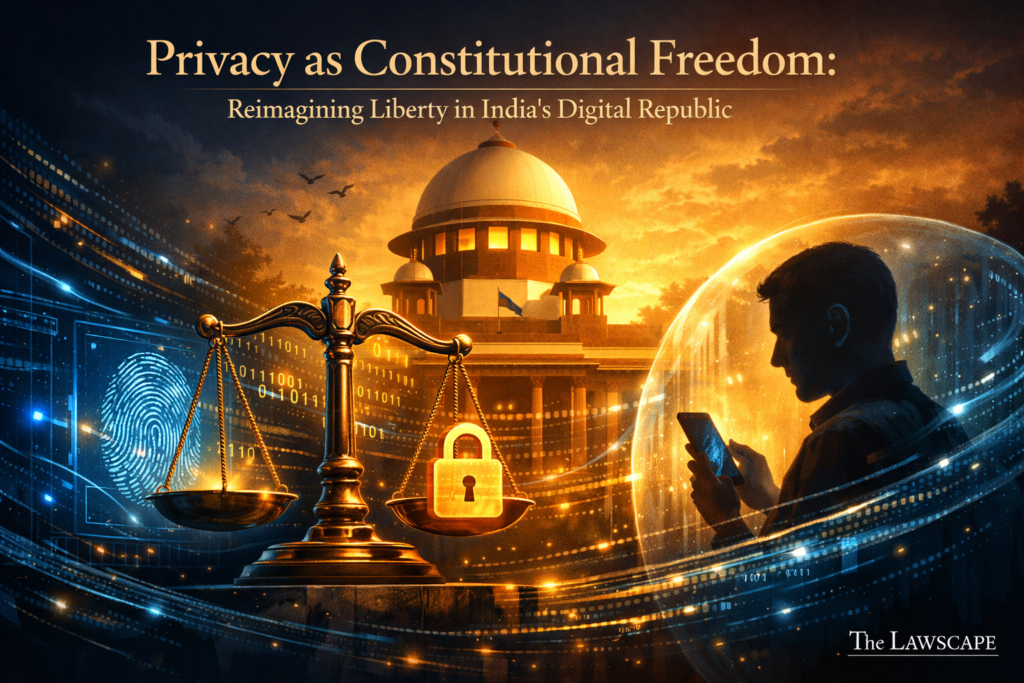
Privacy as Constitutional Freedom: Reimagining Liberty in India’s Digital Republic
Author: Abhipsa Priyadarsani
Student, National Institute of Rural Development and Panchayati Raj
———————————————————————————————————————
3 Quick Takeaways
- The nine-judge bench ruling in Justice K.S. Puttaswamy v. Union of India (2017) settled decades of constitutional uncertainty by unanimously recognising privacy as a fundamental right under Articles 14, 19, and 21, grounded in the principles of dignity, autonomy, and proportionality.
- Privacy jurisprudence has catalysed transformative social change, providing the constitutional foundation for decriminalising homosexuality in Navtej Singh Johar and striking down the adultery law in Joseph Shine.
- Constitutional recognition of privacy is only the beginning: India’s real challenge lies in closing the wide gap between the right as declared in the Puttaswamy judgment and its enforcement against state surveillance, data extraction, and the expanding power of private digital platforms.
Abstract
The recognition of privacy as an inherent right is one of the most significant developments in the evolution of Indian constitutional law. From being an abstract judicial notion, the right to privacy has come full circle with the judgment of the nine-judge bench of the Supreme Court of India in Justice K.S. Puttaswamy v. Union of India (2017). The right to privacy has redefined the relationship between the citizen and the State.
This article analyses the evolution of the right to privacy, its roots, and its contemporary implications, particularly in the context of digital governance, welfare databases, and the rise of data economies, as developed by the Supreme Court, the High Courts, the legislature, and various scholars. It focuses on the three aspects of the right to privacy as outlined under the Constitution: dignity, autonomy, and proportionality. The article also examines the tensions between security, liberty, welfare, informational self-determination, technological innovation, and the right to privacy, concluding that safeguarding privacy is not merely a legal necessity but a democratic imperative, and that the constitutional promise of liberty must be actively defended in an era of algorithmic governance.
Keywords: Right to Privacy; Constitutional Law; Surveillance; Digital Rights; Proportionality.
I. Introduction: Privacy and the Constitutional Moment
Few constitutional questions have made as dramatic a journey through Indian constitutional history as the right to privacy. For a large part of that history, the right to privacy remained in the constitutional shadow: implied but uncertain, invoked but unsettled. The Indian Constitution, unlike a number of modern constitutional documents, makes no explicit mention of the right to privacy. Yet, constitutional silence often belies deeper constitutional commitments.
The development of the constitutional right to privacy reflects the judiciary’s evolving understanding of the right to liberty under Article 21. The journey from M.P. Sharma v. Satish Chandra (1954) and Kharak Singh v. State of Uttar Pradesh (1962), both of which denied the right to privacy, to the explicit recognition of the right in Justice K.S. Puttaswamy v. Union of India, reflects a jurisprudential shift informed by democratic maturity.
Privacy in the contemporary world of governance and technology has become the new frontier of constitutional rights, with welfare databases, biometric identification, facial recognition, predictive policing, and digital technology redefining the constitutional landscape of individual rights. The question today is no longer whether the right to privacy exists, but whether the right to privacy survives.
II. Early Constitutional Skepticism: Privacy Denied
The Supreme Court was initially skeptical of the right to privacy. In M.P. Sharma v. Satish Chandra, AIR 1954 SC 300, an eight-judge bench held that the Constitution does not recognise the right to privacy, particularly in relation to the powers of search and seizure.
In Kharak Singh v. State of Uttar Pradesh, AIR 1963 SC 1295, police regulations authorising surveillance were largely upheld by the majority. However, Justice Subba Rao, in dissent, argued powerfully that the right to privacy is an inherent aspect of the right to personal liberty.
III. The Expansion of Article 21: Seeds of Privacy
The doctrinal shift began in Maneka Gandhi v. Union of India, (1978) 1 SCC 248, where the Court interpreted Article 21 as a guarantee of substantive due process. Liberty now entailed fairness, reasonableness, and non-arbitrariness.
Subsequent judgments progressively acknowledged the contours of privacy:
Gobind v. State of Madhya Pradesh, (1975) 2 SCC 148: Privacy was recognised as an inherent facet of personal liberty.
R. Rajagopal v. State of Tamil Nadu, (1994) 6 SCC 632: The “right to be let alone” was judicially recognised.
People’s Union for Civil Liberties v. Union of India, (1997) 1 SCC 301: Telephone conversations were held to be protected against arbitrary interception.
These judgments, while not conclusive on the full nature and extent of privacy, collectively established the constitutional foundation for personal autonomy.
IV. The Puttaswamy Revolution: Privacy as a Fundamental Right
The constitutional turning point was reached in 2017.
In Justice K.S. Puttaswamy (Retd.) v. Union of India, (2017) 10 SCC 1, the nine-judge bench unanimously held that privacy was an integral part of Articles 14, 19, and 21. The decision overruled M.P. Sharma and Kharak Singh to the extent they refused to recognise the right to privacy.
The Court laid down three core principles:
Privacy as Dignity: The “inner space” of individual life encompasses physical integrity, decisional autonomy, and control over information.
Privacy as Autonomy: Decisions regarding identity, faith, sexuality, and relationships are constitutionally protected.
Privacy as Constitutional Morality: The State cannot impose “majority morality” on individuals.
As Justice D.Y. Chandrachud observed, privacy protects the sanctity of individual choice against State intrusion.
V. The Proportionality Doctrine: Constitutional Test for State Action
The Court formulated a structured proportionality test with five elements: legality (the existence of a law), legitimate aim, necessity, proportionality, and procedural safeguards.
This test has since been applied to surveillance, data collection, and restrictions on personal liberty. In Anuradha Bhasin v. Union of India, (2020) 3 SCC 637, the Court applied the proportionality test to internet shutdowns, confirming that access to the internet for the exercise of fundamental rights is constitutionally protected and that blanket restrictions require rigorous justification.
VI. Aadhaar Litigation: Welfare State versus Informational Privacy
The privacy doctrine was immediately tested in K.S. Puttaswamy (Aadhaar) v. Union of India, (2019) 1 SCC 1. The Court upheld the constitutional validity of Aadhaar, but with significant restrictions: mandatory linkage with private services was struck down, data retention requirements were imposed, and private companies were barred from accessing the Aadhaar infrastructure.
The majority viewed Aadhaar as a legitimate welfare instrument, but dissenting judges raised the serious concern of a “surveillance State.” The case crystallised a familiar constitutional tension between administrative efficiency and individual liberty.
VII. Informational Privacy and the Data Economy
The nature of the challenge to privacy in the contemporary world is less physical than informational. India’s model of governance is increasingly built on digital infrastructure: biometric identities, fintech platforms, health information systems, and predictive analytics. Informational privacy concerns now encompass profiling, algorithmic discrimination, data breaches, and behavioural manipulation.
This challenge is increasingly understood in scholarship not as a property-based problem but as one tied to the extension of personality: the same dignity-centred framework that Puttaswamy anchored at the constitutional level.
VIII. Legislative Response: Data Protection and Regulatory Gaps
The Digital Personal Data Protection Act, 2023 represents India’s first comprehensive legal framework for data processing. Its key features include the processing of personal data through consent, obligations on data fiduciaries, penalties for data protection violations, and an exemption framework for State entities.
However, significant concerns persist. The government exemption is broad, there is no genuinely independent oversight body, and redressal mechanisms for individual citizens remain inadequate. As long as enforcement bodies are absent or lack independence, constitutional privacy remains a principled aspiration rather than a practical guarantee.
IX. Surveillance and National Security: The Constitutional Faultline
Indian courts continue to confront surveillance-related controversies, including allegations involving Pegasus spyware, the use of facial recognition technology, and internet shutdown policies.
In Manohar Lal Sharma v. Union of India (Pegasus case, 2021), the Supreme Court held that “national security cannot be allowed to become the ‘talismanic incantation’ to avoid judicial scrutiny,” and reiterated that secrecy and accountability must go hand in hand. The Court appointed an independent expert committee to investigate the allegations, signalling that the right to privacy does not yield automatically to executive claims of security necessity.
X. Privacy and Social Transformation: Gender, Sexuality, and Identity
The development of privacy jurisprudence has given rise to transformative new rights. In Navtej Singh Johar v. Union of India, (2018) 10 SCC 1, the Court relied on the principles of privacy and dignity to decriminalise consensual homosexual relations, reading the right to sexual autonomy as an essential component of individual identity.
In Joseph Shine v. Union of India, (2019) 3 SCC 39, the Court struck down the adultery law, relying on the right to marital autonomy as an aspect of privacy under Article 21. From the protection of the body and physical space to the protection of existence and personal choice, the concept of privacy has come a long way in Indian constitutional jurisprudence.
XI. Digital Constitutionalism: Emerging Challenges
India is now grappling with second-generation privacy concerns: artificial intelligence governance, biometric policing, deepfake technology, and platform surveillance capitalism. Unlike the State-centric threats that dominated earlier privacy discourse, these new challenges originate as much from private corporations as from government actors. Constitutional law must develop frameworks that address both.
XII. Comparative Constitutional Perspectives
Across the world, approaches to privacy protection differ significantly. The European Union’s GDPR places emphasis on informational self-determination, giving individuals robust control over how their data is processed. The United States relies on a more fragmented, sectoral model of privacy protection. India’s approach, rooted in the dignity-based framework of Puttaswamy, represents a blend of welfare governance and rights-based constitutionalism, wherein the doctrine of proportionality plays the central role in mediating conflicts between individual privacy and legitimate state interests.
XIII. The Democratic Stakes of Privacy
Privacy is often misunderstood as an elitist or individualistic concern. Constitutional history reveals otherwise. The ability to dissent politically, enjoy intellectual freedom, protect minorities, and avoid the chilling effects of surveillance are all made possible through the protection of privacy. A democracy without privacy is not genuinely free: it is performative. The protection of privacy is therefore inseparable from the protection of democracy itself.
XIV. The Way Forward: Institutionalising Privacy
Three reforms appear essential. First, an independent Data Protection Authority free from executive control is necessary if the right to privacy is to have meaningful enforcement. Second, judicial oversight of surveillance mechanisms must be institutionalised rather than reserved for exceptional cases. Third, transparency requirements must be embedded into all forms of algorithmic governance. Furthermore, the judicial response must go beyond compensation and begin to include structural injunctions and compliance audits where systemic privacy violations are established.
Conclusion: Liberty in the Age of Algorithms
The right to privacy has marked India’s constitutional coming of age. From judicial ambivalence to conceptual clarity, this journey has reflected the deeper truth that democracy cannot be sustained without the protection of individuality.
Yet recognising the right to privacy is only the first step, and the real constitutional struggle lies ahead. As the government seeks to become a data-driven state and citizens become increasingly digitised, India has a historic opportunity to give privacy the substantive meaning it deserves.
The Constitution, through the Puttaswamy judgment, has spoken loudly and clearly on the importance of dignity and autonomy. Whether the institutions of the country, the judiciary, the legislature, and civil society, will be able to translate the right to privacy from a celebrated judgment into a constitutional reality remains the defining question of India’s democratic future.
End Notes
- Justice K.S. Puttaswamy (Retd.) v. Union of India, (2017) 10 S.C.C. 1 (India)
- M.P. Sharma v. Satish Chandra, AIR 1954 SC 300 (India)
- Kharak Singh v. State of Uttar Pradesh, AIR 1963 SC 1295 (India)
- Maneka Gandhi v. Union of India, (1978) 1 S.C.C. 248 (India)
- Gobind v. State of Madhya Pradesh, (1975) 2 S.C.C. 148 (India)
- R. Rajagopal v. State of Tamil Nadu, (1994) 6 S.C.C. 632 (India)
- People’s Union for Civil Liberties v. Union of India, (1997) 1 S.C.C. 301 (India)
- Anuradha Bhasin v. Union of India, (2020) 3 S.C.C. 637 (India)
- K.S. Puttaswamy (Aadhaar) v. Union of India, (2019) 1 S.C.C. 1 (India)
- Navtej Singh Johar v. Union of India, (2018) 10 S.C.C. 1 (India)
- Joseph Shine v. Union of India, (2019) 3 S.C.C. 39 (India)
- Manohar Lal Sharma v. Union of India (Pegasus case), AIR 2021 SC 5396 (India)
- Upendra Baxi, The Future of Human Rights (Oxford Univ. Press, 3d ed. 2008).
- M.P. Jain, Indian Constitutional Law (LexisNexis, 8th ed. 2018).
- Gautam Bhatia, The Transformative Constitution (HarperCollins India 2019).
- Lawrence Lessig, Code and Other Laws of Cyberspace (Basic Books 1999).
- Daniel J. Solove, Understanding Privacy (Harvard Univ. Press 2008).
- PRS Legislative Research, Digital Personal Data Protection Act, 2023: Legislative Brief (2023).
- Justice B.N. Srikrishna Committee Report on Data Protection Framework for India (2018).
Disclaimer: The views expressed in this article are those of the author and do not necessarily reflect the views of The Lawscape.
The Lawscape — clear, practical legal insight for students and future lawyers.