
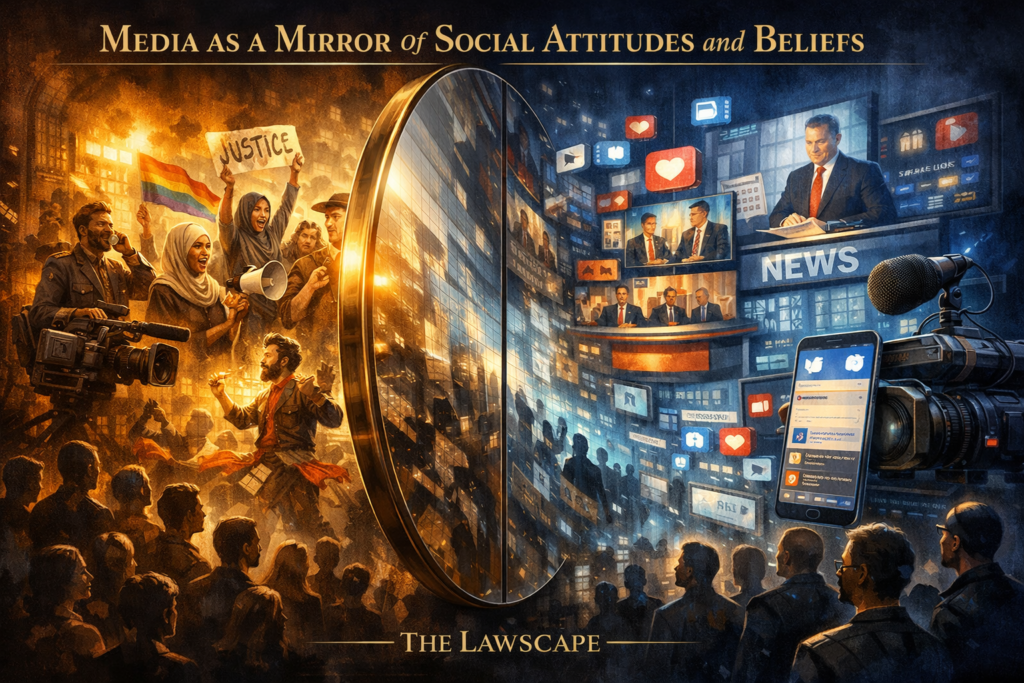
Media as a Mirror of Social Attitudes and Beliefs
Author: Siddhi Kirit Ruparel
Student, KES Shri Jayantilal H. Patel Law College
—————————————————
3 Quick Takeaways
- Media functions simultaneously as a mirror that reflects existing social values and as an active force that shapes new ones, making it one of the most powerful instruments of social transformation in the modern world.
- While media promotes awareness, mobilises communities, and holds power accountable, it also carries serious risks including misinformation, biased framing, and the projection of unrealistic social standards, particularly affecting young people.
- Responsible, ethical, and accurate media is not optional but essential for healthy democratic societies, and media literacy is an increasingly critical skill for every citizen.
Abstract
Media plays a vital role in shaping society by influencing people’s thoughts, beliefs, attitudes, and behaviour. It acts both as a mirror that reflects social values and as a force that drives change. Through newspapers, television, radio, and social media, people become aware of social issues, political developments, and cultural trends. Media helps spread awareness, mobilise people for social causes, promote education, and hold power accountable. At the same time, it shapes public opinion and influences social norms. However, media can sometimes spread misinformation and project unrealistic standards, which may negatively affect society. This article examines the role of media in social change, its influence on public opinion, behaviour, and social development, and highlights the importance of responsible and ethical media for the betterment of society.
Keywords: Media, Social Change, Public Opinion, Education, Awareness.
Introduction
“The media is a mirror held up to society, reflecting both its virtues and its flaws.”
Media plays an important role in shaping public opinion and influencing the development of society. It connects events and people, helping individuals understand what is happening around them. The influence of media depends largely on how far it reaches and how easily people can access it. Today, people in developed and urban areas have better access to newspapers, television, the internet, and social media platforms. In contrast, many individuals in less developed or rural regions still struggle with access to these forms of communication. Even so, these populations have largely managed their lives and addressed their problems without direct reliance on electronic or print media.
The global influence of media can be fully understood only in the context of a globalised world. In such a world, cultures, thinking patterns, social norms, and practices are increasingly shaped by communication networks that cross national boundaries. Media plays a crucial role in spreading global ideas, trends, and values. Yet in many societies, especially in rural and traditional communities, local customs, beliefs, and traditions continue to have a stronger impact on daily life than global media influences. This creates an interesting tension between global and local forces.
The study of media and social change is especially important because it helps us understand how deeply media affects society. Media does not simply reflect social realities but also actively shapes them. In its various forms, including print, electronic, and digital media, it serves as a powerful tool that both mirrors existing social values and promotes new ones. Media influences what people see as important, how they understand social issues, and how they respond to challenges. By exploring the relationship between media and social change, we can gain a better understanding of how societies grow, transform, and adapt to changing conditions.
Background and Significance
The world we live in and the society we are part of are constantly shaped by the media of the time. Media reporting and analysis influence how people interpret events, understand social values, and form their personal opinions. Through news stories, advertisements, films, television programmes, and social media posts, media creates images of reality that people frequently accept as truth. As a result, media plays a major role in shaping collective beliefs and attitudes.
Society is constantly changing due to economic developments, political shifts, technological advancements, and cultural transformations. With each change in society, there is a corresponding change in people’s views, opinions, and values. Media plays an important role in influencing these changes. It introduces new ideas, highlights emerging issues, and provides platforms for discussion and debate. At the same time, society also influences media by determining what is considered important, relevant, and acceptable. This creates a two-way relationship between media and society.
Many times, society views certain events and norms in a particular way, while media reporting presents them differently. When this happens, public perception can be manipulated. Media can highlight certain aspects of a story while ignoring others, thereby shaping public understanding in specific directions. This process can lead to confusion, misreading, and social conflict. In such situations, media becomes not only a mirror of society but also an important force capable of influencing values and social norms.
Media significantly affects our perception of success, beauty, happiness, and social status. Advertisements, films, and social media often project idealised images of life, portraying wealth, physical attractiveness, luxury, and constant happiness as measures of success. These portrayals can create unrealistic expectations and pressures, especially among young people. Over time, such representations can reshape social values and influence lifestyle choices.
In addition to entertainment and advertising, media also includes educational content, documentaries, journals, and investigative reports. These forms contribute to knowledge, awareness, and critical thinking. However, when media becomes excessively commercial, unfair, or politically driven, it can distort reality and negatively impact society. Manipulative reporting and undue control over media content can have serious consequences, including misinformation, social conflict, and erosion of public trust.
Understanding the background and significance of media is therefore essential to appreciate its role in shaping society and guiding social change.
About Media
Media is a powerful tool that can be used to bring about social change. It plays an important role in drawing attention to social issues and encouraging action. Through its various platforms, media can influence public attitudes, mobilise communities, and hold authorities accountable.
Media helps in several important ways:
- Creating Awareness about Social Issues
One of the most important roles of media is to create awareness about social problems. Problems such as poverty, inequality, gender discrimination, caste-based injustice, and child labour often remain hidden without media attention. By reporting on these problems, media helps bring them into public discussion. This awareness encourages individuals, communities, and governments to take steps toward solving these issues.
Media also educates people about health, hygiene, nutrition, and safety. Campaigns related to vaccination, disease prevention, sanitation, and mental health have helped improve public awareness and behaviour.
- Mobilising People for Social Action
Media has the power to mobilise people by encouraging participation in social movements and campaigns. Through news reports, interviews, and social media posts, people are informed about injustices and encouraged to raise their voices. Media platforms allow individuals to share their opinions, organise events, and coordinate collective action.
Social media in particular has transformed the way people mobilise for social causes. Hashtags, online petitions, and digital campaigns have played significant roles in raising awareness and promoting activism. These platforms provide space for individuals to express concerns and connect with others who share similar views.
- Holding Power Accountable
Media acts as a watchdog by monitoring the actions of governments, corporations, and institutions. Investigative journalism exposes corruption, misuse of power, and violations of law. By reporting on these issues, media helps ensure transparency and accountability. Public exposure often leads to investigations, legal action, and policy reforms.
Through interviews, debates, and opinion columns, media also provides space for discussion and criticism of public policies. This encourages democratic participation and helps maintain checks and balances within society.
What Is Media and Social Change?
Media refers to all forms of communication used to share information, ideas, stories, and entertainment with large audiences. This includes traditional media such as newspapers, magazines, radio, television, and films, as well as modern digital media like social media platforms, websites, blogs, podcasts, and mobile applications.
Social change refers to significant transformations in social structures, cultural norms, values, behaviours, and institutions. These changes may involve shifts in laws, attitudes, social practices, and power relationships. Examples of social change include movements for gender equality, the abolition of unfair practices, the promotion of education, environmental protection, and the advancement of human rights.
When media and social change are studied together, they reveal how communication plays a vital role in influencing and driving societal transformation. Social changes can in turn influence the content, focus, and methods of media communication.
How Media Helps Social Change
Media acts as an important instrument in shaping society and promoting social change. It influences individuals and communities through several key functions.
- Spreading Awareness
Media brings attention to social issues that people may not be aware of. Through news stories, documentaries, interviews, and reports, media highlights problems such as poverty, injustice, environmental degradation, and health crises. By providing information, media encourages people to think critically about these issues and consider possible solutions.
- Shaping Opinions
Repeated exposure to specific narratives, images, and messages influences how people think and feel about social issues. Media determines which aspects of a problem are highlighted and which are ignored. Over time, this shapes public opinion and societal attitudes.
- Mobilising People
Media encourages collective action by informing people about protests, campaigns, and social movements. It provides platforms for organising events, sharing experiences, and coordinating activities. Through these efforts, media helps bring about political, social, and cultural changes.
- Giving Voice to the People
Media allows ordinary individuals to share their stories, opinions, and concerns. Social media platforms in particular have empowered communication by allowing people to participate in public discussions. This strengthens democratic values and social participation.
- Influencing Behaviour
Media campaigns encourage positive behaviours such as recycling, healthy eating, education, cleanliness, and environmental protection. Public service advertisements and awareness programmes promote social responsibility and ethical conduct.
- Shaping Attitudes and Beliefs
Media influences how individuals understand social realities and interpret events. It determines which topics receive attention and how they are presented. This process of selection and framing shapes public perception.
Repeated exposure to specific narratives can gradually shape beliefs, whether positively or negatively. Continuous coverage of social issues can increase awareness and empathy, while biased or sensational reporting can create fear and misunderstanding.
Media also influences cultural norms and moral values. Television shows, films, and advertisements portray certain lifestyles, relationships, and behaviours as desirable or normal. Over time, these portrayals can reshape social expectations and cultural practices.
- Influence on Behaviour
The influence of media on behaviour is a major area of concern because media can directly affect how people act and interact within society. Media often presents certain behaviours, lifestyles, and social norms as acceptable or desirable.
- Social Norms and Lifestyle Choices
Television programmes, films, and advertisements frequently depict specific lifestyles, fashion trends, and social behaviours. When people repeatedly see these representations, they may begin to view them as normal and expected. As a result, individuals may adopt similar behaviours in their own lives to conform to perceived social norms.
- Consumer Behaviour
Advertising and product placements influence purchasing decisions. Media creates associations between products and desirable qualities such as success, beauty, and happiness. These associations shape consumer preferences and encourage consumption, having a significant impact on economic behaviour and market trends.
- Social Interaction and Communication
Social media has transformed communication patterns by enabling instant interaction across geographical boundaries. People can share experiences, express opinions, and connect with others easily. This has strengthened social networks and enabled community building. However, it has also led to challenges such as misinformation, online harassment, and unrealistic social comparisons.
- Influence on Youth
Young people are particularly influenced by media content. Exposure to idealised images of success, beauty, and lifestyle can create pressure, anxiety, and identity confusion. Responsible media representation is therefore essential for the healthy development of younger generations.
- Spreading Education and Awareness
Media provides information on health, education, environment, legal rights, and government schemes. Educational programmes, public service announcements, and awareness campaigns help improve knowledge and social responsibility.
- Promoting Equality and Justice
By highlighting issues such as caste discrimination, gender inequality, child labour, and social injustice, media encourages legal reforms and social change. Media coverage brings marginalised voices to the forefront and promotes inclusivity.
- Building Social Unity
Media promotes national integration by showcasing cultural diversity, traditions, and shared values. It fosters understanding among different communities and strengthens social harmony.
- Educational and Informational Impact
Media plays an important role in the educational sphere by providing access to knowledge and learning resources. Educational programmes, documentaries, online courses, and digital libraries support lifelong learning and personal development.
However, the spread of misinformation and disinformation presents a serious challenge. Misleading information can distort public understanding and lead to harmful behaviours, particularly in areas such as health, politics, and social relations. Media literacy and critical thinking are therefore essential skills for evaluating information and making informed decisions.
Media Influence on Public Opinion
Media strongly influences public opinion by shaping perceptions of political, social, and moral issues. For many people, media is the primary source of information about current events. The way media frames news and stories affects how people interpret and evaluate social realities.
Television, newspapers, and digital platforms provide immediate access to global events, enabling people to form opinions quickly. Political leaders often use media platforms to communicate policies, influence voters, and shape public discourse. This gives media significant power in democratic societies.
This power also carries responsibility. Media must adhere to ethical standards, fairness, and accuracy to ensure informed citizenship and social trust.
News Media
News media plays a key role in shaping societal discourse. Heavy coverage of certain issues increases public awareness and concern. Research shows that media attention influences what people consider important.
The digital transformation of news has increased speed, accessibility, and reach. However, it has also led to challenges such as information overload and biased reporting. Understanding how news is produced, selected, and presented is essential for informed media consumption.
Social Media
Social media has transformed communication by creating virtual communities where individuals share their ideas, opinions, and experiences. These platforms allow for interactive communication, enabling two-way engagement between governments and citizens.
Social media has become a powerful tool for political participation, activism, and social movements. It provides space for debate, collaboration, and collective action. However, it also presents serious risks such as misinformation, cyberbullying, and digital addiction.
Conclusion
In short, media functions both as a mirror that shows us who we are and as a shaping force that influences who we will become. By influencing beliefs, attitudes, and behaviours, media plays a central role in social development. It highlights social problems, promotes awareness, mobilises people, and holds power accountable. At the same time, it shapes cultural norms, lifestyle choices, and public opinion.
In a world that is changing faster than we can keep up with, we need a media that values truth, fairness, and the public interest to ensure positive social transformation. The goal is not just to be connected. The goal is to be informed.
Disclaimer: The views expressed in this article are those of the author and do not necessarily reflect the views of The Lawscape.
The Lawscape — clear, practical legal insight for students and future lawyers.