
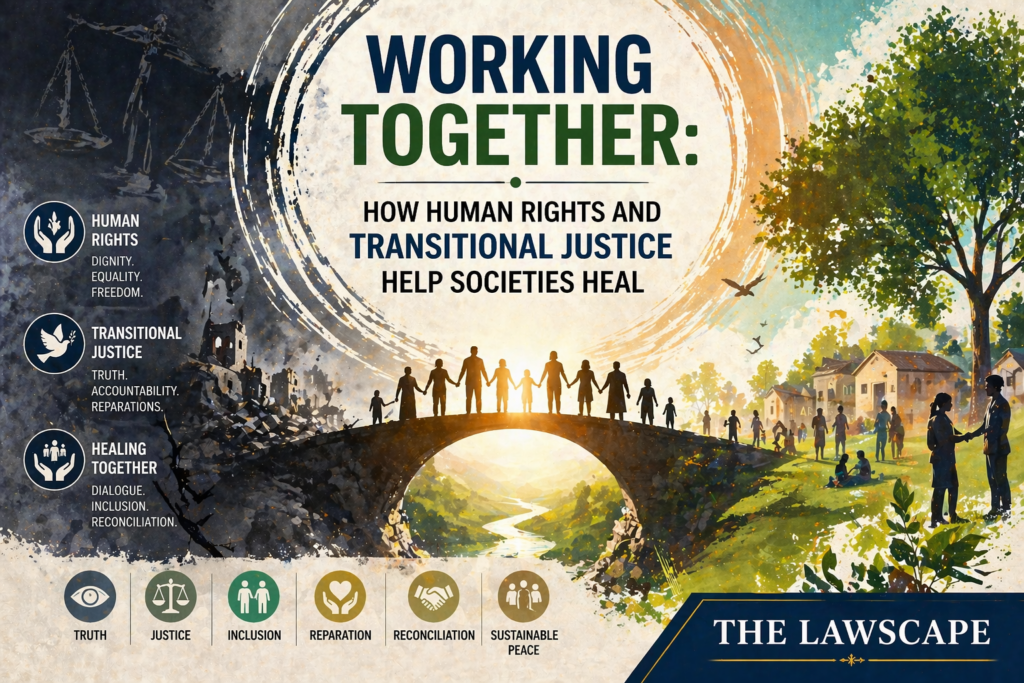
Working Together: How Human Rights and Transitional Justice Help Societies Heal
Author: Abrham Seife Muluneh
Student, Bahirdar University
———————————————————————————————————-
💡 3 Quick Takeaways
Human rights law and transitional justice are not competing frameworks — they are deeply interdependent: human rights law provides the legal foundation and the duties, while transitional justice provides the practical tools to fulfil those duties in societies emerging from conflict or repression.
Each transitional justice mechanism — criminal trials, truth commissions, reparations programmes, and institutional reform — directly corresponds to a specific legal obligation under international human rights law, including the duties to investigate, prosecute, provide remedy, and ensure non-recurrence.
The peace-versus-justice dilemma, the limits of amnesty, and the need to include victims as active participants remain the central tensions in transitional justice — tensions that can only be navigated responsibly through a commitment to both human rights principles and contextual political realism.
Introduction: Choosing Both Peace and Justice
For a long time, people believed that after a war or the fall of a harsh government, a country had to make a hard choice: peace or justice. The thinking was simple — if you put the perpetrators on trial, they will keep fighting. So, to stop the violence, you might have to let them go free. This was called the “peace versus justice” debate.
But as many countries have gone through this difficult process — from Latin America to Eastern Europe, from South Africa to Sierra Leone — a new understanding has emerged. We now know that peace and justice do not have to be enemies. True, lasting peace cannot exist without justice. A peace built on ignoring serious crimes is not real peace — it is a pause, and the violence is likely to return.
This is where transitional justice comes in. Transitional justice is not a replacement for human rights. It is a way of making human rights real in places where normal systems have broken down. It is a set of tools — both legal and non-legal — that societies use to deal with a past full of serious human rights abuses. The goal is accountability, justice, and ultimately, reconciliation.
This article argues that human rights and transitional justice are deeply connected — that they depend on each other. Human rights law gives us the reasons and the rules. It tells us what victims are entitled to and what the state must do. Transitional justice gives us the practical methods — showing how a country can actually deliver on those promises when everything is in chaos. One without the other does not work. A justice process that ignores human rights can become a political tool that lets criminals escape accountability. But a rigid approach to human rights that ignores the real-world difficulties of a peace process may also fail. This article will explain this connection — first by examining the international rules that form the foundation, then by showing how each transitional justice tool protects specific rights, and finally by addressing the difficult choices that arise and how this relationship continues to evolve.
Part I: The Basic Link — What International Law Says About Rights After Conflict
A. The Duty to Help Victims: Key International Documents
The most important principle is that when a state fails to protect someone’s rights, it has a duty to provide a remedy. This is a foundational principle of law, stated clearly in the International Covenant on Civil and Political Rights (ICCPR). Article 2 of the ICCPR provides that any person whose rights are violated must have an “effective remedy.”³ The state must do something to make it right.
This idea was elaborated in the United Nations’ Basic Principles and Guidelines on the Right to a Remedy and Reparation for Victims of Gross Violations of International Human Rights Law and Serious Violations of International Humanitarian Law — commonly called the Van Boven Principles. This document sets out exactly what the state’s duties are. These duties form the backbone of transitional justice:
The first is the Duty to Investigate. The state must look into what happened — quickly, fairly, and thoroughly. This duty does not disappear because the people who committed the abuses are no longer in power. A new government inherits the duty to investigate crimes committed by the old one.
The second is the Duty to Prosecute. For the most serious crimes — torture, extrajudicial killing, enforced disappearance, war crimes — investigating is not enough. The state must put those responsible on trial and punish them if found guilty. This is the most important means of combating impunity.
The third is the Duty to Provide Reparations. Victims have a right to be made whole, as far as possible. Reparation can take many forms: returning land or property (restitution); paying money for losses (compensation); providing medical care or psychological support (rehabilitation); public apologies or official acknowledgements that restore the victim’s dignity (satisfaction); and measures to ensure it never happens again (guarantees of non-recurrence).
The fourth is the Duty to Ensure Non-Recurrence. The state must change the systems that allowed the abuse to happen — removing abusers from the police and army, reforming the courts, and building a culture of human rights protection.
Transitional justice is the name we give to the full set of actions a country takes to fulfil these four duties when moving from violence and repression to peace and democracy.
B. How Transitional Justice Puts These Duties into Practice
Human rights law tells us where we want to go — it describes a society where everyone’s rights are respected. But a country just emerging from war is very far from that goal. Transitional justice is the map and the compass for the journey. It shows the path from a place where the law was used as a weapon to one where the law protects everyone.
Viewed this way, a truth commission is not merely a fact-finding group — it is a mechanism for fulfilling the right to truth.⁹ A reparations programme is not charity — it is the state discharging its duty to provide a remedy.¹⁰ A criminal trial is not only about punishment — it is a declaration to the victim that their rights mattered and that what happened to them was wrong. Reforming the police and army is the direct means of ensuring non-recurrence.
When we evaluate a country’s transitional justice process, we should ask: is it trying to fulfil all four duties? If a country grants amnesty to war criminals — failing the duty to prosecute — and does nothing for victims — failing the duty to provide a remedy — it is not merely doing a poor job of transitional justice. It is breaking its obligations under international law.
Part II: The Main Tools and the Rights They Protect
A. Holding Trials: Upholding the Right to Justice
Criminal trials are the most direct way a state demonstrates seriousness about its duty to investigate and prosecute. They do several important things for human rights.
First, they give victims their day in court — the opportunity to tell their story publicly and to see the person who harmed them held accountable. This public acknowledgement is powerful. It tells the victim, and the whole society, that the abuse was wrong and that the law applies to everyone.
Second, trials fight impunity. When a former general or a former president is tried, a powerful message is sent: no one is above the law. This can deter future crimes, as potential perpetrators see that they will not escape accountability.
International law has become clear that amnesties cannot be granted for the worst crimes. The Inter-American Court of Human Rights has held that amnesty laws covering genocide, torture, or crimes against humanity are impermissible. When countries cannot or will not hold trials, international courts can intervene. The International Criminal Court (ICC) was created for precisely this purpose — a court of last resort to ensure the right to justice is not lost because a country’s own courts are broken or unwilling.
B. Truth Commissions: Protecting the Right to Know
Victims and their families have a right to know the truth about what happened — the right to truth. This is both a personal right, for the family of someone killed or disappeared, and a collective right, for society as a whole, which needs to know its own history.
Truth commissions are the primary mechanism for protecting this right. Unlike a trial, which focuses on whether one person is guilty of a specific crime, a truth commission tries to create a complete picture of the past — identifying patterns, explaining why the violence happened, and giving thousands of victims a platform to share their stories.
The reports produced by truth commissions are enormously significant. They create an official, publicly acknowledged record. The reports of the truth commissions in South Africa and Guatemala became the accepted historical accounts of what happened in those countries. This truth-telling is a form of satisfaction for victims — a formal acknowledgement that their suffering was real and wrong. It is also a prerequisite for the next step: reparations. A fair reparations programme cannot be designed without first knowing who the victims are and what they suffered.
C. Reparations Programmes: Fulfilling the Right to Be Made Whole
The right to a remedy includes the right to be compensated for harm suffered. But after a massive conflict, there may be millions of victims — far too many for individual lawsuits. The courts would be overwhelmed, and the process would take generations.
This is why many countries establish administrative reparations programmes — special schemes designed to help large numbers of victims efficiently and fairly. These directly fulfil the right to reparation. They may provide financial payments, free healthcare or education, the return of seized land, or the construction of memorials in communities that were destroyed.
Through these programmes, the state admits responsibility. It says: the state failed you, and we are trying to make it right. International law requires that such programmes be adequate, effective, and prompt. Most importantly, victims should have a voice in how programmes are designed. They are not receiving charity — they are claiming a right.
D. Reforming Institutions: Working to Ensure Abuse Never Happens Again
The most important promise a country can make after conflict is “never again.” To keep that promise, the institutions that carried out or enabled the abuse must be transformed. This is institutional reform — the direct means of fulfilling the duty to ensure non-recurrence.
This involves several interconnected actions. Vetting means removing from the police, army, and government those individuals involved in human rights abuses. Security sector reform means retraining the military and police to understand that their role is to protect citizens, not harm them, and placing them under genuine civilian oversight. Judicial reform means ensuring courts are independent and impartial, appointing judges who are not implicated in past abuses, and providing training on human rights standards. Legal reform means repealing laws used by the old regime to arrest and silence opponents, and building new constitutional frameworks that guarantee basic rights for everyone.
These changes build a new foundation — one that takes the lessons of the past and embeds them into the very structure of the state.
Part III: When Things Get Complicated — Balancing Different Needs
A. Peace Talks Versus the Courtroom: A Difficult Choice
Imagine negotiating an end to a war. The leaders of an armed group have committed terrible crimes. You want them to stop fighting and join the peace process — but they will only agree if granted amnesty. What do you do?
This is a real and painful dilemma. Insisting on immediate trials may prolong the war and cost more lives. But granting amnesty denies justice to victims and lets criminals go free.
There is no easy answer. Human rights law does not permit amnesty for the worst crimes, but it does not demand that every person be tried immediately. A possible approach is sequencing: a peace agreement might include commitments to a future truth commission or a plan to eventually try the main leaders. The ICC has developed a policy of “positive complementarity,” encouraging and supporting countries to conduct their own trials. The goal is a creative solution that moves toward peace without permanently surrendering justice.
B. The Problem with Amnesty: Letting Go Versus Moving Forward
Amnesty represents a direct conflict between the desire to move forward and the demands of human rights. International law is clear: amnesty cannot be granted for genocide, crimes against humanity, war crimes, torture, or enforced disappearance. A country cannot use its domestic laws to escape its international obligations.
The most famous compromise was South Africa’s Truth and Reconciliation Commission, which offered amnesty to individuals — but only in exchange for full public disclosure of their crimes. This was a unique model, and many human rights experts criticised it for allowing serious criminals to escape prosecution. The lesson drawn from South Africa and subsequent developments in international law is that a truth commission, however valuable, should work alongside, not instead of, trials for the worst offenders.
C. Keeping Victims at the Heart of the Process
Historically, peace negotiations were conducted between the old leadership and the new — victims were forgotten. A modern, human rights-based approach places victims at the very centre.
This means victims are active participants, not passive bystanders. They have the right to be heard: to testify at truth commission hearings, to participate in trials as provided under the Rome Statute, and to be consulted on the design of reparations programmes. When victims are marginalised, the entire process loses legitimacy. Their participation is not merely desirable — it is essential for genuine healing and lasting peace.
Part IV: New Challenges and the Road Ahead
A. Beyond Physical Harm: Addressing Economic and Social Rights
Transitional justice has historically focused on physical violence — killings, torture, disappearances — which are violations of civil and political rights. But many conflicts are rooted in deep economic unfairness: communities denied land, education, or healthcare on the basis of their ethnicity or beliefs. These are violations of economic and social rights.
Transitional justice is increasingly being called upon to address these harms as well. If a government deliberately impoverished a particular group, that injustice demands acknowledgement and remedy. Some truth commissions are now including economic root causes in their investigations — the Kenya Truth, Justice and Reconciliation Commission, for example, examined the economic dimensions of the violence it investigated. Reparations programmes can also be designed to address economic wrongs — for instance, by returning land to displaced communities. This represents an important expansion of transitional justice toward a fuller vision of human rights.
B. The Role of the International Criminal Court
The ICC is a permanent institutional expression of the link between human rights and criminal accountability. By prosecuting individuals for the gravest crimes, it affirms that these rights matter everywhere, not only in some countries.
The ICC operates on the principle of complementarity — it only acts when a country is genuinely unwilling or unable to investigate and prosecute. This creates a powerful incentive for countries to initiate their own transitional justice processes. The knowledge that the ICC is watching can encourage states to act. The Court’s engagement with Colombia’s peace process demonstrates how international justice can support, rather than undermine, negotiated peace — helping countries find the right balance between accountability and reconciliation even in the most difficult circumstances.
Conclusion: A Shared Path Toward Lasting Peace
The transition from violence to peace is one of the hardest things a society can undertake. Human rights and transitional justice are the guide for this journey — not separate ideas, but deeply interdependent ones.
Human rights law provides the destination. It tells us what a just society looks like and sets out the state’s duties: to investigate, to prosecute, to provide reparations, and to prevent future harm. These duties are the foundation. Transitional justice provides the path — the practical tools that turn these duties into real actions that help real people.
This relationship is not always straightforward. It demands difficult choices and careful balance. But history has taught a consistent lesson: when countries take shortcuts, sacrificing justice for the promise of quick peace, the peace rarely holds. The only peace that endures is one built on a foundation of human rights.
This is the shared path — and it is the only path that leads to a future where the violence of the past is truly left behind, and where the dignity of every person is finally protected.
Disclaimer: The views expressed in this article are those of the author and do not necessarily reflect the views of The Lawscape.
The Lawscape — clear, practical legal insight for students and future lawyers.