
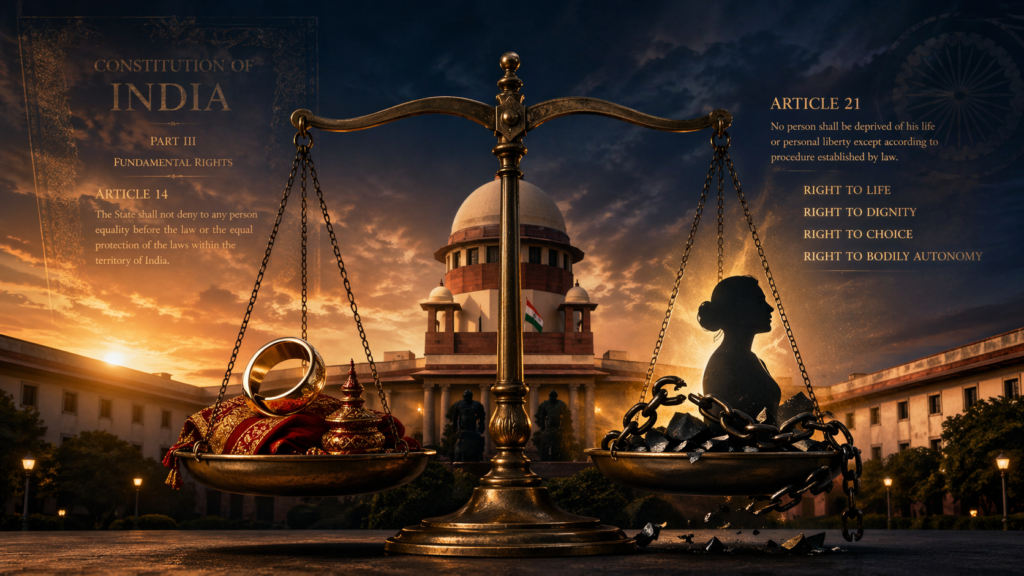
RIT Foundation v. Union of India: The Marital Rape Exception and India’s Constitutional Reckoning
Case Citation: RIT Foundation v. Union of India, (2022) SCC OnLine Del 1404
Author: Abhipsa Priyadarsani
Student, national Institute of Rural Development and Panchayati Raj
———————————————————————————————————————–
3 Quick Takeaways
- The Delhi High Court’s split verdict in RIT Foundation v. Union of India (2022) exposed a fundamental constitutional fault line: whether Exception 2 to Section 375 of the Indian Penal Code, which exempts husbands from rape liability in relation to their wives, can survive scrutiny under Articles 14, 15, 19, and 21 of the Constitution.
- Justice Rajiv Shakdher held the Marital Rape Exception (MRE) unconstitutional on grounds of gender discrimination and violation of bodily autonomy, while Justice C. Hari Shankar upheld it as a permissible classification protecting the institution of marriage, producing one of the most consequential judicial divergences in recent Indian constitutional history.
- The matter is now pending before the Supreme Court of India, and its outcome will determine whether the MRE is an unconstitutional colonial remnant or a valid legislative classification, with profound implications for gender equality, bodily integrity, and the constitutional framework of marriage in India.
1. Introduction: The Constitutional Landscape
The legal challenge surrounding the Marital Rape Exception (MRE) in India is representative of a fundamental struggle in the nation for transformative constitutionalism, one that requires a clean break with old colonial legal fictions. For over one hundred years, the MRE has been associated conceptually with what is referred to as the “Hale Dictum,” a common law principle from the seventeenth century attributed to English Chief Justice Sir Matthew Hale. The principle held that when a woman enters into a marriage, she gives her husband irrevocable permission to access her body in all circumstances, meaning consent, once given at the altar, could never be withdrawn. This legal concept was further reinforced through the Doctrine of Coverture, an archaic doctrine creating a legal fiction whereby upon marriage, a woman’s individual legal identity ceased to exist and effectively merged into that of her husband. Under this framework, a man could not be held criminally liable for raping his wife because he could not be said to violate his own property.
Contemporary Indian jurisprudence has substantially moved away from these premises. In Justice K.S. Puttaswamy v. Union of India (2017), the Supreme Court recognised privacy as a fundamental right, extending constitutional protection not merely to one’s physical home environment but to individual freedom and bodily integrity as dimensions of personhood. In Joseph Shine v. Union of India (2018), the Supreme Court struck down the adultery law under Section 497 of the Indian Penal Code, affirming that a woman’s partner does not own her and that marriage does not extinguish a woman’s agency, identity, or personhood. Despite these doctrinal advances, the MRE continues to exist as a statutory reminder of the Hale Dictum, providing no criminal protection to married women who do not consent to sexual activity with their husbands. The exception is, therefore, increasingly viewed as incompatible with the constitutional values of gender equality and human dignity that contemporary jurisprudence has sought to advance.
2. Facts of the Case
The litigation was initiated through several writ petitions filed from 2015 onwards before the Delhi High Court. The petitioners, including the RIT Foundation, the All India Democratic Women’s Association (AIDWA), and individual survivor Khushboo Saifi, challenged the constitutionality of Exception 2 to Section 375 of the Indian Penal Code, which provides that sexual acts committed by a husband upon his wife over the age of eighteen do not constitute rape.
The historical context of this exception is rooted in a long legacy of legal indifference to non-consensual sexual violence within marriage. The case of Phulmoni v. Raja Ram (1889) brought to light the horror of non-consensual marital sex, involving a child bride who died as a result of injuries sustained from sexual assault by her adult husband. In 1860, Justice Wilson had remarked upon the Code’s treatment of a husband’s forcible intercourse with a ten-year-old wife as a “rash and negligent act” rather than rape. Following this period, proposals emerged to raise the minimum age of consent: the Age of Consent Act, 1891, increased the age to twelve, and subsequent reform raised it to fifteen by 1940. In Independent Thought v. Union of India (2017), the Supreme Court finally raised the age of consent for minors from fifteen to eighteen, including in the context of marital sexual intercourse. However, despite each of these incremental reforms, the broader exception protecting husbands from rape liability in relation to their adult wives was retained, first under Section 375 of the IPC and subsequently under Section 63 of the Bharatiya Nyaya Sanhita (BNS), which replaced the IPC.
3. Issues Raised
The Delhi High Court’s Division Bench was called upon to determine a number of serious constitutional questions:
Article 14 (Equality): Whether Exception 2 to Section 375 of the IPC is contrary to the principle of equality by creating an arbitrary classification between married and unmarried women, thereby denying married women equal protection from sexual assault. The State was required to demonstrate an “intelligible differentia” justifying such a classification.
Article 15 (Non-discrimination): Whether the Exception institutionalises discrimination on the basis of marital status and sex, thereby perpetuating patriarchal stereotypes about women’s submission and treating a woman’s identity as subsumed within her status as a wife.
Article 19(1)(a) (Expression): Whether the MRE interferes with a woman’s right to express her sexuality and to withhold consent to sexual activity, and whether the colonial concept of “implied irrevocable consent” can survive against the modern framework of autonomy-based privacy established in Puttaswamy.
Article 21 (Dignity and Autonomy): Whether granting a husband a legal immunity to ignore his wife’s non-consent violates her fundamental right to life, bodily integrity, and dignity. The court was required to reconcile the “sanctity of the home” with the “sanctity of the individual” who resides within it.
Separation of Powers: Whether the judiciary has the power to invalidate the MRE, or whether such an act would constitute “judicial legislation” by effectively creating a new criminal offence, a function traditionally reserved for the legislature. The resolution of this issue turned on whether removing an unconstitutional immunity constitutes the exercise of judicial review rather than the creation of a new category of crime.
4. Critical Analysis: The Judicial Divide
The judgment in RIT Foundation produced a significant split verdict, reflecting a collision between two fundamentally incompatible judicial philosophies.
4.1 Transformative Constitutionalism vs. Institutional Preservation
Justice Rajiv Shakdher’s opinion was anchored in transformative constitutionalism. He held that the MRE supports systemic gender discrimination and disregards the victims of marital sexual violence who are “silently suffering.” He further stated that the concept of conjugal rights does not give a husband complete control over his wife’s body, nor does it entitle him to ignore her lack of consent. Striking down the exception was, in his view, not judicial legislation but the fulfilment of the Constitution’s own mandate.
Justice C. Hari Shankar adopted a contrasting position, focusing on the “pristine institution” of marriage as the “foundation on which society is built.” He held that the MRE is a necessary protection for the marital union and that introducing rape allegations into the marriage would “discolor” or “taint” the union, potentially leading to divorce. He contended that marriage involves “emotional, psychological and social equations” that defy precise definition, and that the distinction between marital and non-marital sexual intercourse accordingly constitutes an “intelligible differentia” capable of sustaining the exception under Article 14.
4.2 The “Sexual Expectation” and “Taint of Rape” Argument
Justice Hari Shankar defended his conclusion partly by drawing an analogy between a husband’s “legitimate expectancy” of sexual intimacy within marriage and a stranger who has no such expectation, suggesting that this differential expectation reduced a husband’s culpability in comparison to that of a third party. He also raised concern over the “slur of rape,” implying that the legislature had intended to prevent the label of rape from being applied to the marital relationship.
This reasoning has been squarely rejected by the body of scientific and sociological literature on the subject. Research published in peer-reviewed journals including the American Journal of Psychotherapy and the Journal of Family Violence has consistently found that marital rape is not less traumatic than rape by a stranger. To the contrary, the trauma inflicted by spousal rape is frequently accompanied by greater and longer-lasting psychological distress, precisely because the perpetrator is a person whom the victim trusted and depended upon. Survivors may exhibit symptoms of PTSD, depression, anxiety, and sexual dysfunction for years following such incidents. Physical injuries including bruising, tissue damage, and reproductive health complications such as miscarriage are also well-documented. The “expectation of sexual pleasure” argument also mischaracterises the nature of sexual violence itself: research consistently demonstrates that sexual violence is driven by an abuser’s desire for dominance and control, rather than by a desire for sexual satisfaction. A United Nations survey of approximately 10,000 men across Asia and the Pacific found that the belief in entitlement to sex regardless of consent was among the most commonly cited motivations for sexual violence, and that offenders held similar attitudes whether or not the victim was known to them. The “taint of rape” framing, rather than protecting women, operates to reinforce the stigma that burdens survivors and obscures the gravity of the violation they have experienced.
4.3 Sufficiency of Alternative Remedies and Procedural Hurdles
A significant dimension of the case concerned whether existing statutory provisions, including Section 498A (cruelty), Section 376B (intercourse during separation), and the Protection of Women from Domestic Violence Act, 2005, provided adequate remedies for married women who experienced non-consensual sexual violence.
The Men Welfare Trust, represented by Advocate J. Sai Deepak, argued in favour of judicial restraint, contending that existing provisions were sufficient to address the harm and that striking down the MRE would invite “legal abuse” and “false accusations,” particularly given the evidentiary standards under Section 114 of the Indian Evidence Act. It was further argued that proving the absence of consent in the intimate context of marriage would place an effectively impossible burden on the prosecution.
These arguments were not accepted by Justice Shakdher, who pointed out several critical limitations of the alternative remedies. The penalties available under Sections 498A and 376B are substantially less severe than those prescribed for rape under Section 376, which creates an implicit message that a married woman’s bodily autonomy is accorded lesser legal value than that of an unmarried woman. More fundamentally, the absence of the term “rape” from the available legal characterisation fails to capture the distinctive and serious nature of the violation. Forced sexual intercourse is not adequately described by the more general term “cruelty,” and that inadequacy of language carries real consequences for how the law acknowledges, and fails to acknowledge, the dignity of the survivor.
5. Conclusion: Implications and the Road Ahead
The split decision in RIT Foundation v. Union of India brings into sharp relief the deep conflict between older conceptions of matrimonial privacy and the Constitution’s requirement to respect individual dignity. Recognising the significance of the constitutional questions raised, the High Court granted leave to appeal to the Supreme Court of India. That appeal remains pending and will be determinative of whether the MRE is a valid protection for the institution of marriage or an unconstitutional remnant of colonial legal thinking that has no place in a rights-respecting democracy.
Advocates of eliminating the exception argue that rape is rape regardless of the relationship between the parties, and that criminalising marital rape is necessary to achieve the constitutional objective of gender equality. What the case ultimately compels India to confront is whether the moral legitimacy of the institution of marriage can and should be sustained by denying a married woman the same legal protection available to every other person in the country, and whether personal dignity and bodily integrity are rights that apply within the home with equal force as they do outside it. The Supreme Court’s answer to that question will be among the most consequential statements on gender justice and constitutional morality in Indian legal history.
References
- RIT Foundation v. Union of India, (2022) SCC OnLine Del 1404 (Delhi High Court).
- Justice K.S. Puttaswamy v. Union of India, (2017) 10 SCC 1 (India).
- Joseph Shine v. Union of India, (2018) 2 SCC 189 (India).
- Independent Thought v. Union of India, (2017) 10 SCC 800 (India).
- Kartik Ravindran, Analysis of the Opinion by Justice Hari Shankar in RIT Foundation: The Case against the Marital Rape Exception, 3 HPNLU L.J. 66 (2022).
- Manya Singh, Marital Rape: Social and Legal Issues, 3(2) Int’l J. Legal Stud. and Soc. Sci. 33 (2025).
Disclaimer: The views expressed in this article are those of the author and do not necessarily reflect the views of The Lawscape.
The Lawscape — clear, practical legal insight for students and future lawyers.