
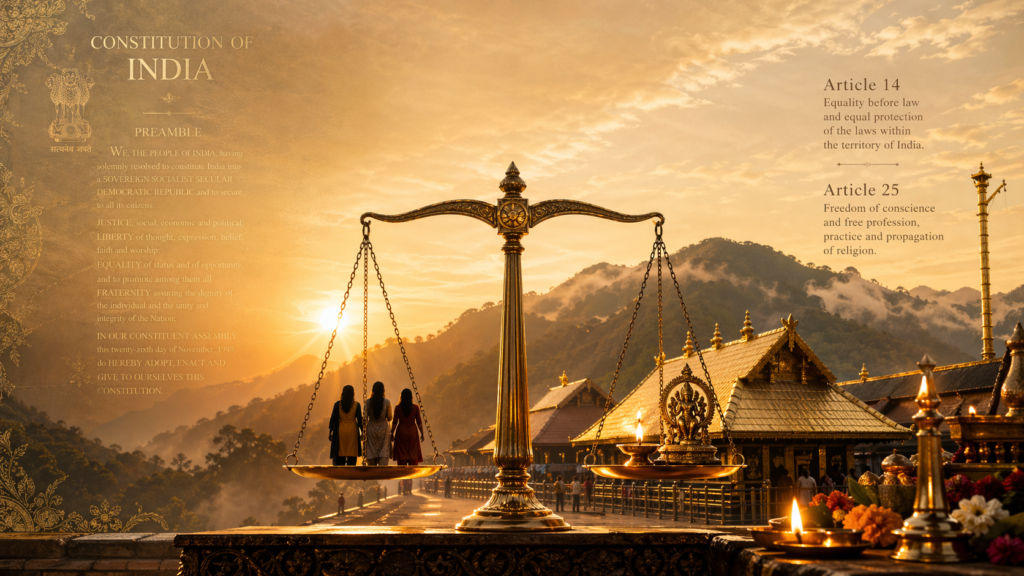
Indian Young Lawyers Association v. State of Kerala: The Sabarimala Case
(2018) 11 SCC 243
Author: Prithvi Mukherjee
Student, Lord’s Universal college of law
—————————————————————————
3 Quick Takeaways
- In Indian Young Lawyers Association v. State of Kerala (2018), the Supreme Court of India held by a majority of 4:1 that the exclusion of women between the ages of ten and fifty from the Sabarimala temple was unconstitutional, violating Articles 14, 15, and 25 of the Constitution.
- The majority held that devotees of Lord Ayyappa do not constitute a separate religious denomination capable of claiming protection under Article 26, and that the exclusion of women on menstrual grounds is not an essential religious practice protected under Article 25.
- The judgment firmly established that constitutional morality must prevail over social and religious customs that violate fundamental rights, particularly the rights to equality, non-discrimination, and religious freedom guaranteed to all citizens, including women.
I. Case Details
Case Name: Indian Young Lawyers Association and Others v. State of Kerala and Others
Citation: (2018) 11 SCC 243
Court: Supreme Court of India
Bench: Five-Judge Constitution Bench
Judges: Dipak Misra, C.J.; R.F. Nariman, J.; A.M. Khanwilkar, J.; D.Y. Chandrachud, J.; Indu Malhotra, J.
Date of Judgment: 28 September 2018
Petitioners: The Indian Young Lawyers Association and other women devotees challenging the exclusion
Respondents: State of Kerala; Travancore Devaswom Board; Chief Thanthri of Sabarimala Temple; Nair Service Society
II. Facts
The Indian Young Lawyers Association v. State of Kerala case revolves around the centuries-old practice of prohibiting women of menstruating age from entering the Sabarimala temple in Kerala. The temple is dedicated to Lord Ayyappa, who is believed to be a “Naisthika Brahmachari,” meaning an eternal celibate. Temple authorities justified the restriction as a custom grounded in religious belief, while the petitioners challenged it on the basis of fundamental rights, particularly the right to gender equality. The case sparked a nationwide debate touching upon deeply rooted religious sentiments, women’s rights, and constitutional principles. The Court was tasked with balancing these conflicting interests.
The exclusion was formalised through Rule 3(b) of the Kerala Hindu Places of Public Worship (Authorisation of Entry) Rules, 1965, framed in exercise of the powers conferred by Section 4 of the Kerala Hindu Places of Public Worship (Authorisation of Entry) Act, 1965. Rule 3(b) authorised the denial of entry to women between the ages of ten and fifty years to the Sabarimala temple.
In 2006, the Indian Young Lawyers Association filed a writ petition under Article 32 before the Supreme Court of India, challenging Rule 3(b) as unconstitutional and as being violative of Articles 14, 15, 25, and 51A(e) of the Constitution. The petition was initially heard by a three-judge bench, which referred the matter to a five-judge Constitution Bench, recognising that the issues involved raised significant constitutional questions. The Court also appointed Senior Counsel Mr. Raju Ramachandran and Mr. K. Ramamoorthy as amici curiae to assist the bench.
On 28 September 2018, the Supreme Court held by a majority of 4:1 that the exclusion of women between the ages of ten and fifty from the Sabarimala temple was unconstitutional. Chief Justice Dipak Misra and Justice A.M. Khanwilkar together held that the restriction violated Articles 14 and 25 of the Constitution. Justices R.F. Nariman and D.Y. Chandrachud delivered concurring opinions, each emphasising constitutional morality and gender equality. Justice Indu Malhotra delivered the sole dissent.
III. Issues
The Supreme Court was called upon to examine the following constitutional questions:
- Whether the exclusion of women of menstruating age from the Sabarimala temple violated Articles 14, 15, and 17 of the Constitution.
- Whether the practice constituted an essential religious practice protected under Articles 25 and 26 of the Constitution.
- Whether the Sabarimala temple could claim protection as a separate religious denomination under Article 26.
- Whether Rule 3(b) of the Kerala Hindu Places of Public Worship (Authorisation of Entry) Rules, 1965 was constitutionally valid.
IV. Arguments of Both Parties
A. Petitioners
The petitioners argued that the exclusion of women between the ages of ten and fifty was a violation of Articles 14, 15, 25, and 51A(e) of the Constitution. They submitted that the Sabarimala temple is not a separate religious denomination, since the religious practices performed there during puja and other ceremonies are not materially different from those performed in any other Hindu temple. The temple does not have its own independent administration; it is administered by a statutory body constituted under the Travancore-Cochin Hindu Religious Institutions Act, 1950, under which the Devaswom Commissioner is required to submit quarterly reports to the Government.
The petitioners relied upon the Shirur Mutt case to argue that only those practices which are essential to a religion are protected under Article 26, meaning that the Court must examine whether a given religious practice truly represents the core of the religion rather than merely an accretion. They also cited the Durgah Committee case, which clarified that clauses (c) and (d) of Article 26 do not create new rights but protect only those that already exist. The petitioners submitted that some practices, including those premised on superstition, may have become associated with a religion over time, but that practices which are harmful to others or contrary to the Constitution cannot claim constitutional protection.
The petitioners further argued that discrimination against women in matters of temple entry is not a core Hindu belief. Hinduism, as a tradition, places women in high esteem, and restricting their entry to a place of worship is contrary to its fundamental principles. They also submitted that even if the devotees of Lord Ayyappa were to constitute a distinct religious group, the temple’s practices allow all categories of pilgrims to enter freely at various other points in the pilgrimage season. They argued that merely observing women does not compromise any vow of celibacy, since the practice of celibacy involves individual spiritual discipline and is not contingent on physical exclusion of women from a particular space. People visit Sabarimala primarily for the blessings of Lord Ayyappa, not to take vows. Accordingly, while religious institutions may regulate the manner of entry for good reason, they may not impose an absolute ban on the entry of an entire class of women.
B. Respondents
The State of Kerala, as the first respondent, adopted a shifting position over the course of the litigation. An affidavit filed in 2007 stated that the government does not support discrimination against women or any other group. However, a subsequent affidavit filed in February 2016 revised this position to support the High Court’s earlier ruling. When called upon to clarify its stand before the Constitution Bench, the State indicated that it relied upon its original 2007 affidavit. Senior Counsel Mr. Jaideep Gupta, appearing for the State, argued that the Kerala Hindu Places of Public Worship (Authorisation of Entry) Act, 1965, and its rules are in consonance with Article 25(2)(b) of the Constitution, which deals with places of worship open to all sections of Hindus. The State’s position was that the legislation does not, on its face, prohibit women’s entry categorically, and that the restriction was a matter of religious practice rather than state-sanctioned discrimination.
The Travancore Devaswom Board, as another respondent, argued that the restrictions are based on long-standing religious custom. It submitted that Lord Ayyappa is worshipped as a celibate deity and that the presence of women of menstruating age would be inconsistent with the deity’s nature and the temple’s sacred character. The Board contended that the devotees of Lord Ayyappa constitute a distinct religious denomination entitled to manage their own religious affairs under Article 26. It further argued that the restriction was not a form of discrimination but an essential religious practice integral to the temple’s tradition, and that the Court should not interfere with such practices.
V. Judgment
The five-judge bench delivered its verdict by a majority of 4:1, with four separate opinions presented by Chief Justice Misra, Justice Nariman, Justice Chandrachud, and Justice Malhotra. Justices Nariman and Chandrachud concurred with the Chief Justice, while Justice Malhotra dissented.
Majority Opinion
The majority held that the exclusion of women from the Sabarimala temple violated Article 14 of the Constitution on the ground that it created an arbitrary and unreasonable classification based on a physiological characteristic unique to women. It further held that the practice violated Article 15, which prohibits discrimination based on sex. The majority held that women have an equal right to practise religion under Article 25, and that the exclusion impairs that right without constitutional justification.
Crucially, the majority held that the devotees of Lord Ayyappa do not constitute a separate religious denomination entitled to claim the protection of Article 26. Since the Sabarimala temple is administered by a statutory body and its practices are not distinct from those of the broader Hindu community in any meaningful doctrinal sense, it cannot claim the autonomy that Article 26 confers upon genuinely distinct denominations. The majority further held that the exclusion of women of menstruating age is not an essential religious practice within the meaning of Article 25 of the Constitution.
The Court emphasised that constitutional morality must prevail over social morality and religious practices that deny equality and dignity to citizens. The exclusion of women from a place of worship is incompatible with the constitutional values of equality and liberty that the Constitution embodies. Accordingly, Rule 3(b) of the Kerala Hindu Places of Public Worship (Authorisation of Entry) Rules, 1965 was declared unconstitutional, and women of all ages were held to be entitled to enter the Sabarimala temple.
Dissenting Opinion
Justice Indu Malhotra delivered the sole dissent. She took the view that courts should exercise restraint when asked to interfere in matters of religious practice and faith. In her opinion, matters of faith should ordinarily be resolved within the religious community itself, and the practice in question was protected under Articles 25 and 26 of the Constitution. She emphasised that the constitutional legitimacy of a religious practice should not be assessed solely by its compatibility with constitutional values, and that judicial humility in matters of deeply held religious belief is itself a constitutional virtue.
VI. Ratio Decidendi
Violation of Article 14 (Equality before Law): The exclusion of women on the basis of a biological characteristic such as menstruation is arbitrary and discriminatory, and therefore violates the guarantee of equality under Article 14 of the Constitution.
Violation of Article 15 (Prohibition of Discrimination): Denying women entry to the temple solely on the basis of sex, a ground expressly prohibited under Article 15(1), cannot be sustained.
Not an Essential Religious Practice: The restriction on women’s entry is not an essential religious practice protected under Articles 25 or 26 of the Constitution.
Devotees of Lord Ayyappa Are Not a Separate Religious Denomination: Since the devotees form part of the broader Hindu community and the temple is administered by a statutory body, they cannot claim protection as a distinct religious denomination under Article 26 to justify the exclusion.
Constitutional Morality Must Prevail: The Court affirmed that constitutional morality must prevail over religious customs that violate fundamental rights, particularly the rights to gender equality and human dignity.
VII. Conclusion and Observations
The judgment in Indian Young Lawyers Association v. State of Kerala remains a landmark ruling in Indian constitutional jurisprudence. By declaring the exclusion unconstitutional, the Supreme Court reaffirmed that equality, liberty, and dignity are foundational values that must guide the interpretation of religious practice. The Court clarified that religious freedom cannot override fundamental rights guaranteed to every citizen under Part III of the Constitution, and that the Constitution’s vision of a just and equal society extends equally to the threshold of a place of worship.
At the same time, the dissent in this case serves an important function. It highlights the institutional significance of respecting religious autonomy and the need for courts to exercise considered restraint when intervening in matters of deeply held faith. The widespread societal debate that followed the judgment, including review petitions and references to larger benches on related questions, reflects the complexity involved in calibrating the relationship between tradition and constitutional principle in a pluralistic democracy like India. The case has established that constitutional morality is not simply a check on the state but a standard by which all practices, including religious ones, must ultimately be measured when they bear upon the fundamental rights of citizens.
References
- Indian Young Lawyers Association v. State of Kerala, (2018) 11 SCC 243 (India).
- Kerala Hindu Places of Public Worship (Authorisation of Entry) Act, 1965.
- Kerala Hindu Places of Public Worship (Authorisation of Entry) Rules, 1965, Rule 3(b).
- Travancore-Cochin Hindu Religious Institutions Act, 1950.
- India Const. arts. 14, 15, 17, 25, 26, 32, 51A(e).
Disclaimer: The views expressed in this article are those of the author and do not necessarily reflect the views of The Lawscape.
The Lawscape — clear, practical legal insight for students and future lawyers.