
Sarla Mudgal v. Union of India (1995): Religious Conversion, Bigamy, and the Quest for a Uniform Civil Code
AUTHOR – Yashasvi Jaiswal
Student at Sage University, IndoreSage University,Indore
——————————————————————————————
Court: Supreme Court of India
Bench: Justice Kuldip Singh and Justice R.M. Sahai
Case Citation: Sarla Mudgal v. Union of India, AIR 1995 SC 1531.
Introduction
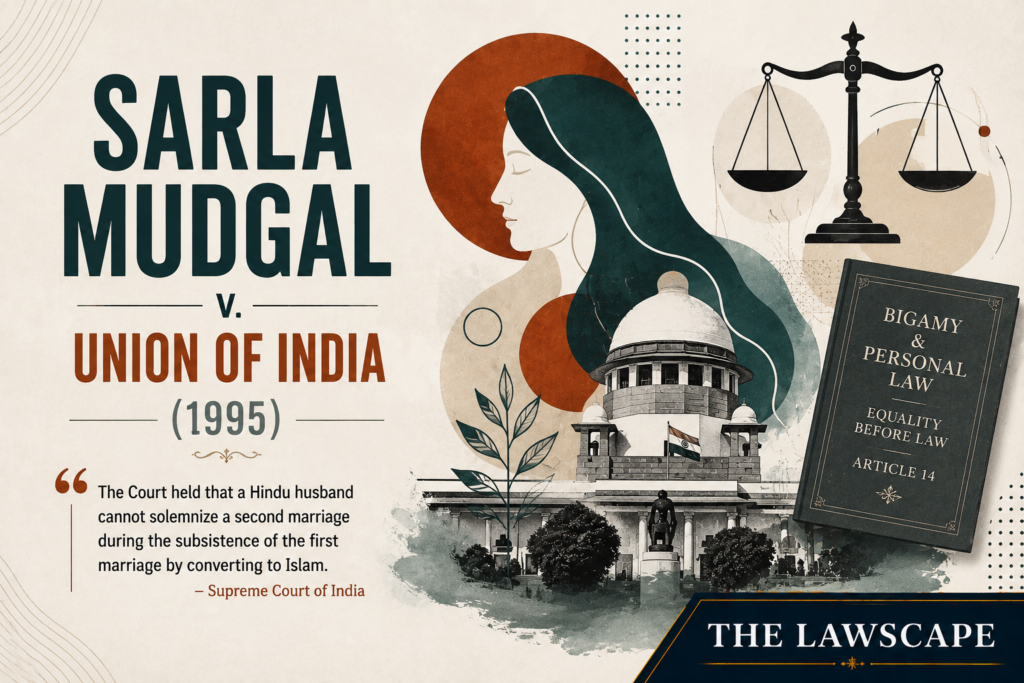
The case of Sarla Mudgal v. Union of India is one of those landmark decisions that sits right at the intersection of personal laws, gender justice, and constitutional principles. At its core, the case deals with a sensitive yet significant issue—whether a Hindu husband, already married under Hindu law, can convert to Islam solely for the purpose of entering into a second marriage without dissolving the first one. While this may seem like a personal choice at first glance, the Court had to look deeper into whether such a conversion was genuine or merely a tool to bypass legal restrictions.
This case is also remembered for reigniting the long-standing debate on the need for a Uniform Civil Code under Article 44 of the Constitution. The central question before the Court was whether a Hindu man, already married under Hindu law, could convert to Islam simply to contract a second marriage without dissolving the first. What makes this case particularly important is not just the legal answer, but the broader message it sends—that law cannot be bypassed through technical or strategic religious conversion.¹
Facts of the Case
The case was not based on a single petition but rather a group of petitions filed by different women who found themselves in similar distressing situations. One of the main petitioners, Sarla Mudgal, was the president of an NGO called “Kalyani,” which worked for the welfare of women.
The common thread across all petitions was that their husbands, who were originally Hindus and married under the Hindu Marriage Act, had converted to Islam. However, this conversion was not driven by faith or belief—it was done to legally justify a second marriage, as Islamic law permits polygamy under certain conditions.
For example, in one of the petitions, a husband named Meena had converted to Islam and married another woman without divorcing his first wife. The first wife challenged this action, arguing that her husband’s conversion was merely a façade to escape the legal consequences of bigamy under Hindu law.
Issues Before the Court
The Supreme Court had to address several important legal questions:
- Whether a Hindu husband, married under the Hindu Marriage Act, can convert to Islam and marry again without dissolving the first marriage.
- Whether such a second marriage would be valid under the law.
- Whether the act of conversion for the sole purpose of remarriage amounts to misuse of religion.
- Whether such actions would attract the offence of bigamy under Section 494 of the Indian Penal Code.2
Arguments
The petitioners argued that allowing such conversions would create a loophole in the law, enabling men to exploit religious freedom for personal gain. They emphasized that this practice was unjust to women and violated their rights, leaving them without proper legal protection.
On the other hand, the respondents contended that once a person converts to Islam, they are governed by Muslim personal law, which allows multiple marriages. Therefore, the second marriage should be considered valid.
Judgment
The Supreme Court took a firm stand against such practices. It held that a Hindu marriage solemnized under the Hindu Marriage Act can only be dissolved through legal means provided under that Act. Simply converting to another religion does not automatically dissolve the first marriage.
The Court clearly stated that if a Hindu husband converts to Islam and marries again without divorcing his first wife, the second marriage would be void. Moreover, such an act would amount to the offence of bigamy under Section 494 of the IPC.3
The judges emphasized that religion cannot be used as a tool to defeat legal obligations. Conversion must be genuine and based on faith, not convenience.
Reasoning of the Court
- What stands out in this judgment is the Court’s attempt to balance religious freedom with social justice. The judges recognized that while the Constitution guarantees the right to freely profess and practice religion under Article 25, this right is not absolute.4
- The Court observed that allowing such conversions would lead to injustice, especially against women, who are often left in vulnerable positions without legal remedies. It pointed out that personal laws should not be misused in a way that undermines the dignity and rights of individuals.
- Interestingly, the Court also used this opportunity to highlight the importance of a Uniform Civil Code. It expressed concern that the absence of a common set of laws governing marriage and divorce often leads to such conflicts and exploitation.5
Significance of the Case
- This judgment is significant for several reasons. First, it closed a major loophole in the law that allowed men to escape the consequences of bigamy by simply changing their religion. It reinforced the idea that legal obligations cannot be avoided through superficial means.
- Second, the case brought attention to the need for protecting women’s rights within the framework of personal laws. It highlighted how legal systems must evolve to ensure fairness and justice, especially for those who are often at a disadvantage.
- Third, the Court’s remarks on the Uniform Civil Code sparked widespread discussion and debate. While the Court did not mandate its implementation, it strongly advocated for it as a step toward legal uniformity and national integration.
Critical Analysis
While the judgment was widely appreciated for its progressive stance, it also attracted some criticism. Some argued that the Court overstepped its boundaries by commenting on the Uniform Civil Code, which is essentially a matter of legislative policy.
Others pointed out that the decision could be seen as interfering with religious freedom. However, a closer reading shows that the Court was not against conversion itself—it was against the misuse of conversion as a legal loophole.
From a broader perspective, the case reflects the ongoing struggle between tradition and modernity in Indian law. It shows how courts often have to step in to interpret laws in a way that aligns with constitutional values.
Conclusion
Sarla Mudgal v. Union of India is more than just a case about bigamy—it is a reflection of the challenges involved in balancing personal laws with constitutional principles. The Supreme Court’s decision made it clear that religion cannot be used as a shield to justify actions that are otherwise illegal.
The case also serves as a reminder that the law must ultimately protect the vulnerable and uphold justice. Even today, it remains a crucial reference point in discussions around personal laws, gender equality, and the Uniform Civil Code.
Footnotes
- Sarla Mudgal v. Union of India, AIR 1995 SC 1531.
- Indian Penal Code, 1860, 494.
- Sarla Mudgal v. Union of India, AIR 1995 SC 1531.
- Constitution of India, Art. 25.
- Constitution of India, Art. 44.
Disclaimer: The views expressed in this article are those of the author and do not necessarily reflect the views of The Lawscape.
The Lawscape — clear, practical legal insight for students and future lawyers.