
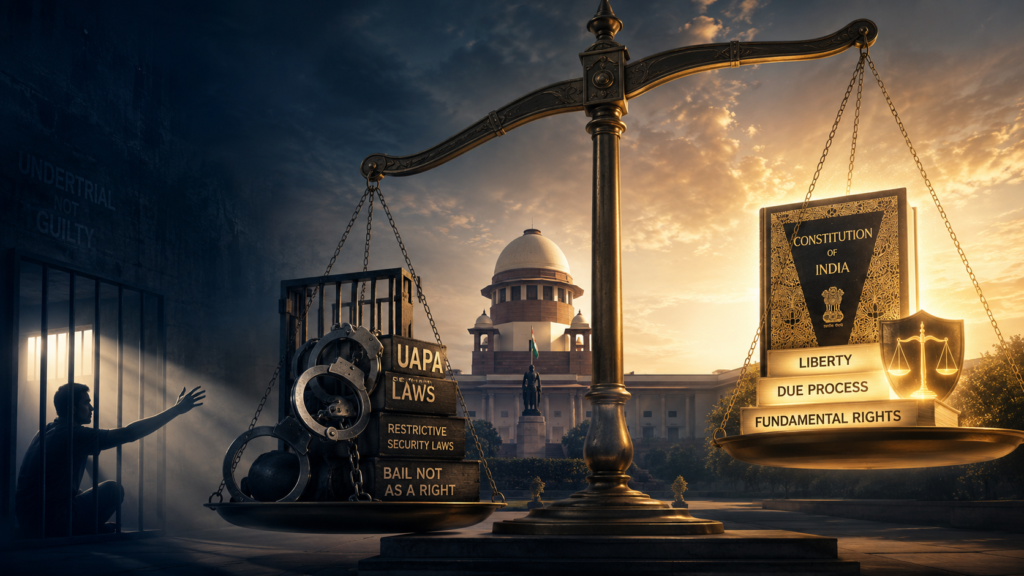
Bail is the Rule, Jail is the Exception: How UAPA Inverts the Constitutional Promise of Liberty
Author: Yadu Krishna K G
Student, Bharata Mata School of Legal Studies, Aluva, Kerala
—————————————————————————————————–
💡 3 Quick Takeaways
- Section 43D(5) of the UAPA has transformed bail from a constitutional norm into a rare exception.
- Judicial interpretations of the UAPA often result in prolonged pre-trial detention without conviction.
- Reforming the UAPA bail framework is essential to reconcile national security concerns with constitutional guarantees of liberty.
Abstract
The Unlawful Activities (Prevention) Act, 1967 (UAPA), through Section 43D(5), has effectively reversed one of the foundational principles of Indian criminal jurisprudence: that bail is the rule and jail the exception. This article examines how the UAPA bail provision, as interpreted by courts in a series of recent cases, operates as a near-absolute bar on pre-trial liberty, leaving accused persons in prolonged detention that amounts, in practice, to punishment without conviction. Drawing on the cases of Umar Khalid, Siddique Kappan, and Sonam Wangchuk, the article analyses the tension between national security imperatives and the constitutional guarantee of personal liberty under Article 21. It argues that while the State has a legitimate interest in addressing terrorism, the current framework fails the test of proportionality, conflates lawful dissent with unlawful activity, and places the burden of disproving accusations on the accused. The article concludes with suggestions for reform that would bring the UAPA bail regime into closer alignment with constitutional values.
Keywords: UAPA, Bail, Article 21, Personal Liberty, National Security, Dissent, Section 43D(5)
Introduction
On 5 January 2026, the Supreme Court of India delivered a 142-page, 444-paragraph judgment on a bail application. The accused had already spent more than five years in pre-trial detention. He had not been convicted of any offence. Yet, the Court denied him bail.
The accused was Umar Khalid, a former doctoral researcher at Jawaharlal Nehru University, arrested in September 2020 in connection with the North-East Delhi riots. He was charged under Sections 13, 16, 17, and 18 of the Unlawful Activities (Prevention) Act, 1967 (UAPA). The Supreme Court, in a judgment authored by Justices Aravind Kumar and N.V. Anjaria, described him as an “architect” of the alleged conspiracy and denied bail.
Indian criminal law has long recognised that personal liberty is of paramount importance and that pre-conviction detention is a serious matter. The Supreme Court articulated this principle in State of Rajasthan v. Balchand, where Justice V.R. Krishna Iyer famously declared that “bail is the rule, jail is the exception.” That principle rests on Article 21 of the Constitution, which guarantees that no person shall be deprived of life or personal liberty except according to procedure established by law.
The UAPA, particularly through Section 43D(5), has effectively inverted this principle. Under its operation, bail becomes the exception and incarceration becomes the norm.
This article does not contend that terrorism is not a serious threat, nor does it deny the State’s legitimate interest in detaining individuals who pose genuine dangers to public safety. Rather, it argues that the current UAPA bail regime fails the constitutional test of proportionality, punishes individuals before conviction, and is increasingly applied to conduct that falls within the scope of lawful democratic dissent.
The UAPA Bail Provision: What Section 43D(5) Actually Says
Section 43D(5) of the UAPA provides that a court shall not grant bail if, upon perusal of the case diary or the report submitted under Section 173 of the Code of Criminal Procedure, it is of the opinion that there are reasonable grounds for believing that the accusation against the accused is prima facie true.
On its face, this appears to be a standard bail consideration. The difficulty lies in the judicial interpretation of the phrase “prima facie true.” In National Investigation Agency v. Zahoor Ahmad Shah Watali, the Supreme Court held that courts, at the bail stage, are not required to assess evidence as they would during trial. Instead, they need only determine whether the accusations appear prima facie true on a broad consideration of the available material.
Consequently, a chargesheet containing allegations—however contested—often becomes sufficient to deny bail. The accused is generally unable to effectively challenge that material at the pre-trial stage.
The result is a structural inversion of ordinary criminal procedure. In conventional criminal cases, the prosecution bears the burden of justifying continued detention. Under the UAPA framework, as interpreted through Watali, the accused must effectively establish that the accusation is not prima facie true—a burden that is exceedingly difficult to discharge before the evidence is tested through trial.
Three Cases, One Pattern
The practical consequences of this framework become evident when examining three cases that arose in different contexts yet reveal a common pattern.
Umar Khalid was arrested in September 2020, approximately seven months after the North-East Delhi riots of February 2020. The prosecution alleged that he was part of a conspiracy to orchestrate violence coinciding with a foreign dignitary’s visit and that speeches delivered during protests against the Citizenship Amendment Act formed part of that conspiracy.
His bail applications were rejected by the Sessions Court in March 2022, by the Delhi High Court in October 2022, and ultimately by the Supreme Court in January 2026. By the time the Supreme Court delivered its decision, he had spent more than five years in custody without conviction. The Court relied substantially on the content of his speeches, treating them as evidence of conspiratorial intent rather than protected expression under Article 19(1)(a) of the Constitution.
The case of Siddique Kappan presents an equally compelling example. Kappan, a journalist and Delhi Secretary of the Kerala Union of Working Journalists, was travelling to Hathras, Uttar Pradesh, in October 2020 to report on a gang rape and murder case that had attracted national attention. He was arrested en route and charged under the UAPA as well as provisions of the Indian Penal Code.
He remained in custody for nearly two years. When the Supreme Court finally granted bail in September 2022, it questioned how travelling to report on a matter of public concern could constitute a UAPA offence and observed that nothing provocative had been recovered from him at the time of arrest.
The case of Sonam Wangchuk raises similar concerns in the context of preventive detention. Wangchuk, a climate activist and educationist from Ladakh, was detained under the National Security Act, 1980 (NSA), in September 2025 following protests demanding statehood and Sixth Schedule protections for Ladakh.
His wife filed a habeas corpus petition before the Supreme Court. Over the course of five months, the Court conducted twenty-four hearings. However, three days before the matter was scheduled to resume, the Ministry of Home Affairs revoked the detention order. The Supreme Court consequently disposed of the petition as infructuous, leaving unanswered the constitutional validity of the detention.
Across all three cases, a common pattern emerges. Detention is prolonged. Trials remain distant or absent. Convictions are lacking. Yet state action is directed against conduct that lies close to the boundary between legitimate democratic participation and what authorities characterise as unlawful activity.
The Constitutional Problem: Article 21 and the Test of Proportionality
Article 21 guarantees that no individual shall be deprived of life or personal liberty except according to procedure established by law. The Supreme Court has repeatedly held that such procedure must be fair, just, and reasonable.
In Maneka Gandhi v. Union of India, the Court clarified that any law affecting personal liberty must satisfy the test of reasonableness. Later, in K.S. Puttaswamy v. Union of India, the nine-judge Bench articulated a four-pronged proportionality test requiring that state action be sanctioned by law, pursue a legitimate objective, be proportionate to that objective, and contain adequate procedural safeguards against abuse.
The UAPA bail regime struggles particularly with the third and fourth requirements. Even if combating terrorism is accepted as a legitimate state objective, a near-absolute restriction on bail is difficult to justify as a proportionate means of achieving that goal. Less restrictive alternatives are available, including stringent bail conditions, electronic monitoring, surrender of travel documents, and periodic reporting requirements.
The procedural concerns are equally serious. Accused persons have limited opportunities to challenge the material relied upon by the prosecution, while trials often take years to conclude. If an accused is ultimately acquitted, the years spent in detention cannot be restored.
The Supreme Court recognised the gravity of wrongful detention in Rudul Sah v. State of Bihar, where compensation was awarded for illegal incarceration. Yet compensation after acquittal remains an inadequate substitute for liberty during the pendency of proceedings.
There is also a broader chilling effect. When speeches at public protests are treated as evidence of terrorism, when journalism becomes grounds for arrest, and when demands for constitutional protections invite preventive detention, citizens receive a powerful message regarding the risks associated with dissent. Even absent conviction, such a message can significantly constrain the freedoms guaranteed by Articles 19 and 21.
The Judicial Response: Caution Where Courage Is Needed
The judiciary’s response to UAPA bail cases has been mixed.
The judgment in Siddique Kappan demonstrated judicial willingness to question the basis of state action, but only after nearly two years of incarceration. In contrast, the Supreme Court’s judgment in Umar Khalid’s case extensively examined the factual record yet ultimately accepted that the accusations were prima facie true without fully considering whether the alleged conduct constituted constitutionally protected speech.
The Wangchuk matter concluded without any determination on the merits because the detention order was revoked before the Court could pronounce upon its legality.
This pattern reflects a broader tendency to defer to executive claims concerning national security. While some degree of deference may be understandable, it cannot be unlimited. The Court’s own proportionality jurisprudence in Puttaswamy requires meaningful judicial scrutiny even in matters involving national security.
A more encouraging development emerged in Mortuza Hussain Choudhary v. State of Nagaland, where the Supreme Court described preventive detention as “draconian” and insisted upon strict adherence to statutory safeguards. However, similar scrutiny must become a consistent feature of UAPA bail jurisprudence.
Suggestions for Reform
Three reforms would bring the UAPA bail framework closer to constitutional principles without undermining the State’s ability to address genuine security threats.
First, the interpretation adopted in Watali should be revisited. Courts should require the prosecution to demonstrate that the specific conduct alleged falls within the scope of offences under the UAPA, rather than permitting broad allegations of conspiracy to justify continued detention.
Second, a statutory limitation on pre-trial detention should be introduced. Courts should be required to grant bail where trials fail to conclude within a specified period, unless exceptional circumstances justify continued incarceration.
Third, courts should insist upon a clear and direct nexus between the alleged conduct and the offences enumerated under the UAPA before invoking the Section 43D(5) restriction. The Act was enacted to address threats involving terrorism, violence, and secessionism. Its extension to political speech, journalism, and demands for constitutional protections represents a significant expansion of its original purpose.
Conclusion
“Bail is the rule, jail is the exception” reflects a foundational constitutional principle governing the relationship between the State and the individual. It embodies the idea that the presumption of innocence extends beyond trial and that the State must justify detention rather than requiring citizens to justify their liberty.
The UAPA, in its present operation, has effectively reversed that principle. Section 43D(5), interpreted through Watali, creates a regime in which pre-trial detention can continue for years while trials proceed slowly, if at all.
The experiences of Umar Khalid, Siddique Kappan, and Sonam Wangchuk are not anomalies. They illustrate the practical consequences of a framework that increasingly permits prolonged incarceration in cases involving political expression, journalism, and civic activism.
Perhaps the starkest example emerged on 22 May 2026, when the Delhi High Court granted Umar Khalid interim bail for only three days—from 1 June to 3 June—so that he could be present during his mother’s surgery and attend his uncle’s Chehlum ceremony. He was required to remain within the National Capital Region, visit only the hospital, and return to Tihar Jail by 5:00 PM on 3 June.
This episode captures the nature of liberty under the present regime: temporary, conditional, and exceptional. Significantly, the High Court itself observed that even under the UAPA, “bail is the rule and jail is the exception,” and that constitutional protections under Articles 21 and 22 cannot be ignored.
The constitutional promise of personal liberty is not suspended merely because the State invokes national security. The proportionality test remains applicable. The presumption of innocence remains applicable. And the principle that bail is the rule—not the exception—remains applicable.
Until the UAPA bail framework is reformed to reflect these constitutional commitments, the distance between constitutional promise and lived reality will remain profound.
Disclaimer: The views expressed in this article are those of the author and do not necessarily reflect the views of The Lawscape.
The Lawscape — clear, practical legal insight for students and future lawyers.