
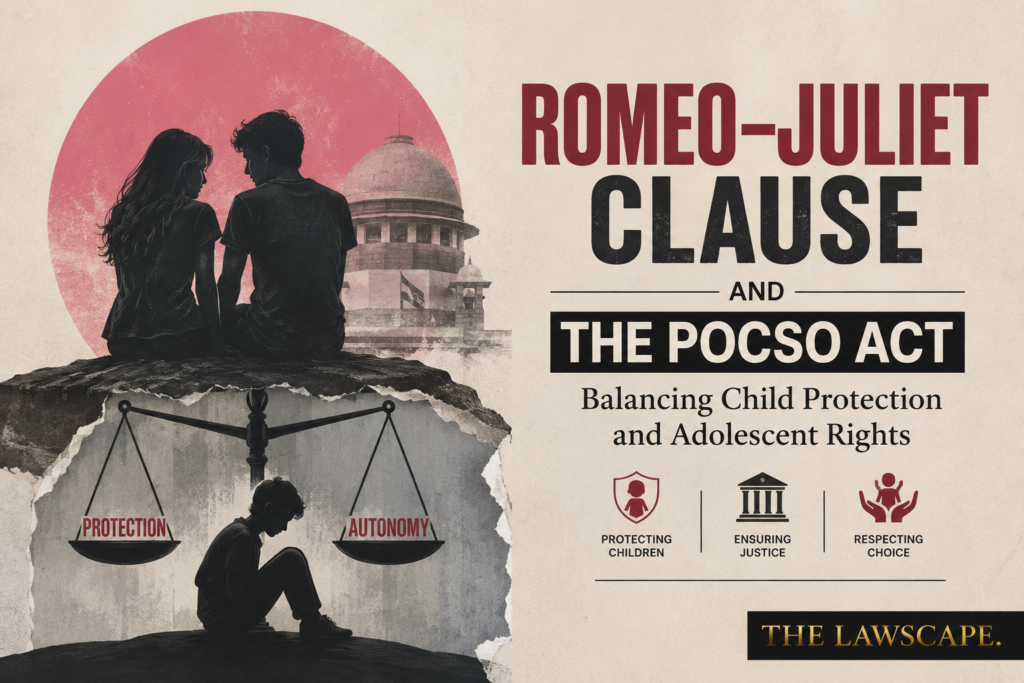
Romeo–Juliet Clause and the POCSO Act: Balancing Child Protection and Adolescent Rights
Author: Srishti Singh
Student, Gujarat national law University, silvassa
——————————————————————————————-
💡 3 Quick Takeaways
- The Supreme Court’s decision in State of Uttar Pradesh v. Anurudh & Anr. has reignited debate regarding the criminalisation of consensual adolescent relationships under the POCSO Act.
- A Romeo–Juliet Clause, or close-in-age exemption, seeks to distinguish consensual adolescent relationships from exploitative sexual conduct without weakening child protection laws.
- Constitutional principles of equality, privacy, dignity, and personal liberty provide a strong foundation for reconsidering the current approach to adolescent consent under Indian law.
Abstract
The Supreme Court of India, in State of Uttar Pradesh v. Anurudh & Anr., delivered a significant judgment on 9 January 2026 that has reignited legislative and constitutional debate surrounding the Protection of Children from Sexual Offences Act, 2012 (POCSO Act). The Court recognised growing concerns regarding the application of child protection laws to consensual adolescent relationships and urged consideration of a statutory “Romeo–Juliet Clause” or close-in-age exemption.
This article examines the conceptual foundations of the Romeo–Juliet Clause, the facts and observations in the landmark judgment, the systemic concerns regarding the application of the POCSO Act to consensual adolescent relationships, comparative international approaches, constitutional arguments under Articles 14, 19, and 21 of the Constitution of India, and the future prospects for legislative reform.
The article argues that while the POCSO Act remains a critical safeguard against child sexual abuse and exploitation, its strict liability framework may, in certain circumstances, criminalise consensual adolescent relationships that differ fundamentally from exploitative conduct. A carefully designed close-in-age exemption may help reconcile child protection objectives with adolescent rights and constitutional values.
Keywords: Romeo–Juliet Clause, POCSO Act, Adolescent Rights, Age of Consent, Close-in-Age Exemption, Child Protection, Consensual Relationships, Criminal Law Reform
Introduction
The Protection of Children from Sexual Offences Act, 2012 (POCSO Act) occupies a central position within India’s child protection framework. Enacted to combat sexual exploitation and abuse of children, the legislation reflects the State’s commitment to safeguarding minors from harm.
However, the implementation of the Act has generated an important legal and social paradox.
A statute intended to protect vulnerable children has increasingly been invoked in cases involving consensual adolescent relationships. In several documented instances, criminal proceedings have arisen not from allegations of exploitation or abuse but from family opposition to relationships involving caste, religion, or social considerations.
The POCSO Act operates through a strict liability framework. Since every individual below eighteen years of age is legally considered a child, the law does not distinguish between exploitative sexual conduct and consensual age-proximate adolescent relationships.
This rigid approach has prompted growing concern among judges, legal scholars, and civil society organisations. Critics argue that the law, while serving a legitimate protective purpose, sometimes fails to recognise the realities of adolescent development and consensual relationships between teenagers.
The Supreme Court’s intervention in State of Uttar Pradesh v. Anurudh & Anr. has brought renewed attention to this issue and intensified discussions regarding the possible introduction of a statutory close-in-age exemption in India.
Understanding the Romeo–Juliet Clause
A Romeo–Juliet Clause, commonly referred to as a close-in-age exemption, is a legal mechanism that protects adolescents from criminal liability when they engage in consensual romantic or sexual relationships with partners who are close to them in age.
The concept originated in comparative criminal jurisprudence, particularly in the United States, where legislators recognised the potential unfairness of prosecuting teenage partners under statutory rape laws.
The objective of such provisions is not to weaken protections against sexual abuse or exploitation. Rather, they seek to distinguish between predatory conduct involving significant power imbalances and consensual relationships between adolescents who are at similar developmental stages.
The underlying rationale is that criminal law should focus on preventing exploitation rather than penalising ordinary adolescent behaviour.
Many jurisdictions across the world have adopted similar safeguards.
Comparative International Approaches
United States
Several American states recognise close-in-age exemptions where consensual sexual relationships occur between adolescents whose age difference falls within prescribed limits.
Canada
Section 150.1 of the Canadian Criminal Code provides close-in-age exemptions for certain consensual relationships involving minors, subject to specific age-gap limitations and safeguards.
United Kingdom
The United Kingdom maintains an age of consent of sixteen years while incorporating broader proportionality considerations within its sexual offences framework.
These international models reflect legislative recognition that consensual adolescent relationships differ fundamentally from exploitative sexual conduct and may therefore warrant separate legal treatment.
State of Uttar Pradesh v. Anurudh & Anr. (2026)
Facts and Procedural Background
The case arose from an FIR registered at Police Station Kotwali, Orai, District Jalaun, Uttar Pradesh, under Sections 363 and 366 of the Indian Penal Code and Sections 7 and 8 of the POCSO Act.
The accused sought bail before the Allahabad High Court. While granting bail, the High Court issued broader directions applicable to POCSO cases generally, including directions concerning age determination and the evidentiary value of medical opinions.
The State of Uttar Pradesh challenged these directions before the Supreme Court, arguing that:
- The High Court had exceeded its jurisdiction while exercising bail powers; and
- The directions conflicted with the legislative scheme contained in Section 94 of the Juvenile Justice (Care and Protection of Children) Act, 2015.
Supreme Court’s Decision on Age Determination
The Supreme Court allowed the appeal and set aside the impugned directions.
The Court held that age determination is a matter to be adjudicated during trial in accordance with the evidentiary framework prescribed by Section 94 of the Juvenile Justice Act. It further clarified that bail courts cannot override the statutory mechanism established by Parliament regarding age determination.
The judgment therefore reaffirmed the importance of adhering to the legislative framework while avoiding judicial overreach at the bail stage.
The Romeo–Juliet Observation and Its Constitutional Importance
Although the Court resolved the procedural issue before it, the judgment extended beyond technical questions of age determination.
The Bench observed that the repeated application of the POCSO Act to consensual adolescent relationships reflected a broader social and legal problem. It acknowledged concerns regarding the use of child protection laws in situations that may not involve exploitation or abuse.
Significantly, the Court recommended that the judgment be forwarded to the Secretary, Department of Legal Affairs, Government of India, for consideration of measures aimed at addressing misuse of the law, including the possible introduction of a Romeo–Juliet Clause.
The Court also stressed the responsibility of legal professionals to exercise caution in such cases and avoid becoming instruments in disputes where criminal proceedings may be driven by motives unrelated to genuine child protection concerns.
These observations are particularly noteworthy because they represent a direct institutional call for legislative engagement with a recurring issue that courts have increasingly encountered.
Systemic Concerns Regarding the POCSO Act
The concerns expressed in Anurudh are not isolated.
Judicial observations across various courts have repeatedly highlighted the growing number of cases involving consensual adolescent relationships prosecuted under the POCSO Act.
According to the empirical study referenced by the author, an analysis of 7,064 POCSO judgments between 2016 and 2020 revealed that approximately 24.3% of cases involved romantic relationships. A substantial majority of complaints in such cases were reportedly initiated by parents rather than by the adolescents themselves.
Legal commentators have similarly suggested that a significant proportion of POCSO prosecutions arise from romantic relationships that later become criminal cases due to familial or social opposition.
The article further notes NCRB data indicating substantial registration of POCSO offences, with a considerable number of adolescents themselves becoming subjects of criminal proceedings.
These trends have prompted growing concern that the law may sometimes operate beyond its original protective purpose.
Judicial Responses Across India
Several courts have previously acknowledged the challenges posed by consensual adolescent relationships under the POCSO framework.
The Madras High Court, in multiple decisions, has emphasised the need for legislative consideration of close-in-age exemptions.
Similarly, the Delhi High Court has recognised that adolescent relationships may form a natural part of social and emotional development and that criminal liability should not automatically follow in every such case.
However, the judiciary’s ability to address the issue remains limited. Courts can decide individual disputes, but comprehensive reform requires legislative intervention.
As the Supreme Court observed in Anurudh, structural problems ultimately require structural solutions.
Legislative History of Reform Discussions
The debate surrounding adolescent consent is not new.
The Justice Verma Committee, constituted following the 2012 Nirbhaya incident, recommended reducing the age of consent from eighteen to sixteen years. Parliament, however, chose to retain the age threshold at eighteen.
More recently, the Law Commission of India revisited the issue. Although it did not recommend reducing the age of consent, it suggested introducing greater flexibility in sentencing for consensual cases involving adolescents.
These developments demonstrate that the issue has remained a recurring subject of legal and policy debate.
Constitutional Arguments
Article 14: Equality Before Law
Article 14 prohibits arbitrary classification and guarantees equality before the law.
The article argues that treating a predatory adult offender and an adolescent involved in a consensual relationship with a similarly aged partner under the same legal framework may create concerns regarding reasonable classification.
A close-in-age exemption would seek to differentiate between fundamentally different factual situations while preserving protection against genuine exploitation.
Article 21: Privacy, Dignity, and Personal Liberty
Article 21 protects personal liberty, privacy, dignity, and autonomy.
Following Justice K.S. Puttaswamy v. Union of India (2017), privacy has been recognised as encompassing intimate personal decision-making.
The article argues that blanket criminalisation of all consensual adolescent relationships may raise questions regarding proportionality and individual autonomy, particularly where no exploitation is involved.
Article 19 and Adolescent Autonomy
The author also connects the debate to broader constitutional freedoms and emerging recognition of adolescent decision-making capacity.
International human rights principles, particularly those reflected in the United Nations Convention on the Rights of the Child (UNCRC), acknowledge the concept of evolving capacities, under which adolescents gradually acquire increasing autonomy as they mature.
These principles inform contemporary discussions regarding the balance between protection and autonomy.
Concerns Regarding Reform
Despite support for a Romeo–Juliet Clause, legitimate concerns remain.
Critics argue that introducing exemptions could expose vulnerable adolescents to coercive relationships disguised as consensual interactions. Others caution that perpetrators may misuse such provisions to avoid liability.
These concerns highlight the need for any reform to be carefully designed rather than broadly framed.
The challenge lies in protecting adolescents from exploitation while avoiding unnecessary criminalisation of consensual conduct.
Proposed Safeguards
The article proposes several safeguards that could accompany a close-in-age exemption:
- A clearly defined maximum permissible age difference;
- A minimum age threshold below which no exemption would apply;
- Verification of genuine and voluntary consent;
- Judicial discretion where factual disputes arise; and
- Exclusion of relationships involving authority, trust, dependency, or coercion.
Such safeguards would help ensure that child protection objectives remain intact while addressing concerns regarding over-criminalisation.
Conclusion
The Supreme Court’s judgment in State of Uttar Pradesh v. Anurudh & Anr. has brought renewed urgency to an issue that has occupied courts, scholars, and policymakers for several years.
The POCSO Act remains one of India’s most important child protection statutes. However, the increasing number of prosecutions involving consensual adolescent relationships has exposed a tension between the objectives of child protection and the realities of adolescent development.
The Court’s recommendation regarding a Romeo–Juliet Clause does not weaken the commitment to protecting children. Rather, it invites consideration of whether the law should distinguish between exploitation and consensual age-proximate relationships.
Comparative international experience demonstrates that such distinctions can be incorporated without compromising safeguards against abuse.
The constitutional values of equality, dignity, privacy, and personal liberty further strengthen the case for legislative examination of the issue.
Ultimately, the challenge is not whether children should be protected—they unquestionably must be—but whether the law can protect children while simultaneously avoiding the criminalisation of adolescents engaged in consensual relationships. The answer may lie in a carefully drafted statutory framework that balances protection, autonomy, and proportionality in a manner consistent with constitutional principles and contemporary social realities.
Disclaimer: The views expressed in this article are those of the author and do not necessarily reflect the views of The Lawscape.
The Lawscape — clear, practical legal insight for students and future lawyers.