
Menstrual Hygiene and Constitutional Dignity: Reimagining Menstrual Justice Through Fundamental Rights
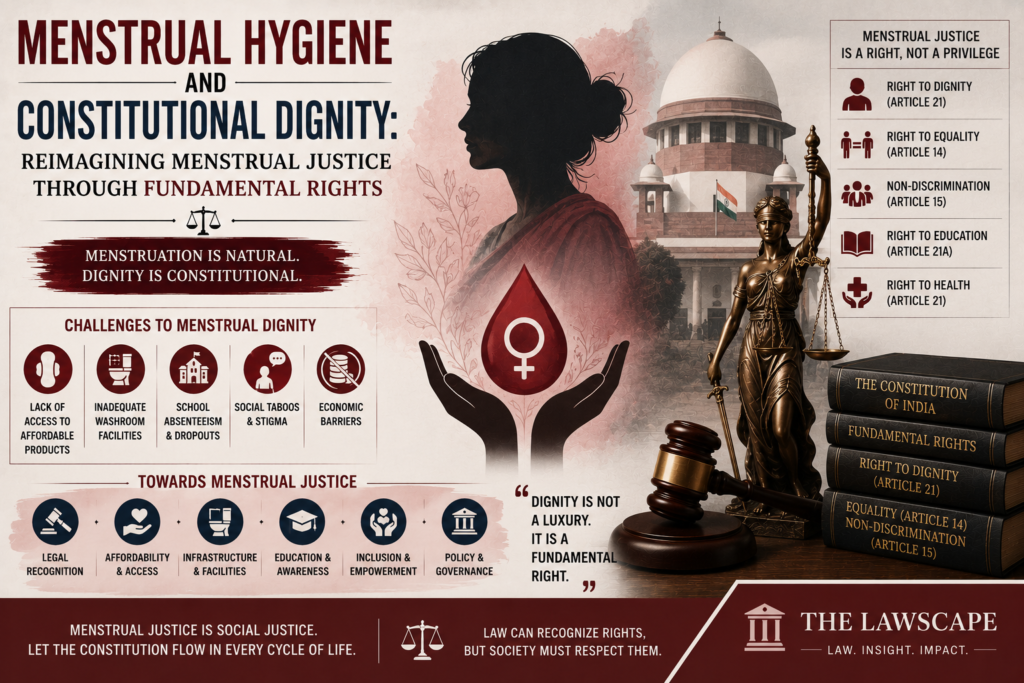
Author: Manjiri Vaidya
Student, Government New Law College Indore
———————————————————————–
💡 3 Quick Takeaways
- The Supreme Court’s decision in Dr. Jaya Thakur v. Government of India & Ors. recognises Menstrual Health and Hygiene (MHH) as an integral component of constitutional rights under Article 21.
- Menstrual dignity is closely connected to equality, bodily autonomy, privacy, health, and educational access under Articles 14, 15, and 21 of the Constitution.
- Legal recognition alone is insufficient; meaningful menstrual justice requires infrastructure, awareness, affordability, and effective implementation.
Introduction
Menstruation is a natural biological process experienced by millions of women and menstruating individuals. Despite its universality, menstruation in India continues to be shaped by patriarchal attitudes, cultural taboos, and social stigma. It is frequently associated with shame, secrecy, impurity, exclusion, and discrimination, affecting the dignity and well-being of those who menstruate.
The consequences of these attitudes are particularly visible among adolescent girls, women from rural communities, and economically disadvantaged groups. Inadequate access to sanitary products, lack of awareness, poor sanitation facilities, and the absence of safe disposal mechanisms often result in chronic absenteeism, educational disruption, and reduced participation in social and professional life.
Against this backdrop, the Supreme Court’s decision in Dr. Jaya Thakur v. Government of India & Ors. (2026) marks a significant constitutional development. The Court recognised Menstrual Health and Hygiene (MHH) as an essential component of the right to life and dignity under Article 21 and connected menstrual hygiene to equality, bodily autonomy, privacy, and educational access under Articles 14, 15, and 21 of the Constitution.
The judgment represents an important step towards recognising menstrual dignity as a constitutional entitlement rather than a mere welfare concern. This article examines the concept of menstrual hygiene, its constitutional foundations, the recent judgment, and the broader social, legal, and workplace implications of menstrual justice in India.
Understanding Menstrual Hygiene and Constitutional Dignity
Menstrual Hygiene
Menstrual hygiene refers to the safe and hygienic management of menstruation through access to:
- Affordable and safe sanitary products;
- Clean water;
- Functional sanitation facilities;
- Safe disposal mechanisms; and
- Adequate awareness regarding menstrual health.
The absence of these essentials may lead to infections, discomfort, psychological distress, social exclusion, and reduced educational and economic participation.
Consequently, menstrual hygiene must be viewed not merely as a health concern but as an issue of public health, gender justice, and constitutional rights.
Constitutional Dignity
Constitutional dignity refers to the recognition of every individual’s intrinsic worth, bodily integrity, autonomy, and equal participation in society.
The Supreme Court has consistently interpreted Article 21 to encompass dignity, privacy, and personal autonomy. Within the context of menstruation, constitutional dignity requires that women and menstruating individuals have access to facilities and conditions that protect them from humiliation, exclusion, discrimination, and stigma.
Menstrual dignity therefore demands access to sanitation infrastructure, healthcare, awareness, and supportive environments that allow individuals to manage menstruation safely and with dignity.
Constitutional Framework
Article 14: Equality Before Law
Article 14 guarantees equality before the law and equal protection of laws.
A lack of menstrual facilities creates indirect discrimination by disproportionately affecting women and girls. Inadequate access to sanitary products, toilets, and menstrual support systems limits educational opportunities and social participation.
The principle of substantive equality requires the State to recognise biological realities and provide facilities necessary to ensure equal participation in public life.
Article 15: Prohibition of Discrimination
Article 15 prohibits discrimination on grounds of sex.
The denial of adequate menstrual facilities and the persistence of menstrual stigma reinforce patriarchal structures that restrict women’s participation in education, employment, and public spaces.
Addressing menstrual inequities therefore forms an important component of gender equality.
Article 21: Right to Life and Personal Liberty
Article 21 provides the strongest constitutional basis for menstrual dignity.
The right to life extends beyond mere survival and includes dignity, privacy, bodily autonomy, and meaningful participation in society.
Without access to basic menstrual facilities, individuals cannot fully exercise these rights. The Supreme Court’s recognition of menstrual health as a constitutional entitlement significantly expands the scope of Article 21 and reinforces the State’s obligation to ensure dignified conditions for menstruating individuals.
Historical Background
Historically, menstruation has been surrounded by myths, taboos, and restrictions rooted in patriarchal social structures.
Women were frequently excluded from religious ceremonies, kitchens, educational activities, and social gatherings during menstruation. Menstruation was often regarded as a private and impure matter, resulting in social isolation and discrimination.
The situation was further exacerbated by inadequate healthcare infrastructure and limited awareness. In many regions, women relied on unsafe materials such as cloth, ash, hay, or sand due to poverty and the unavailability of sanitary products.
Over time, feminist movements, public health initiatives, and women’s rights organisations challenged these practices and highlighted menstruation as an issue of dignity, equality, and public health.
Government initiatives such as:
- The Scheme for Promotion of Menstrual Hygiene;
- Menstrual Hygiene Management programmes;
- Swachh Bharat Mission guidelines; and
- The Pradhan Mantri Bharatiya Janaushadhi Pariyojana’s “Suvidha” sanitary napkins,
have contributed to improving awareness and access.
Despite these developments, social stigma, infrastructural deficiencies, and economic barriers continue to affect menstrual health outcomes across India.
The Supreme Court’s Decision in Dr. Jaya Thakur v. Government of India & Ors. (2026)
In Dr. Jaya Thakur v. Government of India & Ors. (2026), the Supreme Court recognised Menstrual Health and Hygiene as an integral component of the right to life under Article 21.
The Court observed that the absence of adequate menstrual facilities undermines:
- Human dignity;
- Equality;
- Bodily autonomy;
- Privacy; and
- The right to education.
Accordingly, the Court issued several directions requiring governments and educational institutions to ensure:
- Free oxo-biodegradable sanitary napkins;
- Functional gender-segregated toilets with running water and soap;
- Menstrual Hygiene Management corners;
- Environmentally compliant waste disposal mechanisms;
- Teacher training programmes on menstrual awareness;
- Gender-sensitive menstrual education through NCERT and SCERT curricula;
- Regular inspections by district authorities; and
- Monitoring by National and State Child Rights Commissions.
The judgment transformed menstrual hygiene from a policy objective into an enforceable constitutional obligation.
Critical Analysis of the Judgment
The judgment represents a significant advancement in constitutional jurisprudence and gender-sensitive governance.
By recognising menstrual dignity as a constitutional entitlement, the Court acknowledged the lived realities of women and girls and reinforced the principle of substantive equality.
The decision also reflects an understanding that educational access, health, dignity, and autonomy are interconnected. Ensuring menstrual hygiene therefore becomes essential to meaningful participation in social and public life.
However, implementation remains a major challenge.
Many schools and institutions continue to lack:
- Functional toilets;
- Reliable water supply;
- Maintenance staff;
- Sanitary disposal systems; and
- Adequate menstrual awareness programmes.
Without sufficient funding, monitoring, and institutional commitment, the transformative potential of the judgment may remain unrealised.
Consequently, legal recognition must be accompanied by practical measures capable of addressing persistent infrastructural and social barriers.
Judicial Perspective
The Court’s reasoning reflects a broader constitutional commitment to dignity, liberty, and equality.
By recognising menstrual hygiene as a constitutional issue rather than merely a welfare concern, the judgment challenges restrictive social customs and patriarchal attitudes that have historically marginalised menstruating individuals.
The decision aligns with earlier constitutional jurisprudence.
In Suchita Srivastava v. Chandigarh Administration, the Supreme Court recognised reproductive choice as part of personal liberty under Article 21.
Similarly, in Justice K.S. Puttaswamy v. Union of India, the Court emphasised privacy, dignity, and bodily autonomy as fundamental rights.
The menstrual hygiene judgment builds upon these principles by affirming that biological processes cannot become grounds for humiliation, exclusion, or discrimination.
Social and Workplace Perspectives
Menstruation continues to be treated as a taboo subject in many parts of Indian society.
Silence, stigma, and misinformation contribute to discrimination and social exclusion. Many adolescent girls experience embarrassment and fear due to inadequate awareness and the absence of open conversations regarding menstrual health.
In educational institutions, poor sanitation infrastructure and inadequate support systems frequently contribute to absenteeism and school dropouts.
Similar challenges exist within workplaces. Inadequate sanitation facilities and the absence of gender-sensitive workplace policies often affect women’s comfort, productivity, and dignity.
The social and workplace dimensions of menstrual justice therefore require broader institutional and cultural change alongside legal reform.
Continuing Challenges
Despite judicial recognition of menstrual dignity, several challenges remain.
Infrastructural Deficiencies
Many schools, colleges, and public institutions continue to lack:
- Functional toilets;
- Running water;
- Sanitary products; and
- Safe disposal facilities.
Menstrual Poverty
Economic barriers continue to prevent many women and girls from accessing affordable sanitary products, particularly in rural and economically disadvantaged communities.
Social Stigma
Deep-rooted cultural attitudes continue to portray menstruation as shameful or impure, discouraging discussion and awareness.
Educational Barriers
Lack of menstrual support systems contributes to absenteeism, educational inequality, and school dropouts among adolescent girls.
Workplace Challenges
The absence of gender-sensitive workplace policies and sanitation facilities affects the dignity and productivity of women employees.
Environmental Concerns
Improper disposal of menstrual waste presents environmental and public health challenges, highlighting the need for sustainable menstrual products and disposal mechanisms.
Weak Implementation
Inadequate funding, insufficient monitoring, and limited accountability often undermine the effective implementation of menstrual health policies.
These challenges demonstrate that menstrual justice requires more than judicial recognition; it requires sustained institutional commitment.
Key Findings
This study highlights several important findings:
- Menstrual hygiene is intrinsically linked to dignity, equality, bodily autonomy, and reproductive health.
- Social stigma and patriarchal attitudes continue to undermine menstrual justice.
- Lack of menstrual facilities contributes to absenteeism, educational inequality, and social exclusion.
- The Supreme Court has expanded Article 21 by recognising menstrual dignity as an enforceable constitutional right.
- The State now bears positive obligations to ensure access to sanitary products, sanitation infrastructure, awareness programmes, and dignified conditions.
- Persistent infrastructural deficiencies, menstrual poverty, and weak implementation continue to obstruct effective realisation of these rights.
Suggestions
Meaningful menstrual justice requires a comprehensive approach extending beyond legal recognition.
Key measures include:
- Establishing functional toilets, water supply systems, and sanitary disposal facilities in schools, colleges, and workplaces;
- Ensuring affordable and accessible sanitary products, particularly in rural and economically disadvantaged communities;
- Incorporating menstrual awareness and gender sensitisation programmes into educational curricula;
- Strengthening monitoring mechanisms and allocating adequate funding;
- Implementing gender-sensitive workplace policies;
- Promoting environmentally sustainable menstrual products and disposal systems; and
- Ensuring that menstrual health policies are inclusive of trans men and non-binary individuals who menstruate.
Only through coordinated legal, social, educational, and infrastructural reforms can meaningful menstrual justice be achieved.
Conclusion
Menstrual hygiene is not merely a matter of personal health; it is fundamentally connected to dignity, equality, bodily autonomy, and constitutional justice.
The Supreme Court’s decision in Dr. Jaya Thakur v. Government of India & Ors. represents a transformative moment in constitutional jurisprudence by recognising Menstrual Health and Hygiene as an enforceable component of fundamental rights.
The judgment affirms that menstruation cannot be a basis for exclusion, discrimination, or indignity and places positive obligations upon the State to ensure supportive and dignified conditions for menstruating individuals.
However, constitutional recognition alone cannot eliminate menstrual injustice. Persistent stigma, menstrual poverty, inadequate infrastructure, and weak implementation continue to undermine access to dignity and equality.
Achieving true gender justice requires sustained efforts to ensure that every woman and menstruating individual can manage menstruation safely, affordably, and with dignity. Only then can the constitutional promise of equality, autonomy, and human dignity be fully realised.
Disclaimer: The views expressed in this article are those of the author and do not necessarily reflect the views of The Lawscape.
The Lawscape — clear, practical legal insight for students and future lawyers.