
The Legality of Restaurant Service Charges in India: From Trade Custom to Consumer Rights Protection
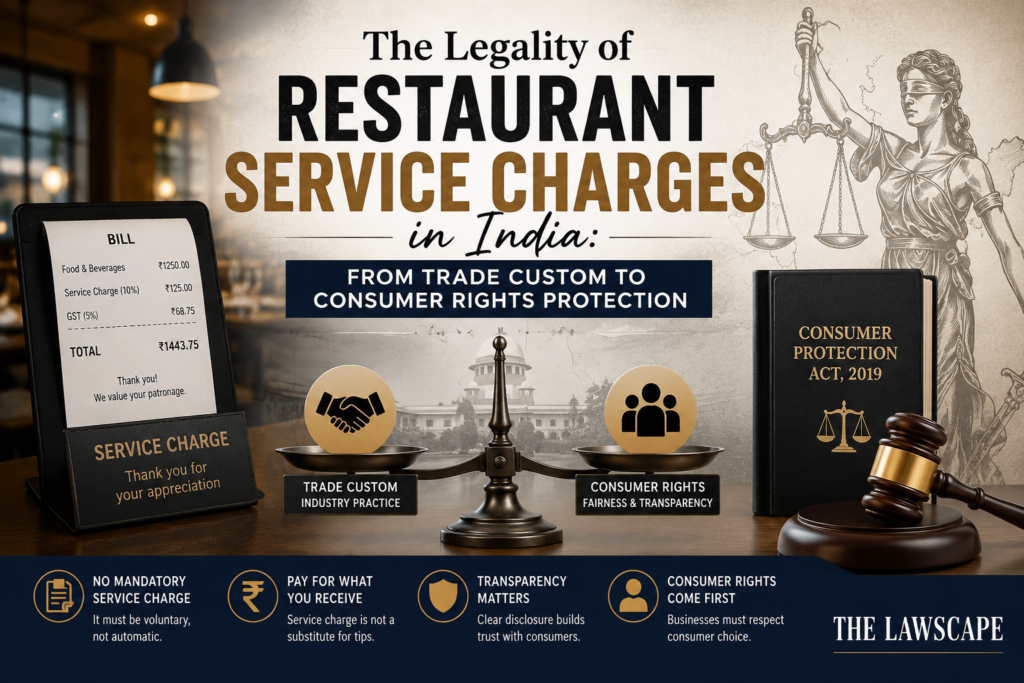
Author: Komal Ramdayal Satwe
Student, Indian Institute Of Management Rohtak, Nagpur
—————————————————————————————————————-
💡 3 Quick Takeaways
- The Delhi High Court’s 2025 decision in National Restaurant Association of India v. Union of India upheld the CCPA Guidelines prohibiting the automatic levy of service charges by restaurants.
- Mandatory service charges were found to undermine pricing transparency, consumer consent, and protections guaranteed under the Consumer Protection Act, 2019.
- The hospitality industry is increasingly transitioning toward menu-integrated pricing and voluntary digital gratuities, reinforcing consumer choice and contractual fairness.
Introduction
The relationship between pricing and consumer consent has long occupied a central position within consumer protection law. In India’s hospitality sector, one of the most contentious issues has been the practice of imposing restaurant service charges—a percentage-based addition to the food bill levied before the application of statutory taxes.
Historically, hospitality industry associations justified service charges as a mechanism for employee welfare and equitable distribution of gratuities among staff members. However, consumer groups and regulatory authorities increasingly questioned the practice, arguing that service charges were often imposed without meaningful consent, lacked transparency, and functioned as compulsory surcharges rather than voluntary contributions.
A critical distinction emerged between service charges and voluntary tips. While gratuities traditionally reflect a customer’s voluntary assessment of service quality after a meal, service charges are automatically added to the bill by the establishment. This distinction ultimately became central to the legal debate concerning consumer autonomy, informed consent, and fair pricing practices.
The controversy reached its peak following the issuance of the Central Consumer Protection Authority (CCPA) Guidelines on 4 July 2022, which prohibited the automatic or default levy of service charges by hotels and restaurants. These guidelines were challenged by hospitality industry associations before the Delhi High Court, resulting in the landmark decision of National Restaurant Association of India v. Union of India delivered on 28 March 2025.
This article examines the historical evolution of service charges in India, the legal and consumer protection concerns surrounding the practice, empirical evidence regarding consumer behaviour, the regulatory framework established by the CCPA, and the judicial developments that culminated in the Delhi High Court’s affirmation of consumer rights and pricing transparency.
Service Charge and Tip: Understanding the Distinction
A clear understanding of the dispute requires distinguishing between a service charge and a tip.
A restaurant transaction ordinarily involves a consumer agreeing to purchase food and beverages at prices displayed on the menu, together with applicable statutory taxes. The menu price is generally understood to include the cost of both goods and services associated with the dining experience.
A tip, by contrast, is a voluntary payment made directly by a customer to restaurant staff after service has been rendered. It reflects the customer’s independent assessment of the quality of service received and remains entirely discretionary.
A service charge differs fundamentally from a tip. Rather than being voluntary, it is predetermined by the establishment and automatically added to the consumer’s bill. Consequently, the consumer loses the freedom to decide whether to reward service and, if so, to what extent.
The central legal concern therefore becomes whether an automatically imposed service charge represents a valid contractual term or whether it amounts to an unfair and non-consensual surcharge imposed without meaningful consumer choice.
Historical Evolution of Service Charges in India
The practice of service charges in India predates modern consumer protection legislation by several decades.
The Dewan Chaman Lal Committee
One of the earliest institutional examinations of tipping practices occurred through the Dewan Chaman Lal Committee Report of June 1958.
The Committee sought to address inconsistencies and inequities associated with individual tipping systems by encouraging a more organized method of collecting and distributing gratuities among hospitality workers.
Delhi Wage Board Recommendations
The practice was further formalized by recommendations issued by the Delhi Wage Board in October 1964.
The Board proposed a service charge model ranging between 5% and 10% and suggested a structured allocation mechanism:
- 45% for employees;
- 30% towards wage obligations;
- 15% for breakage-related contingencies; and
- 10% for staff welfare purposes.
These recommendations reinforced the hospitality industry’s position that service charges formed an important component of labour and welfare arrangements.
Judicial Treatment in Labour Law
Several judicial decisions subsequently addressed service charges within the context of labour and employment disputes.
In Management of Wenger & Co. v. Their Workmen, the Supreme Court observed that gratuities could not substitute for fair wages payable by employers.
Similarly, in The Rambagh Palace Hotel, Jaipur v. Rajasthan Hotel Workers’ Union, the Court held that tips and service charges collected from customers represented transfers of money from patrons to employees, with management merely acting as an intermediary.
In M/s Quality Inn Southern Star v. Regional Director, ESIC, the Supreme Court further held that service charges collected and distributed by management did not constitute “wages” under the Employees’ State Insurance Act because employers merely facilitated distribution.
While these cases recognized service charges within employment contexts, they did not directly address the legality of imposing mandatory service charges upon consumers under consumer protection laws.
Consumer Grievances and Market Concerns
As service charges evolved from industry practice into routine billing mechanisms, significant consumer concerns emerged.
Lack of Genuine Consent
One of the principal objections concerned the absence of meaningful consumer consent.
In many establishments, service charges were automatically added to bills regardless of customer preferences or satisfaction with service quality.
Consumers frequently discovered the surcharge only after receiving the final bill.
Double Taxation Concerns
Another major concern involved the interaction between service charges and the Goods and Services Tax (GST).
Restaurants commonly calculated GST on the combined value of food items and service charges. As a result, consumers effectively paid statutory tax on an additional private surcharge.
This practice increased the overall cost of dining and contributed to consumer confusion regarding the nature of the charge.
Ambiguous Billing Practices
Consumer complaints also highlighted the use of unclear terminology.
Bills often contained abbreviations such as:
- “SER”;
- “CHGS”;
- “S. CHARGE”; or
- “SRVCGH”.
Such descriptions frequently obscured the nature of the charge and reduced pricing transparency.
Coercive Recovery Practices
Consumers who requested removal of service charges often reported hostile responses from establishments.
Complaints included allegations of:
- Refusal to modify bills;
- Verbal intimidation;
- Obstruction of exits; and
- Pressure to pay disputed charges.
These practices further intensified concerns regarding fairness and consumer rights.
Consumer Behaviour and Pricing Transparency
Empirical studies concerning consumer psychology and pricing behaviour provide significant insights into the service charge debate.
Research comparing direct menu price increases with separate surcharges demonstrates that consumers generally perceive transparent pricing as fairer and more trustworthy.
Consumers react negatively when additional charges are imposed after purchase decisions have effectively been made. Separate surcharges are frequently viewed as mechanisms that conceal the true cost of a transaction.
Survey data cited in the article reveals several important trends:
- 98.6% of respondents preferred restaurants that did not impose service charges;
- Only 1.4% preferred establishments that retained service charges;
- 44.1% of consumers checked whether a restaurant imposed service charges before deciding where to dine; and
- 91.7% preferred slightly higher menu prices if doing so eliminated separate service charges and improved bill predictability.
These findings suggest that transparent pricing enhances consumer confidence and may strengthen long-term customer loyalty.
The evidence further indicates that menu-integrated pricing not only promotes legal compliance but may also offer commercial advantages to hospitality businesses.
The CCPA Guidelines of 2022
A significant regulatory shift occurred when the Central Consumer Protection Authority issued guidelines on 4 July 2022 under the Consumer Protection Act, 2019.
The guidelines prohibited the automatic or default addition of service charges by restaurants and hotels.
The CCPA reasoned that the cost of service was already reflected in menu prices and identified several legal violations associated with compulsory service charges.
Unfair Trade Practice
The CCPA classified mandatory service charges as an unfair trade practice under Section 2(47) of the Consumer Protection Act, 2019.
According to the Authority, automatic service charges misrepresented the actual price at which services were offered and misled consumers regarding transaction costs.
Unfair Contract
The practice was also characterized as an unfair contract under Section 2(46).
Consumers generally lacked any meaningful opportunity to negotiate, waive, or reject the charge, resulting in significant imbalance between the parties.
Restrictive Trade Practice
The CCPA further concluded that mandatory service charges constituted a restrictive trade practice under Section 2(41).
The requirement effectively imposed an additional financial obligation as a condition for receiving restaurant services.
The Delhi High Court Decision of 2025
The hospitality industry, represented by the National Restaurant Association of India (NRAI) and the Federation of Hotel and Restaurant Associations of India (FHRAI), challenged the CCPA Guidelines before the Delhi High Court.
The associations argued that the guidelines:
- Violated their right to carry on trade under Article 19(1)(g);
- Interfered with pricing autonomy; and
- Lacked statutory authority.
Although an interim stay was granted in July 2022 subject to specific conditions, the litigation ultimately culminated in a landmark judgment delivered on 28 March 2025.
Upholding Consumer Protection
Justice Prathiba M. Singh dismissed the petitions and upheld the CCPA Guidelines in their entirety.
The Court vacated the interim stay and imposed costs upon both industry associations.
Reasonable Restriction Under Article 19(6)
The Court held that no fundamental right under Article 19(1)(g) is absolute.
The prohibition on mandatory service charges constituted a reasonable restriction designed to protect consumers from coercive pricing practices while preserving the freedom of restaurants to determine menu prices.
Rejection of the Implied Contract Theory
The Court rejected arguments based on implied contractual consent.
Even where menu disclaimers purported to notify consumers about service charges, the Court held that such arrangements could amount to unconscionable bargains because consumers lacked meaningful bargaining power.
Relying on Central Inland Water Transport Corporation Ltd. v. Brojo Nath Ganguly, the Court emphasized that contracts imposing unilateral obligations upon consumers may be invalid where significant inequality exists between the parties.
Mandatory Levies as Sovereign Functions
The Court further held that the power to impose mandatory charges resembling taxes or compulsory levies belongs exclusively to public authorities.
Private entities cannot transform voluntary gratuities into mandatory financial obligations.
Accordingly, compulsory service charges were found to be inconsistent with consumer protection principles and contractual fairness.
Post-Judgment Enforcement
Following the Delhi High Court’s decision, the CCPA initiated extensive enforcement measures across the country.
Several restaurants and restaurant chains faced regulatory scrutiny, penalties, and refund orders for continuing to impose automatic service charges.
The enforcement campaign emphasized:
- Removal of automatic service charges;
- Consumer refunds;
- Billing transparency;
- Compliance audits; and
- Grievance redressal mechanisms.
The National Consumer Helpline also processed substantial numbers of complaints concerning service charge practices, reinforcing the significance of the issue from a consumer protection perspective.
The Future of Restaurant Billing in India
The hospitality industry is increasingly adapting to the post-2025 regulatory landscape.
Menu-Integrated Pricing
Many establishments have begun incorporating operational and employee welfare costs directly into menu prices rather than imposing separate charges.
This approach promotes transparency and reduces billing disputes.
Voluntary Contributions
Some businesses have adopted optional contribution models allowing customers to support staff welfare funds voluntarily.
Importantly, such contributions remain entirely discretionary.
Digital Tipping Systems
Technology has facilitated the growth of digital gratuity systems.
QR-code-based payment platforms increasingly offer customers optional tipping choices at checkout, enabling gratuities to be transferred directly to service staff while preserving customer choice.
These developments align with the broader objective of ensuring transparency, fairness, and consumer autonomy.
Conclusion
The legal evolution of restaurant service charges in India reflects a broader shift toward strengthening consumer rights and promoting pricing transparency.
While service charges originated as industry practices linked to employee welfare and tipping systems, their transformation into mandatory surcharges generated significant concerns regarding consent, contractual fairness, and consumer protection.
The CCPA Guidelines of 2022 and the Delhi High Court’s decision in National Restaurant Association of India v. Union of India have firmly established that historical trade practices cannot override statutory consumer rights. Restaurants remain free to determine the prices of their goods and services, but they cannot impose additional compulsory charges without genuine consumer consent.
The industry’s gradual transition toward menu-integrated pricing and voluntary digital gratuities demonstrates that consumer protection and commercial viability need not be mutually exclusive.
Ultimately, the move away from mandatory service charges represents a significant victory for transparency, contractual fairness, and consumer sovereignty. It reinforces the principle that consumers must be informed of the true price of services before making purchasing decisions and preserves their right to exercise meaningful choice within the marketplace.
Disclaimer: The views expressed in this article are those of the author and do not necessarily reflect the views of The Lawscape.
The Lawscape — clear, practical legal insight for students and future lawyers.