
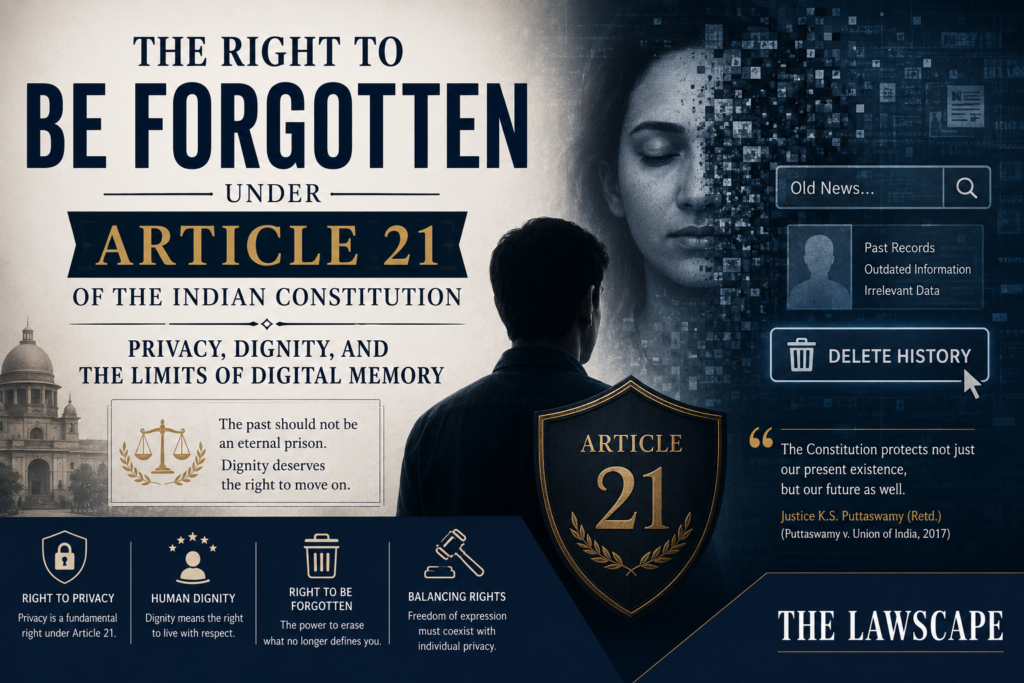
The Right to Be Forgotten Under Article 21 of the Indian Constitution: Privacy, Dignity, and the Limits of Digital Memory
Author: Rupesh Ranga
Student MDU Centre for Professional and Allied Studies, Gurugram
—————————————————————————————–
💡 3 Quick Takeaways
- The Right to Be Forgotten (RTBF) has emerged in India as an aspect of informational privacy protected under Article 21 following the Supreme Court’s decision in K.S. Puttaswamy v. Union of India.
- Indian courts remain divided on the extent of RTBF, particularly where privacy interests conflict with open justice, judicial transparency, and public access to court records.
- A balanced framework based on identity masking and selective redaction, rather than complete erasure of judicial records, may better reconcile dignity, privacy, and transparency.
Introduction
In the pre-digital era, human memory naturally faded with time. Personal disputes, mistakes, and unfortunate incidents gradually disappeared from public consciousness, allowing individuals to move forward with their lives. The digital age has fundamentally altered this reality. Search engines now function as permanent repositories of information, preserving records indefinitely and making them accessible to anyone with an internet connection.
A single online search can reveal an individual’s past mistakes, criminal accusations, matrimonial disputes, or personal controversies long after their legal or social relevance has ended. Such information can adversely affect employment opportunities, professional growth, social relationships, and personal reputation, often creating a lasting stigma.
Against this backdrop, the Right to Be Forgotten (RTBF) has emerged as a significant dimension of privacy jurisprudence. The right is increasingly understood as an extension of the broader Right to Privacy, which the Supreme Court of India recognized as a fundamental right under Article 21 of the Constitution in Justice K.S. Puttaswamy v. Union of India.
The RTBF generally refers to an individual’s ability, subject to legal limitations, to seek removal, masking, or restricted access to personal information that is no longer relevant, necessary, or legally justified. Importantly, the right does not necessarily require complete deletion of all information. Rather, it seeks to prevent perpetual and unjustified circulation of personal data that undermines dignity and autonomy.
India, however, does not yet possess a dedicated statutory framework exclusively governing the Right to Be Forgotten. Consequently, individuals often approach constitutional courts seeking relief under Article 21, resulting in evolving and sometimes inconsistent judicial approaches.
This article examines the constitutional foundations of the RTBF, the judicial developments surrounding informational privacy, the conflict between privacy and open justice, the implications of the Digital Personal Data Protection Act, 2023, and the need for a balanced legal framework capable of protecting both individual dignity and judicial transparency.
Constitutional Foundation of the Right to Be Forgotten
Privacy Before Puttaswamy
For several decades, Indian constitutional jurisprudence did not explicitly recognize privacy as a fundamental right.
In M.P. Sharma v. Satish Chandra and Kharak Singh v. State of Uttar Pradesh, the Supreme Court either rejected or narrowly interpreted claims seeking constitutional protection of privacy.
This position remained largely unchanged until the landmark decision in Justice K.S. Puttaswamy v. Union of India.
The Puttaswamy Judgment
In 2017, a nine-judge Constitution Bench unanimously held that privacy constitutes a fundamental right protected under Part III of the Constitution and forms an intrinsic component of the right to life and personal liberty under Article 21.
The Court emphasized that privacy is indispensable to:
- Human dignity;
- Personal autonomy;
- Individual liberty;
- Freedom of choice; and
- Self-determination.
The judgment recognized that an individual’s ability to control personal information forms an essential aspect of constitutional freedom.
The Court further clarified that privacy is not confined to protection against physical intrusion. Instead, it extends to informational privacy and an individual’s control over personal data in the digital environment.
Consequently, the constitutional basis for the Right to Be Forgotten emerged from the broader recognition of informational privacy within Article 21.
Informational Privacy in the Digital Age
Traditional privacy law primarily focused on physical intrusions such as unauthorized entry into homes, searches, surveillance, and interference with personal spaces.
The digital revolution transformed this understanding.
Modern privacy concerns now include:
- Data collection;
- Online profiling;
- Search engine indexing;
- Permanent digital archives;
- Social media dissemination; and
- Long-term storage of personal information.
The internet has effectively eliminated the natural process through which society once forgot past events.
Justice S.K. Kaul, in his concurring opinion in Puttaswamy, highlighted the dangers of permanent digital memory. Information available online can continue to define individuals indefinitely, even where they have been acquitted, rehabilitated, or otherwise moved beyond the circumstances reflected in the records.
Such permanence can interfere with:
- Reputation;
- Employment opportunities;
- Social reintegration;
- Personal development; and
- Human dignity.
The Right to Be Forgotten therefore seeks not merely to remove data but to preserve an individual’s ability to move forward without being permanently burdened by historical information that no longer serves a legitimate purpose.
Privacy Is Not an Absolute Right
Although Puttaswamy recognized informational privacy, the Supreme Court did not characterize privacy as an unrestricted right.
The Court emphasized that constitutional rights frequently require balancing against competing public interests.
An unlimited Right to Be Forgotten could potentially:
- Restrict freedom of expression;
- Undermine journalistic reporting;
- Weaken public accountability;
- Interfere with historical records; and
- Impair access to judicial proceedings.
The Constitution simultaneously protects freedom of speech and expression under Article 19(1)(a), creating an inherent tension between privacy and transparency.
Certain categories of information possess enduring public significance and cannot simply be erased because they are inconvenient or embarrassing.
Judicial records, in particular, play an important role in ensuring accountability, public confidence, and transparency within the legal system.
Consequently, the RTBF must be balanced against the constitutional principle of open justice.
Judicial Development of the Right to Be Forgotten
The absence of comprehensive legislation has resulted in courts developing RTBF jurisprudence on a case-by-case basis.
This process has produced divergent judicial outcomes.
Privacy-Oriented Approach
Jorawar Singh Mundy v. Union of India
One of the most significant RTBF decisions emerged from the Delhi High Court in Jorawar Singh Mundy v. Union of India.
The petitioner had been acquitted of criminal charges. Despite his acquittal being upheld, online search results continued to display judicial records concerning the allegations.
The petitioner argued that continued online accessibility adversely affected his employment opportunities and reputation.
The Delhi High Court recognized the continuing harm caused by digital permanence and directed the removal or blocking of access to the judgment through search engines.
The decision acknowledged that individuals may continue to suffer reputational consequences even after legal exoneration.
Karthick Theodore v. Registrar General
The Madras High Court similarly adopted a sympathetic approach toward individuals seeking to move beyond past legal disputes.
The Court recognized the importance of allowing individuals to regain normalcy and avoid perpetual social consequences arising from past proceedings.
These decisions reflect a privacy-centred approach emphasizing dignity, rehabilitation, and informational autonomy.
Transparency-Oriented Approach
Dharamraj Bhanushankar Dave v. State of Gujarat
A contrasting position emerged in Dharamraj Bhanushankar Dave v. State of Gujarat.
The Gujarat High Court refused to direct removal of judicial records from public access.
The Court emphasized that judicial records are not merely private information but constitute part of the public legal archive.
According to the Court:
- Judicial transparency is a constitutional value;
- Public access promotes accountability;
- Court records form part of legal history; and
- Selective removal risks permitting individuals to rewrite historical events.
The decision represents one of the strongest judicial rejections of RTBF claims in India and highlights concerns regarding censorship and historical revisionism.
The Constitutional Dilemma: Privacy Versus Open Justice
The divergence among High Courts has elevated the debate to a matter of national constitutional significance.
The central issue is not whether privacy is important or whether transparency is valuable. Both principles enjoy constitutional protection.
The challenge lies in reconciling:
- Privacy and dignity under Article 21;
- Freedom of expression under Article 19(1)(a); and
- The principle of open justice.
Open courts promote:
- Public confidence in the judiciary;
- Judicial accountability;
- Development of legal precedent; and
- Democratic transparency.
At the same time, unrestricted digital accessibility may impose disproportionate burdens upon individuals whose legal disputes have long ceased to possess public relevance.
The Supreme Court’s emerging approach appears to favour contextual balancing rather than absolute solutions.
Particular sensitivity is often shown in cases involving:
- Sexual offences;
- Child abuse survivors;
- Juveniles;
- Matrimonial disputes; and
- Cases involving severe privacy concerns.
The Court appears reluctant to endorse unrestricted erasure while remaining receptive to targeted privacy protections.
The Digital Personal Data Protection Act, 2023
A major legislative development occurred with the enactment of the Digital Personal Data Protection Act, 2023 (DPDPA).
The legislation provides individuals with rights relating to personal data, including rights concerning correction, completion, updating, and erasure of personal information held by data fiduciaries.
Under the Act, individuals may seek removal of personal data where:
- The specified purpose has been fulfilled; or
- Consent has been withdrawn.
The DPDPA therefore represents an important step toward strengthening data sovereignty and informational control.
Limitations of the DPDPA
Despite its significance, the Act does not fully resolve the RTBF debate.
The legislation specifically excludes information made publicly available pursuant to legal obligations or court orders.
As a result:
- Judicial records remain outside its primary scope;
- Court databases are largely unaffected; and
- Legal repositories cannot ordinarily be compelled to remove judgments under the Act.
Consequently, the most contentious aspect of RTBF—access to judicial records—continues to depend largely upon constitutional adjudication rather than statutory regulation.
The DPDPA therefore addresses commercial data processing but leaves unresolved the conflict between privacy and open justice.
A Proposed Middle Path: Redaction and Identity Masking
The article proposes a balanced alternative to complete erasure.
Rather than deleting judgments entirely, courts could adopt structured mechanisms involving:
Identity Masking
Names and identifying details may be concealed in cases involving:
- Matrimonial disputes;
- Family disputes;
- Sensitive personal matters; and
- Clean acquittals after the passage of time.
Selective Redaction
Certain identifying information may be removed while preserving access to the substantive legal reasoning and judicial record.
Preservation of Public Interest Records
Serious criminal convictions, matters involving public accountability, and cases possessing continuing legal significance should remain publicly accessible.
Such an approach protects dignity without compromising transparency.
Importantly, it avoids transforming RTBF into a mechanism for rewriting history while still addressing the harms caused by permanent digital exposure.
Conclusion
The Right to Be Forgotten represents one of the most significant privacy challenges arising in the digital era.
The recognition of informational privacy in Justice K.S. Puttaswamy v. Union of India laid the constitutional foundation for RTBF by affirming that privacy, dignity, autonomy, and personal liberty are essential components of Article 21.
However, the right exists within a broader constitutional framework that also protects freedom of expression, judicial accountability, and open justice. Consequently, RTBF cannot operate as an unrestricted right to erase inconvenient aspects of personal history.
The absence of a dedicated legislative framework has produced inconsistent judicial outcomes, leaving individuals dependent upon case-specific constitutional adjudication. While the Digital Personal Data Protection Act, 2023 introduces important rights concerning personal data, it does not resolve the core tension surrounding judicial records and public access to legal information.
A balanced solution lies neither in absolute erasure nor unrestricted transparency. Instead, carefully structured mechanisms involving identity masking, selective redaction, and contextual judicial balancing offer a more sustainable approach.
Such a framework would preserve the dignity and autonomy of individuals while safeguarding the constitutional commitment to transparency, accountability, and open justice. In an era where digital memory is permanent, the law must evolve to ensure that individuals are not forever defined by their past while ensuring that public institutions remain subject to democratic scrutiny.
Disclaimer: The views expressed in this article are those of the author and do not necessarily reflect the views of The Lawscape.
The Lawscape — clear, practical legal insight for students and future lawyers.