
Strengthening Child Protection in India: Assessing the Effectiveness of the POCSO Act, 2012
Author: Devika Krishna
Student, SREE NARAYANA GURU college of Legal studies
———————————————————————————————————-
💡 3 Quick Takeaways
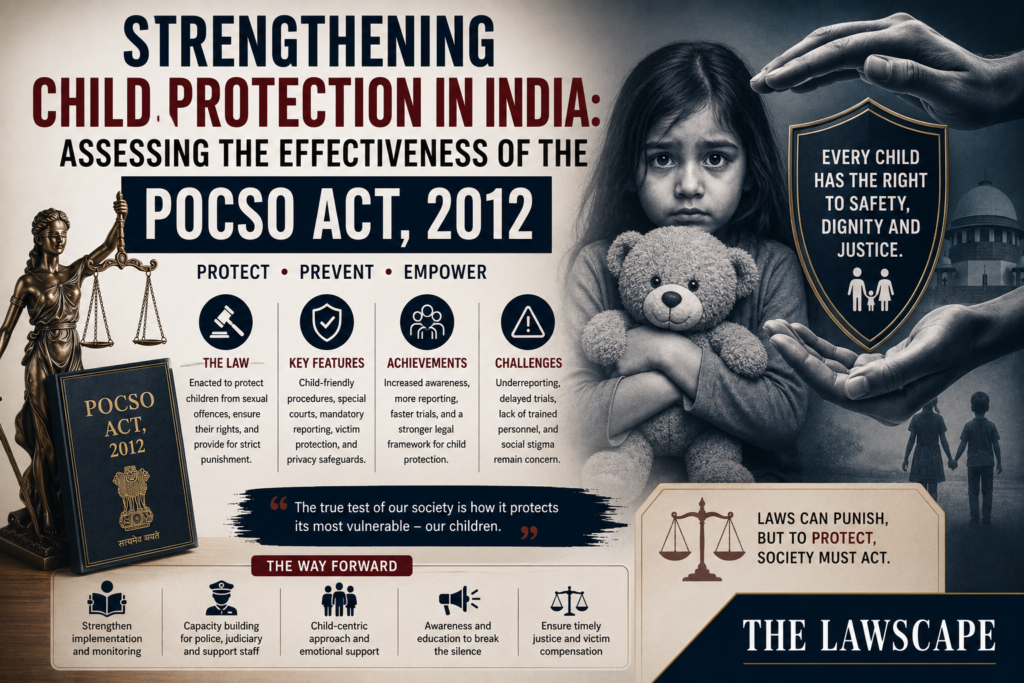
- The Protection of Children from Sexual Offences (POCSO) Act, 2012 was enacted to provide a comprehensive legal framework for protecting children from sexual abuse, exploitation, and harassment.
- Despite robust legal provisions and the establishment of Special Courts, delays in investigations and trials continue to affect the effective implementation of the Act.
- Greater public awareness, institutional strengthening, child-friendly procedures, and faster justice delivery mechanisms are essential to enhancing child protection in India.
Introduction
“We owe our children a life free of violence and fear.” — Nelson Mandela
Children constitute one of the most vulnerable sections of society and require special protection against exploitation, abuse, and violence. Sexual offences against children not only affect their physical and mental well-being but also undermine the future of society, as children represent the foundation of national development and social progress.
In India, incidents of child sexual abuse have raised serious concerns regarding child safety and protection. Children often face exploitation from both known individuals and strangers, making them particularly susceptible to abuse. Recognizing the need for a comprehensive legal framework, the Indian legislature enacted the Protection of Children from Sexual Offences Act, 2012 (POCSO Act) to address sexual crimes against children and provide stringent punishment for offenders.
The Act represents a significant step towards safeguarding children from sexual exploitation, abuse, harassment, and pornography while ensuring child-friendly procedures during investigation and trial. It also reflects India’s commitment to international child rights obligations and constitutional principles aimed at protecting children from exploitation and abandonment.
This article examines the international foundations of child protection, the objectives and features of the POCSO Act, implementation challenges, statistical trends relating to child sexual abuse cases, and measures necessary to strengthen child protection mechanisms in India.
Rights of Children in the International Context
The protection of children’s rights has long been recognized as a matter of international concern.
Geneva Declaration of the Rights of the Child
One of the earliest international efforts to protect children emerged through the Geneva Declaration of the Rights of the Child adopted by the League of Nations following the First World War.
The Declaration emphasized:
- Protection of children from exploitation;
- Economic security;
- Welfare and development;
- Freedom and dignity; and
- The importance of ensuring a safe childhood.
Universal Declaration of Human Rights
In 1959, the United Nations General Assembly adopted the Universal Declaration of Human Rights, which emphasized the need for special care, assistance, and protection for women and children.
These developments laid the foundation for modern international child rights jurisprudence.
United Nations Convention on the Rights of the Child (UNCRC)
A major milestone in international child protection was the adoption of the United Nations Convention on the Rights of the Child (UNCRC) in 1989.
The Convention entered into force on 2 September 1990 and is widely regarded as one of the most significant human rights instruments concerning children. It contains 54 Articles addressing virtually every aspect of a child’s life and establishes minimum standards for the protection of children’s civil, political, economic, social, and cultural rights.
The Convention recognizes children as independent rights-holders and requires State Parties to take appropriate measures to protect children from abuse, neglect, exploitation, and violence.
Important protections include:
Article 1
Defines a child as every human being below the age of eighteen years unless majority is attained earlier under applicable law.
Article 2
Requires States to respect and ensure children’s rights without discrimination.
Article 32
Protects children from economic exploitation and hazardous labour.
Articles 34 and 35
Require States to take measures to protect children from:
- Sexual abuse;
- Sexual exploitation;
- Trafficking; and
- Related forms of exploitation.
Article 39
Mandates protection and rehabilitation for children who have suffered abuse, exploitation, torture, or cruel treatment.
The UNCRC is supplemented by three Optional Protocols concerning:
- The involvement of children in armed conflict;
- The sale of children, child prostitution, and child pornography; and
- Communications procedures.
India ratified the UNCRC on 11 December 1992 and subsequently strengthened its domestic legal framework to comply with these international obligations.
The POCSO Act, 2012
The Protection of Children from Sexual Offences Act, 2012 was enacted to provide comprehensive legal protection to children below the age of eighteen years against sexual offences.
The Act criminalizes various forms of sexual abuse and establishes a specialized legal framework for the investigation and prosecution of offences committed against children.
Objectives of the Act
The principal objectives of the POCSO Act are:
- Protection of children from sexual offences;
- Punishment of offenders;
- Child-friendly investigation and trial procedures;
- Prevention of secondary victimization; and
- Speedy disposal of cases.
The legislation applies equally to all children and does not discriminate on the basis of gender.
Definition of Child
Under the Act, a child means any person below eighteen years of age.
This broad definition ensures that all minors receive protection under the statute.
Offences Covered Under the Act
The Act recognizes and criminalizes multiple forms of sexual abuse, including:
- Penetrative sexual assault;
- Aggravated penetrative sexual assault;
- Sexual assault;
- Sexual harassment;
- Use of children for pornographic purposes; and
- Other forms of sexual exploitation.
The legislation was designed to address gaps in the existing criminal law framework and provide specialized protection for children.
Consent Under the POCSO Act
A significant feature of the Act is that consent is legally irrelevant where the victim is below eighteen years of age.
The law recognizes that minors are incapable of providing legally valid consent for sexual activity.
Special Courts and Child-Friendly Procedures
The POCSO Act provides for the establishment of Special Courts to ensure speedy disposal of cases involving child victims.
These include:
- Regular Special Courts; and
- Fast Track Special Courts.
According to the data cited in the submission, hundreds of Special Courts and Fast Track Courts have been established across the country to reduce delays and improve access to justice for child victims.
POCSO Rules, 2020
The Ministry of Women and Child Development notified the POCSO Rules, 2020 to strengthen implementation of the Act and enhance protection mechanisms.
The Rules aim to ensure:
- Child-friendly procedures;
- Institutional safeguards;
- Sensitive handling of victims;
- Protection from secondary trauma; and
- Respect for the dignity of child survivors.
These measures are intended to minimize the psychological impact of legal proceedings and facilitate access to justice.
Understanding Sexual Offences Under the POCSO Framework
The Act broadly addresses sexual offences against children and complements existing criminal law provisions.
Sexual offences generally include:
Sexual Assault
Sexual assault refers to unwanted physical advances or conduct of a sexual nature directed towards another person.
Sexual Harassment
Sexual harassment includes unwelcome sexual advances, comments, behaviour, or conduct that creates an intimidating, hostile, or offensive environment.
The POCSO Act provides detailed statutory definitions and corresponding punishments tailored specifically to offences committed against children.
By expanding the legal understanding of child sexual abuse, the legislation significantly strengthened protections previously unavailable under general criminal law.
Implementation Challenges
Despite the comprehensive framework established under the POCSO Act, several challenges continue to affect its implementation.
Increasing Number of Cases
Data cited in the submission indicates a steady increase in the number of POCSO cases registered across the country.
States such as:
- Madhya Pradesh;
- Maharashtra;
- Uttar Pradesh;
- Haryana; and
- Delhi
account for a substantial proportion of POCSO cases in India.
The increasing number of reported offences demonstrates both the prevalence of child sexual abuse and the growing willingness of victims and families to report such crimes.
Low Conviction Rates
Although large numbers of cases are registered annually, conviction rates remain relatively modest.
This raises concerns regarding:
- Investigation quality;
- Evidentiary challenges;
- Witness protection;
- Delays in trial; and
- Overall effectiveness of prosecution.
Pendency of Cases
One of the most significant challenges is the large number of pending cases.
According to the data discussed in the article:
- A substantial number of cases remain under investigation;
- Many trials remain incomplete; and
- A significant percentage of cases await adjudication for extended periods.
Delays in the justice delivery process undermine the objectives of the Act and may discourage victims from pursuing legal remedies.
Need for Additional Special Courts
The growing volume of cases has created pressure on existing judicial infrastructure.
To ensure timely justice, there is a continuing need for:
- Additional Special Courts;
- Increased judicial capacity;
- Better investigative support; and
- Efficient case management systems.
Constitutional Commitment to Child Protection
The constitutional foundation for child protection can be found in the Directive Principles of State Policy.
Article 39(f) directs the State to ensure that:
- Children are given opportunities and facilities to develop in a healthy manner;
- Childhood is protected against exploitation;
- Dignity is preserved; and
- Children are safeguarded against moral and material abandonment.
The POCSO Act represents an important legislative effort to translate these constitutional principles into practical legal protections.
By criminalizing sexual exploitation and establishing specialized procedures, the legislation seeks to uphold the constitutional commitment to child welfare and protection.
The Need for Greater Awareness and Reform
The increasing number of POCSO cases highlights the need for broader societal engagement in child protection.
Legal reforms alone cannot eliminate child sexual abuse.
Effective protection requires:
Public Awareness
Awareness programmes should educate:
- Children about personal safety;
- Parents regarding signs of abuse;
- Teachers and caregivers about reporting obligations; and
- Communities about available legal remedies.
Strengthening Institutions
Institutional mechanisms must be strengthened through:
- Better training for police officers;
- Child-sensitive investigation practices;
- Increased availability of counsellors;
- Victim support services; and
- Improved coordination among stakeholders.
Speedy Justice
Reducing delays in investigation and trial remains essential.
Timely disposal of cases helps:
- Protect victims;
- Preserve evidence;
- Improve conviction rates; and
- Strengthen public confidence in the justice system.
Conclusion
The Protection of Children from Sexual Offences Act, 2012 represents a landmark legislative initiative aimed at protecting children from sexual abuse, exploitation, harassment, and violence.
By establishing a comprehensive legal framework, creating Special Courts, criminalizing a wide range of sexual offences, and introducing child-friendly procedures, the Act has significantly strengthened child protection in India.
However, the increasing number of reported cases, persistent delays in investigations and trials, pendency of cases, and implementation challenges demonstrate that legal reform alone is insufficient. Effective child protection requires continuous institutional strengthening, public awareness, efficient judicial processes, and coordinated action among government agencies, law enforcement authorities, educational institutions, and civil society organizations.
India’s constitutional and international commitments require sustained efforts to ensure that every child grows up in conditions of safety, dignity, and freedom from exploitation. Strengthening implementation of the POCSO Act and improving access to justice for child victims remain essential steps toward achieving that objective.
Disclaimer: The views expressed in this article are those of the author and do not necessarily reflect the views of The Lawscape.
The Lawscape — clear, practical legal insight for students and future lawyers.