
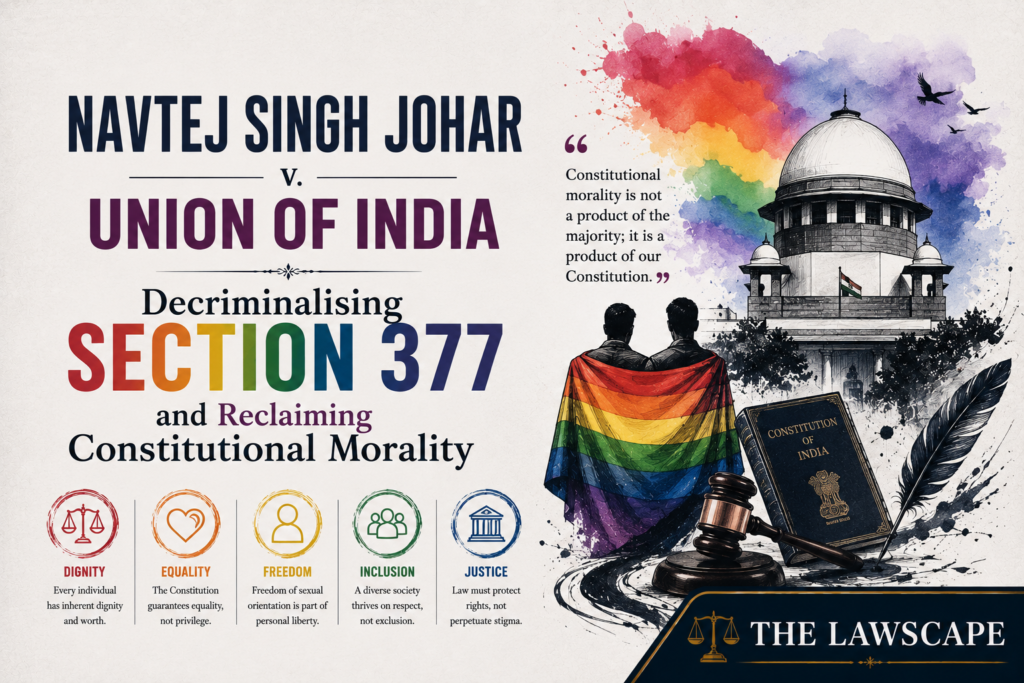
Navtej Singh Johar v. Union of India: Decriminalising Section 377 and Reclaiming Constitutional Morality
Author: Mallika Kumari
Student, Amity University Patna
———————————————————————–
💡 3 Quick Takeaways
1. Navtej Singh Johar v. Union of India marked a constitutional turning point by partially striking down Section 377 of the Indian Penal Code and decriminalising consensual same-sex relations between adults in private.
2. The Supreme Court anchored its reasoning in Articles 14, 15, 19(1)(a), and 21, affirming dignity, privacy, equality, identity, and autonomy for LGBTQIA+ persons.
3. The judgment is not only a milestone in Indian constitutional law but also a major step in the broader movement toward gender justice, substantive equality, and the recognition of sexual minorities in Indian society.
Introduction
Navtej Singh Johar v. Union of India is one of the most significant constitutional decisions in modern Indian legal history. It stands as a landmark in the evolution of fundamental rights jurisprudence and reflects the Supreme Court’s liberal and rights-oriented approach to constitutional interpretation. The judgment occupies a historic place in India’s legal development because it transformed the understanding of equality, dignity, privacy, and sexual autonomy under the Constitution.
The case challenged the constitutional validity of Section 377 of the Indian Penal Code, 1860, a colonial-era provision that criminalised “carnal intercourse against the order of nature.” For decades, this provision was used to stigmatise, marginalise, and criminally target homosexual persons and members of the LGBTQIA+ community. In striking down the application of Section 377 to consensual sexual acts between adults in private, the Supreme Court recognised that constitutional morality must prevail over social prejudice and majoritarian morality.
The judgment thus became a defining event in India’s constitutional journey, not only because it decriminalised same-sex intimacy, but also because it laid a strong foundation for the future recognition and protection of LGBTQIA+ rights.
Case Details
Case: Navtej Singh Johar v. Union of India
Citation: (2018) 10 SCC 1
Court: Supreme Court of India
Bench: Dipak Misra, A.M. Khanwilkar, R.F. Nariman, D.Y. Chandrachud, and Indu Malhotra, JJ.
Date of Judgment: 6 September 2018
Type of Petition: Writ Petition under Article 32 of the Constitution of India
Subject Matter: Challenge to the constitutional validity of Section 377 of the Indian Penal Code, 1860
Constitutional Provisions Invoked: Articles 14, 15, 19(1)(a), and 21
Precedents Referred
The judgment engaged with a number of important constitutional precedents, including:
- Naz Foundation v. Government of NCT of Delhi, 160 DLT 277 : 2009 SCC OnLine Del 1762
- Suresh Kumar Koushal v. Naz Foundation, (2014) 1 SCC 1 : AIR 2014 SC 563
- Justice K.S. Puttaswamy v. Union of India, (2017) 10 SCC 1 : AIR 2017 SC 4161
- National Legal Services Authority v. Union of India, (2014) 5 SCC 438 : AIR 2014 SC 1863
- Maneka Gandhi v. Union of India, (1978) 1 SCC 248 : AIR 1978 SC 597
- Shafin Jahan v. Asokan K.M., (2018) 16 SCC 368 : AIR 2018 SC 1933
- Shakti Vahini v. Union of India, (2018) 7 SCC 192
- Anuj Garg v. Hotel Association of India, (2008) 3 SCC 1 : AIR 2008 SC 663
- Francis Coralie Mullin v. Administrator, Union Territory of Delhi, (1981) 1 SCC 608 : AIR 1981 SC 746
- Common Cause v. Union of India, (2018) 5 SCC 1
- Indian Young Lawyers Association v. State of Kerala, (2019) 11 SCC 1
- Aparna Bhat v. State of Madhya Pradesh, (2021) 3 SCC 247
Facts of the Case
The central issue in the case was the constitutional validity of Section 377 of the Indian Penal Code, 1860. The provision criminalised “carnal intercourse against the order of nature,” and historically it had been invoked to penalise homosexual conduct. The petitioners challenged the provision on the ground that, insofar as it criminalised consensual same-sex relations between adults in private, it violated the guarantees of equality, dignity, privacy, freedom of expression, and personal liberty under the Constitution.
The writ petition was filed by Navtej Singh Johar along with other members of the LGBTQIA+ community. The petition relied on Articles 14, 15, 19(1)(a), and 21 of the Constitution, and argued that Section 377 had become a tool of discrimination, social exclusion, and state-sanctioned stigma against sexual minorities.
The matter was heard by a Constitution Bench of five judges of the Supreme Court. On 6 September 2018, the Court delivered its judgment and partially struck down Section 377. The Court held that consensual sexual relations between adults in private could not be criminalised merely because they involved same-sex partners. However, the provision continued to apply to non-consensual acts, acts involving minors, and bestiality.
Issues Raised
The case raised a number of constitutional questions, the most important of which concerned whether Section 377, to the extent that it criminalised consensual same-sex relations between adults, violated the fundamental rights guaranteed under the Constitution.
At a broader level, the case also raised questions concerning the treatment of homosexual persons and the LGBTQIA+ community within Indian society and the legal system. Following the recognition of transgender persons and gender identity rights in NALSA v. Union of India, the continued operation of Section 377 appeared increasingly inconsistent with constitutional values of equality and dignity. The provision had long operated as an instrument of harassment and misuse against sexual minorities, even where the conduct in question was consensual and private.
The case therefore brought into focus the tension between colonial-era morality and constitutional morality. It also highlighted the need to protect privacy, decisional autonomy, and the right of individuals to choose intimate partners without fear of criminal prosecution. In this sense, the challenge to Section 377 was not merely about a penal provision; it was about the constitutional promise that where there is a right, there must be a remedy.
Analysis
The judgment in Navtej Singh Johar represents a major constitutional affirmation of the right of consenting adults to engage in intimate relations in private without state interference. By partially decriminalising Section 377, the Supreme Court restored constitutional protection to persons who had long been denied recognition, dignity, and equality under the law.
At the core of the judgment lies the constitutional “golden triangle” of Articles 14, 19, and 21. The Court recognised that sexual orientation is an intrinsic part of identity and that criminalising consensual same-sex intimacy violates the guarantee of equality under Article 14, the freedom of expression and selfhood under Article 19, and the right to life, dignity, privacy, and personal liberty under Article 21. The judgment thus reinforced the idea that the Constitution protects not merely formal equality, but substantive equality grounded in dignity and individual autonomy.
The decision must also be read in light of the Supreme Court’s privacy jurisprudence, particularly Justice K.S. Puttaswamy v. Union of India. Privacy was understood not as a narrow right of seclusion, but as a broader constitutional guarantee protecting bodily integrity, decisional autonomy, identity, and intimate personal choices. In that framework, consensual sexual relations between adults fall squarely within the protected domain of personal liberty and privacy. By recognising this, the Court moved away from a moralistic and exclusionary approach to sexuality and embraced a rights-based constitutional understanding.
The case is equally important from the standpoint of gender and sexuality jurisprudence. It gave meaningful constitutional recognition to the lived experiences of LGBTQIA+ persons and acknowledged that the law cannot be used to perpetuate stigma against a vulnerable minority. In doing so, the Court implicitly rejected the colonial moral framework embedded in Section 377 and recognised that the constitutional order must be responsive to the rights of all persons, including those historically excluded from social and legal recognition.
The judgment can also be understood through broader jurisprudential lenses. From the perspective of the sociological school of jurisprudence, it reflects the idea that law must evolve in accordance with the needs of society and must respond to changing social realities. The law is not static; it is an instrument for the betterment of society, and society in turn shapes the law. In that sense, Navtej Singh Johar is a clear example of constitutional adjudication responding to the demands of justice in a modern democratic society.
Similarly, the realist understanding of law also finds resonance in the judgment. Law is not only what exists in statutory text; it is also what the courts interpret and enforce in practice. Through judicial interpretation, the Court transformed the meaning and effect of Section 377 by reading it down in accordance with constitutional values. This demonstrates how the judiciary can serve as a site of constitutional correction where outdated laws continue to violate present-day guarantees of justice, liberty, and equality.
The decision also aligns with broader human rights principles reflected in international instruments such as the Universal Declaration of Human Rights and the International Covenant on Civil and Political Rights. The judgment’s emphasis on dignity, autonomy, and equal treatment resonates with the universal human rights principle that all individuals are entitled to live with freedom and respect by virtue of being human. In this sense, the judgment moves beyond a narrow domestic constitutional dispute and becomes part of a wider global conversation on sexuality, equality, and human dignity.
Further, the judgment has an important interdisciplinary dimension. It intersects with constitutional law, gender justice, feminist jurisprudence, human rights law, and broader debates on identity and discrimination. It also exposes the enduring impact of colonial legal frameworks and the way in which such laws can continue to shape social prejudice long after formal colonial rule has ended. Section 377 reflected not merely a penal rule but a mindset—one that viewed certain identities and forms of intimacy as deviant, unworthy, and criminal. The Court’s intervention was therefore not only legal but also symbolic: it marked a rejection of a long history of state-backed exclusion.
At the same time, the judgment must be appreciated as part of a larger rights movement rather than as its conclusion. While it decriminalised consensual same-sex relations, the larger struggle for LGBTQIA+ equality in India continues across multiple domains, including family rights, anti-discrimination protections, social acceptance, and institutional inclusion. Nevertheless, Navtej Singh Johar laid a foundational constitutional framework for those future developments. It recognised that sexual minorities are entitled to the full protection of the Constitution and that prejudice, however socially entrenched, cannot override fundamental rights.
The judgment was both praised and criticised, but it remains undeniable that it marks a revolutionary moment in Indian constitutional law. It reaffirmed that constitutional morality must prevail over social morality, that rights are not subject to majoritarian approval, and that the dignity of every person is central to the constitutional order. In doing so, it created a pathway for future rights-based developments and strengthened the promise of real and substantive equality.
Conclusion
Navtej Singh Johar v. Union of India occupies a vital place in the constitutional and social evolution of India. By partially striking down Section 377 and decriminalising consensual same-sex relations between adults, the Supreme Court reaffirmed the values of equality, dignity, liberty, privacy, and constitutional morality. The judgment corrected a deep historical injustice rooted in colonial legislation and recognised the rights of LGBTQIA+ persons as an inseparable part of the constitutional promise.
The case also holds enduring significance for gender justice and the future development of Indian constitutional law. It reflects a progressive legal outlook in which fundamental rights are understood not merely in theory but in their practical application to the lives of real individuals. More importantly, it opens a pathway for future legal reforms and judicial developments that may continue to strengthen the position of sexual and gender minorities in India.
In that sense, Navtej Singh Johar is not only a landmark case of decriminalisation; it is a constitutional statement that human dignity, identity, and autonomy cannot be denied on the basis of prejudice. It remains one of the most important judgments in India’s journey toward substantive equality and a more inclusive constitutional democracy.
References
- Navtej Singh Johar v. Union of India, Indian Kanoon.
- Navtej Singh Johar v. Union of India, Global Freedom of Expression, Columbia University.
- Sarthak Gupta, “Case Comment: Navtej Singh Johar v. Union of India,” iPleaders (15 Sept. 2020).
- “Case Comment: Navtej Singh Johar & Ors. v. Union of India,” Lawctopus.
- Navtej Singh Johar v. Union of India, Supreme Court Observer.
Disclaimer: The views expressed in this article are those of the author and do not necessarily reflect the views of The Lawscape.
The Lawscape — clear, practical legal insight for students and future lawyers.