
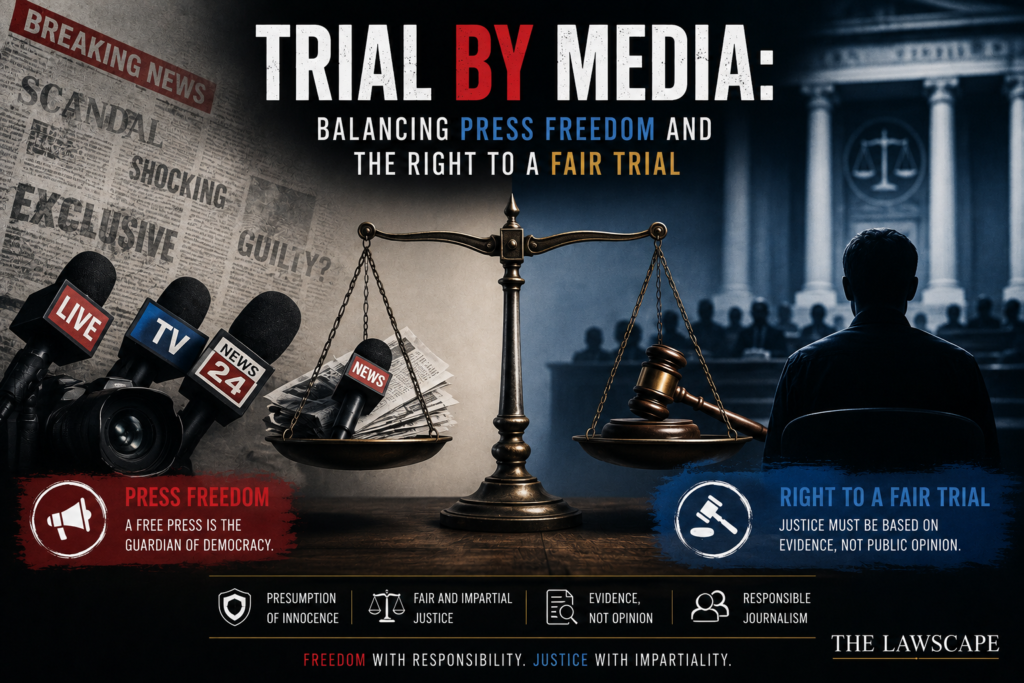
Trial by Media: Balancing Press Freedom and the Right to a Fair Trial
Author: Simran Singh
Student, Bharati Vidyapeeth, New law college, Pune
——————————————————————————————————-
💡 3 Quick Takeaways
1. Trial by media threatens the constitutional principle that every accused person is presumed innocent until proven guilty.
2. Freedom of the press under Article 19(1)(a) must be balanced against the right to a fair trial guaranteed under Article 21 of the Constitution.
3. Responsible journalism and stronger ethical standards are essential to protect both democratic transparency and judicial fairness.
Abstract
In today’s digital era, the media has become one of the most influential institutions in shaping public perception of criminal cases. Television news, digital platforms, and social media frequently do far more than merely report facts—they often present opinions and narratives before a court has delivered its judgment. While the media has an important responsibility to inform the public and create awareness, it possesses neither the authority to adjudicate disputes nor to determine criminal guilt. Its role should remain limited to accurate and responsible reporting.
High-profile criminal cases increasingly become matters of public debate, with accused persons frequently portrayed as guilty before judicial proceedings are completed. This phenomenon is commonly referred to as “trial by media.”
In India, freedom of the press enjoys constitutional protection under Article 19(1)(a), reflecting the importance of an independent media in ensuring transparency, accountability, and public awareness. The media has historically exposed corruption, highlighted delays in the administration of justice, and held public authorities accountable. However, modern journalism has increasingly become driven by competition for viewership and ratings, resulting in sensationalised reporting.
One of the most serious consequences of trial by media is its impact on the fundamental rights of the accused. The Indian criminal justice system rests upon the principle that every individual is presumed innocent until proven guilty. Article 21 of the Constitution guarantees the right to life, personal liberty, dignity, reputation, and a fair trial.
When media organisations repeatedly portray an accused person as a criminal before judicial determination, public perception becomes prejudiced. The accused may suffer social humiliation, reputational harm, mental distress, and lasting damage even if eventually acquitted. The growth of digital and social media has intensified this concern, allowing unverified information, leaked investigative material, edited videos, and emotionally charged content to spread rapidly to millions of people.
The judiciary has consistently recognised these dangers. The Supreme Court has repeatedly observed that although press freedom is fundamental, media reporting should not prejudice pending judicial proceedings. Justice must ultimately be determined through evidence and legal procedure rather than television debates or public outrage.
This article examines the concept of trial by media in India and analyses the constitutional tension between freedom of the press and the right to a fair trial. It further discusses judicial precedents, media ethics, the influence of social media, and the need for legal reforms. Its primary objective is to demonstrate that in a democratic society, determining criminal guilt must remain the exclusive function of the courts.
Introduction
The media occupies a vital position within every democratic society. In India, newspapers, television channels, digital platforms, and social media have become indispensable sources of information and public awareness. Owing to its influence, the media is often regarded as the fourth pillar of democracy. It has historically played an important role in exposing corruption, questioning inequality, promoting governmental transparency, and strengthening democratic accountability.
Modern journalism, however, now operates within an intensely competitive environment where viewership, online engagement, and the race to break news frequently receive greater priority than responsible reporting. Television debates, YouTube discussions, Instagram reels, and social media posts routinely analyse ongoing criminal investigations while publicly debating the guilt or innocence of accused persons before courts have delivered their judgments.
This growing phenomenon is commonly described as trial by media, where media reporting shapes public opinion regarding the guilt or innocence of an accused before judicial determination. Rather than merely presenting facts, media organisations often begin interpreting evidence, discussing motives, and drawing conclusions. In many instances, news anchors assume the role of prosecutors while social media users become judges delivering instant verdicts.
The digital era has significantly aggravated this problem. Unverified rumours can become nationwide discussions within hours, and once an accused person is publicly portrayed as guilty, reputational damage often becomes irreversible, even if the individual is subsequently acquitted.
This development raises serious constitutional concerns because the Indian criminal justice system is founded upon the principle that every person remains innocent until proven guilty. Courts are expected to decide cases solely on the basis of evidence and legal procedure—not public emotion or media pressure.
This article examines the growing influence of media trials in India and analyses whether unrestricted media reporting threatens fair trial rights, judicial independence, and constitutional values.
Presumption of Innocence
The presumption of innocence is a fundamental principle of criminal law. It means that every person accused of committing an offence must be treated as innocent until guilt is established before a competent court. The burden of proving guilt always rests upon the prosecution or the State.
Merely being accused, arrested, or subjected to media coverage does not make an individual a criminal. Until a court determines guilt through due legal process, the accused continues to enjoy the protection of this legal presumption.
This principle protects innocent persons from wrongful punishment and ensures that justice is determined through evidence rather than public emotion.
For example, a person accused of murder may be arrested and widely portrayed by the media as the offender. News channels may repeatedly broadcast photographs and sensational headlines declaring that the accused deserves punishment. However, during the trial, the evidence may ultimately prove insufficient or unreliable, resulting in acquittal. By that stage, the individual’s reputation, family life, career, and mental well-being may already have suffered irreparable damage.
Why is this principle important?
The presumption of innocence remains one of the foundations of a democratic legal system because:
- Every individual deserves a fair opportunity to defend themselves.
- Courts—not the media or public opinion—must determine criminal liability.
- Justice must be based upon evidence rather than emotion.
Connection with Trial by Media
Trial by media directly undermines this principle. When media organisations portray an accused person as guilty before judicial determination, public opinion becomes prejudiced, reputations are destroyed, and the possibility of a fair trial may be compromised.
Concept of Trial by Media
Trial by media refers to situations in which extensive media coverage effectively encourages the public to determine the guilt or innocence of an accused before judicial proceedings conclude.
Ordinarily, only courts possess the authority to determine criminal liability after examining evidence, hearing witnesses, and following established legal procedures. During media trials, however, television channels, online platforms, and social media discussions continuously analyse ongoing investigations, often presenting conclusions rather than merely reporting facts.
Such reporting may seriously affect the accused. Reputation, mental health, family relationships, and professional life frequently suffer long before any judicial determination. Even subsequent acquittal may fail to restore public confidence because media narratives often remain embedded in public memory.
At the same time, the existence of trial by media should not be interpreted as an argument against press freedom. The media performs an indispensable democratic function by informing society and exposing wrongdoing. The problem arises only when reporting transforms into adjudication.
Justice in a constitutional democracy must always be determined by courts on the basis of law and evidence—not television debates, viral hashtags, or public sentiment.
Article 21 and the Right to a Fair Trial
Article 21 of the Constitution guarantees the right to life and personal liberty. Judicial interpretation has consistently expanded its scope to include the right to dignity, reputation, and a fair trial.
A fair trial requires impartial judges, unbiased investigations, adequate legal representation, procedural fairness, and freedom from external influence.
Media trials frequently undermine these safeguards. Continuous coverage portraying an accused as guilty before the completion of investigations influences public perception and places immense psychological pressure upon the accused. Even where courts subsequently acquit the individual, the damage to reputation often becomes permanent.
Recognising these concerns, Indian courts have repeatedly emphasised that freedom of the press, though constitutionally protected, is not absolute. Responsible reporting is essential to ensure that Article 21 rights remain protected.
Important Judicial Decisions
R.K. Anand v. Delhi High Court
The Supreme Court acknowledged the valuable role of investigative journalism in exposing corruption and misconduct. At the same time, it cautioned that excessive media intervention in pending judicial proceedings could prejudice the administration of justice and influence public perception before the final verdict.
Sahara India Real Estate Corporation Ltd. v. SEBI
This landmark judgment addressed the conflict between freedom of the press and the right to a fair trial. The Supreme Court recognised that courts may issue postponement orders where extensive reporting poses a substantial risk of prejudicing judicial proceedings. The Court emphasised the need to balance Article 19(1)(a) with Article 21.
State of Maharashtra v. Rajendra Jawanmal Gandhi
The Supreme Court strongly criticised the practice of trial by media, observing that journalists should not assume the role of judges or publicly declare accused persons guilty before judicial determination. Criminal liability must always be decided inside courtrooms through evidence.
Jessica Lal Murder Case
Media coverage played an important role in exposing shortcomings in the investigation and ensuring continued public attention towards the case. However, the case simultaneously demonstrated the potential danger of excessive publicity influencing public opinion and judicial neutrality.
Aarushi Talwar Murder Case
This case remains one of India’s most frequently cited examples of media sensationalism. Extensive speculation regarding the guilt, character, and personal lives of the accused significantly influenced public perception before the conclusion of judicial proceedings, illustrating the lasting reputational damage caused by irresponsible reporting.
Romesh Thappar v. State of Madras
Although unrelated to media trials, this landmark decision established freedom of speech and expression as a cornerstone of Indian democracy. It continues to provide the constitutional foundation for discussions concerning the balance between press freedom and fair judicial proceedings.
Need for Responsible Journalism and Legal Reforms
Journalism plays a central role in shaping public opinion and strengthening democracy. Consequently, media organisations bear a corresponding responsibility to report accurately, fairly, and ethically.
Responsible journalism requires factual accuracy, neutrality, respect for privacy, and restraint from sensationalism. Allegations alone should never be treated as proof of guilt.
The rapid growth of television debates, digital journalism, and social media has increased the prevalence of media trials, where public opinion is often shaped long before judicial proceedings conclude. Such reporting can influence witnesses, damage reputations, and undermine the fairness of criminal trials.
India presently lacks a comprehensive statutory framework specifically regulating media trials. Accordingly, stronger ethical standards, greater digital accountability, and effective judicial safeguards are necessary to ensure that freedom of the press does not undermine an individual’s constitutional right to dignity and a fair trial.
Conclusion
The relationship between the media and the criminal justice system has become increasingly complex in contemporary India. While the media continues to strengthen democracy by promoting transparency, accountability, and public awareness, sensational reporting has simultaneously created significant challenges for the administration of justice.
Today, criminal cases are frequently transformed into public spectacles. Television debates, breaking news, viral hashtags, and social media discussions often portray accused persons as guilty before judicial determination, directly undermining the principle of presumption of innocence.
In a constitutional democracy governed by the rule of law, guilt must be established solely through evidence, legal procedure, and impartial judicial reasoning—not public opinion or emotional media narratives. Behind every allegation stands a human being whose dignity, reputation, career, and mental well-being may suffer irreversible harm through irresponsible reporting.
At the same time, restricting press freedom entirely would neither be practical nor consistent with democratic values. A free and independent press remains indispensable to constitutional governance. The real challenge lies in maintaining an appropriate balance between freedom of the press and the right to a fair trial.
Ultimately, justice must be delivered in courtrooms through law, evidence, and judicial reasoning—not through television studios, social media trends, or public outrage.
Disclaimer: The views expressed in this article are those of the author and do not necessarily reflect the views of The Lawscape.
The Lawscape — clear, practical legal insight for students and future lawyers.