
Selvi v. State of Karnataka: Safeguarding the Right Against Self-Incrimination in the Age of Scientific Investigation
Author: JYOTHIKA K G
Student,Mar Gregorios College of Law, Thiruvananthapuram
——————————————————————————————————————-
💡 3 Quick Takeaways
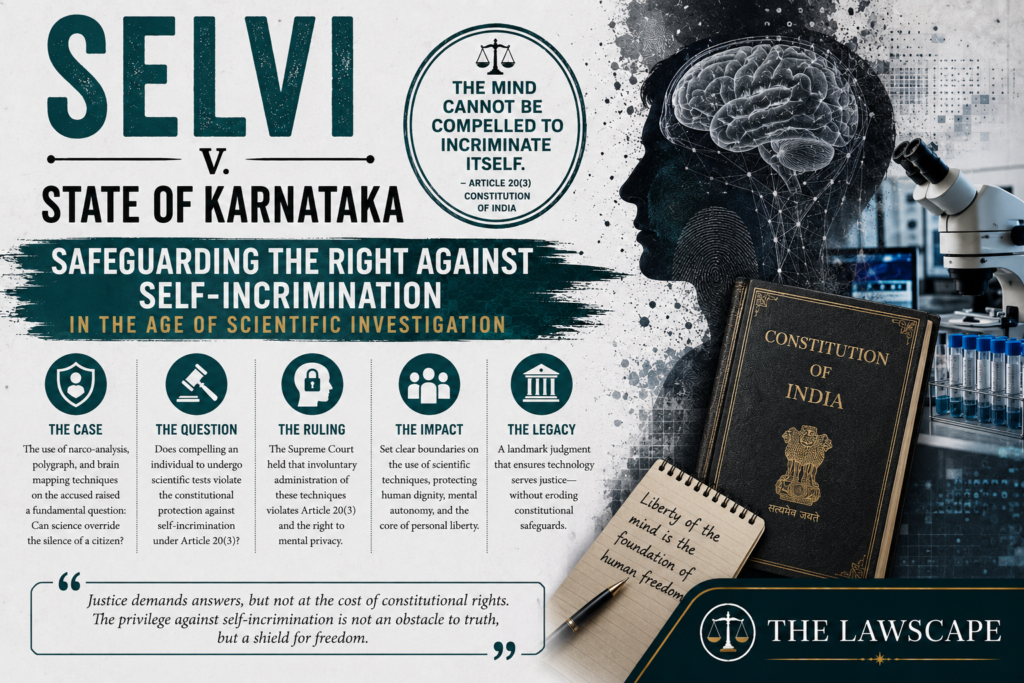
- Selvi v. State of Karnataka held that the involuntary use of narco-analysis, polygraph examinations, and BEAP tests violates Articles 20(3) and 21 of the Constitution of India.
- The Supreme Court recognised that the right against self-incrimination extends to the investigation stage and protects individuals from compelled testimonial responses.
- The judgment significantly strengthened constitutional protection of mental privacy, dignity, and personal liberty in criminal investigations.
Introduction
Selvi & Ors. v. State of Karnataka & Anr. is a landmark judgment of the Supreme Court of India on the constitutional validity of neuroscientific investigative techniques such as narco-analysis, polygraph examinations, and Brain Electrical Activation Profile (BEAP) tests. The case sought to balance the need for effective criminal investigation with the protection of the fundamental rights guaranteed under the Constitution of India.
The central question before the Court was whether compelled scientific tests could be permitted consistently with the right against self-incrimination under Article 20(3) and the right to life and personal liberty under Article 21. The Court also examined whether information obtained through such techniques could be treated as voluntary and reliable evidence.
The Supreme Court held that the involuntary administration of narco-analysis, polygraph examinations, and BEAP tests violates the constitutional guarantees against self-incrimination and the protection of personal liberty. The decision is particularly significant because it expanded the scope of Article 21 to include mental privacy, thereby affirming that the State cannot intrude into an individual’s mind and compel the disclosure of personal knowledge.
Background of the Case
The case brought together the guarantees under Articles 20(3) and 21 of the Constitution, especially in the context of the compulsory use of neuroscientific methods on accused persons and other individuals involved in criminal investigations.
Article 20(3) protects an individual from being compelled to incriminate themselves. It provides that “no person accused of any offence shall be compelled to be a witness against himself.” This principle reflects the well-established maxim nemo tenetur prodere accussare seipsum, meaning that no one is bound to accuse themselves. At the same time, it is recognised that certain investigative measures—such as fingerprints, footprints, blood samples, handwriting, signatures, and similar physical evidence—are generally permissible and do not amount to testimonial compulsion.
With scientific and technological advancement, new investigative methods emerged with the aim of improving criminal investigations and reducing delay. Among them were narco-analysis, polygraph examinations, and BEAP tests.
Narco-analysis is a technique in which a subject is placed in a semi-conscious state through the administration of a barbiturate drug, usually sodium pentothal, commonly referred to as “truth serum.” It is assumed that in such a condition, the subject’s capacity to fabricate responses is reduced.
Polygraph examination is an investigative test that records involuntary physiological responses such as pulse rate, blood pressure, breathing rate, and perspiration in order to assess whether a person is being truthful. Various methods such as the Irrelevant/Relevant Test, the Control Question Test, and the Guilty Knowledge Test may be used.
Brain Electrical Activation Profile (BEAP) tests, also known as P300 tests, are intended to determine whether a person is familiar with information relevant to an investigation. Electrodes are attached to the scalp to measure brain responses to specific stimuli or “probes.” The test is typically conducted in controlled conditions to avoid interference.
Facts of the Case
In Selvi & Ors. v. State of Karnataka & Anr., a number of appeals were filed before the Supreme Court challenging the constitutional validity of narco-analysis, polygraph examinations, and BEAP tests.
The petitioners argued that investigative agencies were often subjecting individuals to these techniques without their consent. According to them, the forcible administration of such tests violated the fundamental rights guaranteed under Articles 20(3) and 21 of the Constitution, namely the right against self-incrimination and the right to life and personal liberty.
It was contended that these techniques compelled a person to reveal personal knowledge without consent and amounted to a form of “mental intrusion.” Since similar constitutional issues had arisen in several matters, the Supreme Court heard them together and delivered a common judgment.
Issues of the Case
The principal issues before the Court were:
- Whether the involuntary administration of narco-analysis, polygraph examination, and BEAP tests violates the right against self-incrimination under Article 20(3) of the Constitution.
- Whether the investigative use of these techniques creates a likelihood of incrimination for the subject.
- Whether the results obtained from such techniques amount to testimonial compulsion, thereby attracting the bar under Article 20(3).
- Whether the involuntary administration of these techniques constitutes a reasonable restriction on personal liberty under Article 21 of the Constitution.
Arguments of the Petitioners
The petitioners argued that narco-analysis, polygraph examination, and BEAP tests violate the fundamental rights guaranteed under Articles 20(3) and 21 of the Constitution. They contended that these techniques amount to testimonial compulsion and infringe both the right against self-incrimination and the right to life and personal liberty, including mental privacy.
It was further argued that although Sections 53, 53-A, and 54 of the Code of Criminal Procedure permit medical examination during investigation, they do not justify the use of narco-analysis, polygraph examinations, or BEAP tests. According to the petitioners, the phrase “modern and scientific techniques” should be interpreted on the principle of ejusdem generis and therefore be confined to the collection of physical evidence such as blood, hair, or nail samples, rather than methods that extract personal knowledge from the mind of an individual.
The petitioners also contended that Parliament was aware of these investigative techniques at the time of the 2005 amendments to the Code of Criminal Procedure, yet deliberately chose not to include them. They further submitted that the participation of medical professionals in such procedures was inconsistent with medical ethics, particularly Principle 4 of the United Nations Principles of Medical Ethics.
Finally, the petitioners challenged the scientific reliability of so-called “truth serum” tests. They argued that the use of sodium pentothal places the subject in a fluctuating state between wakefulness and anaesthesia, making any resulting statements unreliable, involuntary, and therefore unfit to be treated as valid evidence.
Arguments of the Respondents
The respondents defended the use of neuroscientific investigative techniques on the ground that they assist investigating agencies in obtaining information that might otherwise remain concealed.
They argued that the information obtained through these techniques is not intended to be used as direct evidence against the accused, but rather to facilitate investigation. It was also submitted that if independent evidence is discovered on the basis of information obtained through such methods, that evidence may be admissible under Section 27 of the Indian Evidence Act, which permits the admission of facts discovered from statements made by the accused.
The respondents further contended that the expression “modern and scientific techniques including DNA profiling and such other tests” appearing in Sections 53, 53-A, and 54 of the Code of Criminal Procedure should be interpreted broadly rather than restrictively. In their view, the law must keep pace with technological advancement and should accommodate techniques such as narco-analysis, polygraph examination, and BEAP in aid of criminal investigation.
Judgment
The Supreme Court held that the involuntary administration of narco-analysis, polygraph examination, and BEAP tests is unconstitutional.
On the first issue, the Court answered in the affirmative and held that the right against self-incrimination under Article 20(3) extends not only to the trial stage but also to the investigation stage. Relying on Nandini Satpathy v. P.L. Dani, the Court observed that no person can be compelled during investigation to furnish information that may be used against them.
On the second issue, the Court held that the use of these techniques creates a real likelihood of incrimination. Even if the statements obtained are not directly used as evidence in court, they may lead to the discovery of incriminating material and therefore fall within the protective scope of Article 20(3).
On the third issue, the Court rejected the argument that these techniques merely collect physical evidence. It held that narco-analysis, polygraph examination, and BEAP tests involve the extraction of information from the subject’s personal knowledge and mental processes. Such material is testimonial in nature, and when obtained without consent, it amounts to testimonial compulsion prohibited by Article 20(3).
On the fourth issue, the Court held that the involuntary administration of these techniques does not constitute a reasonable restriction on personal liberty under Article 21. Instead, it interferes with the subject’s mental privacy and personal freedom. The Court made it clear that there is no legal basis for forcibly intruding into a person’s mental processes in the course of investigation.
Analysis
The judgment in Selvi v. State of Karnataka is an important constitutional development in the Indian criminal justice system because it affirms that the State’s investigative powers must remain subject to constitutional limitations. The Supreme Court correctly recognised that neuroscientific investigative techniques such as narco-analysis, polygraph examinations, and BEAP tests do not merely gather physical evidence; rather, they intrude into a person’s mental processes and compel the disclosure of personal knowledge.
By extending the protection of Article 20(3) to the investigation stage, the Court significantly strengthened the safeguards available against coercive investigative practices. The decision also reinforces the principle that the State must respect human dignity, personal liberty, and mental privacy during criminal investigations.
At the same time, the judgment may be seen as limiting the use of scientific techniques that could potentially assist in investigations where evidence is otherwise difficult to obtain. Another point of concern is that while the Court clearly held that involuntary and forced use of these techniques is unconstitutional, it did not fully address in detail the position of voluntary administration conducted with informed consent and due process safeguards.
Nevertheless, the judgment is significant because it attempts to strike a balance between scientific advancement and the preservation of constitutional rights. It makes clear that technological progress in criminal investigation cannot come at the cost of fundamental freedoms.
Conclusion
The decision in Selvi v. State of Karnataka is a landmark judgment in Indian constitutional law because it strongly upholds the right against self-incrimination and the right to personal liberty. The Supreme Court held that the involuntary and forced use of neuroscientific techniques such as narco-analysis, polygraph examination, and Brain Electrical Activation Profile tests is unconstitutional as it violates Articles 20(3) and 21 of the Constitution of India.
By recognising personal freedom, dignity, and mental privacy as essential constitutional values, the Court reaffirmed that scientific advancement cannot override fundamental rights. The judgment therefore remains an important precedent in the Indian legal system for balancing the demands of effective investigation with the protection of individual liberty and constitutional guarantees.
Disclaimer: The views expressed in this article are those of the author and do not necessarily reflect the views of The Lawscape.
The Lawscape — clear, practical legal insight for students and future lawyers.