
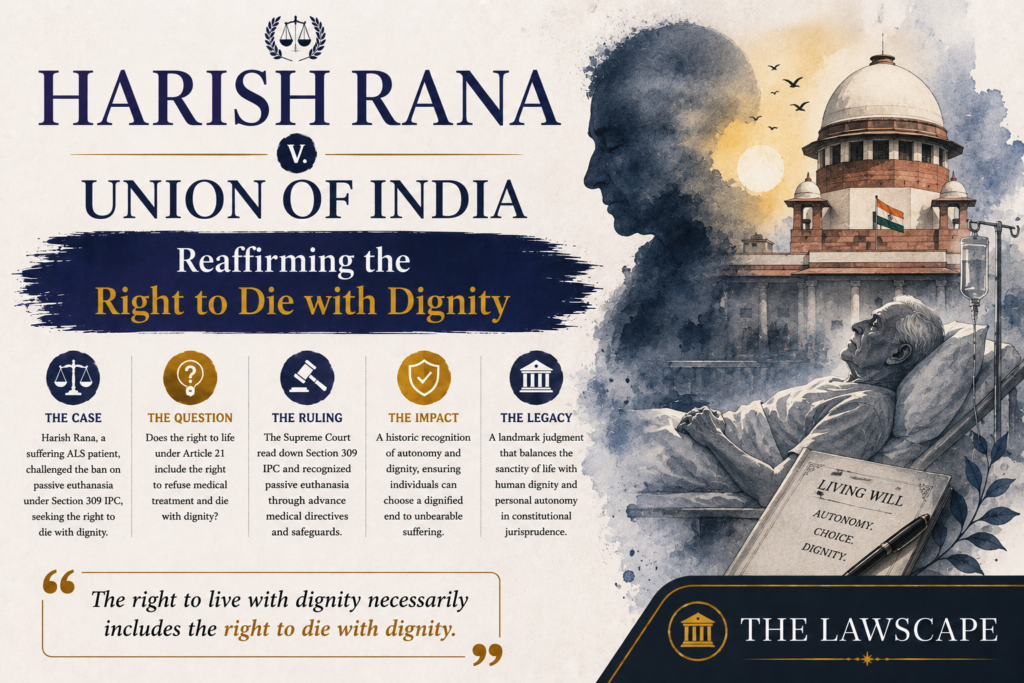
Harish Rana v. Union of India: Reaffirming the Right to Die with Dignity
Author: Deepti Agrawal
Student, Kanoria School of Law for Women, Jaipur
——————————————————————————————————-
💡 3 Quick Takeaways
- Harish Rana v. Union of India clarifies that Clinically Assisted Nutrition and Hydration (CANH) delivered through a PEG tube constitutes medical treatment and may be withdrawn under the law governing passive euthanasia.
- The judgment reinforces that Article 21 protects not merely biological existence but also the right to live—and die—with dignity.
- By applying the best interests test and relying on independent medical boards, the Supreme Court strengthened procedural safeguards in end-of-life decision-making.
1. Introduction
Whether an individual has a right to die with dignity remains one of the most controversial questions in constitutional and medical jurisprudence. The rapid development of medical technology has enabled doctors to keep patients biologically alive for prolonged periods even where recovery is impossible. Legal systems across the world have therefore had to confront difficult questions concerning the withdrawal of life-sustaining treatment, patient autonomy, and the relationship between dignity and medical intervention.
In India, the legal position on passive euthanasia evolved gradually through judicial intervention. The Supreme Court first recognised the concept in Aruna Ramachandra Shanbaug v. Union of India in 2011. Subsequently, a Constitution Bench in Common Cause v. Union of India expanded the jurisprudence by affirming the right to die with dignity and laying down guidelines for passive euthanasia and advance directives. Despite these developments, certain legal ambiguities persisted, particularly regarding whether Clinically Assisted Nutrition and Hydration (CANH) falls within the category of life-sustaining treatment that may be withdrawn.
The judgment in Harish Rana v. Union of India (UOI) & Ors. constitutes an important step in resolving these uncertainties. The case involved a young man who had remained in a Permanent Vegetative State (PVS) for over thirteen years following severe brain damage sustained in an accident. The Supreme Court was required to decide whether CANH administered through mechanical support constituted a medical intervention and whether its withdrawal would fall within the ambit of passive euthanasia as recognised in Common Cause. The judgment is significant because it settles an important point of law in medical ethics while reaffirming the constitutional guarantee of dignity under Article 21 of the Constitution of India.
2. Facts of the Case
Harish Rana was a young B.Tech. student whose life changed dramatically after an accident in 2013. He fell from the fourth floor of his hostel and sustained grievous brain injuries that resulted in traumatic brain damage. He was subsequently diagnosed as being in a Permanent Vegetative State. As a result of this condition, he suffered from total quadriplegia and was unable to communicate or move on his own. His level of consciousness was severely diminished, leaving him entirely dependent on mechanical and medical support.
For more than thirteen years, Harish Rana remained unable to talk, think, or move voluntarily. He required constant medical supervision and life support through various tubes. In particular, a tracheostomy tube assisted his breathing, while a PEG tube was used to provide nutrition and hydration in the form of CANH, thereby enabling his biological survival.
Despite the care provided by his family and continuous medical treatment, his neurological condition showed no improvement. Repeated medical examinations concluded that there was no possibility of recovery. In view of the complete absence of progress and the medical opinion that his condition was irreversible, Harish Rana’s parents approached the Supreme Court seeking withdrawal of life-prolonging treatment. They argued that continuing CANH would merely prolong biological existence without any possibility of restoring consciousness or meaningful life.
The Supreme Court directed the constitution of both a Primary Medical Board and a Secondary Medical Board at the All India Institute of Medical Sciences (AIIMS) to independently examine Harish Rana’s condition. Both boards concluded that he was in an irreversibly comatose Permanent Vegetative State.
3. Issues Raised
The Supreme Court considered the following legal questions:
- Whether the administration of Clinically Assisted Nutrition and Hydration through a PEG tube amounts to medical treatment that may be withdrawn as part of passive euthanasia.
- Whether the withdrawal of CANH from a person in a Permanent Vegetative State is consistent with Article 21 of the Constitution of India.
- Whether continuing treatment in a case of irreversible illness serves the best interests of the patient.
- Whether the principles laid down in Common Cause v. Union of India apply to cases involving artificial nutrition and hydration.
- What procedural safeguards must be followed before treatment is withdrawn.
4. Analysis
Constitutional Foundation: Article 21 and Human Dignity
The judgment is fundamentally rooted in Article 21 of the Constitution, which guarantees that no person shall be deprived of life or personal liberty except according to procedure established by law. Over the years, the Supreme Court has interpreted Article 21 expansively to include a range of fundamental rights such as privacy, autonomy, health, and dignity.
In Harish Rana, the Court once again reaffirmed that dignity forms an inseparable part of the right to life. Article 21 does not merely protect biological existence; it also requires respect for the person at every stage of life, including its final stage. The Court’s reasoning reflects a broader understanding of constitutional morality, one that does not reduce the right to life to the mere continuation of bodily functions through artificial means. Rather, it recognises that sustaining a person indefinitely in a vegetative state through medical intervention may, in certain circumstances, be inconsistent with the constitutional value of dignity.
Evolution of Passive Euthanasia Jurisprudence
The significance of the judgment can only be fully appreciated in light of the development of passive euthanasia jurisprudence in India.
In Aruna Ramachandra Shanbaug v. Union of India (2011), the Supreme Court dealt with the case of a nurse who had remained in a vegetative state for several decades following a brutal assault. Although the Court did not permit active euthanasia, it recognised passive euthanasia in limited circumstances and introduced judicial safeguards.
This jurisprudence was significantly expanded in Common Cause v. Union of India (2018), where a Constitution Bench held that the right to die with dignity forms part of Article 21. The Court upheld passive euthanasia and also recognised advance medical directives. It laid down detailed procedural safeguards for the withdrawal of life-sustaining treatment and sought to balance patient autonomy with the need to prevent misuse.
The decision in Harish Rana builds upon these precedents and extends the law by clarifying the legal status of CANH.
CANH as Medical Treatment
The most important contribution of the judgment lies in its classification of Clinically Assisted Nutrition and Hydration as a form of medical treatment rather than ordinary feeding. This distinction has profound legal and ethical consequences.
In ordinary circumstances, feeding and hydration are considered basic aspects of care and are generally non-negotiable. However, when nutrition and hydration are administered through a PEG tube or similar medical mechanism, the situation changes. Such intervention requires medical expertise, constant supervision, and technological support. It is therefore not equivalent to ordinary feeding but constitutes a medical intervention designed to sustain life artificially.
The Court accepted this distinction and held that CANH delivered through a PEG tube falls within the category of medical treatment. Since it is a form of life-sustaining treatment, it may be withdrawn under the framework of passive euthanasia where the legal and medical requirements are satisfied. This clarification resolves a major ambiguity in Indian law and aligns Indian jurisprudence more closely with developments in other jurisdictions.
The Best Interests Test
Another crucial aspect of the Court’s reasoning is its reliance on the best interests test. Rather than basing its decision solely on the wishes of family members or medical practitioners, the Court sought to determine which course of action would best protect the welfare and dignity of the patient.
The medical boards unanimously concluded that Harish Rana’s condition was irreversible and that there was no realistic prospect of regaining consciousness. They further opined that the continuation of CANH would merely sustain biological life without offering any therapeutic benefit. In these circumstances, the Court held that continued treatment would not be in Harish Rana’s best interests.
The use of the best interests test is significant because it keeps the focus on the patient rather than on external emotional, social, or institutional considerations. It ensures that decisions concerning withdrawal of treatment are based on objective medical facts and on an assessment of whether continued intervention genuinely serves the welfare of the person concerned.
Role of Medical Expertise
The judgment also demonstrates the Court’s careful reliance on medical expertise. By directing the constitution of both a Primary Medical Board and a Secondary Medical Board, the Supreme Court ensured that Harish Rana’s condition was independently and thoroughly assessed.
This approach reflects judicial recognition that end-of-life decisions involve highly specialised medical and scientific questions. Courts may determine legal principles, but they cannot substitute medical expertise in evaluating the prognosis of a patient in a Permanent Vegetative State. The requirement of independent medical boards therefore serves as a vital safeguard against arbitrariness and misuse. It also ensures that any decision to withdraw treatment rests on reliable and objective medical evidence.
Balancing Sanctity of Life and Dignity
One of the most difficult questions in euthanasia jurisprudence is how to reconcile the sanctity of life with dignity and autonomy. Opponents of withdrawal of treatment often argue that permitting passive euthanasia may weaken the legal and moral commitment to preserving life.
The Court attempted to resolve this concern by clearly distinguishing passive euthanasia from active euthanasia. Active euthanasia involves a deliberate act intended to cause death and remains illegal in India. Passive euthanasia, by contrast, involves the withdrawal of futile medical treatment where no recovery is possible. In such cases, death occurs not because the law permits the killing of the patient, but because the underlying illness takes its natural course once artificial intervention is discontinued.
The Court carefully clarified that its ruling did not legalise the active ending of life. Rather, it allowed only the discontinuation of futile medical treatment where continued intervention no longer serves any therapeutic or dignitary purpose.
Comparative Perspective
The reasoning adopted in Harish Rana is broadly consistent with developments in several foreign jurisdictions. In England, courts have recognised that artificial feeding and hydration may be withdrawn from patients in a Persistent Vegetative State where such treatment is no longer in their best interests. Similar approaches have emerged in Canada, Australia, and parts of Europe.
These jurisdictions increasingly acknowledge that patient dignity, self-respect, and freedom from futile medical intervention are central considerations in end-of-life decision-making. The Supreme Court’s reasoning in Harish Rana reflects an awareness of these comparative developments while grounding its conclusions firmly in the constitutional framework of India.
Critical Evaluation
The judgment deserves appreciation for its humane and constitutionally sensitive approach. The Court recognised that dignity is not an abstract concept but a real constitutional principle that must shape legal responses to end-of-life situations. By treating CANH as medical treatment, the Court resolved an important ambiguity that would otherwise have continued to complicate future cases involving prolonged vegetative states.
The judgment also reflects judicial restraint. The Court did not adopt an unrestricted or abstract theory of euthanasia. Instead, it confined its reasoning to cases where there is clear and irrefutable medical evidence that the patient’s condition is irreversible and that continued treatment serves no meaningful purpose.
At the same time, the case exposes certain weaknesses in the Indian legal framework. End-of-life decision-making in India still depends heavily on judicial intervention, which places an emotional and procedural burden on families already dealing with extreme distress. The need to approach the courts for withdrawal of treatment can be time-consuming and difficult. A statutory framework governing passive euthanasia, advance directives, and end-of-life care would make the process clearer, more accessible, and less traumatic.
The judgment also underlines the importance of public awareness regarding advance medical directives. Greater awareness and wider use of such directives could reduce uncertainty and ensure that patient autonomy is better respected in future cases.
5. Conclusion
Harish Rana v. Union of India marks an important step forward in Indian constitutional and medical jurisprudence. Building upon Aruna Shanbaug and Common Cause, the Supreme Court made it clear that Clinically Assisted Nutrition and Hydration delivered through a PEG tube is a form of medical treatment that may be withdrawn under appropriate conditions.
The judgment reiterates the core constitutional principle that the right to life under Article 21 includes the right to live and die with dignity. It affirms that in cases where treatment no longer serves the patient’s welfare, acting in the patient’s best interests may require permitting the natural process of death rather than mechanically prolonging biological existence.
The case is particularly significant because it resolves an issue that had remained uncertain in Indian law: whether artificial nutrition and hydration may be treated as medical intervention for the purposes of passive euthanasia. The judgment will therefore serve as an important precedent in future end-of-life cases.
At the same time, the decision also highlights the urgent need for legislative reform. Comprehensive statutory regulation of passive euthanasia, advance directives, and end-of-life care would provide clarity, reduce the burden of repeated judicial intervention, and ensure that constitutional principles of dignity and autonomy are implemented more effectively.
Ultimately, Harish Rana reflects the humane side of law and medicine in the face of an exceptionally difficult situation. It reaffirms that human dignity must remain central to constitutional protection at every stage of life, particularly when medicine has reached the limits of what it can meaningfully do.
Disclaimer: The views expressed in this article are those of the author and do not necessarily reflect the views of The Lawscape.
The Lawscape — clear, practical legal insight for students and future lawyers.