
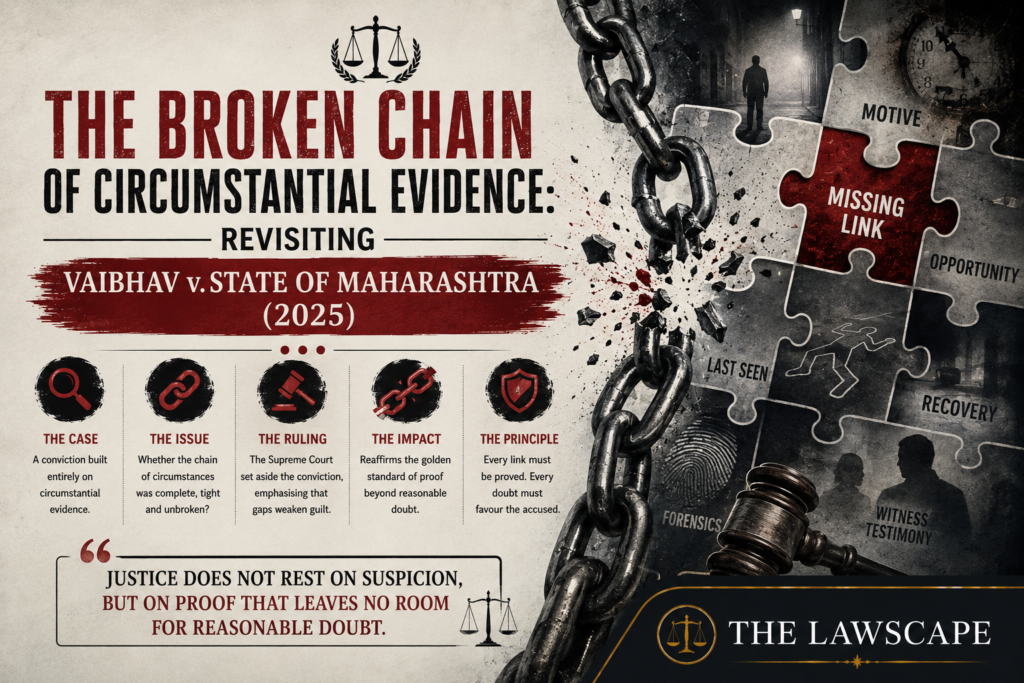
The Broken Chain of Circumstantial Evidence: Revisiting Vaibhav v. State of Maharashtra (2025),
Author: Prapti Vora
Student, Symbiosis Law School, Nagpur
—————————————————————————————-
💡 3 Quick Takeaways
1. The Supreme Court reaffirmed that circumstantial evidence must establish a complete and unbroken chain leading exclusively to the guilt of the accused.
2. Suspicious post-offence conduct cannot, by itself, substitute proof beyond reasonable doubt.
3. The absence of motive significantly weakened the prosecution’s case, resulting in the appellant’s acquittal on the charge of murder while sustaining the conviction for destruction of evidence.
Introduction
In Vaibhav v. State of Maharashtra, the Supreme Court of India examined whether circumstantial evidence was sufficient to establish an unbroken chain of proof beyond reasonable doubt. Circumstantial evidence is not secondary evidence; rather, it consists of facts that indirectly establish the existence of another fact in issue. Throughout criminal jurisprudence, such evidence has served both as a valuable investigative tool and as a potential source of wrongful convictions if not carefully scrutinised.
Allowing the appeal, the Supreme Court reiterated that strong suspicion can never substitute the prosecution’s obligation to prove guilt beyond reasonable doubt. The judgment reinforces the constitutional guarantees embodied in Articles 20 and 21 of the Constitution by protecting individuals against wrongful conviction founded upon incomplete circumstantial evidence. The Court further observed that, in cases resting entirely on circumstantial evidence, the absence of motive assumes considerable importance in evaluating the prosecution’s case.
Facts of the Case
On 16 September 2010, the appellant, Vaibhav, a first-year medical student, was accompanied by his friend, Mangesh. The following day, Mangesh was found dead from a gunshot injury to the eye inside Vaibhav’s residence. The firearm used belonged to Vaibhav’s father.
The prosecution’s case rested almost entirely upon circumstantial evidence. It relied principally on the fact that the appellant was the last person seen with the deceased, that the firearm belonged to his family, and that the appellant gave inconsistent explanations during the investigation. It was further alleged that the appellant and his friends disposed of the body and cleaned bloodstains from the premises. The appellant maintained that the deceased had accidentally discharged the firearm.
The appellant was charged under Sections 302, 201, and 34 of the Indian Penal Code. While both the Trial Court and the High Court convicted him, the Supreme Court re-examined the evidentiary record and concluded that the prosecution had failed to establish a complete chain of circumstances or prove any motive. Consequently, the Court acquitted the appellant of the offence of murder while upholding his conviction for destruction and concealment of evidence.
Issues Raised
The Supreme Court considered the following issues:
- Whether the Trial Court and the High Court incorrectly shifted the burden of proof onto the appellant before the prosecution had discharged its primary burden.
- Whether the prosecution established a complete chain of circumstantial evidence capable of proving the appellant’s guilt beyond reasonable doubt.
- Whether the appellant’s conduct after the incident could itself establish his guilt for murder.
- Whether the absence of motive weakened a prosecution case based solely upon circumstantial evidence.
Applicable Legal Provisions
Section 302, Indian Penal Code
Section 302 prescribes punishment for murder. The Court examined whether the prosecution had established a complete chain of circumstances sufficient to sustain a conviction under this provision.
Section 201, Indian Penal Code
Section 201 criminalises the destruction or concealment of evidence. The Court held that the appellant’s admitted conduct of disposing of the body and cleaning bloodstains attracted liability under this provision irrespective of whether he had committed murder.
Section 34, Indian Penal Code
Section 34 concerns acts committed by several persons in furtherance of a common intention. The Court considered whether common intention had been established on the evidence produced during trial.
Section 25(1)(a), Arms Act, 1959
The prosecution alleged unlawful use of the firearm belonging to the appellant’s father. However, as no evidence established that the appellant had fired the weapon, the Court found no basis for conviction under this provision.
Section 8, Indian Evidence Act, 1872
Section 8 recognises subsequent conduct as relevant evidence. The Supreme Court accepted that the appellant’s conduct after the incident was relevant but emphasised that such conduct alone could not establish guilt for murder.
The Golden Principles of Circumstantial Evidence
The Court reaffirmed the principles laid down in Sharad Birdhichand Sarda, commonly known as the Panchsheel Test. These principles require:
- Circumstances to be firmly established.
- A complete chain of evidence.
- Consistency of every circumstance with the guilt of the accused.
- Exclusion of every reasonable hypothesis consistent with innocence.
- Circumstances that point conclusively towards the guilt of the accused.
Analysis
Issue I: Burden of Proof
The Supreme Court observed that both the Trial Court and the High Court effectively shifted the burden of proof onto the appellant before the prosecution had established its own case. Criminal jurisprudence requires the prosecution to prove guilt beyond reasonable doubt before any adverse inference may be drawn against the accused.
Although the appellant’s conduct in disposing of the body, cleaning bloodstains, and making inconsistent statements was relevant under Section 8 of the Indian Evidence Act, those facts alone could not establish the commission of murder. The Court further noted that such conduct could reasonably be explained by fear of the appellant’s father’s reaction following the accidental use of his service weapon.
Accordingly, the Court concluded that excessive reliance upon circumstantial evidence without first establishing a complete prosecution case resulted in prejudice and compromised the fairness of the criminal trial.
Issue II: Completeness of the Circumstantial Chain
Applying the principles laid down in Sharad Birdhichand Sarda, the Supreme Court assessed whether the prosecution had established an unbroken chain of circumstances.
Certain facts were undisputed. The deceased died inside the appellant’s residence, and the firearm belonged to the appellant’s father. However, important inconsistencies remained unexplained. In particular, the prosecution failed to explain how the bullet entered the ventilator situated above the deceased after passing through his head.
These unresolved inconsistencies prevented the circumstantial evidence from forming a complete chain capable of excluding every reasonable hypothesis other than guilt. Consequently, the prosecution failed to satisfy the standard of proof required in criminal law.
Issue III: Subsequent Conduct
The prosecution relied heavily upon the appellant’s conduct after the incident, including disposal of the body, removal of bloodstains, and false explanations.
The Supreme Court held that although subsequent conduct constitutes relevant evidence under Section 8 of the Indian Evidence Act, it cannot independently establish guilt for murder. Such conduct may equally indicate fear, panic, confusion, or poor judgment. In the present case, the Court accepted that the appellant’s actions were motivated by fear arising from the use of his father’s service pistol rather than by proof that he had intentionally committed murder.
Accordingly, while the appellant remained liable under Section 201 IPC for destruction of evidence, these circumstances did not justify conviction under Section 302 IPC.
Issue IV: Absence of Motive
The Court emphasised that motive assumes considerable importance where the prosecution relies exclusively upon circumstantial evidence.
Referring to Babu v. State of Kerala, the Court observed that motive strengthens the prosecution’s case, whereas its absence may substantially benefit the accused where other circumstances remain inconclusive.
In the present case, no evidence suggested hostility, financial gain, personal animosity, or any other reason that could explain why the appellant would murder his friend. The absence of motive therefore became an important factor reinforcing the reasonable doubt already created by deficiencies in the prosecution’s circumstantial evidence.
Conclusion
Vaibhav v. State of Maharashtra does not diminish the importance of circumstantial evidence within criminal trials. Rather, it reinforces the well-established principle that such evidence must form a complete and unbroken chain pointing exclusively towards the guilt of the accused.
The Supreme Court found that the prosecution failed to satisfy this rigorous standard. Although the appellant’s conduct following the incident justified conviction for destruction of evidence, it could not substitute proof that he had committed murder. The absence of motive further weakened the prosecution’s case and prevented the circumstantial evidence from excluding every reasonable hypothesis consistent with innocence.
The judgment ultimately reaffirms one of the fundamental principles of criminal justice—that suspicion, however strong, cannot replace proof beyond reasonable doubt. It serves as an important reminder that fairness of trial and the presumption of innocence remain central to India’s constitutional criminal justice system.
Disclaimer: The views expressed in this article are those of the author and do not necessarily reflect the views of The Lawscape.
The Lawscape — clear, practical legal insight for students and future lawyers.