
Maneka Gandhi v. Union of India: Expanding the Scope of Article 21 and Protecting Personal Liberty
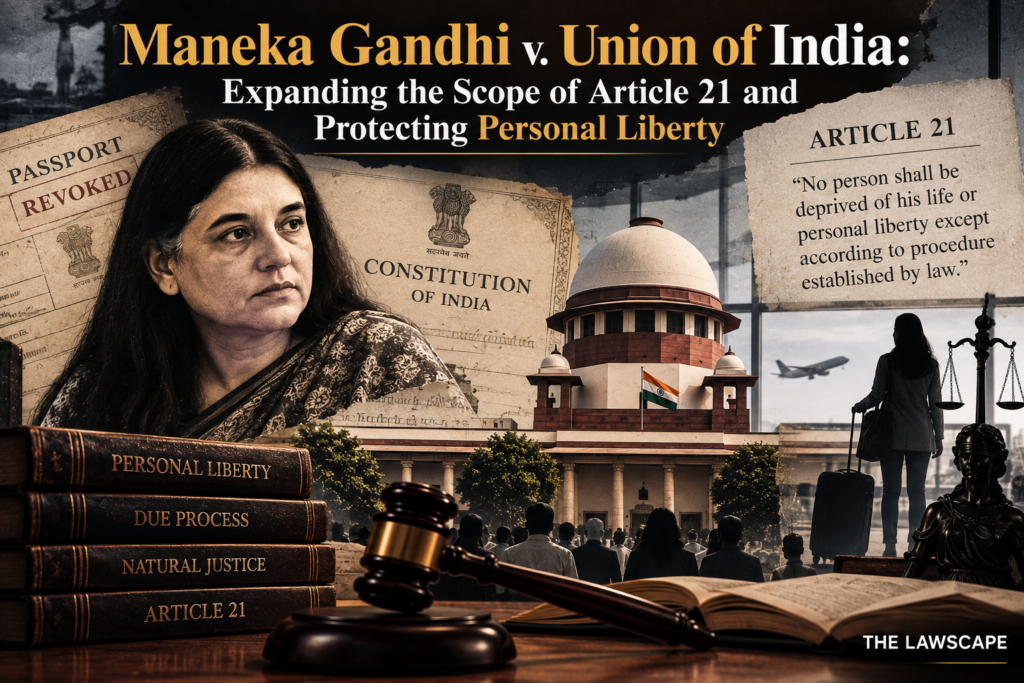
Author: Dhaani
Student, Symbiosis law school nagpur
——————————————————————
💡 3 Quick Takeaways
- In Maneka Gandhi v. Union of India (1978), the Supreme Court held that the procedure established by law under Article 21 must be fair, just, and reasonable, rather than arbitrary, fanciful, or oppressive.
- The judgment established that Articles 14, 19, and 21 must be read together when State action affects life, personal liberty, or the freedoms protected by the Constitution.
- The decision strengthened procedural fairness and protection against arbitrary State action, becoming a foundation for the modern interpretation of personal liberty under Article 21.
Case Details
- Case: Maneka Gandhi v. Union of India
- Citation: AIR 1978 SC 597; (1978) 1 SCC 248
- Court: Supreme Court of India
- Date of Judgment: 25 January 1978
- Bench: Seven-Judge Constitution Bench
- Petitioner: Maneka Gandhi
- Respondent: Union of India
1. Introduction
The case of Maneka Gandhi v. Union of India is a landmark judgment of the Supreme Court of India concerning the Fundamental Rights guaranteed under the Constitution. The judgment significantly expanded the interpretation of Article 21, which protects life and personal liberty. The Court held that the procedure established by law for depriving a person of life or personal liberty must be fair, just, and reasonable and must not be arbitrary, oppressive, or unreasonable. The judgment also established a close relationship between Articles 14, 19, and 21 of the Constitution.
2. Facts of the Case
Maneka Gandhi was issued a passport under the Passports Act, 1967. On 2 July 1977, the Government of India issued an order under Section 10(3)(c) of the Act, directing her to surrender her passport. The Government stated that the passport was being impounded in the interest of the general public.
Maneka Gandhi requested the Government to provide the reasons for its decision and to allow her an opportunity to be heard. The Government refused to disclose the reasons at that stage. Aggrieved by this action, she approached the Supreme Court under Article 32 of the Constitution, claiming that the impounding of her passport violated her Fundamental Rights under Articles 14, 19, and 21.
3. Issues Before the Court
The Supreme Court considered the following important issues:
- Whether the right to travel abroad falls within the scope of personal liberty under Article 21 of the Constitution.
- Whether the procedure established by law under Article 21 must be fair, just, and reasonable.
- Whether Articles 14, 19, and 21 are interconnected and must be read together.
- Whether the Government’s action in impounding the petitioner’s passport was arbitrary and violated her Fundamental Rights.
- Whether the principles of natural justice applied to the Government’s decision.
4. Arguments of the Petitioner
Maneka Gandhi argued that the impounding of her passport deprived her of personal liberty and therefore attracted the protection of Article 21. She contended that the procedure followed by the Government was arbitrary and unreasonable.
She further argued that the Government’s action violated Article 14, which guarantees equality before the law and equal protection of the laws, and Article 19, which guarantees certain fundamental freedoms. She also claimed that she had not been given a reasonable opportunity to be heard before her passport was impounded.
5. Arguments of the Respondent
The Union of India argued that the passport had been impounded under the authority of the Passports Act, 1967. The Government contended that the Act provided a valid legal procedure for impounding passports and that the action had been taken in the interest of the general public.
The Government also relied upon the traditional interpretation of Article 21, according to which a person’s personal liberty could be restricted if the deprivation was carried out according to a procedure established by law.
6. Judgment of the Court
The Supreme Court delivered a landmark judgment that significantly widened the scope of Article 21.
The Court held that the expression “procedure established by law” in Article 21 does not mean any procedure whatsoever. The procedure must be fair, just, and reasonable and must not be arbitrary, fanciful, or oppressive.
The Court further held that Articles 14, 19, and 21 are not separate and isolated provisions. They are interconnected and must be read together when a law or executive action affects the life or personal liberty of an individual.
The judgment therefore strengthened the protection of individual liberty and placed constitutional limits on arbitrary State action.
7. Reasoning of the Court
The Court rejected the narrow interpretation of Article 21 and adopted a broader constitutional approach. It made clear that merely following a procedure prescribed by legislation would not automatically make the deprivation of personal liberty constitutionally valid.
The procedure itself must satisfy the requirements of fairness and reasonableness. The Court also emphasised that Article 14 protects individuals against arbitrary State action and that the freedoms guaranteed under Article 19 must also be considered wherever applicable.
The judgment consequently established that Fundamental Rights should not be interpreted as isolated compartments. Instead, they operate together to protect the liberty and dignity of individuals.
8. Ratio Decidendi
The ratio decidendi of the case is that the procedure established by law under Article 21 must be fair, just, and reasonable and must not be arbitrary or oppressive.
The Court also established that Articles 14, 19, and 21 are interconnected. Therefore, a law affecting personal liberty must satisfy the applicable constitutional requirements under these provisions.
9. Obiter Dicta
The Court made important observations regarding the principles of natural justice. It emphasised the importance of procedural fairness where administrative action affects an individual’s rights or liberty, including the opportunity to present one’s case, subject to circumstances in which such an opportunity may legitimately be excluded.
These observations contributed to the development of procedural fairness in Indian administrative law.
10. Critical Analysis
The judgment represents a major development in Indian constitutional law because it transformed the understanding of personal liberty under Article 21. The Court moved away from a purely formal interpretation of the phrase “procedure established by law” and emphasised substantive requirements of fairness and reasonableness.
One of the major strengths of the judgment is that it provides greater protection against arbitrary governmental action. By reading Articles 14, 19, and 21 together, the Court ensured that the State cannot restrict personal liberty merely by following a formally prescribed procedure.
However, the broad interpretation of Article 21 also gives the judiciary a significant role in determining the content and scope of rights that are not expressly stated in the Constitution. This has contributed to an expanding interpretation of Article 21 in subsequent cases. The judgment therefore raises questions about the relationship between judicial interpretation and the text of the Constitution.
Despite these considerations, the decision remains a significant development in constitutional jurisprudence because it strengthened the protection of individual liberty and reinforced the requirement that State action affecting fundamental rights must satisfy constitutional standards.
11. Significance of the Case
The Maneka Gandhi judgment became a foundation for the modern interpretation of Article 21. It influenced the development of several rights and principles relating to personal liberty, dignity, and procedural fairness.
The judgment also marked a shift in Indian constitutional jurisprudence towards a broader, rights-oriented interpretation of Fundamental Rights. Subsequent cases dealing with privacy, dignity, legal aid, speedy trial, and livelihood have developed principles associated with the expanded understanding of Article 21.
Its continuing significance lies in the principle that personal liberty cannot be restricted through a procedure that is arbitrary or fundamentally unfair. The decision remains an important precedent for examining the constitutionality of State action affecting individual rights.
12. Conclusion
Maneka Gandhi v. Union of India is one of the most important judgments in the history of Indian constitutional law. The Supreme Court’s interpretation of Article 21 established that the State cannot deprive a person of life or personal liberty through an arbitrary or unreasonable procedure.
By recognising the interrelationship between Articles 14, 19, and 21 and requiring procedures affecting personal liberty to be fair, just, and reasonable, the judgment considerably strengthened the protection of Fundamental Rights in India. The case continues to serve as an important precedent for safeguarding individual liberty against arbitrary State action.
References
- Constitution of India, arts. 14, 19, 21 and 32.
- Maneka Gandhi v. Union of India, AIR 1978 SC 597; (1978) 1 SCC 248.
- Passports Act, 1967, § 10(3)(c).
- State of West Bengal v. Anwar Ali Sarkar, AIR 1952 SC 75.
- Kharak Singh v. State of Uttar Pradesh, AIR 1963 SC 1295.
Disclaimer: The views expressed in this article are those of the author and do not necessarily reflect the views of The Lawscape.
The Lawscape — clear, practical legal insight for students and future lawyers.