
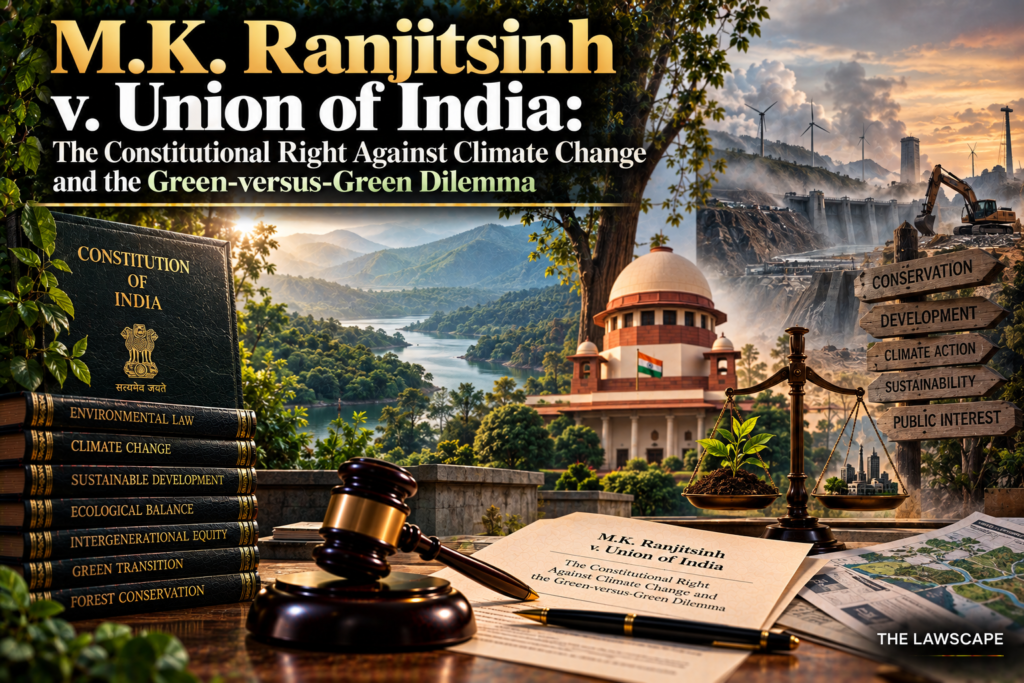
M.K. Ranjitsinh v. Union of India: The Constitutional Right Against Climate Change and the Green-versus-Green Dilemma
Author: Harshit Purohit
Student, Campus Law Centre, Delhi University
————————————————————————————
💡 3 Quick Takeaways
- The Supreme Court recognised the right to be free from the adverse effects of climate change as part of the fundamental rights protected under Articles 14 and 21 of the Constitution of India.
- The judgment addressed the conflict between protecting the critically endangered Great Indian Bustard and facilitating renewable energy infrastructure, replacing a blanket undergrounding directive with a more targeted, expert-guided approach.
- The decision highlights the importance of sustainable development, scientific expertise, and balancing biodiversity conservation with India’s climate commitments.
Introduction
M.K. Ranjitsinh & Ors. v. Union of India & Ors., (2024) 3 S.C.R. 1320, is a significant judgment in the development of Indian environmental and constitutional jurisprudence. Delivered by a three-judge Bench of the Supreme Court of India comprising Chief Justice Dr. D.Y. Chandrachud, Justice J.B. Pardiwala, and Justice Manoj Misra on 21 March 2024, the judgment addressed the complex relationship between wildlife conservation, renewable energy development, and constitutional protection against climate change.
The dispute brought into sharp focus a “green-versus-green” dilemma: the need to protect endangered bird species from collisions with overhead power transmission lines while facilitating renewable energy projects essential to reducing greenhouse gas emissions. The Court’s decision also recognised the right to be free from the adverse effects of climate change, drawing upon the constitutional guarantees of equality and life under Articles 14 and 21.
Facts of the Case
The Great Indian Bustard (GIB) and the Lesser Florican are endangered bird species associated with the grasslands of Rajasthan and Gujarat, particularly the Thar Desert and the Kutch region. The Great Indian Bustard is a heavy, low-flying bird with a limited field of frontal vision, making it particularly vulnerable to collisions with overhead high-tension power transmission lines. According to surveys cited in the original submission, the population of the Great Indian Bustard had declined to fewer than 150 individuals in the wild, placing the species at considerable risk of extinction.
At the same time, the principal habitats of the Great Indian Bustard overlap geographically with regions that possess substantial solar and wind energy potential. India’s transition towards renewable energy, including its commitments under the Paris Agreement, required the development of large-scale solar parks, wind farms, and transmission infrastructure to connect renewable energy generation to the national electricity grid.
In 2019, M.K. Ranjitsinh and other wildlife conservationists approached the Supreme Court under Article 32 of the Constitution, seeking urgent measures to protect the Great Indian Bustard.
On 19 April 2021, the Supreme Court passed an interim order directing that overhead power lines in designated priority and potential habitats of the Great Indian Bustard in Rajasthan and Gujarat be laid underground. The order also required bird diverters to be installed on existing lines until undergrounding was completed.
The Union of India and other stakeholders subsequently sought modification of the order. They argued that undergrounding high-voltage transmission lines, particularly those operating at 400 kV or higher, presented substantial technical difficulties, financial costs, and safety concerns. They further submitted that the blanket restriction could impede renewable energy development in important solar and wind energy regions.
The Court was therefore required to reconsider its earlier directions while addressing the competing concerns of species conservation, infrastructure development, and climate change mitigation.
Issues Before the Court
The principal issues arising in the case were:
- Whether the 2021 direction requiring undergrounding of power lines in the Great Indian Bustard’s habitats required modification in light of technical constraints and the need to develop renewable energy infrastructure.
- How the constitutional obligations under Articles 48A and 51A(g), concerning environmental protection and wildlife conservation, should be balanced against India’s commitments to mitigate climate change through renewable energy development.
- Whether the right to be protected against the adverse effects of climate change could be recognised as a fundamental right under the Constitution of India.
Arguments of the Parties
Petitioners: M.K. Ranjitsinh and Others
The petitioners approached the dispute from the perspective of wildlife conservation and the precautionary principle. They argued that the Great Indian Bustard was on the verge of extinction and that its disappearance would result in irreversible ecological damage. In their view, renewable energy projects could be relocated or implemented through alternative arrangements, whereas the extinction of a species would be permanent.
The petitioners relied on Articles 48A and 51A(g) of the Constitution. Article 48A directs the State to protect and improve the environment and safeguard the country’s forests and wildlife, while Article 51A(g) places a fundamental duty on citizens to protect and improve the natural environment and show compassion for living creatures.
They contended that overhead power transmission lines were a significant human-caused threat to the Great Indian Bustard. The petitioners argued that the financial and logistical difficulties associated with underground cables should not outweigh the need to protect the species. They also invoked the Precautionary Principle and the Doctrine of Public Trust, maintaining that the conservation of the Great Indian Bustard required priority over the practical and financial considerations advanced by power generation companies.
Respondents: Union of India and Others
The Union Government did not dispute the importance of conserving the Great Indian Bustard. However, it challenged the feasibility and proportionality of the blanket directions issued in 2021.
On technical grounds, the Union submitted that undergrounding extremely high-voltage transmission lines across extensive desert regions would be exceptionally difficult. Such infrastructure would require complex cable-jointing arrangements, involve substantial risks of failure, and necessitate extensive trenching that could itself cause localised environmental damage.
The Union also advanced a broader environmental argument based on climate change mitigation. India is a party to the United Nations Framework Convention on Climate Change (UNFCCC) and the Paris Agreement and has announced a target of achieving net-zero emissions by 2070. Rajasthan and Gujarat possess considerable solar and wind energy potential, making them important regions for India’s renewable energy transition.
According to the Union, restricting renewable energy infrastructure could prolong dependence on coal-fired power generation, thereby contributing to greenhouse gas emissions and global warming. Climate change, in turn, threatens biodiversity and may adversely affect the habitats on which the Great Indian Bustard depends.
The Union consequently characterised the dispute as a conflict between localised ecological harm caused by overhead transmission lines and the broader environmental consequences of climate change.
Judgment of the Supreme Court
On 21 March 2024, the Supreme Court substantially modified its earlier directions concerning power transmission lines in the habitats of the Great Indian Bustard.
Modification of the 2021 order: The Court reconsidered the blanket requirement for undergrounding power lines throughout the designated priority and potential habitats. It recognised that a uniform direction did not adequately account for the technical feasibility of undergrounding high-voltage lines or the requirements of renewable energy infrastructure.
Constitution of an expert committee: Recognising the scientific and technical complexity of the dispute, the Court constituted an expert committee to examine the geographical areas in which undergrounding would be necessary and feasible, assess the effectiveness of bird diverters, and recommend appropriate conservation measures. This approach allowed the relevant decisions to be informed by scientific expertise and the specific circumstances of different locations.
Recognition of the right against the adverse effects of climate change: A significant constitutional development in the judgment was the Court’s recognition that people have a right to be free from the adverse effects of climate change. The Court located this right within the protections afforded by Articles 14 and 21 of the Constitution.
Ratio Decidendi
1. Articles 14 and 21: The Right Against Climate Change
One of the most significant aspects of the judgment was the express recognition of the right to be free from the adverse effects of climate change.
Indian courts had previously recognised the right to a clean and healthy environment as an aspect of the right to life under Article 21. In the present case, the Supreme Court explained that climate change presents distinct and serious threats that warrant explicit constitutional recognition.
The Court connected climate change with Article 21 because its consequences affect human health, food and water security, and the conditions necessary for a dignified life. Rising temperatures, extreme weather events, droughts, floods, and changing patterns of disease can directly affect the enjoyment of the right to life.
The Court also linked climate change with Article 14, which guarantees equality before the law and equal protection of the laws. The adverse effects of climate change are not distributed equally. Economically disadvantaged communities, agricultural workers, coastal populations, and indigenous communities may face greater difficulties in adapting to environmental changes.
Climate-related food and water shortages, displacement, and the destruction of traditional livelihoods can deepen existing inequalities. By recognising the connection between Articles 14 and 21, the Court established a constitutional basis for addressing the unequal consequences of climate change.
2. International Law and Domestic Constitutionalism
The Court considered India’s international commitments under the UNFCCC and the Paris Agreement while examining the constitutional dimensions of climate change.
Although international treaties do not automatically become enforceable domestic law merely through ratification, they can inform the interpretation of constitutional rights, subject to the applicable constitutional and statutory framework.
India’s commitments to reduce emissions and expand renewable energy are relevant to understanding the State’s response to climate change. The Court’s reasoning recognised that achieving climate objectives requires the development of renewable energy infrastructure.
Consequently, environmental directions must take account of the State’s ability to pursue climate mitigation measures. Judicial intervention intended to protect one aspect of the environment must also consider whether its consequences could undermine broader efforts to address climate change.
3. Sustainable Development and the Green-versus-Green Dilemma
The judgment illustrates the difficulty of resolving environmental disputes in which two legitimate ecological objectives conflict.
On one side was the constitutional responsibility to protect the Great Indian Bustard under Article 48A, supported by the fundamental duties reflected in Article 51A(g). On the other was the need to facilitate renewable energy generation as part of the response to climate change.
The Court recognised that neither objective could simply be disregarded. Protecting a particular species is important, but climate change can also cause extensive ecological damage. Similarly, expanding renewable energy infrastructure cannot eliminate the need to protect vulnerable wildlife.
The Court’s approach reflected the principle of sustainable development by moving away from an inflexible, blanket direction towards a more targeted and science-based framework. The expert committee was entrusted with examining the circumstances in which undergrounding and other conservation measures could be implemented.
This approach sought to accommodate both biodiversity conservation and renewable energy development through measures informed by technical feasibility and local ecological conditions.
Implications of the Judgment
1. The Development of Climate Constitutionalism in India
The recognition of the right against the adverse effects of climate change provides an important constitutional foundation for future environmental litigation. Articles 14 and 21 can be invoked in examining State action and its consequences for people affected by climate change.
The judgment also strengthens the relationship between environmental protection, equality, and the right to life.
2. Renewable Energy Development and Regulatory Certainty
The modification of the blanket undergrounding requirement addressed concerns about the technical and financial feasibility of renewable energy infrastructure. The judgment recognised the importance of accounting for engineering constraints and the practical requirements of transmission networks.
Its approach permits conservation measures to be considered in a more targeted manner rather than applying a uniform requirement irrespective of local conditions.
3. A Framework for Future Ecological Disputes
The reasoning in the case is relevant to future disputes involving renewable energy projects, infrastructure development, and biodiversity conservation.
Projects such as solar parks, wind farms, and hydroelectric installations may affect local ecosystems even when they serve broader environmental objectives. The judgment demonstrates the importance of examining these competing consequences through a framework that considers constitutional obligations, scientific evidence, and sustainable development.
The expert committee approach also highlights the role of specialised knowledge in resolving disputes that involve complex ecological and engineering questions.
4. The Continuing Vulnerability of the Great Indian Bustard
Despite the modification of the earlier directions, the conservation of the Great Indian Bustard remains a central concern. The effectiveness of the expert-guided approach depends on the implementation of appropriate protective measures, including bird diverters, undergrounding where feasible, and the preservation of important breeding habitats.
The continuing challenge is to ensure that renewable energy development and wildlife conservation can proceed without treating either objective as expendable.
Conclusion
The Supreme Court’s decision in M.K. Ranjitsinh & Ors. v. Union of India & Ors. marks an important development in Indian constitutional and environmental jurisprudence. By recognising the right to be free from the adverse effects of climate change under Articles 14 and 21, the Court connected environmental protection with fundamental rights and the unequal consequences of climate change.
At the same time, the modification of the 2021 order acknowledged the technical requirements of renewable energy infrastructure and the importance of expert assessment in environmental decision-making.
The judgment brings the green-versus-green dilemma into focus: biodiversity conservation and climate change mitigation are both essential environmental objectives, yet pursuing one can create challenges for the other. Its approach emphasises the need for scientific assessment, proportionate measures, and sustainable development.
Ultimately, the judgment’s practical significance will depend on how effectively conservation measures are implemented while renewable energy infrastructure continues to develop. The continuing protection of the Great Indian Bustard will remain an important measure of the success of this approach.
Disclaimer: The views expressed in this article are those of the author and do not necessarily reflect the views of The Lawscape.
The Lawscape — clear, practical legal insight for students and future lawyers.