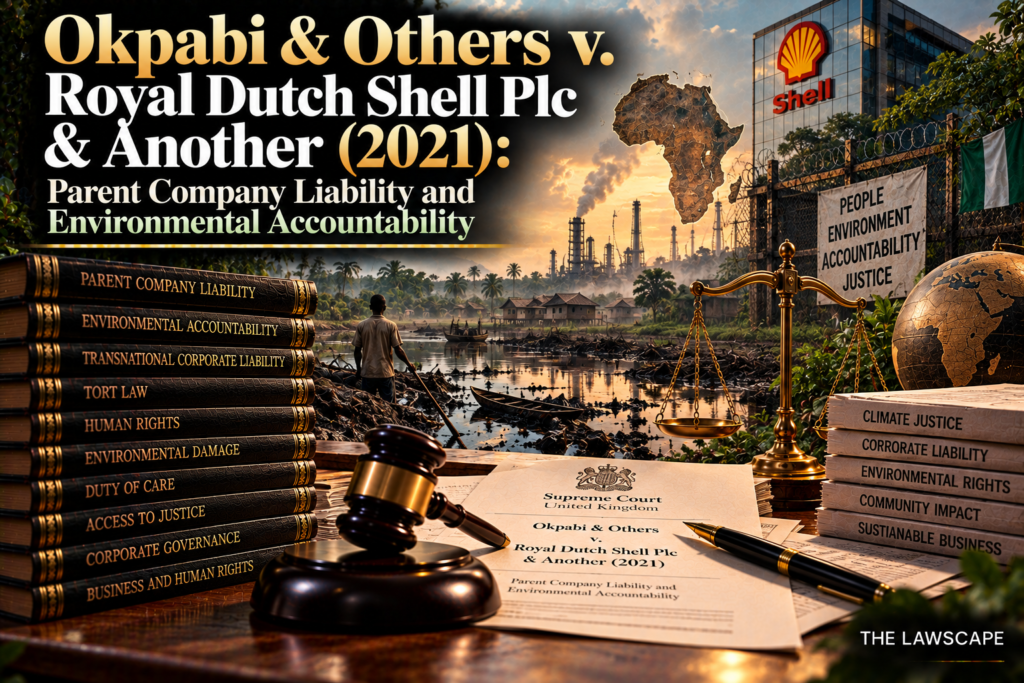
Okpabi & Others v. Royal Dutch Shell Plc & Another (2021): Parent Company Liability and Environmental Accountability
Author: Nabula Gabriel Loghselem
Student: Rivers State University ( A graduate)
——————————————————————————————————
💡 3 Quick Takeaways
- A parent company is not automatically liable for the acts of its subsidiary. However, it may owe a direct duty of care where its own conduct, intervention, supervision or assumption of responsibility satisfies the ordinary principles of negligence.
- Courts should not conduct a mini-trial at the jurisdictional stage by resolving disputed factual issues before disclosure and a full trial.
- The Supreme Court’s decision preserved the Nigerian claimants’ opportunity to establish their case against Royal Dutch Shell Plc. It did not finally determine the company’s liability for the alleged oil spills.
1. Introduction
The decision in Okpabi & Others v. Royal Dutch Shell Plc & Another [2021] UKSC 3 is an important judgment of the Supreme Court of the United Kingdom concerning parent company liability, environmental harm and the jurisdiction of English courts over claims involving multinational corporate groups.
The case arose from allegations of environmental damage caused by oil spills in the Niger Delta region of Nigeria. The claimants, who belonged to the Ogale and Bille communities in Rivers State, alleged that oil spills from pipelines and related infrastructure had contaminated their land and waterways, adversely affecting their livelihoods and access to clean water.
The central issue was whether Royal Dutch Shell Plc (RDS), a company domiciled in the United Kingdom and the parent company of the Shell group, could arguably owe a direct duty of care to the Nigerian claimants in relation to the operations of its Nigerian subsidiary, the Shell Petroleum Development Company of Nigeria Ltd (SPDC).
The judgment was delivered on 12 February 2021, following a hearing on 23 June 2020. The Supreme Court allowed the appeal, holding that the lower courts had incorrectly concluded that there was no real issue to be tried against RDS.
Importantly, the Court did not finally determine that RDS was liable for the alleged environmental damage. Instead, it held that the claimants’ case should not have been summarily dismissed before the relevant evidence could be properly examined.
2. Background and Parties
The appellants comprised claimants from two riverine communities in Rivers State, Nigeria.
The Ogale proceedings were brought by the community’s leadership, including its king, HRH Emere Godwin Bebe Okpabi, and the Council of Chiefs, on behalf of approximately 40,000 members of the community. The Bille proceedings involved 2,335 individual claimants.
The first respondent, Royal Dutch Shell Plc, was domiciled in the United Kingdom and served as the parent company of the wider Shell group. The second respondent, SPDC, was a Nigerian company and a subsidiary of RDS.
SPDC operated the relevant pipelines and associated infrastructure on behalf of a Nigerian joint venture. The Nigerian National Petroleum Corporation held a 55 per cent participating interest, Total E&P Nigeria Ltd held 10 per cent, Nigerian Agip Oil Company held 5 per cent, and SPDC held 30 per cent.
The communities depended on their surrounding land and waterways for drinking, fishing, farming, washing and recreation. They alleged that repeated oil spills had caused widespread contamination and that the resulting pollution had not been adequately cleaned up or remediated.
The proceedings were particularly significant because they raised questions about the relationship between a multinational parent company and its subsidiary, and whether the parent company’s own involvement in the subsidiary’s operations could give rise to a direct duty of care.
3. Facts of the Case
The claimants alleged that numerous oil spills had occurred from pipelines and related facilities operated by SPDC in the vicinity of their communities. According to the claimants, these spills caused extensive environmental damage, contaminating land, rivers and streams and making natural water sources unsafe for drinking, fishing, agriculture, washing and recreation.
They alleged that SPDC had been negligent in preventing oil spills, maintaining pipelines, addressing third-party interference and unlawful bunkering, and responding effectively when spills occurred. They further contended that the company had failed to undertake adequate clean-up and remediation.
In addition to pursuing claims against SPDC under Nigerian statutory and common law, the claimants brought proceedings against RDS in England. Their case was not based merely on RDS’s status as the parent company. Rather, they argued that RDS had assumed responsibility for, and exercised significant supervision or control over, relevant aspects of SPDC’s operations.
The claimants relied on Shell group-wide policies concerning health, safety, security and the environment, together with standards, manuals and technical practices that they alleged were mandatory across the group. They also relied on RDS’s control framework, which described the group’s organisational structure, delegation of authority, reporting lines, technical functions, audit procedures and responsibilities relating to safe and environmentally responsible operations.
Further allegations concerned RDS’s monitoring of SPDC’s compliance with group standards, its receipt of reports on maintenance, safety and environmental performance, its influence over oil-spill response procedures, and its involvement in pipeline security and replacement. The claimants also relied on evidence from former Shell employees suggesting that Nigeria was considered a particularly sensitive and high-risk part of the business and that important matters concerning SPDC were escalated to senior RDS management.
These allegations formed the basis of the claimants’ argument that RDS might owe them a direct duty of care under the ordinary principles of negligence.
4. Procedural History
The Ogale claim was filed on 14 October 2015, while the Bille claim was filed on 22 December 2015. The claim forms were served on RDS in the United Kingdom because it was domiciled there. The claimants subsequently sought permission to serve SPDC outside the jurisdiction, arguing that it was a necessary or proper party to the proceedings under paragraph 3.1(3) of Practice Direction 6B.
At first instance, Fraser J held that the English court had jurisdiction to hear the claims against RDS but concluded that it was not reasonably arguable that RDS owed the claimants a duty of care. Since there was no real issue to be tried against RDS, the jurisdictional basis for serving SPDC outside the jurisdiction was not satisfied. The service on SPDC was therefore set aside, and the claims against RDS were struck out.
The claimants appealed to the Court of Appeal. Although the Court corrected certain errors made by the lower court, the majority reached the same ultimate conclusion. Simon LJ and the Chancellor held that the claimants had no arguable case that RDS owed them a duty of care.
Sales LJ dissented, taking the view that there was a good arguable case that RDS had assumed responsibility for, or exercised practical control over, relevant aspects of SPDC’s operations.
The claimants then appealed to the Supreme Court.
5. Issues Before the Supreme Court
The Supreme Court considered two principal issues:
- Whether the majority of the Court of Appeal had materially erred in law in concluding that there was no arguable case against RDS.
- If the Court of Appeal had erred, whether there was a real issue to be tried against RDS.
The issues required the Court to examine the proper approach to determining whether a parent company could owe a direct duty of care in relation to its subsidiary’s operations and the extent to which disputed evidence should be assessed at the jurisdictional stage.
6. Arguments of the Parties
A. Appellants’ Arguments
The appellants argued that RDS owed them a direct duty of care under the common law because it had materially intervened in SPDC’s relevant operations and assumed responsibility for matters concerning environmental protection, pipeline integrity, security and oil-spill response.
Relying on the principles discussed in Vedanta Resources Ltd v. Lungowe [2019] UKSC 20, the appellants identified four principal grounds on which a parent company might incur a duty of care:
- The parent company had taken over, or jointly managed, relevant aspects of its subsidiary’s activities.
- The parent company had issued defective group-wide safety and environmental policies that the subsidiary implemented.
- The parent company had issued group-wide standards and actively taken steps to ensure their implementation by the subsidiary.
- The parent company had publicly held itself out as exercising a degree of supervision and control over its subsidiaries.
The appellants also challenged the lower courts’ treatment of the evidence. They submitted that the courts had conducted a mini-trial by resolving contested factual issues without cross-examination, discounting witness evidence and treating the absence of disclosed operational documents as evidence against their case.
They argued that their pleadings disclosed a properly arguable claim and that further disclosure could reveal documents demonstrating the nature and extent of RDS’s supervision and control. The potentially relevant documents included annual assurance letters, asset-integrity audits, remedial action plans, minutes of RDS executive committee meetings, country reports concerning Nigeria, technical directions and correspondence between RDS and SPDC.
B. Respondents’ Arguments
RDS and SPDC denied that RDS exercised the operational control or assumed the responsibility necessary to establish a duty of care. They emphasised that SPDC was a separate Nigerian legal entity responsible for its own operations and that it operated the pipelines through an unincorporated joint venture in which the Nigerian National Petroleum Corporation held the majority participating interest.
The respondents maintained that the existence of group-wide policies and standards did not mean that RDS had taken over SPDC’s management or operations. Even where the standards were described as mandatory, SPDC remained responsible for implementing them.
They further argued that SPDC was better placed to address the alleged harm because it possessed the relevant operational knowledge and experience in Nigeria. They maintained that SPDC was financially independent and that RDS did not exercise a high degree of day-to-day operational oversight.
On the procedural question, the respondents submitted that the lower courts were entitled to scrutinise the evidence available at the time of the application and conclude that the claimants had not established a real prospect of success. They also disputed the significance of possible future disclosure.
7. Judgment and Final Decision
The Supreme Court allowed the appeal, holding that the majority of the Court of Appeal had been wrong to conclude that there was no real issue to be tried against RDS.
The Court’s principal criticism concerned the lower courts’ approach to the evidence. Rather than focusing on whether the pleaded facts, assumed to be true unless demonstrably false or unsupportable, disclosed a real prospect of success, the courts had evaluated the weight of competing evidence and resolved disputed factual matters prematurely.
The Supreme Court held that the claimants’ factual allegations should not have been rejected merely because RDS had produced contrary evidence. In a complex case involving possible parent company liability, conflicting evidence may demonstrate the existence of a triable issue rather than establish that no arguable claim exists.
The Court also emphasised the relevance of future disclosure. The proper question was whether there were reasonable grounds for believing that disclosure might materially add to or alter the evidence relevant to the claim’s prospects of success. The lower courts had wrongly discounted the possibility that documents concerning operational control would be held internally by RDS and SPDC.
Having considered the pleadings, RDS’s control framework, the health, safety, security and environmental control framework, the witness evidence and the prospect of further disclosure, the Supreme Court concluded that there was a real issue to be tried. The allegations concerning the possible assumption of management responsibilities and the active implementation of group-wide standards were sufficient to justify allowing the proceedings to continue.
The judgment therefore restored the claimants’ opportunity to pursue their case. It did not, however, establish RDS’s liability for the alleged oil spills or conclusively determine that a duty of care existed.
8. Ratio Decidendi
The ratio decidendi of Okpabi is that, in a jurisdictional or summary application concerning a parent company’s possible negligence liability for the operations of its subsidiary, courts must ordinarily assess the pleaded facts on the assumption that they are true, unless they are demonstrably untrue or unsupportable. Courts should not conduct a mini-trial by resolving contested factual issues or determining the ultimate weight of evidence before disclosure and oral evidence have taken place.
Whether a parent company owes a duty of care must be determined by applying the ordinary principles of negligence. The question is fact-sensitive and depends on the extent to which the parent company intervened in, controlled, supervised or advised on the relevant operations of its subsidiary, or otherwise assumed responsibility for them.
Group-wide policies may, in appropriate circumstances, contribute to the establishment of such a duty. Their existence does not automatically establish liability, but neither can they be dismissed as legally irrelevant in every case.
The Court also reaffirmed that the mere existence of a parent-subsidiary relationship is neither sufficient to establish liability nor conclusive against it. Corporate structure may provide evidence of how responsibilities are allocated, but it does not create a presumption that the parent company is either liable or immune from liability.
9. Critical Assessment and Significance
The decision in Okpabi is significant because it clarifies the approach courts should adopt when considering claims against parent companies for alleged harm arising from the operations of their subsidiaries. It reinforces the principle that corporate responsibility must be assessed by examining the parent company’s own conduct and involvement rather than relying exclusively on formal corporate structures.
The judgment also highlights the importance of disclosure in complex multinational litigation. Relevant information about operational supervision, internal reporting, technical directions and environmental safeguards may be held by the corporate group itself. Dismissing a claim before such evidence can be examined may prevent claimants from properly establishing the nature of the relationship between the parent company and its subsidiary.
At the same time, the decision does not mean that every parent company will be liable for the acts or omissions of a subsidiary. Separate legal personality remains relevant, and ownership alone does not establish a duty of care. The claimants must still demonstrate, on the evidence, that the parent company’s own conduct satisfies the applicable principles of negligence.
Nevertheless, the decision leaves questions concerning the degree of supervision required, the significance of corporate policies, the extent of intervention necessary and the relationship between corporate governance and legal responsibility. These questions must be resolved through a fact-sensitive examination of the particular corporate relationship and the conduct alleged.
The judgment is especially important in environmental and human rights litigation involving multinational companies. It confirms that claimants should not be prevented from investigating a potentially arguable claim merely because the harmful operations were formally conducted by a subsidiary in another country.
10. Conclusion
Okpabi & Others v. Royal Dutch Shell Plc & Another is principally a jurisdictional decision, not a final determination of RDS’s liability for the Nigerian oil spills. The Supreme Court held that the claimants had presented an arguable case that should not have been summarily dismissed before disclosure and trial.
The judgment preserved their opportunity to investigate and prove the actual relationship between RDS and SPDC. It also rejected an approach that would allow formal corporate separation, by itself, to prevent judicial scrutiny of a parent company’s alleged involvement in the operations of its subsidiary.
The central principle is that a corporation should not automatically be held liable merely because it owns another company. Equally, it should not automatically escape scrutiny because harmful operations are formally conducted through a subsidiary. Legal responsibility must depend on the parent company’s own conduct, involvement and assumption of responsibility.
The decision should therefore be understood not as a final expansion of parent company liability, but as a rejection of artificial barriers that prevent courts from examining whether a parent company may have incurred a direct duty of care. Its significance lies in ensuring that potentially arguable claims involving environmental harm and multinational corporate groups receive proper judicial consideration.
Disclaimer: The views expressed in this article are those of the author and do not necessarily reflect the views of The Lawscape.
The Lawscape — clear, practical legal insight for students and future lawyers.