
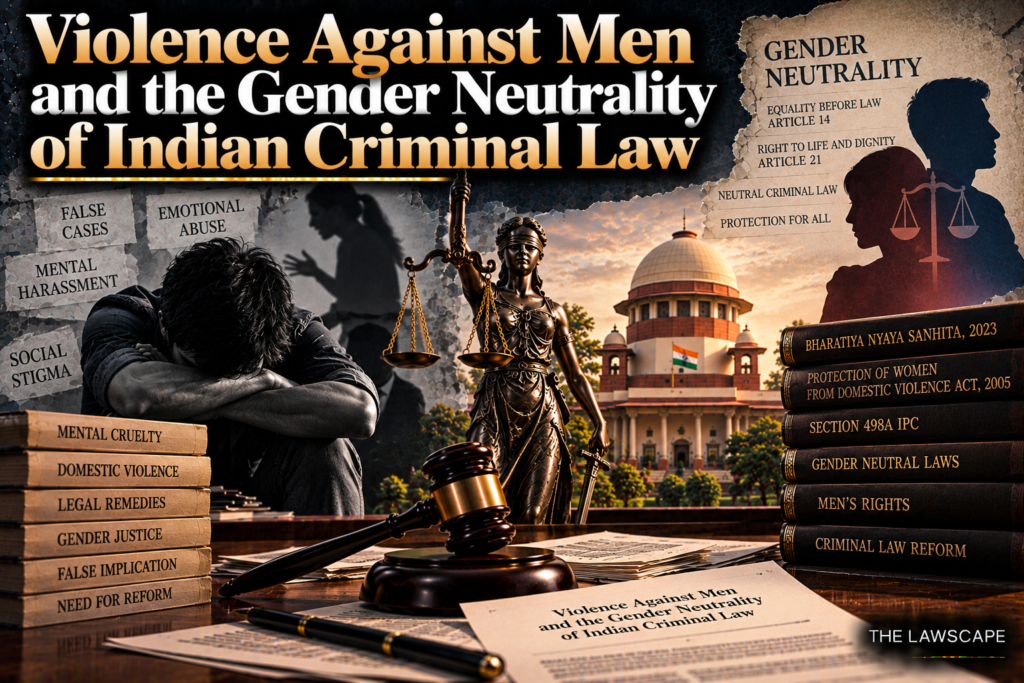
Violence Against Men and the Gender Neutrality of Indian Criminal Law
Author: Saloni Monga
Student, Meerut College, Meerut Affiliated To Chaudhary Charan Singh University, Meerut
—————————————————————————————————————————————————
Abstract
Violence against men remains an underexamined issue within the Indian legal system. Although several laws address violence against women, men may also experience physical, psychological, domestic, and sexual violence. Social expectations surrounding masculinity can discourage male victims from reporting such incidents or seeking legal remedies. This article examines whether Indian criminal law provides gender-neutral safeguards to victims of violence. It analyses the distinction between gender-neutral offences and gender-specific provisions, particularly those concerning sexual offences and matrimonial cruelty. It also considers relevant judicial decisions and briefly examines divorce, maintenance, and alimony to explore broader questions of gender asymmetry in the Indian legal system. The article argues that gender-specific protections may remain constitutionally justified where they address genuine structural vulnerabilities, but such protections should not render male victims legally or socially invisible. A victim-centric approach, supported by evidence-based reforms and gender-sensitive institutions, is necessary to ensure meaningful access to justice irrespective of gender.
Keywords: Violence Against Men, Gender Neutrality, Indian Criminal Law, Male Victims, Victim-Centric Justice
💡 3 Quick Takeaways
- The Bharatiya Nyaya Sanhita, 2023, contains both gender-neutral offences and gender-specific provisions, meaning that legal protection must be examined offence by offence.
- Although male victims may seek remedies under several generally applicable criminal provisions, the gender-specific definitions of rape and matrimonial cruelty create questions about the legal recognition of comparable harms against men.
- Gender-neutral reform need not mean removing protections for women. A victim-centric framework should preserve justified special protections while ensuring that genuine male victims are not overlooked.
1. Introduction
Violence is not experienced exclusively by any one gender. Assault, threats, sexual violence, physical injury, and abuse can affect individuals irrespective of gender. In India, however, public and legal discussions of victimhood have largely focused on violence against women, including dowry-related offences, matrimonial cruelty, sexual harassment, and domestic violence. This raises an important question: does the Indian criminal justice system provide equal recognition and effective protection when the victim is male?
The purpose of examining violence against men is not to diminish the seriousness of violence against women or to undermine the laws enacted to address it. Rather, it is to consider whether a criminal justice system founded on equality, dignity, and equal protection of the laws can recognise women as a group facing structural vulnerabilities while also acknowledging men as potential victims of violence.
The issue has acquired renewed significance following the enactment of the Bharatiya Nyaya Sanhita, 2023 (BNS), which replaced the Indian Penal Code, 1860, and came into force on 1 July 2024. The BNS contains both gender-neutral and gender-specific offences. Several offences against the human body are framed in terms of a “person” and may therefore protect victims irrespective of gender. At the same time, Chapter V, titled “Of Offences Against Woman and Child,” demonstrates that certain forms of harm continue to receive specialised statutory treatment.
Section 63 of the BNS defines rape through specified acts committed against a woman. The provision therefore raises questions about the legal recognition of sexual violence against adult male victims. This does not mean that every form of sexual violence against men is necessarily without criminal-law consequences. Depending on the facts, other provisions concerning assault, hurt, intimidation, confinement, or related conduct may apply. Nevertheless, the legal characterisation and seriousness attached to the offence of rape are not necessarily reproduced where the victim is male.
A related issue arises under Section 85 of the BNS, which criminalises cruelty by a husband or his relatives towards a woman. The provision addresses a context in which matrimonial cruelty and dowry-related harassment have historically presented serious concerns. However, the existence of a legitimate basis for protecting women does not resolve the separate question of whether men subjected to comparable domestic abuse have equally effective legal remedies.
The Supreme Court’s constitutional jurisprudence has emphasised dignity, autonomy, equality, and individual identity. In National Legal Services Authority v. Union of India, the Court recognised the constitutional rights of transgender persons and underscored the importance of dignity and identity. In Navtej Singh Johar v. Union of India, the Court placed individual autonomy, dignity, privacy, and equality at the centre of its reasoning concerning sexual orientation. Although neither decision directly concerned violence against male victims, both are relevant to a broader constitutional understanding that should not depend upon rigid assumptions about gender and sexuality.
Sexual autonomy is an individual right, and its violation cannot logically be understood solely through traditional conceptions of masculinity. The gender-specific statutory framework governing rape therefore remains an important subject for legislative examination. Beyond sexual violence, men may experience domestic abuse, physical assault, criminal intimidation, wrongful confinement, psychological abuse, and other unlawful conduct. Several offences under the BNS are gender-neutral in their formulation. It would consequently be inaccurate to describe Indian criminal law as entirely exclusionary towards men.
The more precise question is whether the law provides an adequate response in areas where gender does not alter the nature of the harm, while retaining gender-specific protections where genuine structural vulnerabilities justify them.
Judicial decisions concerning matrimonial cruelty illustrate this complexity. In Arnesh Kumar v. State of Bihar, the Supreme Court addressed unnecessary arrests in offences punishable with imprisonment of up to seven years and directed police officers and Magistrates to comply with applicable procedural safeguards. In Social Action Forum for Manav Adhikar v. Union of India, the Court considered safeguards developed in the context of Section 498A of the Indian Penal Code and addressed the limits of judicially imposed restrictions upon statutory criminal provisions. These decisions demonstrate that protecting vulnerable victims and preventing arbitrary criminal processes are not necessarily competing objectives.
The issue also extends, indirectly, to matrimonial law. Divorce, maintenance, and alimony primarily concern family and matrimonial law rather than substantive criminal law, but they frequently intersect with allegations of cruelty, domestic violence, and matrimonial disputes. The perception that Indian maintenance law uniformly favours women is legally oversimplified. Section 144 of the Bharatiya Nagarik Suraksha Sanhita, 2023 (BNSS), provides a summary maintenance remedy for wives, children, and parents, while Sections 24 and 25 of the Hindu Marriage Act, 1955, permit maintenance and permanent alimony in appropriate circumstances in favour of either spouse. In Rajnesh v. Neha, the Supreme Court issued guidelines concerning the disclosure of assets and liabilities and the determination of maintenance claims, emphasising the importance of examining financial circumstances rather than relying on assumptions.
The argument of this article is not that gender-specific laws protecting women are inherently discriminatory. Rather, gender-specific protection and the recognition of male victimhood should coexist. A just legal system should retain specialised protections where social realities demand them while ensuring that men who genuinely experience violence are neither legally nor socially rendered invisible.
2. The Gender Architecture of the Bharatiya Nyaya Sanhita, 2023
The BNS reflects a mixed approach to gender. It does not establish an entirely gender-neutral criminal-law framework, nor is every offence gender-specific. Some offences are framed broadly in terms of persons, while others expressly identify women or children as protected victims. Gender neutrality must therefore be examined offence by offence, taking into account the nature of the harm being addressed.
Section 63 of the BNS defines rape through specified acts committed against a woman. This provision retains a framework in which rape is legally conceptualised around a female victim. Consequently, an adult male subjected to non-consensual sexual penetration or other sexual conduct does not fall within the definition of rape under Section 63 merely because the conduct would satisfy that definition if the victim were a woman.
This distinction does not mean that male victims are necessarily without every form of legal protection. Depending on the circumstances, conduct involving assault, hurt, intimidation, confinement, or other unlawful acts may fall within generally applicable criminal provisions. However, the legal characterisation and seriousness associated with the specific offence of rape are not necessarily available where the victim is male.
The resulting concern is the gap that may arise between the social reality of sexual violence and the statutory language used to define one of its most serious forms. The question is whether the legal framework adequately recognises sexual violence as a violation of bodily autonomy irrespective of the victim’s gender.
A similar issue arises in relation to matrimonial cruelty. Section 85 of the BNS criminalises cruelty by a husband or the relatives of a husband towards a woman, while Section 86 defines cruelty for the purposes of the provision. This statutory framework addresses the particular context of cruelty against married women, including dowry-related harassment. However, it does not establish an equivalent gender-specific offence for a husband subjected to comparable cruelty by his wife or her relatives.
The absence of an equivalent offence does not mean that all conduct against a male spouse is lawful. Depending on the facts, generally applicable offences may provide remedies. The question, rather, is whether comparable forms of serious domestic cruelty should receive an appropriately tailored legal response when the victim is male.
The objective should not be to disregard the historical and social circumstances that led to the enactment of women-specific protections. It should be to ensure that protection is proportionate to the nature of the harm and that comparable forms of serious criminal conduct receive an appropriate legal response, regardless of the victim’s gender.
3. Violence Against Men and the Problem of Legal Recognition
Violence against men may take several forms, including psychological abuse, domestic violence, sexual violence, physical assault, intimidation, coercive control, and unlawful confinement. Recognising these forms of harm does not require assuming that men and women experience violence in identical social circumstances. It instead acknowledges that vulnerability cannot be determined exclusively by gender.
One significant barrier to recognising male victimhood arises from social expectations surrounding masculinity. Men are often expected to be physically strong, emotionally resilient, financially capable, and able to protect themselves and others. These expectations can make it difficult for a man to acknowledge that he has experienced abuse or to seek assistance.
A male victim may fear disbelief, reputational damage, ridicule, or the perception that asking for help is inconsistent with traditional masculinity. Such concerns can discourage reporting and delay access to support. However, the absence of reported complaints cannot automatically be treated as evidence that male victimisation is insignificant.
The legal system can also influence whether victims perceive themselves as capable of seeking justice. Where legislation expressly identifies one gender as the victim of a particular offence, individuals who fall outside that definition may find it difficult to identify an equivalent legal remedy. This concern is particularly evident in relation to the statutory definition of rape, which is framed around a female victim.
The appropriate response is not to frame recognition of male victims as a competition with the recognition of female victims. Rather, acknowledging male victimhood should reinforce the principle that criminal law must respond to serious violations of bodily integrity, dignity, and autonomy. A system that recognises the experiences of all victims can provide a more comprehensive understanding of violence without diminishing the importance of existing protections for women.
4. Constitutional Equality and Gender Neutrality
Gender neutrality in criminal law must be considered alongside the constitutional principle of equality. Article 14 of the Constitution of India guarantees equality before the law and equal protection of the laws. Article 15 prohibits specified forms of discrimination while permitting the State to make special provisions for women and children.
These constitutional provisions demonstrate that equality does not invariably require identical treatment in every circumstance. Where a group faces particular social or structural disadvantages, the law may provide specialised protection. This principle is relevant to laws addressing violence against women, given the serious problems associated with dowry-related harassment, matrimonial cruelty, and gender-based violence in India.
Specialised legal protections may therefore serve a legitimate purpose. Nevertheless, recognising the vulnerability of one group should not mean that the vulnerability of another group is ignored.
Article 21, which protects life and personal liberty, is also significant. The Supreme Court has interpreted the right to life broadly, including the right to live with dignity. Violence can affect not only physical safety but also dignity, autonomy, and personal security. These interests are not exclusive to any one gender.
The decisions in National Legal Services Authority v. Union of India and Navtej Singh Johar v. Union of India further illustrate the constitutional importance of dignity, autonomy, identity, and equality. Although these cases did not directly address violence against male victims, their reasoning is relevant to the broader principle that law should not be based on rigid assumptions about gender.
Gender neutrality should not, however, be understood as a requirement to treat every person identically in every legal context. The central question is whether a gender-based distinction is justified by the purpose of the law and the harm it seeks to prevent.
Special protections for women may be justified in circumstances involving structural disadvantage. At the same time, a genuine male victim should not be left without an effective legal response merely because of his gender. The constitutional challenge is to preserve justified distinctions while ensuring that the principles of dignity and equal protection remain meaningful for everyone.
5. Matrimonial Cruelty and Procedural Safeguards
Matrimonial cruelty is an important area in which questions of gender neutrality arise. Section 85 of the BNS addresses cruelty by a husband or his relatives towards a woman. The provision serves an important purpose in addressing cruelty within marriage, particularly where it is connected with dowry demands and related harassment.
However, the gender-specific nature of the provision raises questions about the legal remedies available when a husband experiences serious and sustained cruelty from his wife or her relatives. Although other criminal provisions may apply depending on the conduct and evidence, the BNS does not create an equivalent offence of matrimonial cruelty specifically protecting husbands.
Any discussion of reform must also account for procedural fairness. The protection of victims must coexist with safeguards for persons accused of matrimonial offences.
In Arnesh Kumar v. State of Bihar, the Supreme Court expressed concern about unnecessary arrests in offences punishable with imprisonment of up to seven years. It directed police officers and Magistrates to follow the safeguards prescribed by law. The decision does not weaken the need to protect victims of matrimonial cruelty. Rather, it emphasises that criminal procedure must be exercised carefully and in accordance with statutory requirements.
Similarly, in Social Action Forum for Manav Adhikar v. Union of India, the Supreme Court examined safeguards developed in relation to Section 498A of the IPC and considered the limits of judicial intervention in the operation of statutory criminal provisions.
These decisions should not be interpreted as establishing that allegations of matrimonial cruelty are generally false or that existing protections should be removed. Their relevance lies in the need for a criminal justice process that respects statutory safeguards, evaluates evidence, protects genuine victims, and avoids arbitrary action.
The broader objective should be a system that does not treat victim protection and procedural fairness as mutually exclusive. Evidence-based investigation and lawful procedure are essential regardless of the gender of the victim or the accused.
6. Divorce, Maintenance, and Alimony: A Brief Perspective
Divorce, maintenance, and alimony primarily fall within matrimonial law, but they remain relevant to broader discussions of gender asymmetry in the Indian legal system.
Section 144 of the BNSS provides a summary remedy concerning the maintenance of wives, children, and parents. By contrast, Sections 24 and 25 of the Hindu Marriage Act, 1955, permit interim maintenance and expenses of proceedings, as well as permanent alimony and maintenance, in appropriate circumstances in favour of either spouse.
The legal position therefore varies according to the statute and the remedy being considered. It is inaccurate to assume that all maintenance provisions operate identically or that the law uniformly favours one gender in every matrimonial context.
In Rajnesh v. Neha, the Supreme Court issued guidelines concerning the disclosure of assets and liabilities and the determination of maintenance claims. These guidelines underscore the importance of examining the parties’ actual financial circumstances rather than relying on general assumptions about gender, earning capacity, or financial need.
Maintenance and alimony are not substitutes for criminal-law remedies for violence. Nor do the rules governing matrimonial relief resolve the questions raised by gender-specific definitions of criminal offences. Nevertheless, they illustrate why claims of gender asymmetry should be assessed by examining the precise statutory provision, the circumstances of the parties, and the remedy sought.
A careful legal analysis must distinguish between substantive criminal law, criminal procedure, and matrimonial remedies rather than treating them as one uniform framework.
7. Conclusion
Violence against men remains an issue that can be overlooked in legal and social discussions. Expectations that men must be strong and emotionally resilient may discourage them from acknowledging abuse, reporting it, or seeking assistance. Fear of judgement and shame can make it difficult for victims to disclose their experiences.
Recognising violence against men does not require ignoring or diminishing violence against women. The need for specialised protections for women can coexist with the recognition that men may also experience serious physical, psychological, domestic, and sexual violence.
The BNS contains several gender-neutral offences, but its gender-specific provisions concerning rape and matrimonial cruelty raise important questions about the legal recognition of male victims. These questions should be examined through the principles of constitutional equality, dignity, bodily autonomy, and effective access to justice.
The appropriate response is not necessarily to remove existing protections for women or to assume that every offence must be formulated identically for every gender. Instead, legislative reform should consider whether comparable forms of serious harm receive an adequate legal response and whether any gender-based distinction remains justified by the purpose and context of the law.
A victim-centric approach should be supported by evidence-based legislative review, fair criminal procedures, and institutions that allow victims to seek assistance without stigma. It should also recognise that the existence of a legal provision does not, by itself, guarantee meaningful access to justice.
Ultimately, a just criminal justice system should assess the nature of the harm, the evidence, and the legal rights involved rather than relying exclusively on assumptions about gender. Protecting women where structural vulnerabilities demand special safeguards and recognising male victims where the law falls short are not necessarily contradictory objectives. Both can contribute to a system in which genuine victims are heard, protected, and treated fairly.
Footnotes
- Bharatiya Nyaya Sanhita, No. 45 of 2023, §§ 1, 4 (India); Ministry of Home Affairs, Government of India, New Criminal Laws.
- Bharatiya Nyaya Sanhita, No. 45 of 2023 (India).
- Bharatiya Nyaya Sanhita, No. 45 of 2023, ch. V (India).
- Bharatiya Nyaya Sanhita, No. 45 of 2023, § 63 (India).
- Bharatiya Nyaya Sanhita, No. 45 of 2023, § 85 (India).
- National Legal Services Authority v. Union of India, (2014) 5 SCC 438.
- Navtej Singh Johar v. Union of India, (2018) 10 SCC 1.
- Bharatiya Nyaya Sanhita, No. 45 of 2023, § 63 (India).
- Bharatiya Nyaya Sanhita, No. 45 of 2023, §§ 115, 126, 131, 351 (India).
- Arnesh Kumar v. State of Bihar, (2014) 8 SCC 273.
- Social Action Forum for Manav Adhikar v. Union of India, (2018) 10 SCC 443.
- Janshruti (People’s Voice) v. Union of India, 2025 INSC 536 (15 April 2025).
- Bharatiya Nagarik Suraksha Sanhita, No. 46 of 2023, § 144 (India).
- Hindu Marriage Act, No. 25 of 1955, §§ 24–25 (India).
- Rajnesh v. Neha, (2021) 2 SCC 324.
- Bharatiya Nyaya Sanhita, No. 45 of 2023, § 63 (India).
- Bharatiya Nyaya Sanhita, No. 45 of 2023, § 63 (India).
- Bharatiya Nyaya Sanhita, No. 45 of 2023, §§ 85–86 (India).
- Bharatiya Nyaya Sanhita, No. 45 of 2023, §§ 85–86 (India).
- Bharatiya Nyaya Sanhita, No. 45 of 2023, § 63 (India).
- Constitution of India, arts. 14–15.
- Constitution of India, art. 21; Maneka Gandhi v. Union of India, (1978) 1 SCC 248.
- National Legal Services Authority v. Union of India, (2014) 5 SCC 438; Navtej Singh Johar v. Union of India, (2018) 10 SCC 1.
- Bharatiya Nyaya Sanhita, No. 45 of 2023, § 85 (India).
- Arnesh Kumar v. State of Bihar, (2014) 8 SCC 273.
- Social Action Forum for Manav Adhikar v. Union of India, (2018) 10 SCC 443.
- Bharatiya Nagarik Suraksha Sanhita, No. 46 of 2023, § 144 (India); Hindu Marriage Act, No. 25 of 1955, §§ 24–25 (India).
- Rajnesh v. Neha, (2021) 2 SCC 324.
Disclaimer: The views expressed in this article are those of the author and do not necessarily reflect the views of The Lawscape.
The Lawscape — clear, practical legal insight for students and future lawyers.