
Vishaka & Ors. v. State of Rajasthan & Ors. (1997): Workplace Sexual Harassment and Constitutional Protection
Author: Sujana B Urs
Student, Bharati Vidyapeeth New Law College, Pune.
———————————————————————————————–
💡 3 Quick Takeaways
- The Supreme Court recognised workplace sexual harassment as a violation of fundamental rights under Articles 14, 15, 19(1)(g), and 21 of the Constitution of India.
- In the absence of specific legislation, the Court formulated the Vishaka Guidelines, placing duties on employers and institutions to prevent and address sexual harassment.
- The judgment influenced the enactment of the Sexual Harassment of Women at Workplace (Prevention, Prohibition and Redressal) Act, 2013, commonly known as the POSH Act.
I. Case Title and Citation
Case: Vishaka & Ors. v. State of Rajasthan & Ors.
Citation: (1997) 6 SCC 241; AIR 1997 SC 3011
Date of Judgment: 13 August 1997
II. Court and Bench
Court: Supreme Court of India
Bench:
- Chief Justice J. S. Verma
- Justice Sujata V. Manohar
- Justice B. N. Kirpal
Bench Strength: Three judges
III. Background of the Case
Vishaka v. State of Rajasthan is a landmark judgment in the development of gender justice and workplace rights in India. Delivered at a time when Indian law lacked specific legislation addressing sexual harassment at the workplace, the judgment established an important constitutional framework for protecting working women.
The immediate background of the case was the assault on Bhanwari Devi, a social worker from Rajasthan. However, the proceedings extended beyond the individual incident and raised a broader constitutional question: can women meaningfully enjoy equality and the freedom to work if the law does not protect them from sexual harassment in the workplace?
The Supreme Court addressed this question by recognising workplace sexual harassment as a violation of fundamental rights and formulating a set of guidelines known as the Vishaka Guidelines. These guidelines remained the principal framework for addressing workplace sexual harassment until Parliament enacted specific legislation in 2013.
IV. Facts of the Case
Bhanwari Devi worked as a social worker under a Government of Rajasthan programme. As part of her duties, she worked at the grassroots level and participated in efforts to prevent child marriages.
In the course of her work, she attempted to stop the marriage of a young child belonging to an influential family in her village. Her intervention was opposed by members of the community and resulted in hostility towards her.
In 1992, Bhanwari Devi was allegedly gang-raped by men from the village. The incident attracted national attention and highlighted the risks faced by women engaged in social and developmental work, particularly those challenging entrenched social practices.
The incident also exposed a significant gap in the legal framework. Although criminal law could address acts of sexual violence, India lacked a comprehensive legal mechanism specifically designed to prevent and redress sexual harassment in the workplace.
Several women’s rights organisations and social activists subsequently approached the Supreme Court through a Public Interest Litigation under Article 32 of the Constitution. The petition was filed in the name of Vishaka, a women’s rights group.
The petitioners argued that workplace sexual harassment undermines women’s ability to work, participate in public life, and exercise their constitutional freedoms. They sought judicial intervention to establish effective safeguards for working women.
V. Issues Before the Court
The principal issues before the Supreme Court were:
- Whether sexual harassment at the workplace violates the fundamental rights of women.
- Whether the constitutional guarantee of equality includes protection against workplace sexual harassment.
- Whether sexual harassment infringes the right to life, personal liberty, and dignity under Article 21.
- Whether the freedom to practise a profession or carry on an occupation under Article 19(1)(g) can be meaningfully exercised without a safe working environment.
- Whether the Supreme Court could issue binding guidelines in the absence of legislation specifically addressing workplace sexual harassment.
- Whether international conventions could assist in interpreting and strengthening the protection of fundamental rights under the Indian Constitution.
VI. Arguments of the Petitioners
The petitioners contended that sexual harassment was not merely a personal dispute or a matter of workplace discipline. Rather, it directly affected the constitutional rights of women and restricted their ability to participate equally in professional and public life.
They relied on Article 14 of the Constitution, which guarantees equality before the law and equal protection of the laws, and Article 15, which prohibits discrimination on the ground of sex. They argued that workplace sexual harassment places women at a disadvantage and undermines their equal participation in employment.
The petitioners also relied on Article 19(1)(g), which guarantees the freedom to practise a profession or carry on an occupation, trade, or business. They argued that this freedom becomes ineffective if women are compelled to work in unsafe or hostile environments.
Further, they invoked Article 21, particularly the right to live with dignity and enjoy personal liberty. Sexual harassment, they argued, violates dignity and interferes with a woman’s ability to work without fear or coercion.
A central argument was that the absence of specific legislation should not result in the denial of fundamental rights. Since Parliament had not enacted a law specifically addressing workplace sexual harassment, the petitioners requested the Supreme Court to issue appropriate directions to fill the legal gap.
The petitioners also relied on the Convention on the Elimination of All Forms of Discrimination Against Women (CEDAW). They submitted that India’s constitutional guarantees should be interpreted consistently with international principles aimed at eliminating discrimination against women and protecting their rights.
VII. Judgment and Final Decision
The Supreme Court held that sexual harassment of women at the workplace violates their fundamental rights under the Constitution of India.
The Court connected workplace sexual harassment with several constitutional guarantees:
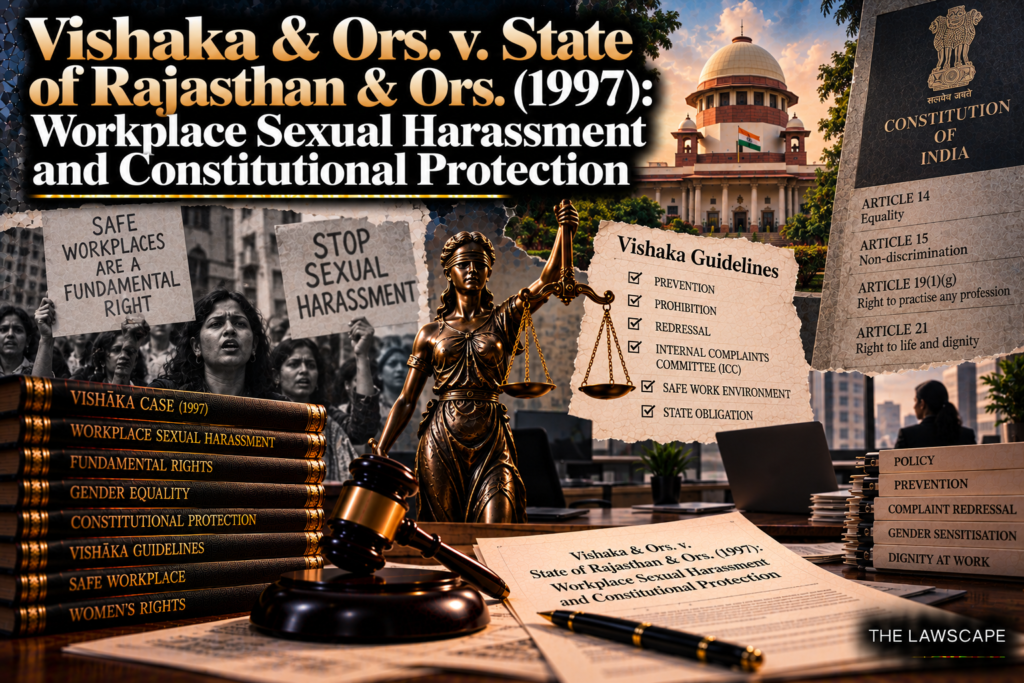
- Article 14: Equality before the law and equal protection of the laws.
- Article 15: Protection against discrimination on the ground of sex.
- Article 19(1)(g): Freedom to practise a profession or carry on an occupation, trade, or business.
- Article 21: Right to life, personal liberty, and dignity.
The Court recognised that a woman’s right to work cannot be separated from her right to equality and dignity. Formal permission to enter the workplace is insufficient if the conditions of employment prevent her from exercising that right safely and equally.
The Court also acknowledged that India lacked specific legislation dealing comprehensively with sexual harassment at the workplace. It held that this legislative gap could not justify leaving fundamental rights without effective protection.
Accordingly, the Court formulated a set of binding guidelines to prevent and redress workplace sexual harassment. These became known as the Vishaka Guidelines.
The guidelines were intended to operate as binding norms until appropriate legislation was enacted. The judgment thereby established an interim legal framework while recognising the legislature’s role in enacting a comprehensive statutory scheme.
VIII. Legal Reasoning and Ratio Decidendi
The most significant aspect of the judgment was the Court’s recognition of sexual harassment as a constitutional wrong.
The Court moved beyond the understanding of sexual harassment as merely inappropriate personal behaviour or misconduct between individuals. It recognised that sexual harassment could prevent women from participating equally in professional and public life, thereby undermining constitutional guarantees.
The Court’s reasoning gave substantive meaning to the principle of equality. A legal system cannot ensure genuine equality merely by allowing women to enter professions. It must also recognise the conditions necessary for women to participate in those professions safely and with dignity.
The Court also connected workplace sexual harassment with the right to life and personal liberty under Article 21. The constitutional guarantee of life extends beyond mere physical existence and encompasses the ability to live with dignity. An environment in which women are subjected to sexual harassment undermines this guarantee.
Another significant aspect of the judgment was its treatment of the legislative vacuum. The Court reasoned that the absence of specific legislation could not become a justification for allowing violations of fundamental rights to continue without an effective remedy.
Where fundamental rights require protection and domestic law does not provide an adequate mechanism, the judiciary may issue appropriate directions to safeguard those rights, subject to constitutional principles and existing law.
The Court also relied on international conventions, particularly CEDAW. It recognised that international norms could assist in interpreting constitutional rights where domestic law was silent, provided those norms were consistent with domestic law.
Ratio decidendi: Sexual harassment of women at the workplace violates fundamental rights relating to equality, non-discrimination, freedom to practise a profession, and life with dignity. In the absence of specific legislation, the Supreme Court may issue binding guidelines to protect these rights and ensure that women can participate in the workplace without sexual harassment.
IX. The Vishaka Guidelines
The Supreme Court established a framework for preventing and addressing sexual harassment at the workplace. The guidelines recognised that employers and institutions have an affirmative responsibility to provide a safe working environment.
1. Duty of Employers and Institutions
Employers and persons responsible for workplaces were required to take appropriate steps to prevent sexual harassment and respond to incidents when they occurred.
This requirement recognised that workplace safety is not solely the responsibility of individual women. Institutions and employers must take reasonable and appropriate measures to prevent harassment and address complaints.
2. Meaning of Sexual Harassment
The Court described sexual harassment as unwelcome sexually determined behaviour, whether direct or indirect. The examples included:
- Physical contact and advances.
- Demands or requests for sexual favours.
- Sexually coloured remarks.
- Showing pornography.
- Other unwelcome physical, verbal, or non-verbal conduct of a sexual nature.
This broad understanding recognised that sexual harassment is not limited to physical violence. It may also involve verbal, non-verbal, or other unwelcome conduct that compromises a person’s dignity and creates an intimidating or hostile working environment.
3. Preventive Measures
Employers were expected to take preventive steps to ensure that sexual harassment did not occur.
This approach went beyond punishing misconduct after an incident. It required institutions to establish conditions in which harassment was actively discouraged and workplace safety was treated as an institutional responsibility.
4. Criminal Proceedings
Where the conduct amounted to an offence under criminal law, the employer or responsible authority was required to take appropriate action in accordance with the law.
The guidelines therefore distinguished between institutional measures for preventing and addressing workplace harassment and the criminal-law consequences that might arise from particular conduct.
5. Complaint Mechanism
Workplaces were required to provide an effective mechanism through which women could raise complaints of sexual harassment.
The Court recognised that legal rights have limited practical value if victims lack an accessible and effective process through which to seek redress.
6. Complaints Committee
The Court directed the establishment of a Complaints Committee to address allegations of sexual harassment.
The Committee was to have adequate representation of women and include an external member or organisation familiar with issues relating to sexual harassment. This was intended to strengthen the independence and credibility of the complaint process and ensure sensitivity to the experiences of women.
7. Awareness and Workplace Responsibility
Employers were also expected to create awareness about sexual harassment and ensure that employees understood that such behaviour was unacceptable.
This aspect of the guidelines recognised that effective prevention requires more than formal complaint procedures. Awareness, institutional accountability, and a clear understanding of unacceptable conduct are also important components of workplace safety.
X. Role of International Law
One of the notable features of the judgment was the Supreme Court’s use of international human rights principles in interpreting constitutional protections.
The Court referred to CEDAW, an international convention aimed at eliminating discrimination against women. The convention provided an important international framework for understanding the State’s responsibility to address discrimination and protect women’s rights.
The Court did not treat international law as a substitute for the Indian Constitution. Instead, it used international norms as an interpretative aid. Where domestic law was silent and international principles were consistent with domestic law, those principles could assist the Court in giving meaningful effect to fundamental rights.
This approach demonstrated the relevance of international human rights standards in the interpretation of constitutional guarantees and in addressing gaps in domestic legislation.
XI. Judicial Intervention and the Legislative Vacuum
The judgment is also significant for its treatment of the relationship between the judiciary and the legislature.
Ordinarily, the enactment of comprehensive legislation falls within the legislative domain. However, in Vishaka, the Court faced a situation in which a serious violation of fundamental rights required an effective response, while specific legislation addressing workplace sexual harassment was absent.
The Court issued guidelines to establish an interim legal framework. In doing so, it sought to balance two constitutional concerns: the legislature’s responsibility to enact laws and the judiciary’s duty to protect fundamental rights.
The guidelines were not intended to permanently replace legislation. Rather, they were designed to operate until Parliament enacted an appropriate statutory framework.
The judgment consequently illustrates how judicial directions may provide interim protection where a legislative gap leaves fundamental rights inadequately safeguarded.
XII. Impact and Subsequent Legal Development
The impact of Vishaka was far-reaching. The judgment transformed the legal understanding of workplace sexual harassment in India by establishing that it could constitute discrimination and a violation of constitutional rights, rather than merely a private dispute or an issue of workplace discipline.
It also recognised the institutional responsibilities of employers and workplaces. By requiring preventive measures and effective complaint mechanisms, the Court placed workplace safety within the broader framework of equality and accountability.
For several years, the Vishaka Guidelines served as the principal framework governing workplace sexual harassment in India.
Parliament subsequently enacted the Sexual Harassment of Women at Workplace (Prevention, Prohibition and Redressal) Act, 2013, commonly known as the POSH Act. The legislation established a statutory framework for the prevention, prohibition, and redressal of sexual harassment of women at the workplace.
The Act gave statutory form to the need for preventive measures, complaint mechanisms, and institutional responsibility. It also replaced the Vishaka Guidelines as the principal statutory framework in this area, subject to the provisions and application of the legislation.
The judgment therefore did more than resolve a constitutional dispute. It influenced legislative development and helped establish workplace sexual harassment as a matter of constitutional importance and institutional accountability.
XIII. Conclusion and Critical Observations
Vishaka v. State of Rajasthan remains one of the most influential judgments in the development of gender justice and workplace rights in India.
Its importance lies not only in the guidelines formulated by the Supreme Court but also in the constitutional principles underlying the decision. The Court recognised that equality cannot be meaningful if women are forced to choose between personal safety and their right to work.
The judgment gave substantive meaning to Articles 14, 15, 19(1)(g), and 21 by connecting equality and freedom with dignity and workplace safety. It also demonstrated that constitutional rights must respond to social realities. A formal guarantee of equality is insufficient when existing social conditions prevent individuals from enjoying that equality in practice.
The case is equally significant as an example of judicial intervention during a legislative vacuum. The Supreme Court introduced interim safeguards to protect fundamental rights without permanently displacing the legislature’s role. The subsequent enactment of the POSH Act, 2013, reflects the judgment’s lasting influence on the development of Indian law.
Ultimately, Vishaka established that a woman’s right to work includes the right to do so with equality, dignity, and protection from sexual harassment. Its enduring contribution is the recognition that constitutional equality requires not merely formal rights, but also effective safeguards that make the exercise of those rights possible.
Disclaimer: The views expressed in this article are those of the author and do not necessarily reflect the views of The Lawscape.
The Lawscape — clear, practical legal insight for students and future lawyers.