
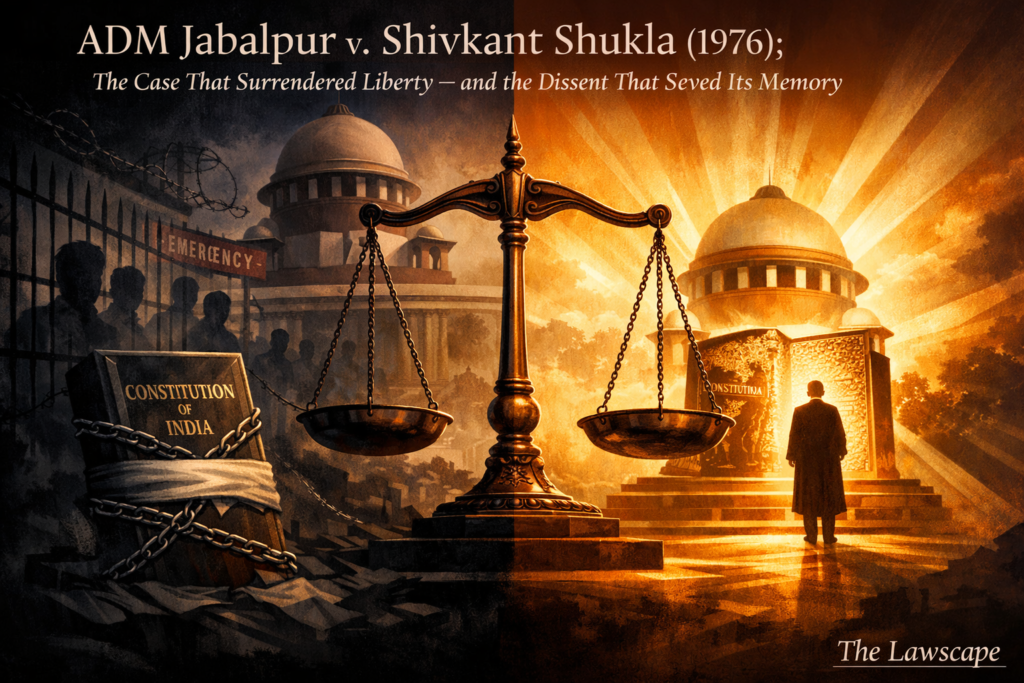
ADM Jabalpur v. Shivkant Shukla (1976): The Case That Surrendered Liberty — and the Dissent That Saved Its Memory
Author: Mitali Shankar Manore
Student, KES’ Shri Jayantilal H. Patel Law College
————————————————————————————-
💡 3 Quick Takeaways
1. By a 4:1 majority, the Supreme Court held that during the 1975 Emergency, no detainee could approach any court for a writ of habeas corpus — effectively placing executive detention beyond judicial scrutiny and leaving thousands of citizens with no legal remedy whatsoever.
2. Justice H.R. Khanna’s lone dissent — arguing that the right to life pre-exists the Constitution and cannot be suspended by Presidential Order — was overruled in 1976 but vindicated in 2017 when a nine-judge bench in Puttaswamy unanimously overruled ADM Jabalpur and confirmed his reasoning as the law of the land.
3. The case remains a defining lesson in constitutional history — not for what the majority decided, but for what a single judge refused to decide, and for the cost he paid for that refusal.
Case Title: Additional District Magistrate, Jabalpur v. Shivkant Shukla
Citation: (1976) 2 SCC 521; AIR 1976 SC 1207
Court: Supreme Court of India — Five-Judge Constitution Bench
Bench: Chief Justice A.N. Ray, Justice P.N. Bhagwati, Justice Y.V. Chandrachud, Justice M.H. Beg, and Justice H.R. Khanna
Date of Judgment: 28 April 1976
Parties:
- Petitioners (Respondents before the High Courts): Shivkant Shukla and other detainees
- Appellant: Additional District Magistrate, Jabalpur, representing the State
Introduction
ADM Jabalpur v. Shivkant Shukla did not arise in a vacuum. It came out of one of the most troubled and politically charged moments in Indian constitutional history — the Emergency of 1975. On 25 June 1975, the President of India declared a national Emergency under Article 352 of the Constitution, citing a serious threat to internal security. That single declaration set off a chain of events that would eventually bring the country’s highest court face to face with a question it was deeply uncomfortable answering: can the State imprison its citizens without any judicial check at all?
The constitutional fallout was immediate. Under Article 358, the six freedoms guaranteed by Article 19 — including freedom of speech, movement, and assembly — stood automatically suspended. The government went further. The President issued a separate order under Article 359, suspending the right of citizens to approach any court for the enforcement of their fundamental rights under Part III of the Constitution, for the entire duration of the Emergency.
Put plainly: the rights may have technically existed on paper, but the door to the courts — the only place where those rights could be made real — was being shut. A right that cannot be enforced is, in any practical sense, not a right at all. That is the situation in which thousands of Indians found themselves after June 1975.
Facts of the Case
To understand what followed, it is important to first understand what preventive detention means. In ordinary criminal law, a person is arrested because they have already committed an offence — there is a charge, a trial, and if convicted, a punishment. Preventive detention works differently. It allows the State to detain someone not because of what they have done, but because of what the authorities believe they might do. There is no trial, no conviction, and often very little explanation. It is a power that demands careful safeguards precisely because it is so easy to misuse.
Parliament had enacted the Maintenance of Internal Security Act, 1971 (MISA) under its power to legislate on preventive detention. The Act gave executive authorities wide discretion to detain individuals whenever they considered it necessary for maintaining internal security or public order. During the Emergency, MISA was not merely a statute sitting quietly on the books — it became the primary instrument of mass detention, invoked on a scale and with a speed that left almost no room for individual scrutiny.
What followed has been described, rightly, as one of the darkest chapters in Indian democratic history. MISA was used to detain thousands of people — opposition leaders, journalists, trade unionists, student activists, lawyers, and civil society figures. None were charged with any criminal offence. None were brought to trial. The logic of preventive detention meant they did not need to be — the government was not claiming they had done anything wrong, only that they might. Thousands of people sat in detention, uncertain of the reason, uncertain of the duration, and uncertain of whether any court in the country would even hear their case.
The families, colleagues, and lawyers of those detained did what people in a constitutional democracy do when the State overreaches — they went to court. Petitions for the writ of habeas corpus were filed before High Courts across the country under Article 226 of the Constitution. Several High Courts — including those of Allahabad, Bombay, Karnataka, Madhya Pradesh, and Rajasthan — heard these petitions and ruled in favour of the detainees. They reasoned that even in an Emergency, courts retained the power to examine whether the executive had acted within the bounds of the law. Detention orders that were illegal, made in bad faith, or in violation of MISA’s own requirements could still be challenged.
The Government of India appealed. The various matters were consolidated and placed before a five-judge Constitution Bench of the Supreme Court. The question the Court now had to answer was stark: when the Presidential Order under Article 359 had suspended the right of citizens to approach courts for enforcement of fundamental rights, could a person detained under MISA still file a habeas corpus petition?
Issues Raised
- Whether a person detained under MISA during the Emergency could still approach a High Court under Article 226 seeking the writ of habeas corpus, despite the Presidential Order issued under Article 359(1).
- Whether the right to life and personal liberty under Article 21 remained judicially enforceable during the Emergency, or whether the Presidential Order had effectively suspended that protection along with the remedy.
- Whether the courts retained any power to review the legality of executive detention orders during the Emergency period.
Arguments of the Parties
Petitioners (Detainees)
The case put forward by the detainees was built on a principle that most people would recognise instinctively: a government must always have a lawful basis for what it does, even — and perhaps especially — during a crisis. The petitioners argued that the right to life and personal liberty is not a statutory convenience. It is one of the most fundamental protections the Constitution offers, and it cannot be extinguished by executive order.
They further argued that suspending the remedy to enforce a right is not the same as extinguishing the right itself. Courts could and should retain the power to examine whether detention orders complied with the law — whether MISA’s own requirements were met, whether the order was made in good faith, whether there was any rational legal basis for the detention. The rule of law, they submitted, does not take a holiday during an Emergency.
State (Appellant)
The government’s position was sweeping and unequivocal. The Attorney General argued that the Presidential Order under Article 359 had completely suspended the right of any individual to move any court for enforcement of suspended fundamental rights. Since habeas corpus is a remedy that exists to vindicate the right to personal liberty — and since that right’s enforcement had been suspended — the writ was simply not available.
The State went further. It argued that it did not matter why a person had been detained, or whether MISA’s requirements had been followed, or whether the detention was motivated by political malice. During the Emergency, courts had no jurisdiction to examine any of that. The executive was answerable to no court for the duration of the Emergency, and the Constitution, properly read, intended it that way.
Judgment
By a majority of four to one, the Supreme Court ruled in favour of the State. Chief Justice A.N. Ray and Justices P.N. Bhagwati, Y.V. Chandrachud, and M.H. Beg held that once the Presidential Order under Article 359 had suspended the right to move courts for enforcement of fundamental rights, no detainee could file a habeas corpus petition challenging their detention. The Court concluded that during the Emergency, courts simply did not have the power to examine the legality of detention orders issued under MISA.
The decisions of the High Courts that had granted relief to detainees were set aside. For the thousands of people sitting in detention across the country, the Supreme Court’s ruling meant one thing above all else: there was nowhere left to turn.
Dissenting Opinion — Justice H.R. Khanna
Justice H.R. Khanna disagreed, and his dissent is the reason this case is still taught, discussed, and remembered nearly fifty years later.
Justice Khanna’s starting point was philosophical rather than purely textual. The right to life and personal liberty, he argued, is not something the Constitution creates — it is something the Constitution recognises because it already exists, as a basic human right that belongs to every person by virtue of their humanity. Article 21 did not bring this right into being. It simply gave constitutional expression to something that was always there. And if the right pre-exists the Constitution, then suspending Article 21 does not make the right disappear — it only removes one layer of its protection.
Justice Khanna also challenged the majority’s reading of Article 359. The suspension of the right to move a court for enforcement of fundamental rights, he argued, is not the same as the suspension of the courts’ power to examine whether the executive has acted within the law. The High Courts’ jurisdiction under Article 226 does not flow exclusively from Part III of the Constitution. Courts could still ask — and should still ask — whether a detention order was made in accordance with the law, even if the specific enforcement of Article 21 was temporarily restricted.
Critical Analysis
The judgment in ADM Jabalpur has never been easy to defend, and few have seriously tried. Constitutional scholars across generations have pointed to it as a moment when the judiciary failed the people it was meant to protect. When thousands of citizens were being held without charge, without trial, and without recourse, the Supreme Court looked at the situation and said, in effect: that is constitutionally permissible. The majority was not careless or inattentive — they reasoned carefully and arrived at their conclusion deliberately. That, in some ways, makes it worse. A formally coherent argument in defence of an unconscionable outcome is still an unconscionable outcome.
The decision also sat uneasily alongside what the Supreme Court had itself said three years earlier in Kesavananda Bharati v. State of Kerala (1973), where a thirteen-judge bench had established the basic structure doctrine — the principle that certain core features of the Constitution, including the rule of law and judicial review, are so fundamental that even Parliament cannot amend them away. If those features are beyond the reach of a constitutional amendment, it is difficult to understand how a Presidential Order can extinguish them. The majority in ADM Jabalpur did not seriously engage with this tension, and that omission has been one of the most persistent criticisms of the decision.
Justice Khanna’s dissent, by contrast, has only grown in stature over time. At the moment he delivered it, he was outnumbered and overruled. His dissent is reported to have contributed to him being superseded for the position of Chief Justice of India — a consequence that spoke volumes about the political pressures of the moment. But history has a way of catching up with courage.
In 2017, a nine-judge Constitution Bench of the Supreme Court decided Justice K.S. Puttaswamy v. Union of India and took the opportunity to do something long overdue — it expressly and unanimously overruled ADM Jabalpur. Justice D.Y. Chandrachud, whose own father had been part of the 1976 majority, wrote with unusual candour, calling the majority’s view an “aberration” that needed to be corrected. The Court confirmed that the right to life and liberty under Article 21 is inalienable — rooted in human dignity, not in constitutional convenience — and cannot be taken away by Presidential Order. Forty years after Justice Khanna’s lone dissent, his reasoning became the law of the land.
Conclusion
Looking back at ADM Jabalpur v. Shivkant Shukla, it is difficult not to feel the weight of what the judgment represented — not just as a legal decision, but as a moment when the institution most trusted to protect ordinary people chose, instead, to step aside.
The majority did not act out of cruelty. But the effect of their decision was cruel nonetheless. By holding that detainees could not approach the courts for habeas corpus during the Emergency, they handed the executive something extraordinarily dangerous: the power to imprison people and face no meaningful challenge for doing so. No scrutiny. No accountability. No remedy. For the thousands of people sitting in detention cells across the country, the Supreme Court’s answer was, in essence: we cannot help you. That is a hard thing for any constitutional democracy to reckon with — and India has been reckoning with it ever since.
What makes the case so instructive, even now, is the contrast it lays bare. On one side, a majority of judges who read the Constitution narrowly, who deferred to executive authority at precisely the moment deference was most dangerous, and who reasoned their way to a conclusion that left personal liberty unprotected. On the other, one judge — Justice H.R. Khanna — who refused to follow that path. His argument was not complicated. He said that the right to life does not exist because a constitution grants it. It exists because we are human. You cannot suspend humanity by proclamation. That conviction, expressed quietly and at personal cost, has outlasted everything the majority wrote.
ADM Jabalpur is, in the end, a case about courage — its absence in the majority, its quiet presence in a single dissent, and its eventual return in the judgments that followed. For any student of constitutional law, that is not just a lesson worth learning. It is one worth carrying.
Disclaimer: The views expressed in this article are those of the author and do not necessarily reflect the views of The Lawscape.
The Lawscape — clear, practical legal insight for students and future lawyers.