
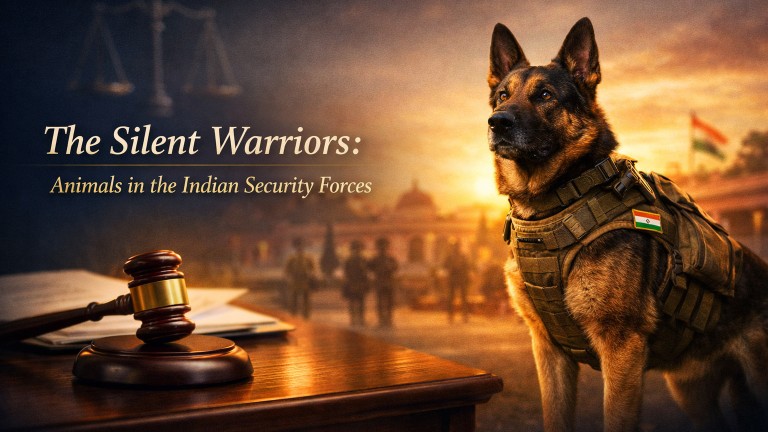
The Silent Warriors: Animals in the Indian Security Forces
Author: Japjot Singh
Jaipur National University
—————————————————————————————————————-
Key Takeaways:
- The Indian security forces heavily rely on animal contingents—dogs, horses, mules, and camels—for tactical advantages that technology cannot yet replicate.
- Military working dogs utilize their 300 million olfactory receptors to detect explosives and track insurgents in conflict zones.+1
- From the BSF Camel Contingent in the Thar Desert to the mules supplying troops at 15,000 feet in the Himalayas, animals remain indispensable to border security.
On the night of May 2nd, 2011, two helicopters descended onto Pakistani soil, carrying 23 American Navy SEAL soldiers on one of the most critical missions in modern history. Their target was Osama bin Laden, the mastermind behind the 9/11 attacks and countless other terrorist activities that had terrorized the world. But among those elite warriors was another soldier, one that walked on four legs. Cairo, a Belgian Malinois military working dog, was an integral part of that historic mission.
This is not a fairy tale where magical animals appear as mere props. This is the unvarnished truth of our modern world: rigorous training, unwavering dedication, and an extraordinary bond between humans and animals.
On January 26th, 2025, during the 77th Republic Day parade, the Indian Army proudly showcased the animals who protect our nation. These silent warriors reminded us that courage does not always roar; sometimes, it barks, whinnies, or simply stands watch with unwavering vigilance.
The Legacy of Animals in Indian Military History
India’s military history is rich with tales of animal warriors. Long before mechanized warfare, elephants formed the backbone of ancient Indian armies, and horses carried kings into battle. The legendary Chetak, Maharana Pratap’s beloved horse, became immortal in Indian folklore for his bravery during the Battle of Haldighati in 1576, carrying his master to safety despite being gravely wounded.
While technology has advanced exponentially, the Indian security forces recognize that the instincts, senses, and adaptability of trained animals provide advantages that machines still cannot replicate.
Dogs: The Four-Legged Soldiers
Military working dogs form the largest contingent of animal warriors in the Indian security forces, serving across the Army, Air Force, Navy, paramilitary forces, and police units.
- Detection and Explosive Ordnance Disposal: German Shepherds, Belgian Malinois, and Labrador Retrievers serve as explosive detection dogs. A dog’s nose contains approximately 300 million olfactory receptors, compared to about 6 million in humans. This makes them invaluable in detecting improvised explosive devices (IEDs) along borders and in conflict zones.
- Tracker and Assault Roles: These canines can pursue suspects through difficult terrain and engage hostile elements during raids. The Remount Veterinary Corps (RVC) trains these dogs for six months to over a year, depending on their role.
- Search and Rescue: Following earthquakes or avalanches, these dogs navigate through rubble to locate trapped survivors, accessing spaces human rescuers cannot reach.
Horses and Mules: The Mountain Lifelines
While modern warfare has reduced the battlefield role of horses, the 61st Cavalry remains the world’s oldest and last operational horse cavalry regiment. Beyond ceremonial duties, mounted patrols navigate treacherous mountain trails in Ladakh and the northeastern states where jeeps and trucks cannot go.+1
Higher up in the Himalayas, mules are the unsung heroes of high-altitude warfare.
- At altitudes exceeding 15,000 feet, where helicopters struggle due to thin air, a single mule can carry loads of 60-80 kilograms across glaciers and steep inclines.
- During the Kargil War in 1999, mules played a crucial role in maintaining supply lines to frontline Indian troops when mechanical transport failed.
- As the military saying goes: “Without mules, the mountains would be unconquerable”.
Camels: The Desert Warriors
In the Rajasthan desert, the Border Security Force (BSF) deploys the unique Camel Contingent. Camels are perfectly adapted to the desert, capable of going days without water and traversing sandy terrain that bogs down vehicles.
These patrols maintain vigilance along remote stretches of the international border. The height advantage improves visibility, and they generate minimal noise compared to motorized vehicles, allowing them to approach suspicious activity undetected. The BSF trains them at their massive Bikaner facility to remain calm during gunfire and navigate minefields.
Recognition and The Future
The Indian security forces invest significantly in the health and welfare of their animal contingents. While animals cannot receive standard gallantry awards, the Chief of Army Staff Commendation Cards have been awarded to dogs and horses for exceptional service. The Remount Veterinary Corps Museum in Meerut even houses a collection documenting their historic sacrifices.
As technology advances, the future likely holds a hybrid approach. Already, some military working dogs wear cameras and communication devices for remote direction. However, a dog’s nose remains superior to electronic sniffers, and a mule’s agility exceeds robotic pack animals.
Conclusion
The 77th Republic Day parade’s tribute to animal warriors was recognition of an enduring truth: the bond between humans and animals remains vital to our national security. From Cairo the Navy SEAL dog to the BSF camels, these silent warriors ask for nothing except food, care, and companionship. In return, they give everything. The next time you see a military working dog or a mounted patrol, recognize them for what they truly are: heroes who protect our nation without complaint
** Disclaimer: The views expressed in this article are those of the author and do not necessarily reflect the views of The Lawscape.
The Lawscape — clear, practical legal insight for students and future lawyers.