
Bail is the Rule, But for Whom? Poverty, Pre-trial Detention, and the Constitutional Illusion of Equal Liberty
Author: Mitali Shankar Manore
————————————————————————————-
3 Quick Takeaways
- India’s bail system creates a constitutional paradox: formally neutral conditions like surety requirements disproportionately burden the poor, making pre-trial detention a function of financial incapacity rather than legal necessity.
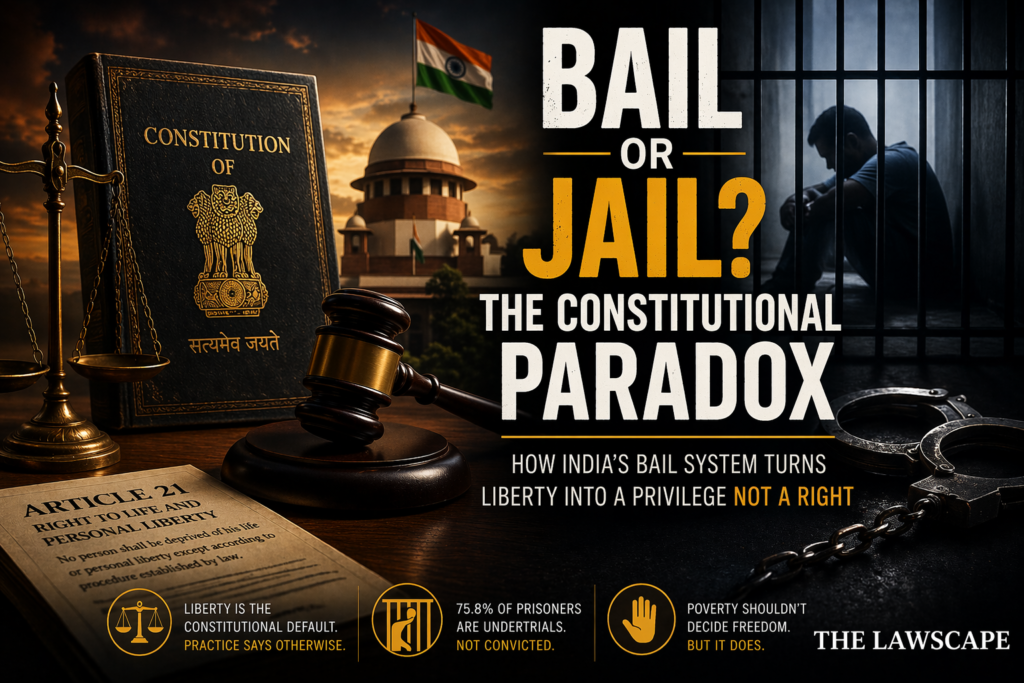
- Decades of Supreme Court jurisprudence, from Balchand to Hussainara Khatoon, firmly establish liberty as the constitutional default, yet 75.8% of India’s prisoners remain unconvicted undertrials, exposing a deep gap between doctrine and practice.
- Meaningful reform demands non-monetary release as the starting norm, proactive undertrial review, and genuine legal representation at first remand: not new principles, but existing constitutional commitments finally made operational.
The constitutional promise that bail is the rule and jail the exception has long been recognised by the Supreme Court, notably in State of Rajasthan v. Balchand, (1977) 4 S.C.C. 308 (India), Moti Ram v. State of Madhya Pradesh, (1978) 4 S.C.C. 47 (India), and Hussainara Khatoon v. State of Bihar, (1980) 1 S.C.C. 81 (India). Yet the reality of India’s criminal justice system reveals a persistent gap between doctrine and practice. A large proportion of prisoners are undertrials detained not due to necessity, but due to inability to satisfy bail conditions.
This article examines monetary bail, surety requirements, and judicial discretion under the Code of Criminal Procedure and the Bharatiya Nagarik Suraksha Sanhita. It argues that formally neutral bail mechanisms disproportionately burden economically marginalised accused persons, weakening the presumption of innocence and the guarantee of personal liberty under Article 21.
The article concludes that meaningful reform requires non-monetary release conditions, proportionality in bail decisions, and a substantive commitment to equal protection.
Keywords: Bail jurisprudence; Undertrial detention; Article 21; Monetary bail; Substantive equality.
Introduction
There are not many legal principles stated with as much confidence in Indian criminal law as this one: bail is the rule, jail is the exception. The Supreme Court has returned to it repeatedly over the decades, treating it as an expression of something deeper: the Constitution’s commitment to personal liberty. It is not a controversial proposition. It is, in fact, widely accepted. And yet, when you look at who is actually sitting in India’s prisons, the principle starts to feel more like an aspiration than a description of how things work. Most of those incarcerated right now have not been found guilty of anything. They are there not because the state has proved its case, not because a court has found their detention genuinely necessary, but because the cost of getting out is more than they can manage.
That gap between what the law says and what actually happens is worth taking seriously, because it is not a minor inconsistency. If liberty is truly the starting point, and if detention is supposed to be the carefully reasoned exception, then something has gone wrong when pre-trial incarceration becomes a routine outcome for people simply because they are poor. And the troubling part is that this cannot be explained by pointing to missing laws or absent protections. The Constitution protects personal liberty. It guarantees equality before the law. It requires the state to provide legal aid to those who cannot afford it. The Supreme Court has recognised the right to a speedy trial and has said plainly that pre-trial custody must not be allowed to function as punishment. The legal architecture is there. The problem is what happens when it meets the ground.
This article works from the position that India’s bail system is not broken at the level of principle; it is broken at the level of practice. Surety requirements that look reasonable on paper become walls for people without money. Legal representation, which should be present at the very first moment liberty is put at stake, is frequently absent or inadequate. Statutory protections that should trigger automatically sit dormant because no one is watching to enforce them. Taken together, these failures do not just produce administrative inefficiency; they produce something more serious. They make poverty the single most important factor in deciding who stays locked up. That is a constitutional problem, not just an operational one.
What follows looks carefully at the doctrinal foundations of bail law in India, the realities of undertrial detention as they actually exist, and the distance between the constitutional promise and what institutions have actually delivered. The case for reform made here does not rest on the need for new ideas or new principles. The principles are already there, already part of India’s constitutional order. What is needed is the honesty and the will to actually follow them.
I. The Constitutional Promise of Liberty
The numbers are hard to ignore. According to Prison Statistics India 2022, three out of every four people sitting in Indian prisons have not been convicted of anything. They are, in the eyes of the law, innocent. And yet they remain behind bars not because a court has determined that their detention is necessary, but because they could not come up with the money to meet bail conditions. That is the reality this article is concerned with, and it is a reality that sits in direct tension with what the Constitution promises.
India’s constitutional framework, at least in principle, leans strongly toward liberty. Article 21 protects every person’s right to life and personal liberty and permits the state to take that liberty away only through a procedure that is just, fair, and reasonable: the standard the Supreme Court set in Maneka Gandhi v. Union of India, (1978) 1 S.C.C. 248 (India). A procedure that passes legal scrutiny on paper but operates arbitrarily in practice does not meet that standard. When a person’s freedom depends on how much money they have rather than on any demonstrated need to detain them, the procedure authorising that detention begins to look constitutionally fragile.
Article 14 adds another layer to this problem. Equality before the law does not only prohibit rules that are explicitly discriminatory; it also catches rules that appear neutral but produce deeply unequal outcomes. A uniform surety requirement looks the same for everyone on paper. In practice, it is manageable for someone with means and effectively insurmountable for someone without. That is not equality in any meaningful sense.
Article 22, which requires that a detained person be produced before a magistrate within twenty-four hours, reflects the Constitution’s deep suspicion of unchecked detention. But judicial authorisation that amounts to little more than rubber-stamping a financial condition satisfies the letter of that requirement while hollowing out its purpose.
Read together, these provisions point toward the same conclusion: pre-trial detention must be the product of genuine, case-specific reasoning about necessity, not a default outcome for people who happen to be poor.
II. Liberty as the Constitutional Default
The Supreme Court has said it plainly and repeatedly: bail is the rule, and imprisonment is the exception. In State of Rajasthan v. Balchand, (1977) 4 S.C.C. 308 (India), the Court made clear that liberty is where the law starts from, and that the burden of justifying detention falls on the state, not on the accused to justify their release.
That is a meaningful principle. It refuses the idea that an accused person must prove themselves worthy of freedom. Freedom is where they begin. Confinement is what must be explained and justified.
But a principle, however well stated, only matters if it works in practice. Declaring that bail is the rule does nothing for the person who technically qualifies for bail but cannot satisfy the conditions attached to it. If the financial requirements imposed are beyond what a large section of accused persons can realistically meet, then the constitutional default becomes something that exists in courtroom language but not in lived experience.
III. When Bail Becomes Illusory
The Court grappled with this directly in Moti Ram v. State of Madhya Pradesh, (1978) 4 S.C.C. 47 (India). The judgment recognised something that should have been obvious but needed saying: a bail order that comes with conditions the accused cannot possibly meet is, in substance, a denial of bail. The form says release; the reality is continued detention.
This matters constitutionally because it forces us to look at procedure not in the abstract but as it actually operates. A condition that cannot be fulfilled does not achieve any legitimate purpose: it does not ensure the accused will appear in court, it does not protect the public, it does not prevent interference with justice. What it does is keep a poor person in custody.
The Court’s response was to insist that bail conditions must be shaped around the individual accused, their actual circumstances, their actual means. Mechanical application of financial conditions without any inquiry into whether the person can realistically comply is inconsistent with the fairness that Article 21 demands.
Running through this reasoning is something like a proportionality requirement: bail conditions must have a genuine connection to legitimate goals. When they do not, when they simply function to exclude people who cannot pay, they stop being safeguards and start being the very thing the bail system is supposed to prevent. The Court’s recognition of personal bonds and non-monetary alternatives pointed toward a better way forward. That path has not been taken nearly far enough.
IV. Speedy Trial and the Reality of Mass Undertrial Detention
Hussainara Khatoon v. State of Bihar, (1980) 1 S.C.C. 81 (India) brought the human cost of this failure into sharp focus. Prisoners were found to have spent years in custody awaiting trial, some for longer than the maximum sentence they could have received had they been convicted. The Court held that the right to a speedy trial is part of Article 21. Detention that stretches on indefinitely without adjudication is not a procedural inconvenience; it is a constitutional violation.
The judgment also took a practical step that mattered: it endorsed release on personal recognizance for accused persons who could not afford surety. It acknowledged, plainly, that traditional bail requirements were operating as walls that kept the poorest prisoners in.
That was decades ago. Today, 4,34,302 of India’s 5,73,220 prisoners are undertrials. Indian prisons are running at 131.4% of their sanctioned capacity, and the accumulation of undertrial prisoners, many held for relatively minor offences, is the main reason for that overcrowding. The constitutional commitment articulated in Hussainara Khatoon has not produced structural change. The crisis it identified has, if anything, deepened.
V. Doctrine in Theory, Inequality in Practice
In Sanjay Chandra v. CBI, (2012) 1 S.C.C. 40 (India), the Court reaffirmed that pre-trial detention cannot function as punishment delivered in advance. The gravity of the allegations against an accused is not, by itself, a reason to keep them locked up. Detention requires demonstrable necessity, not just serious charges.
As a statement of law, this is correct and important. But the case also illustrates a disparity that runs through the entire bail system. An accused with money and access to competent legal representation can actually use these constitutional protections: they can challenge adverse orders, satisfy imposed conditions, and navigate the system effectively. An undertrial from a poor background, often without meaningful legal assistance at the bail stage, typically cannot.
The result is an inversion that is difficult to defend. People charged with minor offences remain in custody because they cannot produce modest sureties. People accused in far more serious and complex cases, but with economic resources behind them, secure release. The law on the books treats everyone the same. The law in practice does not.
VI. Poverty, Procedure, and Institutional Failure
The data on who actually fills India’s undertrial population reinforces what constitutional analysis suggests. Economically and socially marginalised communities are disproportionately represented. Many of these individuals have no effective legal representation at first remand, which is precisely the moment when bail conditions are set and when the trajectory of their detention is determined.
Article 39A directs the state to ensure that poverty does not become a barrier to justice. The legal aid framework exists on paper. In practice, representation at the initial remand stage is frequently absent or inadequate. Once conditions are imposed that the accused cannot meet, detention effectively becomes a function of financial status rather than legal necessity.
Section 479 of the Bharatiya Nagarik Suraksha Sanhita, formerly Section 436A of the Code of Criminal Procedure, provides that an undertrial who has served half the maximum possible sentence for their alleged offence must be released on a personal bond. The provision is well-intentioned. The problem is implementation. Without systems that proactively identify eligible prisoners, the safeguard only works for those who know to ask for it, which is rarely the person most in need of it. A constitutional protection that requires the most vulnerable person in the room to initiate it is not really functioning as a protection at all.
VII. Reform as Constitutional Imperative
The reforms needed here are not radical departures from existing law. They are what the Constitution has always required, made operational.
Non-monetary release should be treated as the starting point, not a last resort. Personal recognizance bonds should be the norm in bailable and non-violent matters. Financial sureties should require specific justification before they are imposed.
Courts should be required to record their reasoning on financial capacity. Imposing a monetary condition without addressing whether the accused can realistically meet it is not a reasoned judicial act; it is a mechanical one, and the Constitution demands more.
Undertrial review must stop depending on individual initiative. District-level oversight bodies should proactively identify prisoners who qualify for release under Section 479 and act on that without waiting for an application.
Legal representation at first remand must be real, not nominal. Article 39A means nothing at the moment liberty is first put at risk if there is no lawyer present who can actually advocate for the accused.
Judicial training and standardised bail guidelines matter too. The constitutional doctrine developed in the Supreme Court needs to reach the trial courts where most bail decisions are actually made.
None of this invents new principles. It takes the principles already embedded in the Constitution and gives them practical effect.
VIII. Conclusion: Liberty and Its Conditions
Over more than four decades, the Supreme Court has built a principled and coherent framework for how bail ought to work in a constitutional democracy. The building blocks are clear. Liberty is where the law begins, not where it ends up after an accused has proven themselves worthy of it. Detention is the exception, and it carries a burden of justification that the state must discharge. Poverty, on its own, cannot be a reason to keep someone behind bars. The right to a speedy trial is not a courtesy extended when resources permit; it is a fundamental right. And pre-trial custody is not, and cannot be allowed to become, a form of punishment delivered before guilt is ever established.
These are not vague commitments. They have been articulated in specific cases, in clear language, by the highest court in the country. Balchand placed the burden of justifying detention on the state. Moti Ram recognised that unaffordable bail conditions are, in substance, no bail at all. Hussainara Khatoon exposed the human cost of systemic failure and called for release on personal recognizance for those who could not afford surety. Sanjay Chandra reaffirmed that serious allegations alone cannot justify incarceration. Taken together, these judgments leave little interpretive room. The constitutional position is settled.
And yet, 75.8% of India’s prison population consists of undertrials. Nearly three in every four people behind bars in this country have not been convicted. Many of them are there for offences that carry modest maximum sentences. Many had no lawyer when bail conditions were first imposed. Many belong to economically marginalised, socially vulnerable communities for whom the legal system has long been more of a burden than a protection. They are not in custody because the doctrine failed to protect them. They are in custody because the doctrine, for all its sophistication, did not reach them.
What this amounts to is a constitutional promise kept selectively. For an accused with financial resources, the bail framework works roughly as it is supposed to. They can instruct experienced counsel, challenge disproportionate conditions, furnish sureties, and secure release while their case proceeds. The presumption of innocence, for them, has practical meaning. For the poor undertrial, that same presumption exists in legal text but not in daily reality. They wait. Months pass, sometimes years. Their families are disrupted, their livelihoods lost, their cases unresolved, not because the system found them dangerous, but because the system found them unable to pay.
The Constitution does not sanction that outcome. Article 21 does not say that liberty is protected only for those who can afford to assert it. Article 14 does not say that equality before the law applies only to those with the means to access it. Article 39A does not make legal aid aspirational. These provisions mean what they say, and what they say is incompatible with a system in which financial incapacity routinely determines who remains imprisoned.
The question, then, is not whether reform is constitutionally required. It plainly is. The question is whether the institutions that carry responsibility for giving the Constitution its practical meaning, being the courts at every level, the legal aid authorities, the prison administration, and the legislature, are prepared to close the gap between what the Constitution promises and what the system actually delivers. Until they are, the maxim that bail is the rule will remain what it has too often been: a promise kept for those who can afford to hold the state to it, and quietly broken for everyone else.
Disclaimer: The views expressed in this article are those of the author and do not necessarily reflect the views of The Lawscape.
The Lawscape — clear, practical legal insight for students and future lawyers.