
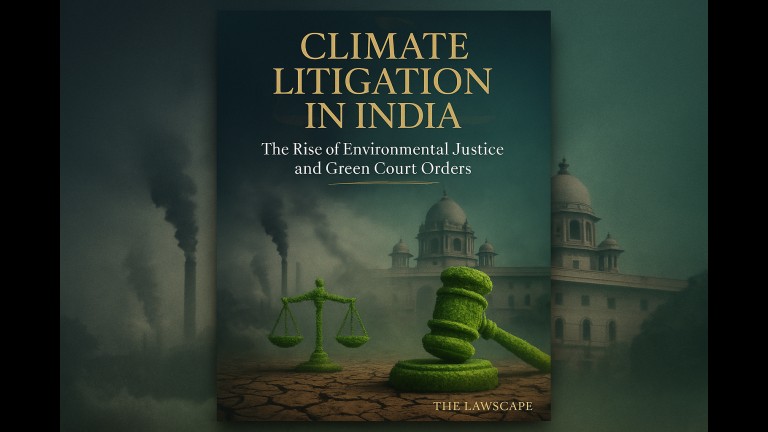
Climate Litigation in India: The Rise of Environmental Justice and Green Court Orders
Author- Ranveer Singh Rathore
B.A. LL.B. (Hons.), 4th Year, Jaipur National University
1. Abstract
India, a country highly vulnerable to the impacts of climate change, is witnessing a significant paradigm shift in its environmental jurisprudence. Driven by constitutional guarantees and proactive judicial interpretation, the Indian legal system is increasingly becoming a crucial arena for addressing climate change and environmental degradation. This article analyses the evolution of Environmental Justice in India, focusing on the rapid rise of Climate Litigation and the impactful orders delivered by the Supreme Court and the National Green Tribunal (NGT). It traces the journey from procedural Public Interest Litigation (PIL) to substantive climate justice claims, anchoring the judicial response within the framework of Article 21 (Right to Life). Furthermore, the article critically discusses the challenges, including judicial enforcement and the tension between environmental protection and economic development, while asserting that the judiciary remains indispensable in shaping India’s response to the climate crisis. The analysis concludes that green court orders are forging a robust, rights-based approach to environmental accountability.
2. Introduction
Environmental justice, in the Indian context, is not merely about procedural fairness in environmental policy; it is deeply entrenched as a fundamental human right. This evolution is vital given India’s unique demographic and environmental pressures—from severe air and water pollution to extreme weather events exacerbated by global warming. The judiciary has recognized the symbiotic link between a healthy environment and the fundamental Right to Life under Article 21 of the Constitution.
The last two decades have marked a significant maturation of this legal doctrine. What began as traditional Public Interest Litigation (PIL) addressing local pollution issues has now morphed into sophisticated Climate Litigation aimed at holding both state and private actors accountable for large-scale environmental harm and inadequate climate mitigation. The establishment of specialized institutions, particularly the National Green Tribunal (NGT), has provided a dedicated, fast-track forum, ensuring that environmental violations are addressed with scientific expertise and legal rigor. This judicial activism highlights the proactive role of the Indian legal system in defending the environment where executive and legislative action has lagged.
3. Background and Legal Context
The foundation of environmental jurisprudence in India is built upon specific constitutional provisions and enabling legislation:
The Constitutional Mandate
The primary legal pillar is the expansive interpretation of the Fundamental Right to Life (Article 21). Landmark judgments, dating back to the 1980s, established that the right to life inherently includes the Right to a Healthy Environment. This crucial interpretation empowered citizens to approach the courts directly under Article 32 (Supreme Court) or Article 226 (High Courts) for environmental redressal.
In addition to Article 21, the Constitution mandates environmental protection through:
- Article 48A (Directive Principle of State Policy): Obligates the State to endeavour to protect and improve the environment and to safeguard forests and wildlife.
- Article 51A(g) (Fundamental Duty): Imposes a duty on every citizen to protect and improve the natural environment, including forests, lakes, rivers, and wildlife, and to have compassion for living creatures.
Legislative Framework and the NGT Act
The primary environmental laws, such as the Water (Prevention and Control of Pollution) Act, 1974, and the Air (Prevention and Control of Pollution) Act, 1981, set standards and created regulatory bodies (Pollution Control Boards). However, the critical institutional development was the enactment of the National Green Tribunal Act, 2010.
The NGT Act established a specialized judicial body tasked with:
- Expeditious disposal of cases relating to environmental protection.
- Enforcement of legal rights relating to the environment.
- Providing relief and compensation for damages to persons and property.
The NGT introduced the critical principles of Sustainable Development, the Polluter Pays Principle, and the Precautionary Principle into Indian environmental law, shifting the burden of proof to the polluter.
4. Detailed Analysis: Pillars of Climate Litigation and Green Orders
The current wave of environmental litigation is characterized by its scope and sophistication, moving beyond local issues to systemic climate accountability.
The Right to a Clean Environment and Article 21
The Supreme Court has consistently reinforced the link between environmental quality and fundamental rights. In cases like M.C. Mehta v. Union of India (on Ganga pollution and the oleum gas leak), the judiciary expanded its scope to include the concept of Absolute Liability and mandated widespread environmental protection measures, including the closure of polluting industries. This legal evolution solidified the judiciary’s role as the primary guarantor of environmental rights.
The Role of the National Green Tribunal (NGT)
The NGT acts as the principal gatekeeper for environmental compliance. Its specialized composition, comprising judicial members and expert members, allows for the resolution of disputes using scientific data rather than just legal precedent.
Key areas where the NGT has issued powerful “Green Court Orders” include:
- Air Pollution Mitigation: The NGT has issued comprehensive directives to tackle the severe air quality crisis in the National Capital Region (NCR), including banning certain old diesel vehicles and imposing substantial penalties for stubble burning.
- Waste Management: The NGT has imposed massive, periodic fines on state governments and municipal corporations for systemic failures in solid and liquid waste management, forcing them to establish decentralized processing units and clear legacy waste sites. For example, it has penalised multiple states for failure to manage legacy waste at landfills, holding that the right to sanitation is part of the right to life.
- Sand Mining and River Protection: The Tribunal has severely restricted illegal sand mining operations, which cause irreversible ecological damage to riverbeds, often ordering significant compensation payments for environmental restoration.
Emergence of Substantive Climate Litigation
The current frontier is climate litigation, where petitioners directly challenge government inaction or development projects that contribute to greenhouse gas (GHG) emissions. These cases often involve:
- Challenging Coal Projects: Petitioners have challenged new thermal power plants and coal mine expansions, arguing that the environmental cost of their GHG emissions was not adequately factored into the Environmental Impact Assessment (EIA) process.
- Coastal Protection: Litigation against infrastructure projects in coastal regulation zones (CRZ) often ties climate change impacts, such as sea-level rise and coastal erosion, directly to the project’s long-term viability and risk.
- Right to Health in a Climate Crisis: Future litigation is expected to focus on the state’s obligation to protect citizens’ health from climate-linked harms, such as heatwaves and zoonotic diseases.
A recent significant ruling acknowledged the Right to be Free from Adverse Effects of Climate Change as a distinct aspect of Article 21, paving the way for more direct challenges to climate policy failures.
5. Critical Discussion: Enforcement, Conflict, and Legitimacy
While India’s judicial approach to environmental protection is pioneering, it faces significant challenges.
The Enforcement Deficit
The most crucial challenge is the enforcement deficit. While the Supreme Court and NGT issue stringent orders and impose heavy penalties, the execution often falters at the state and local government levels. Orders related to factory closures, vehicle bans, or waste processing deadlines frequently meet bureaucratic resistance, political interference, and lack of funding. The NGT’s power to penalize is significant, but its reliance on state agencies for actual implementation remains a systemic vulnerability.
The Development vs. Environment Conflict
The judiciary is constantly balancing the imperatives of economic development with environmental protection. India is a rapidly developing nation, requiring massive infrastructure and energy projects. This often leads to criticism that judicial interventions delay essential projects or impose unworkable financial burdens. The courts must evolve principles that integrate climate mitigation requirements into development planning (i.e., making development sustainable), rather than merely stopping it. The adoption of the Principle of Intergenerational Equity is crucial here, ensuring current development does not compromise future generations.
Judicial Legitimacy and Technical Expertise
Despite the NGT’s technical expertise, environmental decisions often involve highly complex scientific, economic, and technological factors. Critics occasionally question whether the judiciary is equipped to mandate specific technological solutions (e.g., in waste management or pollution control) over the executive’s technical bodies. The judicial role is therefore best framed as one of oversight and accountability, ensuring the executive complies with scientific standards and constitutional duties, rather than replacing executive decision-making.
6. Conclusion
The Indian judiciary has transformed environmental justice from a nascent concept into a robust, rights-based doctrine. The combined efforts of the Supreme Court, interpreting Article 21, and the NGT, applying key environmental principles, have created a powerful legal ecosystem for addressing ecological harm and, increasingly, climate change.
The rise of climate litigation and the resulting green court orders signify that environmental accountability is no longer negotiable. The challenges of enforcement and the ongoing tension between development and conservation remain substantial. However, by enshrining the Right to a Healthy Environment as part of the fundamental Right to Life, the Indian judiciary has laid an indispensable foundation for climate action, setting a crucial global precedent for how developing nations can use the power of the law to secure their environmental future.
7. References
- The Constitution of India, 1950 (Articles 21, 48A, and 51A(g)).
- The National Green Tribunal Act, 2010.
- The Water (Prevention and Control of Pollution) Act, 1974.
- The Air (Prevention and Control of Pollution) Act, 1981.
- M.C. Mehta v. Union of India, AIR 1987 SC 1086 (Oleum Gas Leak Case).
- Vellore Citizens’ Welfare Forum v. Union of India, (1996) 5 SCC 647 (On Precautionary Principle and Polluter Pays Principle).
- Recent NGT orders pertaining to Solid Waste Management and Air Quality in the National Capital Region (NCR).
- Supreme Court decisions on the interpretation of Article 21 and the right to a clean environment.
- Relevant academic publications discussing climate litigation and judicial activism in India.
The Lawscape — clear, practical legal insight for students and future lawyers.