
Criminal Justice and Federalism: Lessons from TN v. Governor
Author- The Lawscape Team
September 3, 2025
Introduction
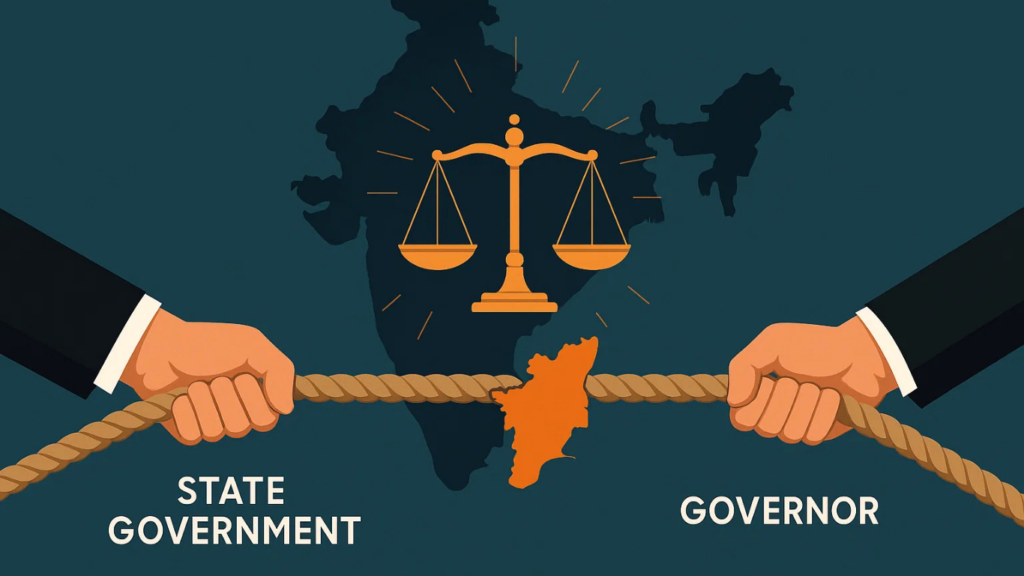
Criminal justice and federalism are deeply intertwined in India’s constitutional framework. The recent Supreme Court case, Tamil Nadu v. Governor, has brought this relationship into sharp focus, sparking nationwide debates about the balance of power between state governments and the union. This article explores the case, its implications for governance, and its impact on India’s federal structure.” This article explains the case in plain language and shows what it means for federalism and criminal justice going forward. The short version: Governors cannot stall elected governments. Assent can’t be pocketed. Discretion is narrow and reviewable. And criminal justice decisions cannot be frozen by constitutional silence.
Background: Governors, Federalism, and the Criminal Justice Chain
The constitutional design
- Articles 154 & 163: Executive power of a State vests in the Governor, but the Governor acts on the aid and advice of the Council of Ministers—except in a narrow set of situations where the Constitution says otherwise. The Supreme Court’s classic statement in Shamsher Singh v. State of Punjab (1974) frames this as the basic rule of India’s parliamentary federalism. The 2025 judgment relies on that rule.
- Articles 200–201: When a State Legislature passes a Bill, the Governor can (a) assent; (b) withhold assent (and send it back with a “message” for reconsideration); or (c) reserve it for the President (for example, if it may affect High Court powers—second proviso). There is no fourth option to sit on Bills indefinitely. The Court has said this repeatedly since late 2023 and has now set out a structured approach in 2025.
- Article 161: The Governor’s power to grant remission or commutation of sentences (premature release) is ordinarily exercised on ministerial advice.
- Prevention of Corruption Act (PC Act): Section 19 requires sanction to prosecute certain public servants; Section 17A (added in 2018) requires prior approval to investigate alleged offences relating to official decisions. Who grants these, and how quickly, can decide whether corruption cases move at all.
Why this matters for criminal justice
Policing and prisons are State subjects. If a Governor can freeze a sanction to prosecute, or sit on remission files, it directly affects trials, prison populations, and victims’ rights. If a Governor can stall state Bills that reorganize universities, police oversight, or anti-corruption architecture, it indirectly shapes the criminal justice ecosystem too.
The Tamil Nadu Case: What Actually Happened
The State of Tamil Nadu approached the Supreme Court complaining of prolonged inaction by the Governor on several fronts:
- Twelve Bills passed between January 2020 and April 2023 were pending. On 13 November 2023—after the Supreme Court’s first hearing—the Governor “withheld assent” on ten and reserved two for the President. The Assembly then re-passed those ten Bills on 18 November 2023 and sent them again for assent.
- Sanctions and approvals in corruption cases (PC Act): files on sanction to prosecute and approvals to investigate had not been decided. The record before the Court shows references to Section 17A(1)(b) and Section 19.
- Premature release: the State said 54 prisoner release files were pending; the judgment also notes hundreds of premature release proposals processed by the State since September 2021 and interactions with the Raj Bhavan.
- TNPSC appointments: proposals for appointments to the Tamil Nadu Public Service Commission were returned without reasons.
- Dismissal/divestment of a Minister’s portfolio: in June 2023, the Governor purported to dismiss and divest the portfolio of Minister V. Senthil Balaji following his arrest; the Governor then kept that decision in abeyance. The Court recorded this background while analysing the Governor’s role under Article 163 (aid and advice).
The Supreme Court’s Ruling: Five Big Takeaways
1) No “pocket veto.” Inaction is unconstitutional.
The Court reaffirmed that indefinite inaction is not an option under Article 200. The Governor must choose one of the constitutional courses. The Court drew on its 2023 Punjab ruling, which had already clarified that if assent is withheld, the Bill must be returned with a message for reconsideration; simply “withholding assent” on a drawer note won’t do.
2) Deemed assent to the 10 re-passed Bills (using Article 142)
Because the Governor withheld assent only after the Court’s initial notice and then reserved the Bills after they had been re-passed (which the Court found impermissible on these facts), the Bench used Article 142 to do complete justice and deemed the ten Bills to have received assent as of 18 November 2023. Steps taken pursuant to the improper reservation were set aside.
3) Clear timelines for action by Governors and the President
To prevent repeats, the Court set outer time limits:
- If acting on the Council of Ministers’ advice to withhold or reserve a Bill: within one month.
- If acting contrary to the advice (e.g., returning with a message): within three months.
- If reserving contrary to advice: within three months.
- If the Legislature re-passes a Bill after reconsideration: Governor must grant assent forthwith, within one month at most.
- When a Bill is reserved for the President: the Court adopted the Union Home Ministry’s guideline of three months for a decision under Article 201.
These are judicially manageable standards, not amendments to the Constitution. The Court reasoned that comparable constitutions (e.g., Pakistan, Bangladesh, South Africa) expressly set timelines, and Indian constitutional practice plus prior precedent supports reasonable limits to prevent paralysis.
4) Discretion exists—but it is narrow and reviewable
The Court carefully mapped where a Governor may legitimately act in discretion:
- Under the second proviso to Article 200, if a Bill would derogate from High Court powers, reservation is a discretionary duty.
- In exceptional cases like sanction to prosecute a Chief Minister or Minister (where there’s an inherent conflict of interest), the Governor may act in discretion as recognised in M.P. Special Police Establishment v. State of M.P. (2004). But these are exceptional circumstances—“peril to democracy,” “manifest bias,” or where the Council of Ministers has disabled itself. Otherwise, the rule of aid and advice governs. And any such exercise of discretion is judicially reviewable.
5) The Governor is not a parallel executive; federal lines must be respected
The judgment reiterates that the Governor is not answerable to the Union for his decisions and cannot run a parallel administration. In conflicts between Union wishes and state Cabinet advice, the Governor must adhere to the latter—except in the limited constitutional pockets of discretion discussed above. This is core to India’s parliamentary federalism.
How This Reshapes Criminal Justice Administration
A. Sanction to prosecute and approvals to investigate (PC Act)
- What changed? The Court recognised that sanctions/approvals under Sections 19 and 17A of the PC Act are primarily executive decisions to be taken on aid and advice. Only in rare cases—such as when the accused is the Chief Minister or a Cabinet colleague and a conflict of interest is baked in—may the Governor act in discretion, following M.P. Special Police Establishment. Even then, the Governor must act promptly and with reasons, because inaction can sabotage prosecutions.
- Why it matters: Anti-corruption cases often stall for months awaiting sanction. The judgment’s logic and its broader timelines principle mean States can no longer be locked in limbo by unexplained gubernatorial silence. Courts can now test delays against a reasonableness yardstick.
- Practical tip: Departments should build record-ready files that address conflict-of-interest concerns up front (e.g., if the accused sits in the Cabinet) and propose a clean chain of decision-making. Where a Governor claims discretion, the file should reflect why this is an “exceptional circumstance” under the M.P. Special Police standard.
B. Premature release (Article 161)
- What changed? The Court’s approach signals that remission/premature release decisions—ordinarily to be taken on ministerial advice—cannot be indefinitely parked. The judgment records the backlog and the back-and-forth between the State and the Raj Bhavan, underlining that the Governor’s role here is not to create a parallel policy.
- Why it matters: Premature release is tied to prison overcrowding, rehabilitation, and victims’ rights. Indefinite hold-ups are unfair to prisoners, victims, and the system.
- Practical tip: States should adopt clear remission policies aligned with Supreme Court guidelines and ensure reasoned recommendations. If the Raj Bhavan returns files, the Department should promptly address reasons and resubmit; if inaction persists, judicial review is now more straightforward.
C. Appointments to commissions (e.g., TNPSC under Article 316)
- What changed? The Court recorded that TNPSC appointment files were returned without reasons; it reiterated that where the Constitution does not carve out discretion, the Governor acts on aid and advice. Unreasoned returns are suspect and reviewable.
- Why it matters: Hiring and promotions in the public service drive the quality and integrity of policing, prosecution, and corrections. Vacancies and appointment limbo weaken institutions.
D. Ministerial dismissals and the Governor’s limits
- What changed? The factual record shows the Governor attempted to dismiss a Minister and then kept it in abeyance. The Court used this backdrop to emphasise that, barring exceptional cases expressly provided by the Constitution, the Governor cannot undercut the Cabinet system. Dismissal of Ministers is a matter for the Chief Minister’s advice and legislative confidence, not unilateral gubernatorial action.
- Why it matters: Arrests of public officials (e.g., by central agencies) often trigger political churn. The judgment warns Governors against stepping into the Cabinet’s shoes, preserving political accountability within the Legislature.
Federalism Takeaways
- Parliamentary federalism over gubernatorial overreach
The judgment re-anchors the system: Governor as constitutional head, not political counterweight. That protects the federal balance and respects state mandates. - Timelines as tools of accountability
By reading Articles 200–201 with implied timelines, the Court supplied a workable constitutional ethic: decide, explain, and move forward. This reduces friction points that have escalated in several States since 2023. (A Presidential Reference now debates whether courts can set such timelines universally, but the Tamil Nadu ruling stands.) - Judicial review of gubernatorial discretion
Discretion is narrow and must be justified. The judgment imports standards from M.P. Special Police to the PC Act context and reiterates that even where discretion exists, courts can review delay, reasonableness, and purpose. - No parallel administration
The Court is explicit: a Governor cannot be an agent of the Union or run a parallel state executive. If the Union has concerns, it has constitutional routes (e.g., Article 356 as a last resort), but routine governance must follow aid and advice.
Comparative Glance (very briefly)
The Court noted that several constitutions expressly fix timelines for assent—for example, in Pakistan and Bangladesh. India’s Constitution doesn’t, but the Court used principles of constitutional morality, prior practice, and functional necessity to craft reasonable limits without rewriting the text. This places India closer to systems that discourage executive inaction as a veto by delay.
What Should Governments, Police, and Prosecutors Do Now?
- Tighten files and reasons. Whether for Bills, sanctions, or remissions, put clear reasons on record. This makes it easier for the Governor to act and for courts to uphold decisions.
- Track the clock. Use the Tamil Nadu timelines as a planning baseline (one month for assent after repassage; three months for returns/reservations contrary to advice; three months at the President’s end). Until the Presidential Reference yields a different binding rule, these are live standards, and courts are already relying on them.
- Escalate responsibly. If files bounce back without reasons, address any legitimate points and resubmit with a short rebuttal note. If silence persists beyond reasonable time, seek judicial review with a precise chronology.
- Respect genuine discretion. In rare sanction cases involving sitting Ministers, propose a conflict-free mechanism (e.g., independent legal opinion, recusal of conflicted Ministers), and invite the Governor’s decision with a tight time frame—citing M.P. Special Police.
What This Means for Citizens and Students
- Clarity and speed. Laws you vote for (indirectly, via your MLAs) should not be stalled by indefinite gubernatorial silence. The Court has now created clear expectations.
- Checks remain. The President and courts still check state laws in appropriate cases. But the default is that elected governments should govern.
- Criminal justice efficiency. Cases should move faster when sanction decisions and release recommendations are not parked indefinitely. That helps victims, accused persons, and the system’s credibility.
Conclusion
State of Tamil Nadu v. Governor of Tamil Nadu is a federalism judgment with practical criminal-justice consequences. It restates the aid and advice rule, trims back overreach, and replaces constitutional silence with workable timelines and reviewable standards. The Supreme Court also used Article 142 to end a cycle of delay by deeming assent to Bills re-passed on 18 November 2023—signalling that it will not allow governance to be vetoed by inaction. Yes, a Constitution Bench is now considering a Presidential Reference about whether courts may set such timelines in general. For the moment, though, the 8 April 2025 ruling stands. Its message is simple: Governors are not alternate executives; they are constitutional umpires. In criminal justice especially—sanctions, investigations, remissions, appointments—decisions must be made, explained, and made in time. That is how Indian federalism keeps faith with democratic choice and the rule of law.
The Lawscape — clear, practical legal insight for students and future lawyers.