
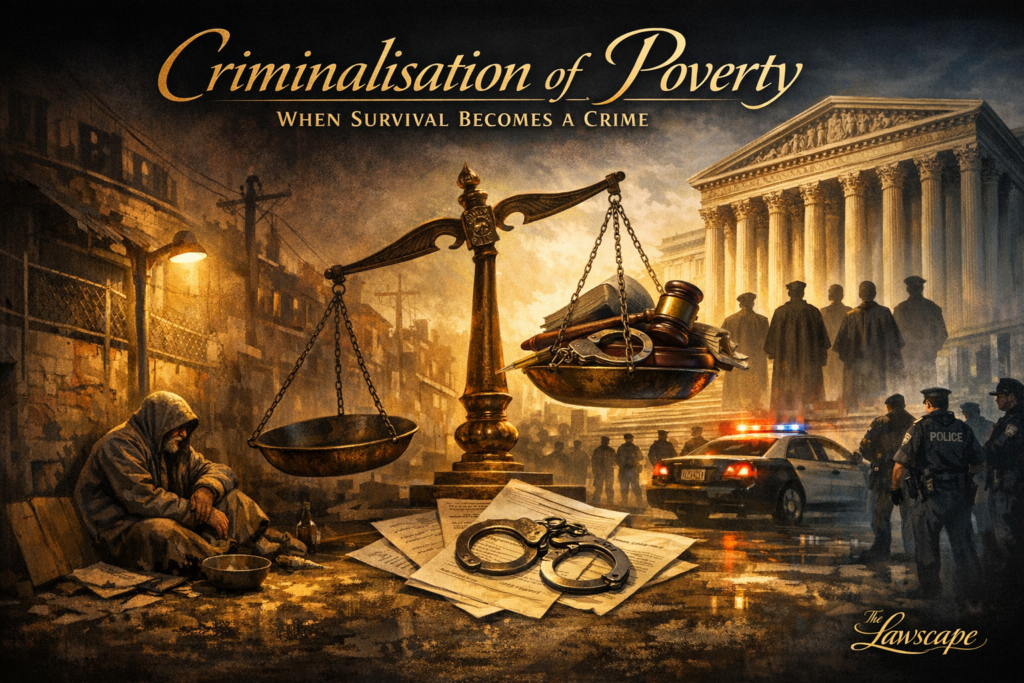
Criminalisation of Poverty: When Survival Becomes a Crime
Author: Prithvi Mukherjee
Student, Lord’s Universal college of law
—————————————————————————————-
3 Quick Takeaways
- The criminalisation of poverty treats the survival strategies of the poor, such as sleeping in public, begging, and street vending, as criminal offences, driving marginalised communities deeper into the justice system rather than addressing the structural causes of their deprivation.
- India’s colonial legal inheritance, from the Criminal Tribes Act, 1871 to vagrancy laws, laid the foundation for a punitive approach to poverty that continues to echo in postcolonial frameworks, reinforcing the treatment of poverty itself as a public wrong.
- The Supreme Court’s landmark ruling in Olga Tellis v. Bombay Municipal Corporation (1985) affirmed that the right to life under Article 21 includes the right to livelihood, establishing that the constitutional promise of dignity cannot be separated from the material conditions of survival.
“It is not great wealth in a few individuals that proves a country is prosperous, but great general wealth evenly distributed among the people… It is the struggling masses who are the foundation of this country; and if the foundation be rotten or insecure, the rest of the structure must eventually crumble.”
~ Victoria Woodhull First woman to run for President of the United States, 1872
Abstract
The criminalisation of poverty describes the making and enforcement of laws that punish homeless and financially disadvantaged individuals for engaging in the everyday survival activities that their condition compels, such as sleeping in public, loitering, street vending, and panhandling.
Rather than addressing the structural causes of poverty, including unemployment, housing shortages, inadequate social protection, and inaccessible healthcare, policies that criminalise poverty push vulnerable people further into the criminal justice system.
This paper discusses how such poorly designed measures make the situation of the homeless, the unemployed, migrants, and marginalised communities significantly worse. Drawing on legal analysis from India and comparative examples, it argues that criminalisation deepens social inequality without eliminating poverty. It concludes that decriminalising survival mechanisms and pursuing genuinely inclusive social policies offers a more ethical and sustainable path toward poverty reduction and social justice.
Introduction
Poverty is generally understood as a social and economic condition, yet it is frequently treated as a form of deviance within legal systems and public policy.
Historically, systems like the class order and the caste system have been among the root causes of poverty. But poverty in contemporary society is also the product of a capitalist economy marked by an enormous gap between the wealthy and the rest, where large industries extract value from those who have no capacity to protect their own interests in return.
Criminalisation of poverty means punishing precisely those people who were pushed to the margins of society and left with no choice but to resort to basic survival mechanisms. These mechanisms, including homelessness, begging, loitering, or the inability to pay fines and fees, are treated by the state as criminal conduct.
When governments enact laws that criminalise poverty, they send a clear message: the poor are not welcome in public life.
A contemporary Indian example is the order-making power under Section 163 of the Bharatiya Nagarik Suraksha Sanhita (BNSS), 2023, which empowers district magistrates, sub-divisional magistrates, and executive magistrates to issue orders restricting certain acts in a specific area in cases of nuisance or apprehended danger. When applied to the homeless or the visibly poor, such powers can function as instruments of exclusion rather than legitimate public order mechanisms.
Welfare fraud is another dimension of this problem. Policies advertised as poverty-reducing interventions often become public relations exercises rather than meaningful interventions. A Parliamentary Committee on Empowerment of Women found that out of a total of Rs. 446.72 crore released under the Beti Bachao, Beti Padhao scheme during the period 2016 to 2019, a striking 78.91% was spent on media advocacy alone. The Committee concluded that the focus must shift to measurable outcomes in health and education. It is deeply troubling that a scheme designed to support girls from poor and financially challenged households was predominantly used to fund advertising rather than to change lives.
The History of Criminalisation of Poverty in India
The British colonial era laid the foundations of the criminalisation of poverty in India. The colonial administration treated the poor, the mobile, and the marginalised as threats to order and productivity.
The Criminal Tribes Act, 1871 exemplifies this approach. Enacted by the British government, it classified entire communities as “criminal tribes” by birth, making the very existence of certain people a criminal condition. The criminalisation of identity rather than conduct is one of the clearest hallmarks of an authoritarian framework.
The colonial government also enacted vagrancy laws to control movement, labour, and social behaviour, particularly among the poor and marginalised. These laws originated in Britain and spread across its empire, with roots traceable to the 14th and 15th centuries. The Vagrancy Act of 1824, in particular, became a foundation of colonial administration, empowering police and magistrates to penalise people who appeared to have no means of subsistence. These provisions gave state officials wide discretionary authority to detain and punish those whose poverty rendered them socially inconvenient.
What is Criminalisation of Poverty?
The criminalisation of poverty refers to laws and enforcement practices that target the visible manifestations of poverty, including homelessness, loitering, street vending, and panhandling, and treat them as criminal or regulatory offences.
Classic examples include the disproportionate detention and punishment of poor people for simply existing in public spaces. Those experiencing poverty also frequently face neglect and mistreatment by authorities. Homeless women and girls are particularly vulnerable, with sexual assault among homeless populations constituting a serious issue that is often overlooked or handled with insufficient urgency, revealing deep gaps in the protective systems meant to serve the most vulnerable.
This directly challenges the constitutional guarantees of equality, life, and personal liberty.
Constitutional Framework
Article 14: Equality before the law guarantees equal treatment for all before the law. Laws that discriminate on the basis of economic status risk violating this guarantee. Bail conditions tied to financial capacity are one example: where access to liberty depends on the ability to pay, poor accused persons may remain in custody not because of the seriousness of their alleged offence but simply because they cannot afford to be free.
Article 21: Right to life and personal liberty includes rights necessary for a dignified life, such as the rights to livelihood, shelter, and rehabilitation. The Supreme Court has significantly broadened this right to include the right to livelihood, recognising that the deprivation of a person’s means of living may effectively amount to the deprivation of life itself.
Olga Tellis v. Bombay Municipal Corporation (1985)
The case that most directly addresses the criminalisation of survival is Olga Tellis and Ors. v. Bombay Municipal Corporation and Ors., 1986 AIR 180.
The case came before the Supreme Court as a writ petition filed by pavement and slum dwellers in Bombay, seeking to resist their eviction during the monsoon months. In 1981, the then Chief Minister of Maharashtra, Shri A.R. Antulay, announced that all pavement dwellers in the city would be forcibly evicted and deported to their respective places of origin outside Bombay.
The petitioners challenged the decision to demolish their structures before the Supreme Court under Article 32, arguing that it violated their rights under Articles 19 and 21 of the Constitution.
On behalf of the Government of Maharashtra, a counter-affidavit argued that no person has any legal right to encroach upon or construct any structure on a footpath or public street, and that pavement dwellers created health hazards and that some engaged in anti-social activities. The Bombay Municipal Corporation similarly argued that pavement dwellers obstructed road repair and maintenance.
Key legal issues:
- Does the right to life encompass the right to livelihood?
- Can the government evict pavement dwellers without violating their fundamental rights?
- Can anyone construct structures on a public footpath?
Supreme Court ruling:
The Court held that the right to livelihood is part of the right to life. It reasoned that denying a person their right to livelihood is, in effect, depriving them of life itself. Accordingly, the right to life under Article 21 includes the right to livelihood.
On the legality of eviction, the Court balanced individual rights with societal interests. While the state is entitled to remove illegal encroachments, the eviction process must adhere to fair procedures, provide proper notice, allow an opportunity to be heard, and include responsible rehabilitation processes where necessary. Eviction is not constitutionally prohibited, but it must be carried out humanely and respectfully.
The Court also clarified that Article 21 does not impose an absolute bar on the deprivation of life or personal liberty, but requires that any such deprivation must be according to procedure established by law.
Significance: This landmark decision expanded the scope of Article 21 beyond the prohibition of arbitrary killing, recognising socioeconomic rights as fundamental rights and compelling the government to prioritise human dignity in urban planning and policy.
Bench: Y.V. Chandrachud CJI, Syed Murtaza Fazalali, V.D. Tulzapurkar, O. Chinnappa Reddy, A. Varadarajan JJ.
The Line Between Rich and Poor
“There is so much wealth and so much misery at the same time, that it seems incredible that people can endure such class differences, and accept such a form of hunger while on the other hand, the millionaires throw away millions on stupidities.”
~ Frida Kahlo Mexican artist, writing about New York City in the 1930s
In So Rich, So Poor, Peter Edelman explores how wealth and poverty exist side by side in modern society, often separated by a thin line that determines access to opportunity, safety, and a sense of belonging. Through his analysis, Edelman shows that money is not merely about comfort: it shapes whether people are heard, seen, and taken seriously. He highlights how the modern economy traps many in low-wage work, disproportionately affecting people of colour and single-parent families.
The book challenges the reader to question whether inequality is something people are born into or something that is socially constructed, and whether society bears a responsibility to close the gap between the rich and the poor.
One of its most striking observations is that wealth creates a distance between people. Those who live comfortably often move through the world with a sense of security, while those in poverty must remain in a constant state of alertness and resourcefulness. Edelman explores how wealth generates a kind of blindness to the daily struggles of ordinary people, mirroring the real world in which the wealthiest continue to accumulate resources while the poor must constantly worry about their survival.
Ultimately, So Rich, So Poor is not only about money: it is about power, empathy, and visibility. By placing people from different economic backgrounds in similar social spaces, Edelman compels readers to see the invisible line separating rich and poor, and to consider their own position within that structure.
Conclusion
The criminalisation of poverty in India reflects a persistent tension between constitutional ideals and inherited models of governance that continue to frame poverty as deviance rather than deprivation. Laws originally designed to regulate public spaces and discipline the poor survive in various forms within postcolonial legal frameworks, reproducing a punitive approach to visible poverty. These laws do not merely regulate conduct: they symbolically construct poverty itself as a public wrong, legitimising state interventions in the lives of the urban poor through detention, policing, and institutionalisation rather than through welfare and rehabilitation.
Dismantling the criminalisation of poverty requires more than the decriminalisation of begging or limiting police discretion. It demands a structural reorientation of law and policy. Ensuring access to welfare benefits and creating genuine economic opportunity for the poor must become the state’s first priority. Criminalising an already vulnerable section of society does not solve poverty: it compounds it.
End Notes
- Bharatiya Nagarik Suraksha Sanhita, 2023, § 163, No. 45, Acts of Parliament, 2023 (India).
- Jagriti Chandra, Beti Bachao, Beti Padhao: 80% of funds spent on media campaigns, says Parliamentary Committee, The Hindu (Dec. 10, 2021), https://www.thehindu.com/news/national/beti-bachao-beti-padhao-whopping-80-of-funds-spent-on-media-campaigns-says-parliamentary-committee/article37922778.ece
- Criminal Tribes Act, 1871, Act No. XXVII of 1871 (India).
- Vagrancy Act, 1824 (United Kingdom).
- Olga Tellis and Ors. v. Bombay Municipal Corporation and Ors., 1986 AIR 180, 1985 SCR Supl. (2) 51, (1985) 3 SCC 545 (India).
- Peter Edelman, So Rich, So Poor: Why It’s So Hard to End Poverty in America (The New Press, 2012).
Disclaimer: The views expressed in this article are those of the author and do not necessarily reflect the views of The Lawscape.
The Lawscape — clear, practical legal insight for students and future lawyers.