
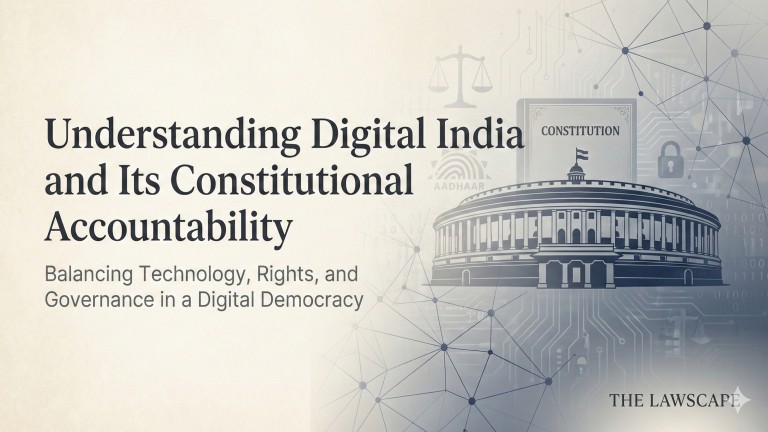
Understanding Digital India and its Constitutional Accountability
Author: Shantam Chakraborty
Student, Amity University, Kolkata.
—————————————————————————————————————-
I. Understanding Digital India and Constitutional Accountability: Addressing Real Challenges
Digital India was launched in 2015 by our Honourable Prime Minister, envisioning the transformation of India into a digitally empowered society by means of improved infrastructure, e-governance, and citizen services. While it promise efficiency and transparency, this digital transformation must operate within constitutional accountability frameworks that guarantee the protection of Fundamental Rights, including Equality under Article 14, Freedom of Expression under Article 19(1)(a), the Right to Privacy as recognised under Article 21, and the right to live with dignity.”
The intersection and crossing of Digitization and Constitutional Values reveals critical tensions. In India, Biometric Authentication Systems such as Aadhaar raise serious privacy concerns. Digital Service Delivery often excludes citizens lacking literacy, connectivity or access to devices while Algorithmic Welfare Distribution system possess has the authority to deny benefits without transparent or accessible appeal mechanisms. These issues in particular affect the marginalized communities, which leads to the potential deepening of existing inequalities rather than bridging them.
India’s real challenges and issues such as poverty, inadequate healthcare, educational disparities, agrarian distress, and social discrimination require more than just technological solutions. Digital tools must also complement and support substantive and major policy reforms, instead of substituting them. Constitutional accountability demands robust and efficient data protection, algorithmic transparency, accessible grievance redressal mechanism, and anti-discriminatory safeguards within Indian digital systems. The fundamental question, therefore, is whether Digital India empowers or excludes. When farmers lose crop insurance due to biometric authentication failures, or citizens are unable to challenge automated welfare denials, constitutional rights risk becoming illusory.” True digital transformation must begin by ensuring that technology serves constitutional values, addresses structural inequalities, and guarantees that innovation enhances rather than erodes the citizen-state relationship envisioned by India’s Constitution.
II. Proposed Solutions: Bridging Digital India with Constitutional Accountability
Addressing the constitutional and practical challenges of Digital India requires multi-layered solutions that acknowledge ground realities while also leveraging India’s technological potential. These solutions must be grounded in India’s socio-economic context, drawing lessons from both the successes and failures of past and present implementations
1. Hybrid Service Delivery Models
Digital-first should not mean digital-only. The rapid push towards digitalisation has often led to the elimination of traditional service channels, leaving vulnerable populations stranded in the process. For example, Kerala’s approach to pension distribution offers an instructive model, while encouraging the use of digital payments, the state also maintained manual alternatives and has deployed Kudumbashree workers to assist and educate elderly citizens with digital processes. Similarly, Tamil Nadu’s e-Sevai centres, which provides assisted digital services, wherein trained personnel help citizens in navigating online applications.
The solution lies in establishing mandatory hybrid service systems for at least an initial period of five to ten years, particularly for essential services such as welfare schemes, healthcare, and legal remedies. Every digital portal should have corresponding offline submission mechanisms to ensure continuity with the existing system, thereby enabling users accustomed to traditional processes to transition gradually and smoothly into digital platforms. Performance metrics should be measured with inclusion rates, not just standalone digitization percentages. The Jan Seva Kendra’s model should be expanded with adequate staffing and regular, timely audits to ensure that these centers function as genuine and practical access points rather than merely cosmetic alternatives.
2. Algorithmic Transparency and Accountability Frameworks
The transparency of automated decision-making systems raises serious concerns under the principles of natural justice. For instance, when Jharkhand’s automated Public Distribution System (PDS) had deleted “duplicate” ration cards, genuine beneficiaries lost food security without being informed of the reasons for deletion or the available appellate mechanisms. The solution that this blog aims to propose requires legislating an Algorithmic Accountability Act mandating:
- Public disclosure of eligibility criteria as well as decision-making logic for welfare schemes.
- Mandatory and compulsory human review for all such automated rejections affecting fundamental rights.
- Accessible and time-bound grievance redressal mechanisms with reasons provided in local and vernacular languages for better understanding of citizens.
- Regular and timely third-party audits of algorithms to identify any sort of biases against SC/ST communities, women, or religious minorities in India.
We can see a case where Estonia’s X-Road system, which logs every government data access and allows citizens to see who accessed their information and why, provides a replicable transparency model. India could implement similar audit trails for Aadhaar authentication and automated welfare decisions to enhance transparency and accountability.
3. Robust Data Protection with Enforcement Teeth
While the Digital Personal Data Protection Act, 2023 exists and continues to be in effect, enforcement mechanisms in India have remained weak for quite some time now. The proposed solution requires the establishment of adequately resourced Data Protection Authorities at both central and state levels with:
- Powers for imposition of meaningful and strict penalties, not just token fines, on government departments violating privacy norms.
- Mandatory privacy impact assessments before initiating the launch of any citizen-facing digital scheme.
- Strict purpose limitation, that is, data collected for Aadhaar cannot be repurposed or reused for surveillance or profiling.
- Community data trustees for tribal and marginalized communities, modelled on the Gram Sabha system under Article 243(b) of the Indian Constitution, who can collectively negotiate data sharing terms.
In the Puttaparthi Aadhaar data breach incident case, known as Justice K.S. Puttaswamy case, where a private operator leaked biometric data of over 200 villagers, this demonstrates why criminal liability for data breaches must extend to implementing agencies and officials, not just mere private entities.
4. Universal Digital Literacy and Infrastructure
Digital exclusion is fundamentally an infrastructure and education problem. Odisha’s post-cyclone experience demonstrated that even smartphone owners could not access relief information due to heavy network failures. Solutions to these prominent issues must include:
- Expanding BharatNet Programme to ensure last-mile connectivity in all villages, with the implementation of public Wi-Fi hotspots at panchayat offices and schools.
- Integration of digital literacy into adult education programs and Mahatma Gandhi National Rural Employment Guarantee Act (MGNREGA) work, where labourers are paid to attend even the most basic digital skills training programmes.
- Mandating of low-bandwidth versions of all Government portals, recognizing that 2G remains the ground reality for many rural areas across the country.
Creating voice-based and vernacular interfaces, for instance, Jharkhand’s “Mobile Vaani” community radio model shows how voice-based platforms can easily democratise information access for non-literate populations throughout the state.
5. Fail-Safe Mechanisms for Essential Services
Biometric Authentication failures have often led to massive issues in our country, including cases of starvation deaths. The Supreme Court’s 2018 Aadhaar judgment mandated alternatives, yet its implementation has remained patchy till date. Proposed solutions for it are as follows:
- Ensuring complete statutory guarantee, whereby no denial of welfare or Public Distribution System (PDS) entitlements for authentication failure would take place, thus providing a mechanism of service first, verify later.
- Mandatory exception handling protocols at every single service point, with officials to be held personally accountable and liable for wrongful denials.
- Provision for the integration of real-time grievance helplines with 48-hour resolution mandates for life-critical services.
6. Participatory Design and Regular Impact Audits
The MGNREGA mobile app excludes workers as designers assume literacy and smartphone ownership. Proposed solutions in such case require:
- Mandatory field testing with the inclusion of actual beneficiaries from diverse socio-economic backgrounds before the rollout of any schemes.
- Annual social audits of digital schemes, conducted by and through civil society organizations, measuring inclusion and exclusion rates across caste, gender, and economic lines in the country.
- Provision of Sunset clauses for digital initiatives performing poorly, with automatic reversion to proven and tested manual systems.
III. The Road Ahead
The future of Digital India lies in embedding and integrating constitutional values into every line of code and every policy decision at the national level. As India stands at the intersection of rapid technological advancement and persistent socio-economic challenges, the path forward demands intentional design, wherein algorithms serve justice rather than mere convenience; where efficiency enhance rather than erode rights and where innovation includes rather than exclude.
Therefore, the road ahead requires political will to prioritize inclusion over metrics, invest in infrastructure capable of reaching the last mile, and establish enforceable accountability mechanisms. Success will be measured not only by digital transaction volumes, but by whether a tribal farmer, an elderly widow, or a daily wage worker can claim their constitutional entitlements with dignity and pride. Digital India’s true potential lies not in replacing or substituting human governance, but also in making it more accessible, transparent, and accountable, thus transforming technology from a barrier into a bridge towards constitutional democracy’s deepest promises.
** Disclaimer: The views expressed in this article are those of the author and do not necessarily reflect the views of The Lawscape.
The Lawscape — clear, practical legal insight for students and future lawyers.