
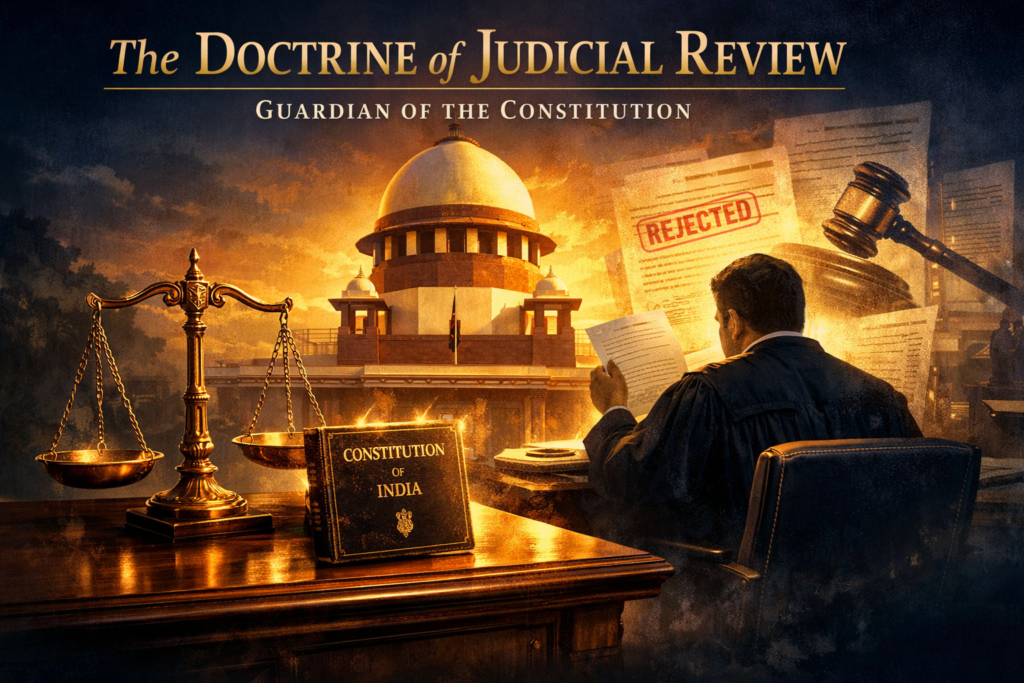
The Doctrine of Judicial Review: Guardian of the Constitution
Author: Vikas
Student, Kcc Institute of Legal and Higher Education
———————————————————————————————-
3 Quick Takeaways
- Judicial review, originating in Marbury v. Madison (1803), is the judiciary’s power to declare legislative and executive actions unconstitutional and serves as the foundational mechanism for maintaining constitutional supremacy and the separation of powers.
- In India, the scope of judicial review was significantly deepened by the Basic Structure Doctrine introduced in Kesavananda Bharati v. State of Kerala (1973), which holds that Parliament cannot amend the Constitution in ways that destroy its essential framework.
- Judicial review operates in a dynamic tension between judicial activism, which expands its scope to promote social justice and fundamental rights, and judicial restraint, which ensures courts do not overstep into the domain of elected branches of government.
Abstract
The doctrine of judicial review is a cornerstone of constitutional law that empowers the judiciary to examine the validity of legislative enactments, executive actions, and government policies to ensure their conformity with the Constitution. It acts as a vital safeguard for constitutional supremacy, fundamental rights, and the rule of law. Judicial review ensures that no law or executive action can exceed the powers granted by the Constitution, thereby maintaining the balance between different organs of the state and preventing arbitrary or unlawful state action.
The origin of judicial review is traced to the landmark United States Supreme Court case Marbury v. Madison (1803), in which Chief Justice John Marshall asserted the Court’s authority to declare legislative acts unconstitutional. This case established that the judiciary has the power to interpret the Constitution and ensure that the legislature and executive do not act beyond their constitutional limits. Judicial review thus serves as a crucial instrument for upholding the principles of separation of powers, checks and balances, and the protection of individual liberties.
In India, the doctrine of judicial review was incorporated into the constitutional framework under Articles 13, 32, 131 to 136, 143, and 226, among others. Its scope was significantly enhanced through judicial decisions. The landmark case Kesavananda Bharati v. State of Kerala (1973) introduced the Basic Structure Doctrine, which limited Parliament’s power to amend the Constitution in ways that could destroy or alter its fundamental framework. Through this doctrine, judicial review ensures that the essential features of the Constitution, such as democracy, secularism, federalism, separation of powers, and fundamental rights, remain inviolable.
Judicial review performs multiple functions in a democratic governance system. It upholds constitutional supremacy by ensuring that all laws conform to constitutional provisions, protects fundamental rights by striking down laws or actions that violate citizens’ freedoms, maintains the separation of powers by acting as a check on legislative and executive overreach, and strengthens the rule of law by preventing arbitrary or unlawful use of authority.
Over time, judicial review has evolved as a dynamic tool for social justice, administrative accountability, and constitutional protection. Courts have expanded its scope to include not only legislative acts but also administrative orders, policies, and even quasi-legislative actions. By interpreting the Constitution in light of changing social, political, and economic conditions, judicial review ensures that the Constitution remains a living document capable of guiding governance and protecting citizens’ rights in a modern democracy.
Keywords: Constitutional check; Judicial control; Separation of powers; Rule of law; Fundamental rights.
Introduction
The doctrine of judicial review is one of the most important principles of constitutional law, serving as a foundation for the rule of law and the protection of constitutional supremacy. Judicial review empowers the judiciary to examine and, if necessary, invalidate legislative enactments, executive actions, or government policies that conflict with the Constitution. It ensures that no branch of government exceeds the powers granted to it, maintaining the balance between the legislature, the executive, and the judiciary. This doctrine is essential in safeguarding citizens’ fundamental rights, preventing arbitrary or unlawful state action, and upholding the principles of democracy and constitutionalism.
The origin of judicial review is most famously traced to the landmark United States case Marbury v. Madison (1803), in which Chief Justice John Marshall established the principle that the Supreme Court has the authority to declare acts of Congress unconstitutional. This case laid the foundation for the judiciary as the guardian of the Constitution and established the doctrine as a vital instrument of checks and balances in democratic governance. Judicial review ensures that the legislature and executive remain within the limits of constitutional authority, thereby preventing misuse of power and protecting the rights of citizens.
In India, the doctrine of judicial review is enshrined in the Constitution through various provisions, including Articles 13, 32, 131 to 136, 143, and 226. The judiciary has actively interpreted these provisions to strengthen its role in reviewing legislative and executive actions. A landmark moment in Indian constitutional history was Kesavananda Bharati v. State of Kerala (1973), which introduced the Basic Structure Doctrine. This doctrine limits Parliament’s power to amend the Constitution in ways that would destroy or alter its essential features, ensuring that core constitutional principles such as democracy, secularism, federalism, and fundamental rights remain protected.
The functions of judicial review are multifaceted. It upholds the supremacy of the Constitution by ensuring all laws conform to it, protects fundamental rights from infringement, maintains the separation of powers among the organs of government, and strengthens the rule of law by preventing arbitrary actions. Over time, the scope of judicial review has expanded beyond merely examining legislative acts to include administrative actions, executive policies, and quasi-legislative measures. Courts interpret constitutional provisions in light of contemporary social, political, and economic challenges, ensuring that the Constitution evolves as a living document.
Meaning and Origin of Judicial Review
Judicial review is a fundamental principle in constitutional law that empowers the judiciary to examine and assess the constitutionality of legislative acts, executive actions, or government policies. If a law or government action is found to violate the Constitution, the judiciary has the authority to declare it null and void. Judicial review essentially acts as a check on the powers of the legislature and executive, ensuring that all branches of government operate within the limits set by the Constitution. It also protects individual rights and maintains the supremacy of the Constitution in a democratic system.
The doctrine is most famously associated with the United States, where it was formally established in Marbury v. Madison (1803). In this case, Chief Justice John Marshall asserted that it is “emphatically the province and duty of the judicial department to say what the law is,” thereby giving the judiciary the authority to strike down laws that conflict with the Constitution. This decision laid the foundation for judicial review as an essential mechanism of checks and balances within the American constitutional system.
Although its origins are often traced to the United States, the concept of judicial review has been adopted and adapted in many countries around the world, including India, Canada, and Australia, though with variations depending on their legal and constitutional frameworks. In India, judicial review is considered a basic feature of the Constitution, allowing courts to protect fundamental rights and prevent the abuse of legislative and executive power.
The doctrine embodies the principles of accountability, separation of powers, and rule of law. By providing the judiciary the power to review and nullify unconstitutional actions, it ensures that no branch of government exceeds its constitutional authority. It is a cornerstone of modern constitutional democracies, safeguarding citizens against arbitrary governance and reinforcing the supremacy of the Constitution.
Judicial Review in Different Jurisdictions
United States
In the United States, judicial review flows from the supremacy of the Constitution. Courts can invalidate federal and state laws that conflict with constitutional provisions. Over time, the United States Supreme Court has used judicial review to address civil rights, separation of powers, and federalism disputes.
In Brown v. Board of Education (1954), for example, the Court declared racial segregation in public schools unconstitutional, marking a turning point in civil rights jurisprudence. Judicial review thus became an instrument of social transformation.
India
In India, judicial review is explicitly recognised under Articles 13, 32, and 226 of the Constitution. The Supreme Court and High Courts possess the authority to examine the validity of legislative and executive actions.
A significant development occurred in Kesavananda Bharati v. State of Kerala (1973), where the Supreme Court propounded the Basic Structure Doctrine. The Court held that while Parliament has wide powers to amend the Constitution, it cannot alter its basic structure. This doctrine strengthened judicial review by extending its reach to constitutional amendments themselves.
Later, in Minerva Mills Ltd. and Ors. v. Union of India and Ors. (1980), the Court reaffirmed that the limited amending power of Parliament is itself part of the Constitution’s basic structure.
Constitutional Foundations
The doctrine of judicial review is firmly rooted in constitutional principles, serving as a mechanism to ensure that all laws and government actions conform to the Constitution. Its foundation lies in the supremacy of the Constitution, the separation of powers, and the protection of fundamental rights. By granting courts the authority to examine and invalidate unconstitutional legislation or executive acts, the doctrine ensures that no organ of government acts beyond its constitutional limits.
In the United States, the foundation of judicial review was established in Marbury v. Madison (1803), where Chief Justice John Marshall asserted that the judiciary has the ultimate authority to interpret the Constitution and nullify laws inconsistent with it. Judicial review is directly tied to the supremacy clause of the United States Constitution, which establishes the Constitution as the highest law of the land.
In India, the constitutional basis for judicial review is explicitly provided under Articles 13, 32, 131 to 136, and 226. Article 13 declares that any law inconsistent with fundamental rights is void, establishing judicial review over legislative actions. Articles 32 and 226 empower the Supreme Court and High Courts to issue writs for the enforcement of fundamental rights. The Basic Structure Doctrine, evolved through judicial interpretation, reinforces that judicial review cannot be undermined even by constitutional amendments, thereby protecting the core features of the Constitution.
Globally, constitutions in countries such as Canada, Australia, and Germany incorporate judicial review either explicitly or through principles ensuring constitutional supremacy. In all these systems, the foundation of judicial review lies in maintaining constitutional governance, the rule of law, and accountability of the legislature and executive to the Constitution.
In essence, the constitutional foundation of judicial review is embedded in the supremacy of the Constitution, the need for a system of checks and balances, and the protection of citizens’ fundamental rights. It transforms the judiciary into the guardian of the Constitution, ensuring that governance remains within the limits prescribed by the constitutional framework and that the rights of individuals are never compromised by arbitrary state action.
Grounds for Judicial Review
Judicial review is the power of the judiciary to examine legislative enactments, executive actions, and administrative decisions to ensure their conformity with the Constitution. Courts exercise this power on specific grounds, which determine when a law, action, or policy can be challenged as unconstitutional or unlawful.
Violation of the Constitution: The primary ground for judicial review is that a law or executive action violates a constitutional provision. If a legislative enactment or executive order conflicts with the Constitution, courts have the authority to declare it void. In India, Articles 13 and 32 provide citizens and courts the power to challenge unconstitutional laws. The United States case Marbury v. Madison (1803) established that the judiciary can nullify acts of the legislature that are inconsistent with the Constitution, a principle widely followed across democratic nations.
Violation of Fundamental Rights: Judicial review protects individuals’ fundamental rights. If any law or executive action infringes upon rights guaranteed under Part III of the Indian Constitution, the courts can strike it down. This ensures that citizens’ liberties, such as the right to equality, freedom of speech, and personal liberty, are not arbitrarily violated. In Maneka Gandhi v. Union of India (1978), the Supreme Court used judicial review to uphold the right to personal liberty under Article 21.
Excess or Abuse of Power (Ultra Vires): Courts can review actions that exceed the authority granted to a legislature or executive, known as acting ultra vires. Any action taken beyond legal or constitutional powers can be declared invalid, preventing arbitrary governance and ensuring that no organ of the state acts beyond its jurisdiction.
Violation of the Basic Structure of the Constitution: In India, judicial review can also be exercised if a constitutional amendment or legislative act violates the Basic Structure Doctrine. As established in Kesavananda Bharati v. State of Kerala (1973), Parliament cannot amend the Constitution in a way that destroys its core features, such as democracy, federalism, secularism, separation of powers, and fundamental rights.
Procedural Impropriety: Judicial review can be invoked if proper procedures mandated by the Constitution or law are not followed in making legislation or executing executive actions. Non-compliance with prescribed procedures may render the action invalid.
Arbitrariness or Unreasonableness: Courts may review laws or executive actions that are arbitrary, irrational, or unreasonable. This includes decisions that are discriminatory, oppressive, or that violate the principle of natural justice.
Judicial Activism
Judicial activism refers to the approach where courts actively interpret the Constitution and laws to protect rights, enforce social justice, and ensure the government acts within constitutional limits. In the context of the doctrine of judicial review, judicial activism goes beyond merely striking down unconstitutional laws: it involves proactively shaping policies, safeguarding fundamental rights, and sometimes filling legislative or executive gaps when public interest demands it. It reflects a dynamic role of the judiciary in upholding the spirit of the Constitution rather than rigidly adhering to literal interpretations.
The doctrine of judicial review empowers the judiciary to examine the constitutionality of legislative and executive actions. Judicial activism strengthens this doctrine by allowing courts to intervene in matters where fundamental rights, social justice, or the rule of law are at stake. In India, the Supreme Court has used judicial activism extensively under Articles 32 and 226 of the Constitution to enforce rights and address issues such as environmental protection, corruption, and public interest litigation. Landmark cases like Maneka Gandhi v. Union of India and Vishaka v. State of Rajasthan (1997) demonstrate judicial activism in enforcing human rights and filling gaps where legislation was silent or inadequate.
Judicial activism in the context of judicial review reflects a necessary balance: while courts respect the separation of powers, they do not remain passive when fundamental rights are threatened or when government action is arbitrary or unconstitutional. Critics argue that it may lead to judicial overreach, but supporters see it as necessary for a vibrant democracy where laws must evolve with social needs.
In essence, judicial activism expands the practical impact of judicial review by making it a tool not only for legal correction but also for social and constitutional transformation. It reinforces the judiciary’s role as the guardian of the Constitution, ensuring that both legislative and executive powers remain accountable, while protecting citizens’ rights and promoting justice in society.
Judicial Restraint
Judicial restraint refers to the principle that courts should exercise caution in the use of their power of judicial review, ensuring that they do not overstep their constitutional role or encroach upon the legitimate domains of the legislature and executive. While judicial review empowers courts to strike down laws or actions that violate the Constitution, it is not an absolute power. Judicial restraint helps maintain the balance of power and ensures respect for the principle of separation of powers in a democracy.
Several considerations guide the exercise of this restraint. Courts generally avoid interfering with policy decisions that fall within the legitimate discretion of the legislature or executive, particularly in areas such as defence, foreign policy, or economic planning. Certain matters are considered “political questions,” such as the appointment of political officials or internal decisions of the legislature, which courts refrain from reviewing so as to maintain institutional balance. Courts also respect established legal precedents and prior legislative intent, limiting judicial review to clear violations of the Constitution. Judges may exercise self-restraint to avoid substituting their own opinions for those of elected bodies, intervening only when laws clearly contravene constitutional provisions. Courts may additionally decline to exercise review when procedural rules, limitation periods, or jurisdictional constraints have not been satisfied.
In India, judicial restraint is reflected in doctrines that protect constitutional supremacy without crossing into policy-making. In the United States, judicial review is similarly tempered by the political question doctrine and principles of federalism.
Limitations of Judicial Review
While judicial review is an indispensable feature of constitutional governance, it is not without criticism or limitation. Excessive judicial interference in policy matters can blur the separation of powers and lead to concerns of judicial overreach, with courts perceived as substituting their judgment for that of elected bodies on matters of legislative or executive policy. Additionally, judicial processes can be time-consuming, and delays in adjudication may impede governance and slow the implementation of necessary reforms.
These concerns do not diminish the importance of judicial review, but they do underscore the importance of exercising this power judiciously. Most constitutional democracies recognise judicial review as indispensable precisely because, when properly applied with restraint and principled reasoning, it remains the most reliable safeguard against unconstitutional governance.
Judicial Review in the Contemporary Era
In recent decades, judicial review has expanded to address emerging issues such as environmental protection, digital privacy, and electoral reforms. Courts increasingly confront complex constitutional questions involving technology, national security, and global governance.
Public Interest Litigation, particularly in India, has widened access to justice, allowing courts to address systemic issues affecting disadvantaged communities. Through PIL, individuals and organisations have been able to invoke judicial review on behalf of those who may otherwise lack access to the courts, making the doctrine a more inclusive and participatory instrument of constitutional governance.
The judiciary’s role continues to evolve in response to societal changes and constitutional challenges, affirming judicial review as a dynamic and adaptive doctrine rather than a static one.
Conclusion
The doctrine of judicial review is a cornerstone of constitutional governance, ensuring that the Constitution remains the supreme law of the land. By empowering the judiciary to examine the constitutionality of legislative and executive actions, it safeguards the rule of law, protects fundamental rights, and maintains the balance of power among the branches of government. Judicial review embodies the principle of checks and balances, preventing any abuse or excess of authority by the legislature or executive.
Over time, the application of judicial review has evolved to meet the needs of a dynamic society. Through judicial activism, courts have interpreted constitutional provisions expansively to promote social justice, protect marginalised groups, and address public interest concerns. In India, judicial review has been instrumental in enforcing rights, regulating government actions, and addressing gaps where legislation is silent or inadequate. At the same time, judicial review operates within the bounds of judicial restraint, respecting the discretion of elected bodies, observing the political question doctrine, and adhering to procedural limits. This balance prevents judicial overreach and ensures that courts do not substitute their views for policy decisions rightly entrusted to the legislature or executive.
The doctrine’s origin in the United States, through Marbury v. Madison (1803), set a precedent for the global acceptance of judicial review, influencing many constitutions worldwide. Its adoption has allowed democracies to remain flexible yet accountable, providing citizens a mechanism to challenge arbitrary or unconstitutional actions. By combining both activism and restraint, judicial review serves as a dynamic instrument that evolves with societal needs while remaining rooted in constitutional supremacy.
The doctrine of judicial review is more than a legal tool: it is a guardian of democracy. It ensures that the government functions within constitutional boundaries, protects individual freedoms, and upholds justice. While courts must exercise this power judiciously to avoid overreach, judicial review remains indispensable for preserving the integrity of the Constitution, reinforcing the rule of law, and fostering a just, accountable, and equitable society.
End Notes
- Marbury v. Madison, 5 U.S. (1 Cranch) 137 (1803) (United States Supreme Court).
- Kesavananda Bharati Sripadagalvaru v. State of Kerala, (1973) 4 S.C.C. 225 (India).
- Minerva Mills Ltd. and Ors. v. Union of India and Ors., (1980) 3 S.C.C. 625 (India).
- Maneka Gandhi v. Union of India, (1978) 1 S.C.C. 248 (India).
- Vishaka and Ors. v. State of Rajasthan and Ors., (1997) 6 S.C.C. 241 (India).
- Brown v. Board of Education, 347 U.S. 483 (1954) (United States Supreme Court).
Disclaimer: The views expressed in this article are those of the author and do not necessarily reflect the views of The Lawscape.
The Lawscape — clear, practical legal insight for students and future lawyers.