
Dolly Rani v. Manish Kumar Chanchal (2024): When a Certificate Is Not a Marriage
Author: Niharika Mishra
Student, KES Shri Jayantilal H. Patel Law College
—————————————————————————–
💡 3 Quick Takeaways
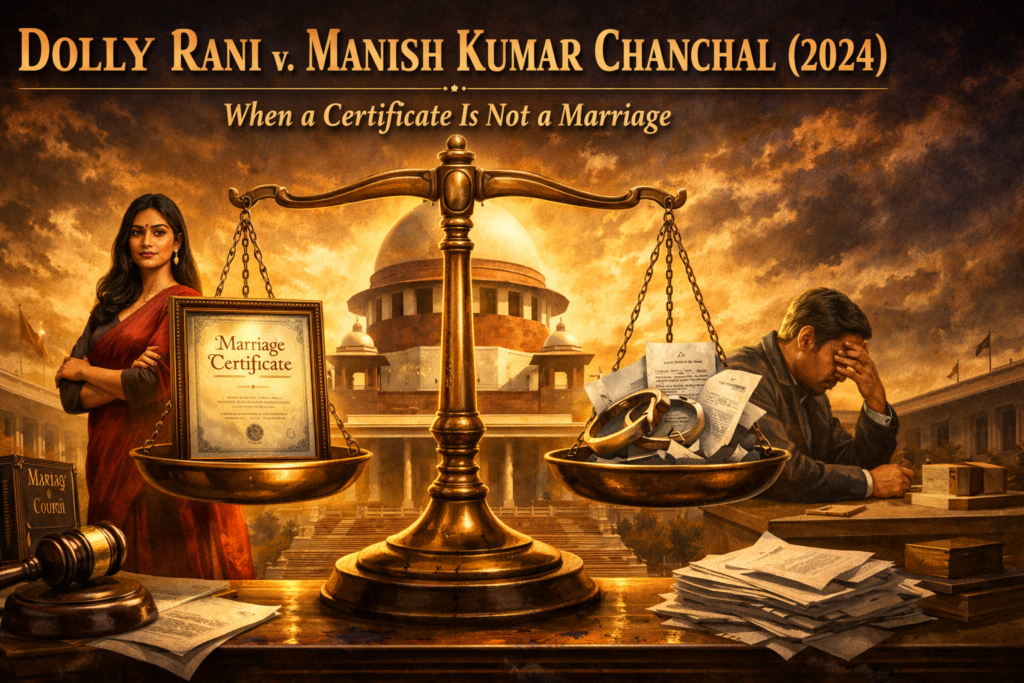
1. A Hindu marriage is not valid unless the essential ceremonies under Section 7 of the Hindu Marriage Act, 1955 are performed — a certificate from a private organisation or a registration entry is not a substitute for ceremonial solemnisation.
2. Where no valid marriage exists in law, a petition for divorce under the Hindu Marriage Act cannot be maintained — you cannot dissolve a marriage that was never legally constituted.
3. The Supreme Court exercised its extraordinary jurisdiction under Article 142 of the Constitution to declare the marriage null and void and quash all related proceedings, ensuring complete and final resolution of the dispute.
Case Title: Dolly Rani v. Manish Kumar Chanchal
Citation: 2024 INSC 355
Court: Supreme Court of India
Bench: Justice B.V. Nagarathna and Justice Augustine George Masih
Date of Judgment: 19 April 2024
Parties:
- Appellant/Petitioner: Dolly Rani
- Respondent: Manish Kumar Chanchal
Introduction
Dolly Rani v. Manish Kumar Chanchal is a recent Supreme Court judgment that clarifies a fundamental requirement of Hindu marriage law — that ceremonial solemnisation under Section 7 of the Hindu Marriage Act, 1955 is not a formality but a legal necessity. The case arose from a matrimonial dispute between two commercial pilots and came before the Supreme Court initially as a transfer petition. It ultimately became the occasion for the Court to declare the alleged marriage void and to exercise its extraordinary powers under Article 142 of the Constitution to bring all related litigation to a close.
The judgment is significant because it addresses a growing practice of couples obtaining marriage certificates from private organisations and registering marriages without having performed the required religious ceremonies — a practice the Court clearly held to be legally insufficient.
Facts of the Case
Both Dolly Rani and Manish Kumar Chanchal are commercial pilots. Dolly approached the Supreme Court under Section 25 of the Code of Civil Procedure seeking transfer of a divorce petition filed by Manish before the Family Court at Muzaffarpur, Bihar, to the Family Court at Ranchi, Jharkhand.
The parties became engaged on 7 March 2021 and claimed to have married on 7 July 2021. They obtained a marriage certificate from an organisation called Vadik Jankalyan Samiti and subsequently registered their marriage under the applicable Uttar Pradesh rules. However, both families had planned and agreed to hold the formal wedding ceremony on 25 October 2022, which suggested that the July 2021 event was not understood by either side to constitute a complete ceremonial marriage under Hindu law.
Before the planned ceremony could take place, the relationship broke down. Dolly filed a criminal complaint on 17 November 2022, alleging dowry demands, cruelty, cheating, and criminal intimidation against Manish and his family members under the Indian Penal Code and the Dowry Prohibition Act. Manish subsequently filed a divorce petition in March 2023 before the Family Court at Muzaffarpur under Section 13(1)(ia) of the Hindu Marriage Act, 1955, alleging cruelty.
While the transfer petition and divorce proceedings were pending, both parties arrived at a mutual settlement and filed a joint application before the Supreme Court under Article 142 of the Constitution, requesting that the Court exercise its special powers to bring all disputes to a final close.
Issues Raised
- Whether the parties had contracted a valid marriage under the Hindu Marriage Act, 1955, specifically whether the essential ceremonies required under Section 7 of the Act had been performed.
- Whether, in the absence of a valid marriage, the respondent’s divorce petition under the Hindu Marriage Act was legally maintainable.
- Whether the Supreme Court could, under Article 142 of the Constitution, declare the marriage invalid and quash all related legal proceedings.
- What legal weight, if any, attaches to a marriage certificate issued by a private organisation and a subsequent registration entry, in the absence of ceremonial solemnisation.
Arguments of the Parties
Petitioner (Dolly Rani)
The petitioner contended that the marriage of 7 July 2021 was not legally valid because the essential religious ceremonies required under Section 7 of the Hindu Marriage Act, 1955 had not been performed. She submitted that the certificate issued by Vadik Jankalyan Samiti did not establish the validity of a marriage — it merely evidenced that an event had taken place, which did not satisfy the legal requirements for a Hindu marriage.
The petitioner further pointed to the fact that both families had agreed to hold the formal ceremonial wedding on 25 October 2022 as evidence that the July 2021 event was not intended or understood as a complete and valid marriage ceremony. She also submitted that litigating at Muzaffarpur caused her significant inconvenience and sought transfer of the proceedings to Ranchi.
Respondent (Manish Kumar Chanchal)
The respondent had initially filed for divorce on the ground of cruelty. However, before the Supreme Court, he acknowledged the serious questions surrounding the validity of the marriage. He ultimately agreed with the petitioner that the marriage had not been validly solemnised and joined her in filing a joint application under Article 142 of the Constitution requesting the Court to quash all pending proceedings and bring the dispute to a final resolution.
Judgment
The Supreme Court examined the facts and the legal requirements governing Hindu marriages and held that solemnisation through the performance of essential religious ceremonies is a mandatory requirement under Section 7 of the Hindu Marriage Act, 1955. The Court observed that the parties had obtained a certificate from a private organisation and registered their marriage, but there was no evidence that the necessary religious ceremonies had actually been performed. Without such ceremonies, no valid marriage came into existence under Hindu law.
The Court accordingly held that the alleged marriage of 7 July 2021 was not a legally valid marriage and that the parties had never acquired the legal status of husband and wife. Since the marriage was void, the divorce petition filed under the Hindu Marriage Act was not legally maintainable — one cannot seek dissolution of a marriage that was never constituted in law.
Exercising its extraordinary jurisdiction under Article 142 of the Constitution, the Supreme Court declared the marriage certificate issued by Vadik Jankalyan Samiti and the subsequent registration certificate to be null and void. It also quashed all pending proceedings between the parties — including the divorce petition before the Family Court at Muzaffarpur, the maintenance proceedings filed by the petitioner at Ranchi, and the criminal proceedings initiated by the petitioner against the respondent and his family members. The Court thereby ensured a complete and final resolution of the entire dispute.
Ratio Decidendi
The core principle established by this judgment is that a Hindu marriage derives its legal validity from the performance of essential ceremonies and customary rites, not from the issuance of a certificate or a registration entry. Section 7 of the Hindu Marriage Act, 1955 requires that a Hindu marriage be solemnised in accordance with the customary rites and ceremonies of either party. Where those ceremonies have not been performed, the marriage has no legal existence regardless of any documentation that may have been obtained.
The Court also addressed a growing practice of couples obtaining certificates from private organisations as a substitute for ceremonial solemnisation. Such certificates, the Court made clear, do not constitute proof of a valid marriage and cannot be treated as conferring the legal status of husband and wife.
The judgment further illustrates the scope of the Supreme Court’s power under Article 142 of the Constitution to do complete justice. Where all related proceedings arise from an underlying dispute that the parties have mutually agreed to resolve, the Court may exercise this power to bring all litigation to a conclusive end — sparing the parties from prolonged and multiplying court proceedings.
Conclusion
Dolly Rani v. Manish Kumar Chanchal reinforces a fundamental principle of Hindu marriage law that ceremony is not merely a tradition but a legal requirement. The Supreme Court’s judgment leaves no room for ambiguity — a marriage certificate from a private organisation or a registration entry is not a valid substitute for the ceremonial solemnisation required under Section 7 of the Hindu Marriage Act, 1955.
The judgment also highlights the breadth of the Supreme Court’s jurisdiction under Article 142 of the Constitution. By declaring the marriage void and quashing all related proceedings in a single order, the Court delivered complete justice and prevented the continuation of overlapping litigation arising from the same underlying dispute. The decision serves as a clear reminder to parties who may be unaware that informal certificates and registration entries do not create a legally recognised marriage under Hindu law.
Disclaimer: The views expressed in this article are those of the author and do not necessarily reflect the views of The Lawscape.
The Lawscape — clear, practical legal insight for students and future lawyers