
Guardians of the Purity: Role of the Election Commission and Constitutional Integrity
Author: Uthraa R. B.
Student, Saveetha School of Law Saveetha Institute of Medical and Technical Sciences (SIMATS), Saveetha University, Chennai
—————————————————————————————————————-
“WE VOTE NOT TO SEE CHANGE IN A DAY BUT THAT ONE DAY IT’LL ALL CHANGE”
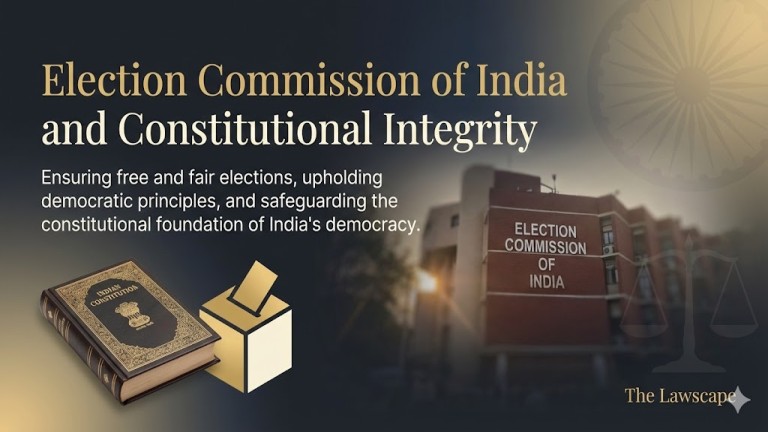
The democratic ideology of India, embodied in the Preamble as a Sovereign, Socialist Secular, Democratic Republic, is most tangibly and repeatedly expressed through elections. The central figure of this process is the Election Commission of India (ECI), an independent and permanent constitutional authority established to convert the idealistic vision of the Constitution into the practical reality of contemporary governance. The Election Commission is not merely an administrative body; it represents a critical exercise in the interpretation and preservation of constitutional values, specifically the principle of constitutional integrity, according to which the democratic process must remain pure, unbiased, and trustworthy.
The authority of the Election Commission is anchored in Article 324 of the Constitution of India, which grants the Commission the power of superintendence, direction, and control of elections. This provision has been deliberately phrased broadly and has been interpreted by the Supreme Court as conferring a reservoir of residuary powers. This interpretation implies that even in the absence of explicit statutory provisions, the Election Commission may take all necessary measures to ensure the conduct of free and fair elections.
These powers reflect three fundamental constitutional values. First, they uphold sovereignty and democracy by ensuring periodic and authentic elections through which the will of the people is expressed. The erosion of the effectiveness of the Election Commission would directly compromise the democratic character of the Republic, as the sanctity of the ballot constitutes the ultimate test of popular sovereignty. Second, they ensure impartiality and independence. The constitutional design safeguarding the tenure of the Chief Election Commissioner, which is comparable to that of a Supreme Court judge in terms of removal, secures functional independence from the executive. This independence allows the Commission to function as a neutral arbiter, insulated from political pressures. Third, they reinforce the rule of law. Through its directives, particularly in areas insufficiently covered by the Representation of the People Acts, the Election Commission ensures that electoral contests are conducted in accordance with legal principles rather than political expediency.
Within the electoral framework, constitutional integrity refers to safeguarding elections from corruption arising from money power, muscle power, and the misuse of state machinery. To enforce this integrity, the Election Commission employs various mechanisms. A prominent example is the Model Code of Conduct (MCC), which has evolved through consensus and sustained practice. Though lacking statutory backing, the MCC derives authority from Article 324 of the Constitution. It ensures a level playing field by preventing ruling parties from misusing state resources, curbing inflammatory speeches based on caste or religion, and restricting last-minute governmental announcements aimed at voter manipulation.
Further, the Election Commission actively addresses the challenges of criminalisation and the influence of money in politics. By mandating disclosure of criminal antecedents and assets of candidates, the Commission upholds the voter’s right to information, recognized by the Supreme Court as a facet of freedom of speech under Article 19(1)(a) of the Indian Constitution. This enables voters to make informed electoral choices. The Commission also undertakes expenditure monitoring through observers and surveillance teams to curb the influence of unaccounted money in elections. Measures to prevent voter inducement, including restrictions on the distribution of liquor, cash, and other incentives, further protect the integrity of the franchise.
Additionally, the Election Commission is responsible for delimitation and the maintenance of the purity of electoral rolls. Through periodic realignment of constituencies and accurate voter registration, the principle of “one person, one vote, one value” under Article 326 is upheld. Efforts to correct discrepancies, eliminate duplications, and ensure inclusivity through special drives for disadvantaged and marginalised groups are ongoing constitutional obligations aimed at preserving electoral equality.
In the contemporary digital age, the Election Commission faces new challenges. The spread of digital misinformation and malicious content on social media threatens informed suffrage. The Commission must interpret its constitutional mandate to address the digital electoral space, while carefully balancing freedom of speech with the necessity of preventing interference in the electoral process. Simultaneously, concerns regarding Electronic Voting Machines (EVMs) and Voter Verifiable Paper Audit Trail (VVPAT) systems have raised issues of public trust. Ensuring transparency, procedural safeguards, and public awareness regarding electoral technology is essential to maintaining confidence in election outcomes.
Another unresolved issue is the transparency of electoral funding. Certain funding mechanisms lack sufficient openness, raising constitutional concerns of accountability. Despite judicial scrutiny and advocacy by the Election Commission, comprehensive legislative reform in this area remains pending. The Commission must continue to push for legislative changes to ensure political financing adheres to constitutional standards of transparency and democratic fairness.
To remain an effective guardian of democracy in the twenty-first century, the Election Commission must be further strengthened. This includes reforms to enhance institutional independence through a transparent and consultative appointment process for Election Commissioners, statutory backing for the Model Code of Conduct to enable enforcement beyond moral censure, and legislative clarification of Article 324 to address emerging concerns such as internal party democracy and financial accountability.
Ultimately, the Election Commission of India is far more than an administrative body; it is the constitutional conscience keeper of Indian democracy. Through its dynamic interpretation and vigilant exercise of powers under Article 324, the Commission ensures the realisation of the constitutional promise that governance shall be conducted with integrity, fairness, and impartiality. The health and resilience of Indian democracy are therefore intrinsically linked to the strength, independence, and credibility of the Election Commission.
** Disclaimer: The views expressed in this article are those of the author and do not necessarily reflect the views of The Lawscape.
The Lawscape — clear, practical legal insight for students and future lawyers.
This is a most impressive chronicle of our nation’s governing principles. The writer hath captured the vital role of the Election Commission with a steady and scholarly hand. By blending formal gravity with clear insight, they have shed light upon the very soul of the Republic.
This review of the electoral process is written with both wisdom and grace, making complex laws accessible to all. The author’s pen is sharp, and their analysis is most profound. I offer my sincere praise for such a well constructed and informative work.