
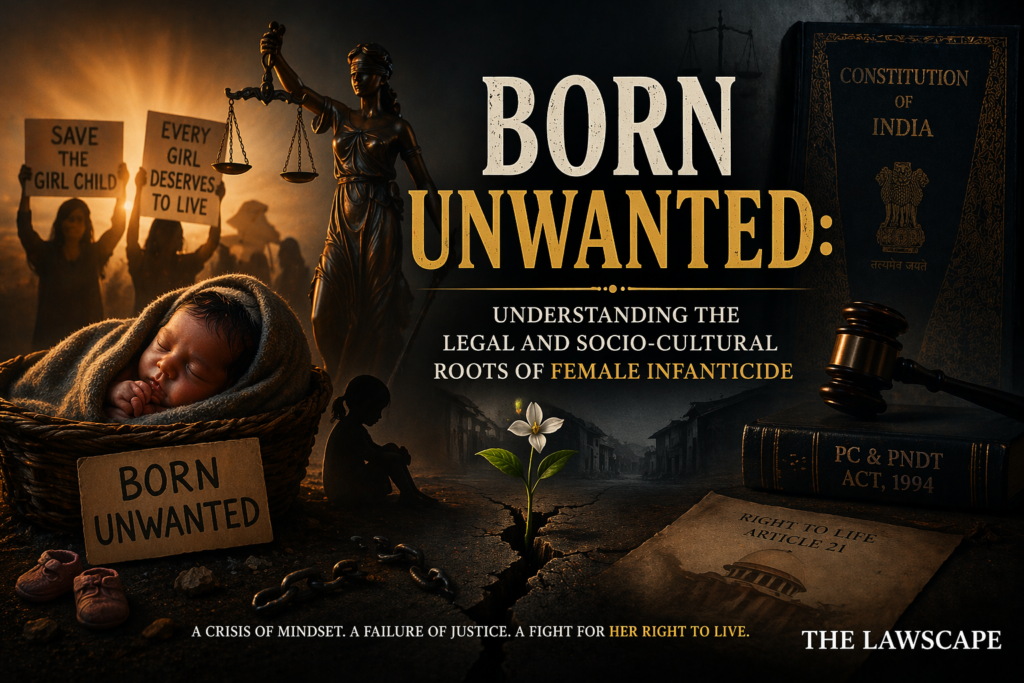
Born Unwanted: Understanding the Legal and Socio-Cultural Roots of Female Infanticide
Author: Niharika Mishra
Student, KES’s Shri Jayantilal H. Patel Law College, Mumbai
————————————————————————————-
3 Quick Takeaways
Female infanticide and sex-selective practices are not merely cultural relics but active constitutional violations, breaching the right to life under Article 21, equality under Article 14, and India’s international human rights obligations.
While legislation such as the PC&PNDT Act, 1994 and the MTRPA, 1971 provide a strong legal framework, enforcement remains inconsistent, with few convictions relative to the scale of the problem.
Ending female infanticide requires more than strict laws: it demands a fundamental shift in societal attitudes toward the value of girls, backed by sustained judicial oversight, community awareness, and structural reform.
“Female infanticide is a crime against humanity.”
~ Amartya Sen
Female infanticide is the deliberate killing of newborn girls because people value boys more than girls. This is not a new problem: it has existed across different cultures and time periods. Families, particularly in places where practices like the dowry system are deeply entrenched, often perceive daughters as a financial burden. That kind of thinking steals away a girl’s most basic right: the right to live.
This is not merely a matter of individual tragedies. When girls are killed simply for being girls, it disrupts the natural balance between men and women in society, giving rise to far larger problems. It is a clear violation of human rights and leaves lasting scars on entire communities.
Some governments, including India’s, have responded with strict laws and campaigns to protect girls, pushing for education, women’s rights, and other social reforms. But laws alone do not solve everything. Real change happens when people begin to see girls as equals rather than burdens. It requires a shift in how society thinks and acts: standing up for girls, creating opportunities for them, and ensuring that every child, regardless of gender, gets to live with dignity and hope.
Keywords: Foeticide; Infanticide; Violation of human rights; Killed.
Introduction
“It is a violation of human rights when baby girls are denied food, or drowned, or suffocated, or their spines broken simply because they are born girls.”
~ Hillary Clinton
Female Infanticide vs. Sex-Selective Abortion
The intentional killing of newborn girls is known as female infanticide, and it is typically motivated by deeply ingrained cultural, patriarchal, or financial preferences for male offspring. It is a form of gender-based violence that occasionally takes the shape of outright homicide, neglect, or starvation, and is frequently rooted in beliefs that women are inferior or a financial burden.
Sex-selective abortion involves terminating a pregnancy based on the anticipated sex of the child, primarily targeting female foetuses. This practice is closely associated with female infanticide and has been condemned by numerous human rights organisations as a form of violence against women.
Female infanticide is not a recent problem: it has existed for centuries, appearing across diverse societies and time periods. Even ancient civilisations such as Greece and Rome sometimes tolerated the abandonment or killing of infants, particularly girls. Economic hardship played a significant part, as did inheritance laws that favoured male heirs. Daughters were often seen as additional mouths to feed rather than future contributors to the family. In these patriarchal societies, girls were routinely treated as burdens, normalising such discrimination across generations.
History records the same pattern in pre-Islamic Arabia, where some tribes buried their newborn daughters alive, driven by concerns about family honour, poverty, or social shame. Later, major religious reforms condemned these killings outright, drawing a clear moral line. Over time, this son preference became intertwined with dowry demands, strict inheritance laws, and restrictions on women’s freedom, stacking the odds against girls and entrenching a culture of discrimination.
When the British colonial administration began maintaining records, it noticed a troubling pattern of missing girls, particularly in parts of northwestern India. Colonial officials documented communities where female infanticide appeared routine. Laws were enacted to prohibit it, and mechanisms for surveillance and punishment were established. Many of these efforts, however, operated more as exercises in colonial control than as genuine attempts to address the underlying causes, such as the dowry system, property rights, and poverty.
Then, in the late twentieth century, advances in medical technology changed how this discrimination played out. With ultrasound and prenatal diagnostic tests, families could determine the sex of a child before birth. Rather than resorting to infanticide, many turned to sex-selective abortion, distorting the natural sex ratio even further. The methods changed, but the mindset did not.
Tamil Nadu illustrates how a government can respond to this crisis. From the mid-1980s onwards, reports of widespread infanticide in certain districts sparked public outrage and compelled official intervention. The state introduced programmes aimed at stopping the killing of newborn girls, some allowing parents to surrender unwanted baby girls safely, others offering financial incentives to families to value daughters. Unlike earlier laws that focused purely on punishment, these initiatives treated female infanticide as a social and public health emergency.
The National Family Health Survey (NFHS-5, 2019-21) found that for every 1,000 boys born in India, only 929 girls were born: a clear indicator that gender imbalance at birth remains a serious concern. By 2023, the overall sex ratio had improved to 1,020 females for every 1,000 males, which appears encouraging, but that progress does not erase the persistent gap at birth.
Haryana serves as a stark example. The state has long struggled with gender bias, and in 2024, the sex ratio at birth dropped to 910 girls per 1,000 boys, the lowest in eight years. Only after authorities intensified enforcement did the figure edge up to 923 girls per 1,000 boys in 2025.
Delhi tells a similar story. The city’s sex ratio at birth fell to 920 females per 1,000 males in 2024, marking the fourth consecutive year of decline. This is a significant warning sign, particularly as it suggests that illegal prenatal sex determination continues to take place.
Looking at the historical trajectory, what began as a deeply rooted cultural practice has gradually come to be treated as a crime, entangled today with complex legal, social, and demographic dimensions. Discrimination has simply taken new forms, from hidden neglect to prenatal sex selection. If real change is to be achieved, laws must do more than prohibit the act itself. They must address the deeper reasons families continue to choose sons over daughters.
Does Female Infanticide, as a Manifestation of Systemic Gender Discrimination and a Direct Violation of the Right to Life and Equality, Impose a Constitutional Duty upon the State to Intervene through Strict Legal Enforcement?
Every child has the right to live, to be treated fairly, and to grow up with dignity. The killing of baby girls is gender-based violence, driven by ideas that place boys above girls. The government has an obligation to protect infants. Skewed sex ratios, in turn, contribute to broader social harms including trafficking and forced marriages.
1. Violation of Right to Life (Article 21, Indian Constitution): Female infanticide directly violates the fundamental right to life enshrined in Article 21 of the Indian Constitution. Every individual, regardless of gender, has an inherent right to live, and the state has a duty to protect this right.
2. Gender Equality and Non-Discrimination (Articles 14 and 15, Indian Constitution): Female infanticide is a severe form of gender discrimination, denying a female child the right to exist solely on account of her gender. Articles 14 and 15 guarantee equality before the law and prohibit discrimination on grounds of sex.
3. Right to Dignity: The killing of a child on the basis of gender is an affront to the inherent dignity that every human being possesses from birth. The constitutional vision of a life lived with dignity, as recognised under Article 21, necessarily includes the right to be born and raised without discrimination.
4. Societal Imbalance and Demographic Impact: Female infanticide leads to a skewed sex ratio, causing severe societal imbalances, including a shortage of women for marriage, increased trafficking, and other social harms. Legal intervention is essential to prevent such demographic consequences.
5. International Human Rights Obligations: India is a signatory to various international human rights conventions, including the Convention on the Rights of the Child (CRC) and the Convention on the Elimination of All Forms of Discrimination Against Women (CEDAW), which obligate the state to protect the right to life and prohibit discrimination against girls.
6. Criminality of the Act (Indian Penal Code): Female infanticide is a criminal act, falling under murder (Section 300, punishable under Section 302 of the IPC) or culpable homicide not amounting to murder (Section 299, punishable under Section 304 of the IPC), depending on the intent and circumstances. The law must intervene to punish perpetrators and deter others.
7. Public Morality and Ethics: Permitting female infanticide would be a grave affront to public morality and ethical standards. The law reflects and upholds the moral fabric of society, and must therefore condemn and prohibit such practices.
Addressing Counter-Arguments to Legal Intervention in Female Infanticide
1. Parental Autonomy: Some argue that decisions concerning children are private family matters and that the state should not interfere. However, this argument is superseded by the child’s fundamental right to life and the state’s obligation to protect it, particularly when parental actions are criminal and harmful.
2. Cultural or Traditional Practices: Some attempt to justify female infanticide by reference to old customs or traditions. However, no tradition can excuse the violation of a person’s most fundamental rights, particularly the right to life. The law must stand firmly for human rights, even when harmful practices are cloaked in the language of tradition.
3. Lack of Enforcement Effectiveness: It is sometimes argued that female infanticide persists despite existing laws, and that law is therefore ineffective. However, this points to the need for better enforcement and greater awareness, not to abandoning the legal framework. Laws establish the standards and give authorities the power to act when those standards are breached.
4. Economic Justifications: Some use the perceived economic burden of raising daughters as a justification for infanticide. This is both unlawful and morally indefensible. The responsibility of the state is to ensure the well-being of all citizens and to guarantee fair opportunities, not to tolerate the killing of children on the basis of outdated economic reasoning.
5. Focus on Root Causes, Not Symptoms: It could be argued that the law should concentrate on addressing the underlying causes of female infanticide, such as poverty, lack of education, and patriarchal attitudes, rather than on the act itself. While addressing root causes is vital, this does not negate the necessity of legal prohibition and punishment, which remain essential responses to a direct violation of rights.
6. Privacy Concerns: In the context of sex-selective abortions, some raise privacy concerns regarding medical procedures. However, the Pre-Conception and Pre-Natal Diagnostic Techniques (PC&PNDT) Act, 1994 specifically prohibits sex determination to prevent female foeticide and, by extension, infanticide, prioritising the right to life over privacy in this context.
The Legislative Framework
The Medical Termination of Pregnancy Act, 1971 permits women to access abortion services in specific circumstances, including cases of rape or where continuing the pregnancy poses a risk to their health. Only registered medical practitioners are authorised to perform the procedure.
As medical technology advanced, however, families began using it to determine the sex of the foetus before birth, leading to a significant rise in female foeticide. To address this, Parliament enacted the Pre-Natal Diagnostic Techniques (Regulation and Prevention of Misuse) Act, 1994, which banned prenatal sex determination and established regulatory standards for the use of diagnostic techniques. Central and State Supervisory Boards were constituted to oversee compliance.
The importance of the legislation is reflected in the language of its Preamble, which declares its purpose as the prohibition of sex selection before or after conception and the regulation of prenatal diagnostic techniques, with specific reference to preventing their misuse for sex determination leading to female foeticide.
The prevalence of prenatal sex selection and female foeticide has also attracted international condemnation. In September 1995, the United Nations Fourth World Conference on Women adopted the Beijing Declaration and Platform for Action, which declared female foeticide and prenatal sex selection to be forms of violence against women (Article 115, Beijing Declaration and Platform for Action, adopted at the 16th Plenary Meeting, 15th September 1995).
While the sex ratio improved following the enactment of the PC&PNDT Act, rising to 933 in the 2001 Census and 943 in the 2011 Census, these practices remain widespread. As per the reply filed by the then Minister of State for Health and Family Welfare in the Rajya Sabha on 27 March 2018, as of December 2017, approximately 3,986 court cases had been filed under the Act, resulting in only 449 convictions and 136 cases of suspension of medical licences.
Judicial Response Towards Female Foeticide and Infanticide
The judiciary plays an important role in interpreting legal provisions and delivering justice to aggrieved parties. Indian courts have responded to matters of gender-related offences in a significant manner, recognising that the fabric of society is strengthened when gender justice is upheld. The following landmark judgments illustrate the important role the judiciary has played in challenging deeply entrenched biases against females.
1. Rekha Sengar v. State of Madhya Pradesh, (2021) 9 S.C.C. 694 (India)
The relevant statutory provisions considered in this case included Section 439 of the Code of Criminal Procedure, 1973 (special powers to grant bail in non-bailable offences), Sections 6, 23, and 27 of the PC&PNDT Act, 1994, Section 27 of the Indian Evidence Act, 1872, and the Medical Termination of Pregnancy Act, 1971.
The Supreme Court examined whether the petitioner was entitled to bail under Section 439 CrPC in a case involving alleged illegal prenatal sex determination and sex-selective abortion. The Court emphasised that when considering bail in non-bailable offences, courts must evaluate the nature and gravity of the offence, the prima facie evidence against the accused, the impact of the offence on society, and the role of the accused relative to co-accused persons.
In this case, the Court found prima facie evidence indicating that the petitioner had an active role in conducting illegal diagnostic procedures related to sex determination. The petitioner attempted to claim parity with a co-accused who had been granted bail. The Court rejected this argument, noting that the co-accused had a limited role in transporting clients, while the petitioner had allegedly performed the illegal medical procedure itself, making her role materially more serious.
The Court also stressed that offences under the PC&PNDT Act are extremely serious because they contribute to female foeticide and gender imbalance in society. Accordingly, the Supreme Court upheld the High Court’s decision and refused bail.
2. Dr. Anant Ram v. State of Haryana, 2024
The relevant provisions included Section 438 CrPC (anticipatory bail) and several provisions of the PC&PNDT Act, 1994, including Sections 3, 4(1) to 4(4), 5(2), 6, 18(1), 23, 25, and 29, as well as Sections 120B and 34 of the Indian Penal Code.
The petitioner sought anticipatory bail under Section 438 CrPC in connection with allegations of conducting illegal sex determination tests using an ultrasound machine. The High Court considered several factors, including the nature of the allegations, the petitioner’s failure to cooperate with investigators, and his refusal to hand over the laptop and ultrasound machine used in the alleged offence. The Court found that custodial interrogation was necessary for the recovery of crucial evidence. It further emphasised that the PC&PNDT Act is a piece of social welfare legislation designed to address declining female sex ratios and that granting anticipatory bail in cases involving deliberate violations of the Act could undermine its enforcement. The Court accordingly declined to grant anticipatory bail, prioritising effective investigation and societal interest.
In this landmark case, the Supreme Court took direct cognisance of the widespread non-implementation of the PC&PNDT Act by both the Central and State Governments. The Court observed that the traditional practice of female infanticide had evolved into a more technologically enabled form, with female foetuses being aborted using advanced medical techniques. It issued comprehensive directions to enforcement authorities, mandating proactive inspection of clinics, seizure of illegal equipment, and cancellation of registrations of clinics found to be in violation of the Act. The Court’s intervention established that judicial oversight is indispensable to ensuring that social welfare legislation achieves its intended purpose.
Suggestions for Strengthening the Legal Framework
Legal Enforcement
If India is to genuinely tackle female foeticide, stronger laws and policies must be accompanied by effective implementation. The PC&PNDT Act, 1994 is sound in its framework, but enforcement remains inconsistent and social biases continue to interfere with its application. A key area for improvement is the monitoring and inspection of clinics. Mobile enforcement teams equipped with their own ultrasound machines should be deployed to detect illegal sex determination on the spot. Without this, clinics can too easily circumvent the law. As emphasised in CEHAT v. Union of India, courts have made clear that authorities must crack down harder, seize illegal equipment, and cancel registrations for non-compliant clinics.
Legal Amendments and Policy Reforms
The financial and criminal penalties for violations should be raised. Heavier fines, longer custodial sentences, and fast-track courts would signal that the state takes these offences seriously. Policy changes should also support community awareness programmes and aim to shift attitudes on gender, since systemic son preference is ultimately a cultural problem requiring a cultural response.
Judicial Interventions and Oversight
Courts have not remained passive: they have directed enforcement agencies to conduct raids, maintain vigilance, and ensure compliance with the law. The CEHAT case is a clear illustration of how essential sustained judicial engagement is to ensuring that social welfare legislation translates into real-world change.
Public Awareness and Societal Change
No volume of legislation will end female foeticide if people’s attitudes do not change. Sustained media campaigns, gender-sensitive curricula in schools, and genuine community engagement are essential to challenging son preference and dismantling outdated gender stereotypes.
Role of Healthcare Providers and Stakeholders
Doctors and clinics bear significant professional responsibility. They must comply with the PC&PNDT Act in full: registering properly, reporting accurately, and maintaining transparency. Regular audits and mandatory professional training should be standard practice. Medical councils and professional associations must also take a proactive role in enforcing ethical standards.
Addressing Loopholes and Societal Biases
The law must be complemented by measures targeting societal bias at the community level, such as incentivising female child education, actively promoting women’s rights, and addressing gender discrimination wherever it is found. These holistic approaches are essential for sustainable change and for reducing the demand for sex-selective practices.
Conclusion
Female infanticide and sex-selective practices remain a harsh reality in India, despite strong legislative provisions such as the Pre-Conception and Pre-Natal Diagnostic Techniques (Prohibition of Sex Selection) Act, 1994. These acts are not merely legal violations: they rob girls of their right to life and dignity, and distort the natural balance of society. Courts have made their position clear, holding that enforcing these laws is a societal imperative and that healthcare professionals are bound by ethical duties they cannot ignore.
Ending female infanticide demands more than rules on paper. It requires real action, strong law enforcement, open public conversation, and a fundamental shift in how society perceives girls. The courts, the government, medical professionals, and ordinary citizens must work in concert. Only then can India give every girl the rights she deserves.
Disclaimer: The views expressed in this article are those of the author and do not necessarily reflect the views of The Lawscape.
The Lawscape — clear, practical legal insight for students and future lawyers.