
The Green Constitution
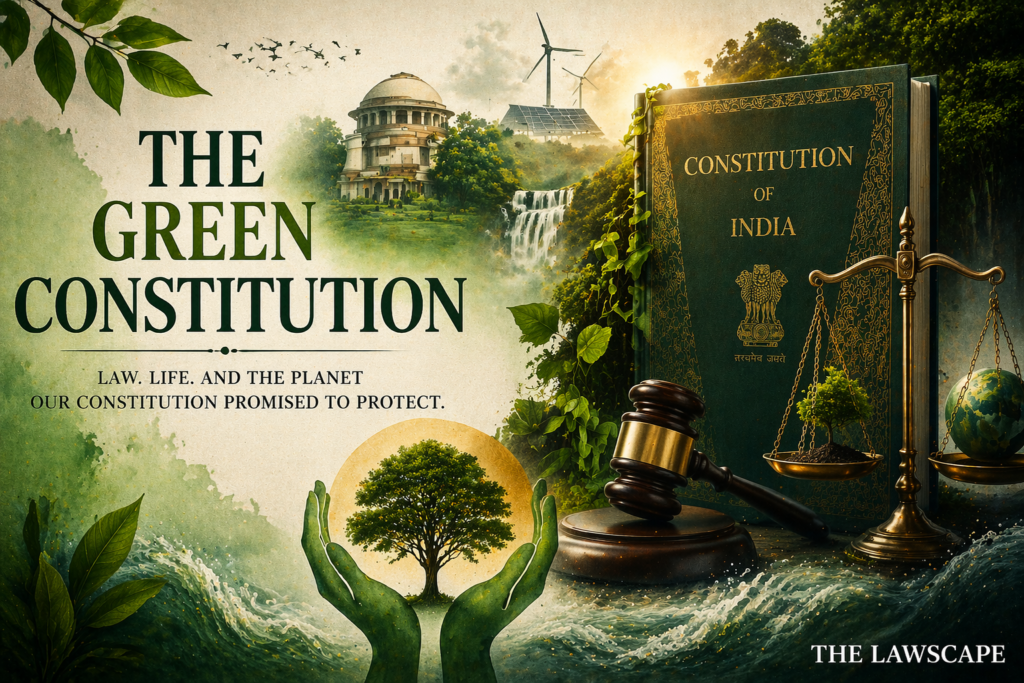
Author: Priyanka Khawale
Student, MUMBAI UNIVERSITY
————————————————————————————-
3 Quick Takeaways
India’s Constitution evolved from being environmentally silent to building a robust framework of ecological protection through the 42nd Amendment of 1976, which introduced Article 48A and Article 51A(g), creating a shared constitutional duty between the State and its citizens.
The Supreme Court’s expansive reading of Article 21 has been the most powerful engine of Indian environmental jurisprudence, producing landmark doctrines including Absolute Liability, the Precautionary Principle, and the Polluter Pays Principle.
Despite impressive constitutional and judicial progress, the real challenge for Indian environmental law lies not in its principles but in their consistent enforcement, and in closing the gap between constitutional promise and institutional delivery.
Abstract
Environment is a concept simple to understand yet complex to interpret. In a developing country like India, the tension between economic development and environmental sustainability is particularly intense. The journey of environmental protection within the Indian Constitution changed from being merely a directive principle to a constitutionally recognised concept through dynamic judicial precedents. The recognition of the need for a healthy environment elevated the legislature to introduce various provisions to safeguard it. With historic amendments to the Indian Constitution and the broadening of the spectrum of Article 21, the Indian judiciary is no longer “environmentally silent.” The Constitution of India has evolved in its approach to the environment through a combination of Fundamental Rights, Fundamental Duties, and Directive Principles of State Policy. This article critically addresses the constitutional provisions, legislative intents, and judicial innovations for environmental jurisprudence developed over time to enhance India’s engagement with environmental protection.
Keywords: Environment; Article 21; Directive Principles; Judicial Innovation; Sustainable Development.
Silence to Recognition
The idea of environmental awareness has deep roots in India, traceable to the pre-Vedic period. Archaeological evidence of environmental consciousness can be found in the Harappan Civilisation. During British rule in India, the colonial administration imposed penalties and provisions to preserve the environment. The Shore Nuisance Act, 1853, the Merchant Shipping Act, 1858, and the Wild Birds and Animals Protection Act, 1912 were among the enactments that imposed heavy penalties on offenders.
In the post-independence era, industrialisation and economic development took priority, and the original Constitution did not contain explicit provisions on environmental protection. However, concern for the environment was reflected in national planning and forest policy. The pivotal moment in the global environmental movement was the United Nations Conference on the Human Environment, also known as the Stockholm Conference of 1972, which established principles of global ecological responsibility. This conference influenced India to constitutionally adopt policies for the betterment of its flora, fauna, and atmosphere. The principles of environmental responsibility articulated in the Stockholm Declaration encouraged India to incorporate environmental safeguards explicitly through the Forty-second Amendment of the Indian Constitution in 1976. Several important environmental statutes followed, including the Water (Prevention and Control of Pollution) Act, 1974, the Air (Prevention and Control of Pollution) Act, 1981, and the Environment (Protection) Act, 1986.
Codified Guardianship
During the period of Emergency under Indira Gandhi, the Forty-second Amendment Act of 1976 was enacted, implementing the principles laid down in the Stockholm Conference.
(A) Directive Principles of State Policy
Article 48A of the Constitution of India
“The State shall endeavour to protect and improve the environment and to safeguard the forests and wildlife of the country.”
- Article 48A is a Directive Principle of State Policy added by the 42nd Amendment of 1976.
- Its objective is to compel the State to shield and enhance the environment.
- Its scope covers the protection of forests, wildlife, and water bodies such as lakes and rivers.
- It has provided judicial recognition to environmental laws such as the Environment Protection Act and the Wildlife Protection Act.
- Sustainable development is promoted through this article to ensure the conservation of natural resources.
- It prohibits activities that endanger the environment or contribute to the deterioration of the atmosphere, wildlife, or water bodies.
- One of the landmark precedents under this article is Minerva Mills Ltd. and Ors. v. Union of India and Ors., (1980) 3 S.C.C. 625 (India).
Article 47 of the Constitution of India
“The State shall regard the raising of the level of nutrition and the standard of living of its people and the improvement of public health as among its primary duties and, in particular, the State shall endeavour to bring about prohibition of the consumption except for medicinal purposes of intoxicating drinks and of drugs which are injurious to health.”
- It directs the State to improve public health.
- It highlights that environmental degradation directly affects public health, and courts have invoked this provision to justify strict environmental controls.
- Although Directive Principles of State Policy are not directly enforceable, they have significantly influenced judicial reasoning and legislative policy.
(B) Fundamental Duties
Article 51A(g) of the Constitution of India
“to protect and improve the natural environment including forests, lakes, rivers and wild life, and to have compassion for living creatures;”
- Article 51A(g) imposes a fundamental duty on every citizen to preserve and protect wildlife, water bodies, flora, and fauna, and to promote awareness of environmental conservation.
- It was introduced by the Forty-second Amendment Act of 1976.
- Its objective is to constitutionally mandate ecological conservation, the protection of natural resources, and the obligation of citizens to guard forests, lakes, and rivers.
- It promotes compassion towards all living creatures and the improvement of the natural environment, as recognised in Animal Welfare Board of India v. A. Nagraja and Ors., (2014) 7 S.C.C. 547 (India).
- The judiciary has expanded its scope to include aspects such as maintaining air quality, soil conservation, and healthy ecosystems.
Article 48A and Article 51A(g) are read together, as they are interrelated. Where Article 48A imposes an obligatory responsibility on the State to enhance the environment, Article 51A(g) reminds citizens of their fundamental duty to preserve the natural environment. Both articles create a shared responsibility between the governor and the governed.
(C) Article 21 of the Indian Constitution: Nature and Life
- Article 21 of the Constitution of India enshrines one of the most primary fundamental rights: the Right to Life and Personal Liberty.
- It establishes a broad principle of the right to life, wherein “life” addresses not only a person but also their surroundings. It encompasses a person’s right to fresh air and ventilation, clean water, proper sanitation, a healthy environment, and access to natural resources.
- On a broader spectrum, various judicial interpretations have been developed under this article.
1. Oleum Gas Leak Case: M.C. Mehta v. Union of India, (1987) 1 S.C.C. 395 (India)
This case laid down the Doctrine of Absolute Liability, under which any enterprise engaged in a hazardous activity is held absolutely liable to compensate victims for any harm resulting from an escape of dangerous substances. This departed from the Doctrine of Strict Liability laid down in Rylands v. Fletcher, under which certain exceptions were available. The decision significantly strengthened environmental accountability in India.
2. Subhash Kumar v. State of Bihar, (1991) 1 S.C.C. 598 (India)
This case acknowledged the right to pollution-free water and air as part of the full enjoyment of life under Article 21.
3. M.K. Ranjitsinh v. Union of India (2024)
The Supreme Court of India recognised the right against the adverse effects of climate change as a component of the right to life under Article 21.
(D) Alternative Approach
Article 14 of the Constitution of India
- Although Article 14 emphasises the Right to Equality, it also establishes that arbitrary and unlawful state actions violate the right to equality. Such actions include illegal mining, poaching, and the unlawful emission of harmful substances into the atmosphere.
Article 19(1)(g) of the Constitution of India
- Article 19(1)(g) guarantees the Freedom to practise any profession or to carry on any occupation, trade, or business. However, reasonable restrictions exist under Article 19(6). This freedom does not permit trade in animal-derived materials such as ivory, pelt, suede, or other products that endanger wildlife.
Parliamentary Interventions
Under Article 253 of the Constitution of India, Parliament holds the authority to enact environmental laws such as the Environment Protection Act, 1986. This article also grants Parliament the power to implement international treaties to which India is a signatory. This implementation serves as a foundation for the enactment of domestic legislation and enables the State to anticipate and respond to emerging environmental challenges.
Preamble Relevance
The Preamble of the Constitution of India emphasises the “Socialist” goal of a welfare state. This goal is to sustain and prioritise public health and to enact laws with due consideration for the well-being of all citizens, which necessarily encompasses their right to a clean and healthy environment.
Judicial Innovations
1. Precautionary Principle
This principle was laid down in Vellore Citizens Welfare Forum v. Union of India, (1996) 5 S.C.C. 647 (India). The case addressed pollution from tanneries in Tamil Nadu that was contaminating the Palar River. The Court ordered the closure of tanneries that failed to comply with pollution control standards and imposed a fine of ten thousand rupees on each to compensate for the damage caused to residents and the environment.
2. Polluter Pays Principle
This principle was laid down in Indian Council for Enviro-Legal Action v. Union of India, (1996) 3 S.C.C. 212 (India), where the Supreme Court held that industries are liable to pay compensation to the affected areas. Compensation was made mandatory both for direct victims and for residents of areas that suffered environmental damage.
In Vellore Citizens Welfare Forum v. Union of India, the Court declared that the Polluter Pays Principle, together with the Precautionary Principle, formed a significant part of the framework for determining the liability of the tanneries, and that compensation to victims was assessed equally on the basis of both principles.
In M.C. Mehta v. Union of India (Taj Trapezium Case), (1997) 2 S.C.C. 353 (India), the Court applied the Polluter Pays Principle to industries whose emissions of hazardous gases were causing damage to the Taj Mahal, holding them liable to pay compensation. The Court was deeply conscious of the need to conserve the monument as a national heritage of immeasurable significance.
PIL Specialist
Public Interest Litigation has played an important role in the development of environmental justice in India. M.C. Mehta is particularly known for his contribution to PIL in this field. His litigation has given rise to landmark judgments in the Ganga Pollution Cases, Vehicular Pollution Cases in Delhi, and Industrial Hazards Cases. PIL has liberalised the principle of locus standi and allowed concerned citizens and social activists to approach courts to seek protection of the environment.
Judicial activism in the development of environmental law has also attracted criticism. Some have argued that the judiciary has encroached upon the domains of the executive and legislature. Though courts have delivered affirmative judgments in environmental matters, the implementation by administrative agencies has been inconsistent. The constitutional responsibility that once rested with ordinary courts has now been substantially transferred to the National Green Tribunal for the adjudication of environmental disputes.
Environmental Intergenerational Equity
An important dimension of Indian environmental jurisprudence is the principle of intergenerational equity, which holds that the present generation has an obligation to protect natural resources for those who come after it. The Supreme Court has repeatedly held that the protection of the environment is not merely a present obligation but a constitutional duty owed to future generations. In State of Himachal Pradesh v. Ganesh Wood Products, (1995) 6 S.C.C. 363 (India), the Supreme Court held that the conservation of forests as a national asset must be preserved in the interest of ecological balance. The principle of environmental rule of law further enhances the accountability of the government to the people in the protection and management of the environment.
Conclusion
The Constitution of India, though initially silent on questions of environmental protection, has come a long way in establishing itself as a robust framework of environmental integrity. This has been achieved through the expansion of Article 21, the integration of Directive Principles of State Policy, the enforcement of Fundamental Duties, and the creation of innovative constitutional doctrines of environmental protection.
Indian constitutional environmentalism may be seen as a dynamic and evolving body of principles and law. Although issues of implementation and development continue to challenge India’s environmental framework, Indian constitutional environmentalism remains a highly progressive and influential body of law. As environmental crises continue to challenge India and other nations, the constitutional commitment to sustainable development will remain at the core of India’s legal and policy responses to ecological integrity and justice.
Disclaimer: The views expressed in this article are those of the author and do not necessarily reflect the views of The Lawscape.
The Lawscape — clear, practical legal insight for students and future lawyers.